



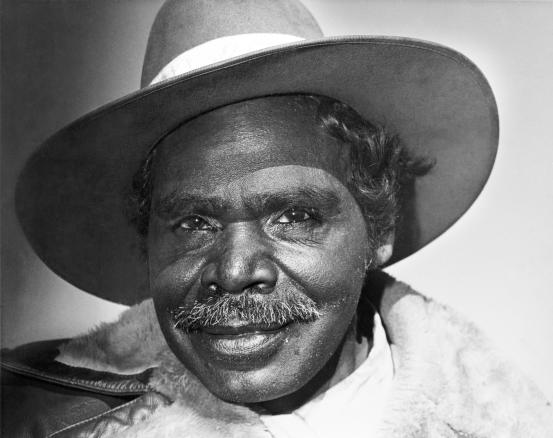
Tim Leura Tjapaltjarri (Anmatyerr c. 1929–1984)
Tim Leura grew to manhood in a cross-cultural world where both Anmatyerr law and pastoral occupation prevailed in uneasy tension. At out-of-the-way Malierra ceremonies, performed for his cohort of novices, Leura absorbed designs and songs associated with the network of songlines that passed though his country. At the same time, he learned horsemanship and cattle wrangling at nearby stock camps. (John Kean, 2011)
Tim Leura was born in a creek bed at Laramba on Napperby Station, a few years earlier than Clifford Possum. The two boys grew up together as brothers, although they had different biological parents. Their mothers were sisters, and they shared grandparents and a rich cultural inheritance. Together they would become leading instigators and brilliant exponents of Papunya Tula art.
As a young man Tim Leura worked as a stockman on Narwietooma Station, becoming familiar with the network of songlines that passed though his country. Here he married Daisy Leura Nakamarra, whom he later encouraged to paint independently, and developed prowess as a carver of weapons and of lifelike representations of reptiles.
Tim Leura moved with his wife and young family to Papunya as part of the construction team. His association with the Honey Ant Dreaming gave him agency at Papunya, even though his country lay to the north. Apart from the converging Dreaming trails of the Honey Ant, he also depicted Possum, Yam, Fire, Blue-tongue Lizard, Sun, Moon, and Morning Star Dreamings. A left-hander, Tim Leura's paintings are distinguished by his delicate touch, subdued palette and layered subtlety of dotting and wash.
By the mid 1970s he was a member of the Aboriginal Arts Board of the Australia Council. His Spirit Dreaming through Napperby country 1980, painted collaboratively with Clifford Possum, is often cited as one of the great paintings of the movement and has been the centrepiece of many major exhibitions, beginning with Perspecta 1981 at the Art Gallery of New South Wales.
Related
-
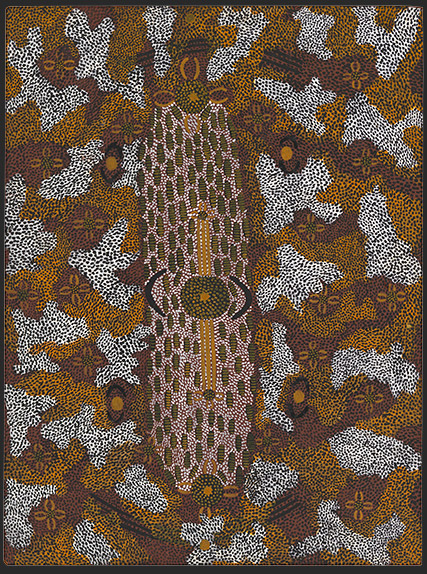 Tim Leura Tjapaltjarri
Anmatyerr c.1929–1984
Butterfly Dreaming 1972
synthetic polymer paint on composition board
45.3 x 61.7 cm
Private collection
© artists and their estates 2011, licensed by Aboriginal Artists Agency Limited and Papunya Tula Artists
-
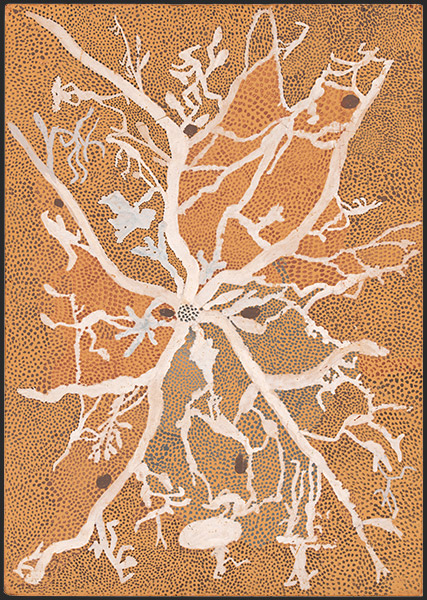 Tim Leura Tjapaltjarri
Anmatyerr c.1929–1984
Yam Spirit Dreaming 1972
synthetic polymer paint on composition board
70.0 x 54.0 cm
Private collection
© artists and their estates 2011, licensed by Aboriginal Artists Agency Limited and Papunya Tula Artists -
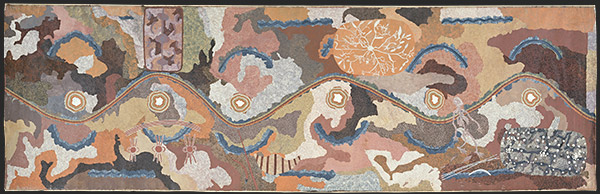 Tim Leura Tjapaltjarri
Anmatyerr c.1929–1984
Clifford Possum Tjapaltjarri
Anmatyerr c.1932–2002
Spirit Dreaming through Napperby country 1980
synthetic polymer paint on canvas
207.7 x 670.8 cm
National Gallery of Victoria, Melbourne
Felton Bequest, 1988
(O.33-1988)
© artists and their estates 2011, licensed by Aboriginal Artists Agency Limited and Papunya Tula Artists
More info
- Anatjari Tjakamarra
- Freddy West Tjakamarra
- John Tjakamarra
- Long Jack Phillipus Tjakamarra
- Ronnie Tjampitjinpa
- Walter Tjampitjinpa
- Uta Uta Tjangala
- Mick Namarari Tjapaltjarri
- Timmy Payungka Tjapangati
- Tutuma Tjapangati
- Charlie Wartuma Tjungurrayi
- Shorty Lungkata Tjungurrayi
- Yala Yala Gibbs Tjungurrayi
- Johnny Warangkula Tjupurrula
- Nosepeg Tjupurrula
- Mick Wallangkarri Tjakamarra
- Kaapa Tjampitjinpa
- Billy Stockman Tjapaltjarri
- Clifford Possum Tjapaltjarri
- Tim Leura Tjapaltjarri