



The anthropologists Baldwin Spencer (1860–1929) and Francis Gillen (1855–1912) amassed the most influential collection of Australian ethnographic material ever assembled. It is composed of thousands of objects, photographs, expedition diaries, drawings and some of the earliest ethnographic sound and film footage ever recorded. They acquired their collection at a time when Aboriginal people in Central Australia were relatively unaffected by European contact (between 1875 and 1923) and as such it constitutes one of the most comprehensive inventories of a regional Aboriginal group in existence.
Their work had a decisive influence on the early development of anthropology as an academic discipline, particularly in Europe. In his 1913 review of Spencer and Gillen's book Across Australia, Malinowski commented, 'Since the publication of their first volume, half the total production of anthropological literature has been based on their work and nine tenths affected or modified by it.'
Their influence was felt in several other branches of the social sciences. One of the foundational figures of modern sociology, Emile Durkheim, based his famous tome The Elementary Forms of Religious Life on Spencer and Gillen's ethnography. Similarly, Sigmund Freud's Totem and Taboo was primarily inspired by Spencer and Gillen's work on Aboriginal religious belief.
Their extensive collection and published works continue to shape the production of knowledge about past and present Aboriginal life in both anthropology and the popular imagination. Just as importantly, it also provides an invaluable cultural archive for the descendants of the Aboriginal people with whom Spencer and Gillen worked in Central Australia: the Arrernte, Anmatyerr, Kaytej, Warumunga, Luritja and Arabana people who still have a substantial presence in the region.
Related images
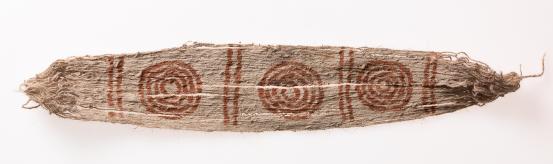
Arrernte active 1900s
Headband early 1900s
fur string, earth pigments
36.0 x 6.0 x 2.5 cm
Museum Victoria, Melbourne
Gift from Baldwin Spencer, 1902 (X9560)
© Museum Victoria 2011 / Photographer Benjamin Healley
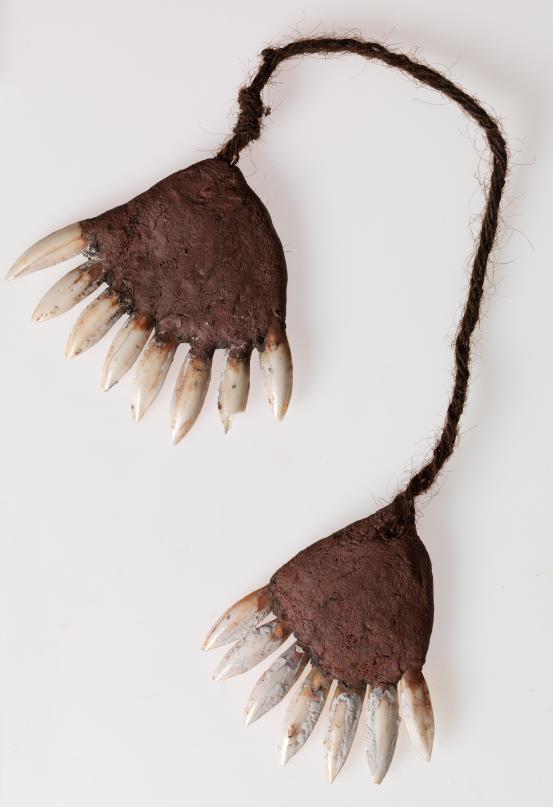
Warumungu active 1890s
Forehead ornament early 1890s
kangaroo teeth, spinifex resin
17.3 x 20.5 x 1.0 cm
Museum Victoria, Melbourne
Purchased from Francis Gillen, 1899 (X5374)
© Museum Victoria 2011 / Photographer Benjamin Healley

Arrernte active 1900s
Necklace 1902
fur string, bandicoot tail tips
29.0 x 22.0 x 5.0 cm
Museum Victoria, Melbourne
Gift from Baldwin Spencer, 1902 (X9622)
© Museum Victoria 2011 / Photographer Benjamin Healley