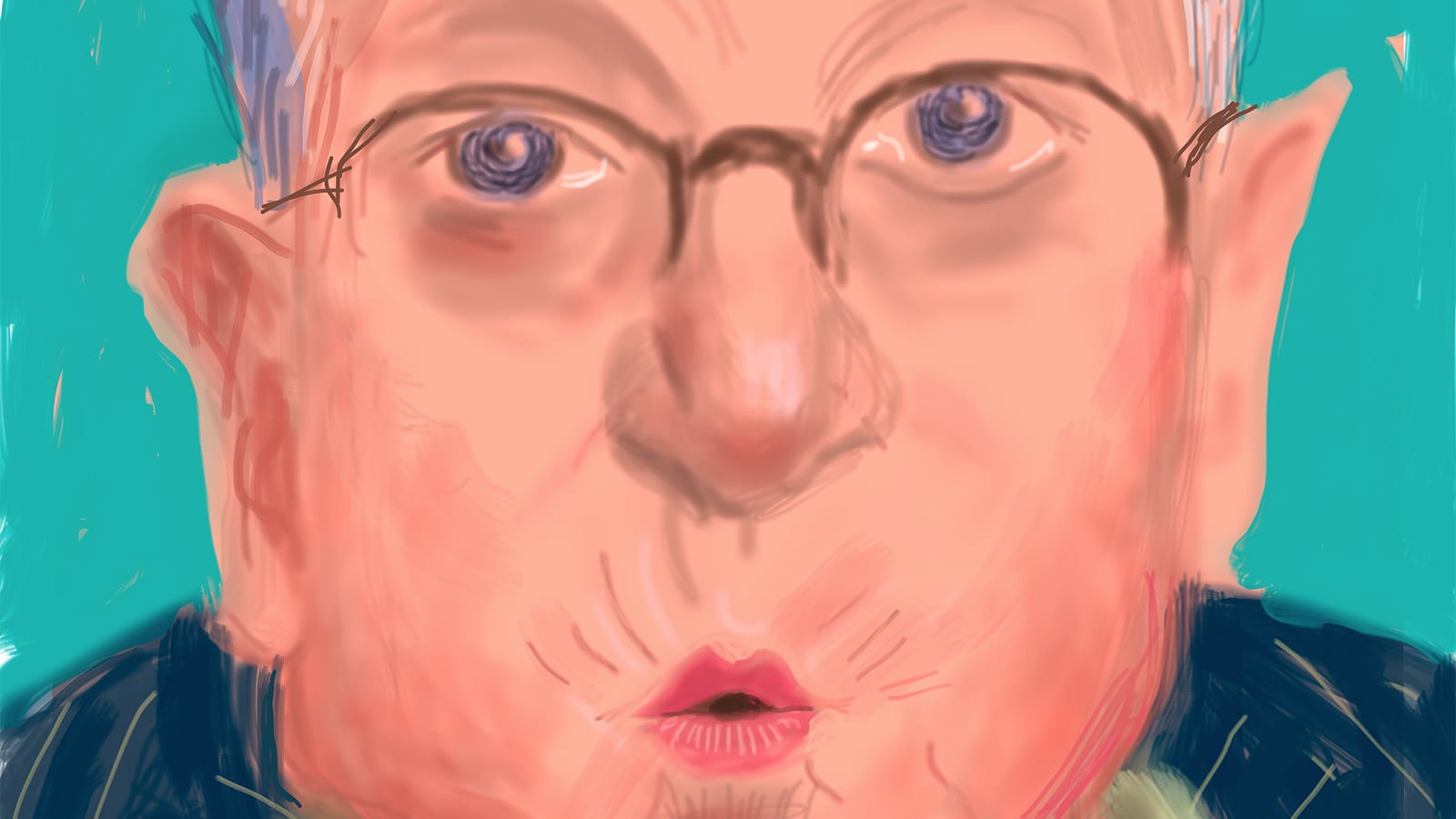
The NGV presents a major solo exhibition of one of the most influential living artists, David Hockney: Current. The exhibition, curated by the NGV in collaboration with David Hockney and his studio, features over 1200 works from the past decade of the artist’s career – some new and many never-before-seen in Australia – including paintings, digital drawings, photography and video works.
Exhibition highlights include more than 600 extraordinary and sometimes animated iPad digital drawings of still life compositions, self-portraits and large-scale landscapes including scenes of Yosemite National Park. Another highlight is The Four Seasons, Woldgate Woods, a breath-taking and immersive video work showcasing the changing landscape of Hockney’s native Yorkshire, each season comprised of nine high-definition screens. A dedicated 60-metre long gallery lined with more than 80 recently painted acrylic portrait paintings of the artist’s family, friends and notable subjects including artists John Baldessari and Barry Humphries is also a major highlight.
Arguably Britain’s greatest living painter, David Hockney, 79, works prolifically, experimenting and mastering new technologies, creating works on iPhone, iPad and in video. The exhibition includes Bigger Trees Near Warter, Hockney’s largest painting comprised of fifty oil on canvas panels, and the centrepiece of Hockney’s hugely popular exhibition Bigger Picture at the Royal Academy, London which he subsequently gifted to the Tate. Transforming the gallery, the three remaining walls of this space display 1:1 digital versions of the same work, the first time that this major work has been exhibited in Australia.
Hockney’s continued investigation into multi-point perspective is represented by The Jugglers, an 18-screen, twenty-two minute video that depicts the artist in a room of performers, injecting Hockney’s signature playfulness into the exhibition. Again utilising technology to reveal a study in perspective, Hockney’s Seven Yorkshire Landscapes is a 12 minute multi-viewpoint video displayed on 18 tiled, 55-inch monitors which monumentally showcases the extraordinary landscape.
Organised by the National Gallery of Victoria in collaboration with Gregory Evans of David Hockney Inc.
Major Supporters: The Bonnici Family, Joan Clemenger AO and Peter Clemenger AO, and Krystyna Campbell-Pretty and the Campbell-Pretty Family.
‘The influence of images shouldn’t be underestimated. They always were very powerful, and always will be.’
Since the 1960s David Hockney has made an enormous contribution to contemporary art. Hockney is a relentlessly curious and experimental artist whose career has encompassed markedly different phases. He has periodically changed his style and technique in a continual search for new artistic challenges. Now in his seventy-ninth year, Hockney is still trialling new approaches and technologies and seems as unafraid of risk as ever.
Hockney is also one of contemporary art’s most prolific practitioners. Although David Hockney: Current features more than 1200 works, these works are a heavily edited selection of the work Hockney has produced in the last ten years alone; his artistic output has been tremendous. This exhibition includes paintings, digital drawings, photography and video works.
‘The urge to draw must be quite deep in us, because children love to do it – being bold with crayon … Making marks always appealed to me. I’m still at it.’
As demonstrated by the works presented in this large but by no means exhaustive survey of Hockney’s past decade, Hockney has continued to explore the relationship between time and space. He has done and continues to do so with gusto and drive, maintaining a daily practice of working and experimentation.
Hockney’s iPhone and iPad sketches, which he begins drawing as the sun rises at the beginning of the day, from his bed with slippers by his feet, and continues to work on throughout the day until evening, highlight his creative drive perfectly. He brings an insatiable curiosity to his art; Hockney is not interested in the fashions of today but rather is deeply connected with the past and the future as a continuum. His life’s work, and particularly his work of the past ten years, connects and contributes to that continuum in a substantive, risk-taking and experimental way.
‘It’s not an illusory thing. It’s not a painting that makes you think, “I want to step into it”. Your mind already is in it. The picture engulfs you. That’s how I hope people will experience it. It is an enormous painting … I think in the final picture you have a sense of being there.’
Bigger trees near Warter or/ou peinture sur le motif pour le nouvel age post-photographique is David Hockney’s largest painting. The work consists of fifty canvases that combine to make one grand work. The painting was first exhibited at London’s Royal Academy of Arts – Hockney created it especially to fit one of the academy’s galleries and subsequently gifted it to the Tate, London. This is the first time Bigger trees has been exhibited in Australia.
The painting transports you to the Yorkshire countryside in wintertime to stand before a thicket of deciduous trees, their bare winter branches tangled against the sky. Standing front and centre is a large sycamore tree – its black trunk and branches stretch through the composition. Further back in the distance, trees with pink-tinged foliage suggest that spring is coming. To the left, a country lane passes through lovely green English pastures; to the right stands a house and barn; and in the forground clusters of bright yellow daffodils confirm that spring is indeed on its way.
Trees offer Hockney an artistic challenge in the same way they did for precursors such as John Constable and Claude Lorrain. Hockney says:
‘Trees don’t follow the laws of perspective, or don’t seem to, because they are so complicated, with lines going in so many directions … Trees have a deep appeal, and I think it’s partly a spatial thrill, a certain kind of thrill that I’m very conscious of.’
Ou peinture sur le motif pour le nouvel age post- photographique
‘I had in my head a kind of anti-photographic thing, but also Chinese painting, late Picasso – meaning the marks are all visible and boldly made with the arm.’
Bigger trees near Warter has the alternative title ou peinture sur le motif pour le nouvel age post-photographique, which provides insight into some of Hockney’s artistic intentions for the work. It is a landscape painting created entirely in front of its subject. The French describe this as sur le motif, but in English we more often use the French phrase en plein air (in the open air). Bigger trees near Warter is a contemporary contribution to the tradition of en plein air landscape painting; in fact, the work is very likely the largest en plein air landscape ever painted.
A novel aspect of Bigger trees relates to Hockney’s use of technology when creating the work. The fact that this is a painting was made in the age of computers and digital photography is alluded by the phase nouvel age post-photographique. In typical Hockney fashion, the artist has combined centuries-old painting and drawing techniques with new digital processes. On site, while Hockney focused on painting each panel using oils, his assistant J-P took digital photographs of the panels in different states. J-P then made colour prints of these photographs for Hockney’s reference and also sequenced them on the computer to create a digital mock-up of the whole work. Both of these strategies enabled Hockney to keep track of the whole composition as he painted its discrete panels.
David Hockney grew up in Yorkshire, in the city of Bradford; however, he left the district around age twenty – first for London, then briefly for Paris before moving to Los Angeles. In the 1990s, after his mother and sister moved to Bridlington, Hockney began to visit them there annually. In 2004 he decided to set up his own residence in Bridlington.
The creation of the series of iPad drawings The Arrival of Spring in Woldgate, East Yorkshire in 2011 coincides with Hockney realising the potential of using large-format inkjet printing technology in conjunction with touchscreen drawing. Hockney took much inspiration from the intensity of the seasons in Yorkshire. While Bigger trees near Warter immerses the viewer in a dreary English winter, by contrast this series plunges you into the dizzy exuberance of spring.
‘In California … you don’t really get spring there. If you know the flowers well, you’ll notice a few coming out – but it’s not like northern Europe, where the transition from winter and the arrival of spring is a big, dramatic event. The surface of the desert in California doesn’t change … Here [in Yorkshire] the light might change every two minutes … In fact we came to the conclusion that every day was totally different in this part of East Yorkshire. There is absolutely constant change.’ David Hockney
‘I’m not sure which modernist critic said that it wasn’t possible to do anything with landscape any more … When people say things like that I’m always perverse enough to think, “Oh, I’m sure it is“‘
This gallery features digital drawings of Yosemite National Park in California, an area famous for its ancient sequoia trees and immense granite cliffs. Whereas The Arrival of Spring images featured relatively crowded, cloistered landscapes, the Yosemite series explores expansive vistas of mountains and towering trees.
The large-scale prints of the Yosemite suite, which extend up to 3.6 metres in height, are created from vector-based images created on the iPad. Unlike pixel-based images, vector-based pictures do not lose sharpness or saturation of colour as they are increased in size. Hockney says:
‘I must admit that the iPhone took me quite a while to master, to discover how to get thicker and thinner lines, transparency and soft edges … [Over time] I realised that it had marvellous advantages; it is a stunning visual tool … The iPhone makes you bold, and I thought that was very good. I looked at [the images] blown up on a big screen, and they made me very excited because you didn’t have any loss of colour, and instead of the finger doing it, it looked as if you were doing it with your arm swinging round. I thought, Hmm, this will affect my painting, trying to find the minimum number of marks needed to do something.’
As well as the bright light in California, Hockney also became preoccupied with the vast scale of landscapes, such as the Grand Canyon and Yosemite National Park. Painting such monumental landscapes allowed him to engage his obsession with space. He explains:
‘For me the biggest thrill [of the Grand Canyon] is standing on the top, looking down, as you do from a mountaintop … it’s wonderful and big … One of my interests in the Grand Canyon [is] that, when you go to the edge, there you just look. There are not many places in nature where you do that; you just stand in one place and start looking. Yosemite … has similar spaces … [At Yosemite] you see this incredible valley, verdant at the base and with big waterfalls, vast canyons walls. It’s truly spectacular. People just stand and look at it. It’s the space that is thrilling. It’s quite something.’
‘You can just have somebody sit down and you can still just paint a portrait of them perceptually today and it’ll be as good as anything in the past, really.’
The major work 82 portraits & 1 still life is a series of acrylic on canvas paintings created between 2013 and 2016. Each of the works was painted by Hockney standing, in direct visual relationship to his subject, usually over a three-day period. The works are shown in the exhibition chronologically, beginning with the portrait of J-P, Hockney’s long-time studio assistant, which inaugurated this body of work.
The painting depicts J-P upset, with his head in his hands, following an untimely death that affected them all. ‘I saw J-P with his head in his hands, and I said, “Well, we both feel like that, don’t we: I’ll paint it”. So I painted him.’ In time, Hockney came to consider this work as a kind of self-portrait, and it became a starting point for an ambitious series.
The portraits depict many people connected with Hockney’s daily life, and others he invited to come and sit for him. They also capture the artist’s unwavering drive when seen all together, uninterrupted, as they are for the first time in David Hockney: Current.
David Hockney is a great advocate for looking closely. His desire to make art is connected to his love for observing a subject in great detail. The artist places a premium on art’s ability, as he says, to ‘[make] you see the world around you just a little more intensely’. He believes that ‘Pictures influence pictures, but pictures also make us see things that we might not otherwise see’.
A bigger card players is among a number of works in David Hockney: Current that are single works that contain multiple images. For instance, there are multiple vanishing points: one in the overall image and two in the images at the back. These complicate the pictorial space and scatter your vision. Your eyes are forced to explore the image more dynamically. There are also multiple narratives: this work is an example of Hockney exploring meta-narratives – the idea of works within works within works.
Hockney’s emphasis on multiple narratives aligns with his belief that we all experience life differently as it is filtered through our subjectivities. In his words:
‘When we go into a room, we notice things according to our own feelings, memories and interests. An alcoholic will spot the bottle of whisky first, then maybe the glass and the table; someone else notices the piano; a third person sees the picture on the wall before anything else. Reality is a slippery concept because it is not separate from us. Reality is in our minds’.
‘Painters have always known there is something wrong with perspective.’
4 blue stools is what David Hockney calls a ‘photographic drawing’: a constructed image in which different photographs are digitally sutured together to create one reality. The people, the chairs, the paintings – they have all been photographed separately and from different angles before being digitally joined together. The result is an image that looks photographic but also confuses our expectations of photography.
For a number of decades Hockney has been not only intellectually curious about but also sharply critical of photography. He has said:
‘I believe photography and the camera have deeply affected us … I think photography’s also done us damage … We think that the photograph is the ultimate reality, but it isn’t because the camera sees geometrically. We don’t. We see partly geometrically but also psychologically.’
We are used to the idea that photographs usually present one moment in time and that they present a scene with a single vanishing point; however, Hockney’s photographic drawings play with these expectations. Many pictorial conventions are tackled in these works. 4 blue stools is an example in which people appear multiple times; the shadows seem tricky and there are multiple vanishing points, including some in the paintings at the back, which pull our eyes in different directions. All of these elements wreak havoc with our understanding of photography. Hockney says:
‘Painters have always known there is something wrong with perspective. The problem is the foreground (hence Cubism). Where am I? Chinese perspective does not have a vanishing point. If it did it would mean you have vanished. The reason we have perspective with a vanishing point is that it came from optics. I am sure that’s what Brunelleschi did. He used a five-inch diameter concave mirror to project the Baptistry onto his panel. This gives automatically a perspective picture just like a camera would. This is why there is always a void between you and the photograph. I am taking this void away, to put you in the picture.’
‘I have said, that perhaps the big mistakes of the West were the introductions of the external vanishing point and the internal combustion engine.’
In David Hockney: Current, stitched-together photographic drawings are presented alongside the original works of art that appear within them. The new composite works layer separate moments and realities on top of one another, with Hockney extending and further experimenting with what it is like to encounter scenes that are ‘out of time’ or asynchronous. The floor‑to-ceiling imagery and room filled with the original objects pictured creates a type of representation of looking itself. Hockney’s breakthrough video The jugglers, with its vision of movement within the artist’s studio from multiple angles at once, completes this fragmented approach to reality in a style characteristic of the Cubism movement.
The video works in the exhibition, such as The jugglers and The Four Seasons, Woldgate Woods (Spring 2011, Summer 2010, Autumn 2010, Winter 2010), could have been captured with a single camera; however, by shooting on multiple cameras, each set up somewhat differently, the result is a disrupted image field. Hockney believes that these composite images are more potent than a single image because they encourage a different type of viewing. Single images seem coherent and easy to understand – you can ‘get’ them with one glance; however, with multi-part images such as The jugglers, as Hockney says, ‘you [can’t] help but look more carefully’.
These works follow and extend the substantial art-historical research manifested in Hockney’s book Secret Knowledge: Rediscovering the Lost Techniques of the Old Masters in 2001. Secret Knowledge published Hockney’s research into the Old Masters’ use of optical devices, which they used as artists’ aides to help translate the three-dimensional world into two-dimensional pictorial space. These optical devices were precursors to the camera. About his video work, Hockney says:
‘[These] depictions of the visible world [are] not quite like any we’ve seen before. I think we have made something new that has only recently become possible technologically. You can make cameras see more. Put a few together and you get a bigger and more intense picture.’
‘I do not really want to repeat. I would rather find something fresh, new.’
In many ways, Hockney is a ‘radical traditionalist’. His pictures usually explore traditional subjects, such as portraits, still life and landscapes; however, Hockney invites us to consider these genres in new, contemporary ways. This is in line with his belief that art, as he states, ‘just goes on and on’. He believes that traditional forms can always be reimagined. As he says, ‘There’s always another way of doing it’.
A hallmark of Hockney’s career has been constant experimentation with new technologies. Since the 1970s he has made art using Polaroid photography, colour photocopying, the fax machine, computers, high-definition multi-screen videos and, in this exhibition, iPhones and iPads. He has always sought to extend his formal and conceptual languages.
‘I do not want to repeat myself too much. I do not really want to repeat. I would rather find something fresh, new. Picasso was a great example. Some artists do the same thing all the time; it’s OK for some, but not for me. I feel I need variety, and I get it … I mostly paint still life, people and landscape. That’s the traditional subject matters for art, and I think they are still perfectly good ones.’ David Hockney