Light is the shared medium that animates the most captivating properties of gemstones. From the richest red rubies and the deepest blue sapphires to the brilliant, ever-changing spectrum of diamonds, light is the universal element that brings precious stones to life, elevating their form to transcend time and place. The unique chemical properties of gemstones, when combined with the complex shapes achieved by cutting and polishing, are translated by the eye through light as it is reflected and refracted in stone. This unique relationship between matter and light is catalogued in the resplendent jewellery designed by Maison Cartier, whose expert knowledge of stones, combined with technical expertise and design innovation, has resulted in an expansive
collection of storied pieces worn by royalty, film stars and socialites.
It was this mastery of material, colour and light, as well as the technical prowess of the Cartier jewellers, that served as the catalyst for the NGV to conceptualise an exhibition of Cartier designed by Sabine Marcelis, Principal of Studio Sabine Marcelis, and Paul Cournet, Director of CLOUD, the multidisciplinary architecture studio based in Rotterdam. Together, they developed a contemporary design and architectural language capable of responding to the mesmerising qualities of Cartier’s masterpieces, while framing the continued significance of the Cartier brothers’ legacy through colour and material.
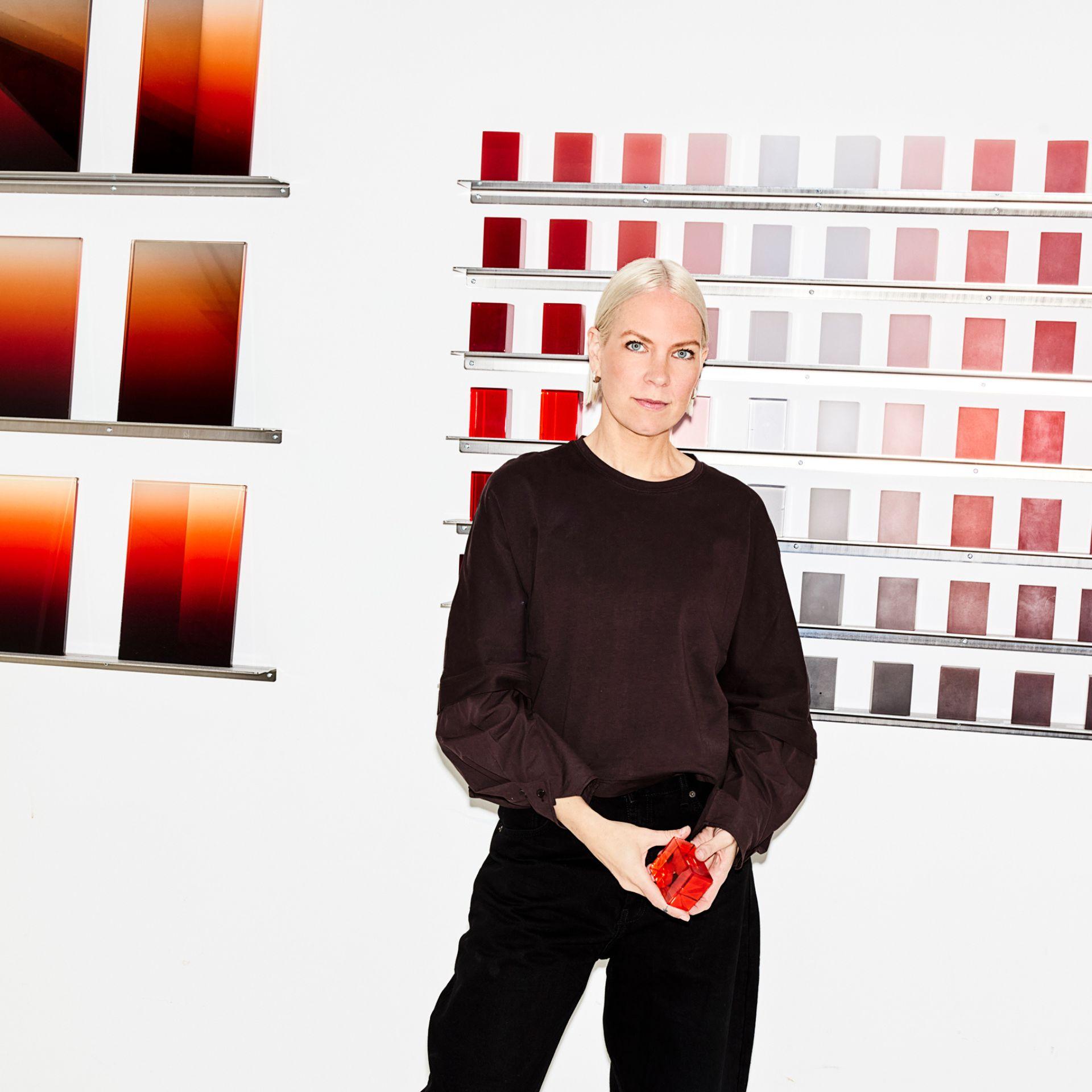
For Marcelis, colour became the central vehicle for this response. Drawing on the natural brilliance of gemstones – what Marcelis describes as ‘one of the most vibrant phenomena on earth’ – the exhibition design was conceived as richly pigmented and saturated. Just as gemstones transform as they move through light, the exhibition unfolds in shifting atmospheres that respond to the jewellery on display and the narrative of each space. For Marcelis, colour is capable of shaping environments that ‘communicate ideas, evoke emotion and create meaning without the need for explicit explanation’. In this way, the spatial experience intentionally mirrors the visceral impact of the gemstones themselves, engaging the viewer through an intuitive and emotional understanding of colour. Marcelis’s articulation of colour as an emotive force was pivotal in the exhibition designers’ vision for this iteration of the V&A’s Cartier show. Rather than presenting the backdrop to Cartier’s history as homogenous and linear, colour operates atmospherically within the exhibition design, allowing visitors to register nuanced shifts in theme and interpret layers of meaning instinctively.
From the outset, the exhibition establishes colour and material as guiding forces of the audience’s experience, working in close dialogue with the jewellery throughout. Visitors enter through a mirrored walkway animated by the coloured reflections of chromatic glass, a signature material in Marcelis’s work. Shifting across a gradient of green, yellow, coral and burgundy, the mirrored surface conceptually reflects the gallery interiors conceived by Studio Sabine Marcellis and CLOUD. Each space is drenched in a unique monochrome palette composed of varied materials and inspired by the Cartier jewels. For Marcelis, this chromatic sequencing is crucial to how the exhibition communicates its many narratives. As she explains, the exhibition is designed ‘to tell the many stories of Cartier, as well as the individual histories of the jewels and their wearers’, with colour and material in each space shaping how those stories are experienced. Bright palettes emerge in the gallery exploring the Maison’s global influences, where colour is drawn from ‘dazzling yellow diamonds’, while deeper, more grounded tones appear in the room focusing on precious stones, which references the earth as the origin site of gems. Elsewhere, galleries dedicated to Cartier’s technical ingenuity use materials that reference precision and engineering, allowing innovation and craftsmanship to be conveyed through colour, materiality and lighting alone. In the space devoted to the stars of stage and screen, green hues reference the eyes and scales of the iconic Cartier serpent and crocodile necklaces designed for Mexican film star María Félix.
Unique to Marcelis’s practice is an understanding of colour as inherent to a material rather than something applied superficially. Throughout the exhibition, this approach is evident in her use of pigmented textiles, glass and signature cast resins, each selected for its ability to hold and transmit colour from within. Across the galleries, materials and colours reference the variation and transformability of Cartier jewels, celebrating their optical and material qualities through different lenses. Inviting complete immersion into the world of gemstones, the spatial logic of the exhibition echoes the rhythm and structure found in Cartier creations. This logic is also articulated through the exhibition’s architectural sequencing. Drawing on research into the geometry and form of Cartier’s cut stones, a central volume anchors each of the largest galleries, creating dynamism in how the jewellery is experienced. Placed along a linear axis, these rooms create an enfilade that connects the exhibition’s rich chapters, guiding visitors through a continuous yet varied journey. The abstracted gemstone forms, reimagined at architectural scale, establish a rhythm and pace through the exhibition, creating moments of pause and intimacy with the jewellery.
For CLOUD Director Paul Cournet, this translation from jewel to architecture is both conceptual and rigorously researched. As he explains, ‘We take the concept of a gemstone at the microscale and expands it to create a distinct spatial volume in each room,’ allowing the stones to ‘inform both the form and the material character of each narrative space’. Each gallery is conceived abstractly, with a stone, colour or detail drawn from a Cartier work and enlarged to become the scenographic motif of the room. While the result is deliberately abstract, Cournet emphasises that ‘it is always grounded in research’, with design decisions informed by close study of the jewellery. This approach operates across scales: just as a tiara possesses structure, material logic and relative proportions, these architectural principles can be reinterpreted and rearticulated from the microscale through to spatial design. Through these design strategies, the exhibition is experienced as a single coherent structure across scales. From gemstone to jewel, jewel to room and room to exhibition, material logic and spatial form are continuously
and intentionally connected throughout.
The shifts in space, colour, material and light throughout the exhibition construct a dynamic narrative that culminates in a celebration of these elements as embodied in the Maison’s tiaras. Building on Cartier’s reputation as the ‘jeweller of kings and the king of jewellers’, the show’s final space captures the essence of the spectacular diamonds that define these works. Designed as a place of reflection, it brings together twenty-four tiaras, offering visitors the opportunity to contemplate both the head ornaments’ material splendour and their significance within
Cartier’s history.
The designers conceive this concluding gallery as a grand circular chamber, illuminated with coloured light that transforms the atmosphere, alluding to the vast spectrum of colours rendered by diamond and light. In this final design movement, Marcelis and Cournet return to the singularity of material first encountered at the exhibition’s entrance. Reimagined as slender columns, chromatic mirror reflects shards of colour, guiding the exhibition to its close.
In developing a generous and potent exhibition experience, Marcelis and Cournet move beyond the usual expectations of exhibition design to embrace the spirit of Cartier. Their design establishes an armature that connects jewellery and design to matter and light, object and architecture, culture and history. By treating gemstones as generators of space rather than artefacts to be contained, the exhibition design forges a dialogue between jewellery, design and architecture, allowing Cartier’s legacy to be experienced as layered and contemporary.
Sabine Marcelis is an artist and designer working in the fields of object and installation design and Paul Cournet is the director of multidisciplinary architecture studio CLOUD.
Gemma Savio is former NGV Curator, Contemporary Design and Architecture.
This essay was published in NGV Magazine Issue 59 | Jul – Aug 2026 and is an edited extract from the publication CARTIER, published by the National Gallery of Victoria; Victoria and Albert Museum, London 2026.