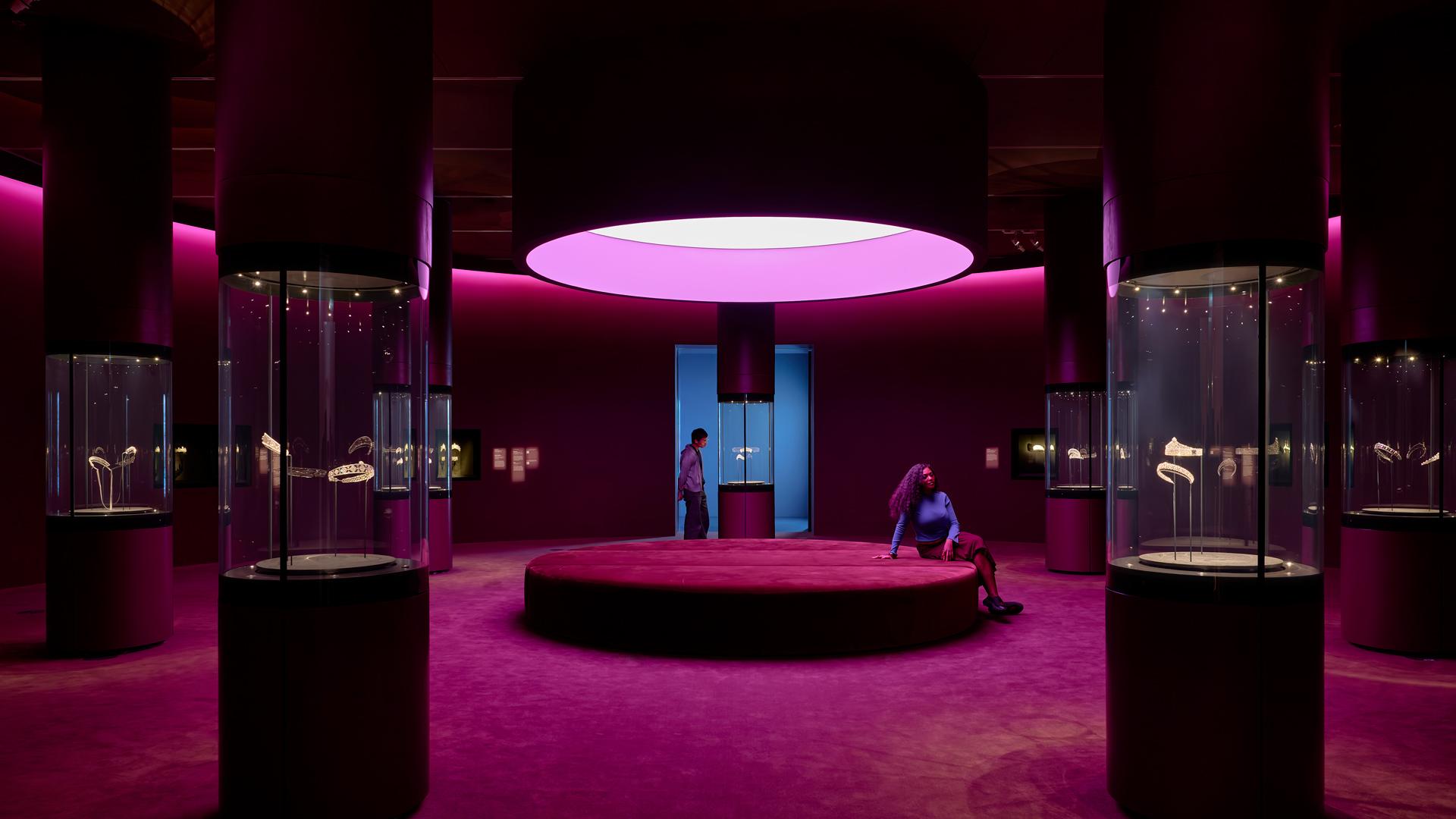
With symbolic links to celestial halos and laurel wreaths of classical antiquity, the tiara occupies a position at the very apex in the hierarchy of jewellery forms. This head ornament has been worn for millennia and, being located on the wearer’s head, is charged with the most potent of symbolism, associated with royal crowns and their nearness to the divine as well as embodying notions of power, wealth and status. As the jewellery historian Geoffrey Munn has noted, ‘Indeed, it may be that we have always felt the desire to adorn the head, the centre of intelligence and the source of emotional expression.’ In terms of their scale, complexity and majesty, tiaras are the ultimate expression of the designer’s ambition and the jewellers’ technical prowess.
The tiara has also long had associations with marriage and, particularly during the early decades of the twentieth century, was considered an essential element of a lady’s jewellery ensemble when attending a royal or aristocratic marriage. Tiaras were also the most significant jewel in a woman’s ensemble when attending royal coronations. The impressively large Cartier Scroll tiara of 1902 was originally commissioned for the Countess of Essex but was later worn by Lady Clementine Churchill, wife of British Prime Minister Sir Winston Churchill, to the coronation of Queen Elizabeth II in 1953. Its design represents the epitome of Cartier’s Garland Style, which the Maison developed during the early years of the twentieth century. The Garland Style was inspired by eighteenth-century French architecture, including the wrought-iron balconies of Paris, and the elegant openwork scrolls of this tiara that rise dynamically to a pinnacle in the centre embody the style perfectly.
‘By the 1930s Cartier had become the leading jewellery house for tiaras, producing more than any other jeweller. Its tiaras were celebrated for their innovative design and exceptional savoir-faire’
AMANDA DUNSMORE
Three decades later, in 1934, Cartier’s London workshops, known as English Art Works, produced a magnificent platinum and diamond Halo tiara. By the 1930s Cartier had become the leading jewellery house for tiaras, producing more than any other jeweller. Its tiaras were celebrated for their innovative design and exceptional savoir-faire. With its upright band of stylised lotus buds and flowers, the Halo tiara is illustrative of the fashion for all things ancient Egyptian, sparked by the discovery of Tutankhamun’s tomb in 1922. The tiara also includes the modernist design aesthetic of the Art Deco period with its lower band of alternating zigzag and vertical stripe motifs. Like many Cartier pieces, this lower register is detachable and able to be worn as a bandeau in its own right, placed low over the brow and perfect for complimenting women’s short, sleek haircuts of the period. This Halo tiara was owned by Andrée Carron, the French-born third wife of Aga Khan III, described by Tatler magazine as ‘one of the best-dressed women in the world’.
In keeping with the rich array of global design sources that influenced Cartier during the early decades of the twentieth century, the diamond and platinum Bandeau of 1923 is a striking example of formal, geometric design inspired by Islamic art. The openwork frame creates a fenestrated pattern of triangular elements, the light surrounding each element only adding to the dazzling brilliance of the diamonds. The open, geometric design may be inspired by the wooden latticework screens, or mashrabiya, from Islamic architecture. The lower section of the tiara is detachable and divides to form two bracelets, creating an even more striking jewellery ensemble. Adaptability continues to be a hallmark of Cartier’s most significant creations.
Amanda Dunsmore is NGV Senior Curator, International Decorative Arts and Antiquities.
This essay was published in NGV Magazine Issue 59| Jul–Aug 2026.
Notes
1. G. Munn, Tiaras. Past and Present, V&A Publishing, London, 2002, 6.
2. Tatler, 2 March, 1938, 74.