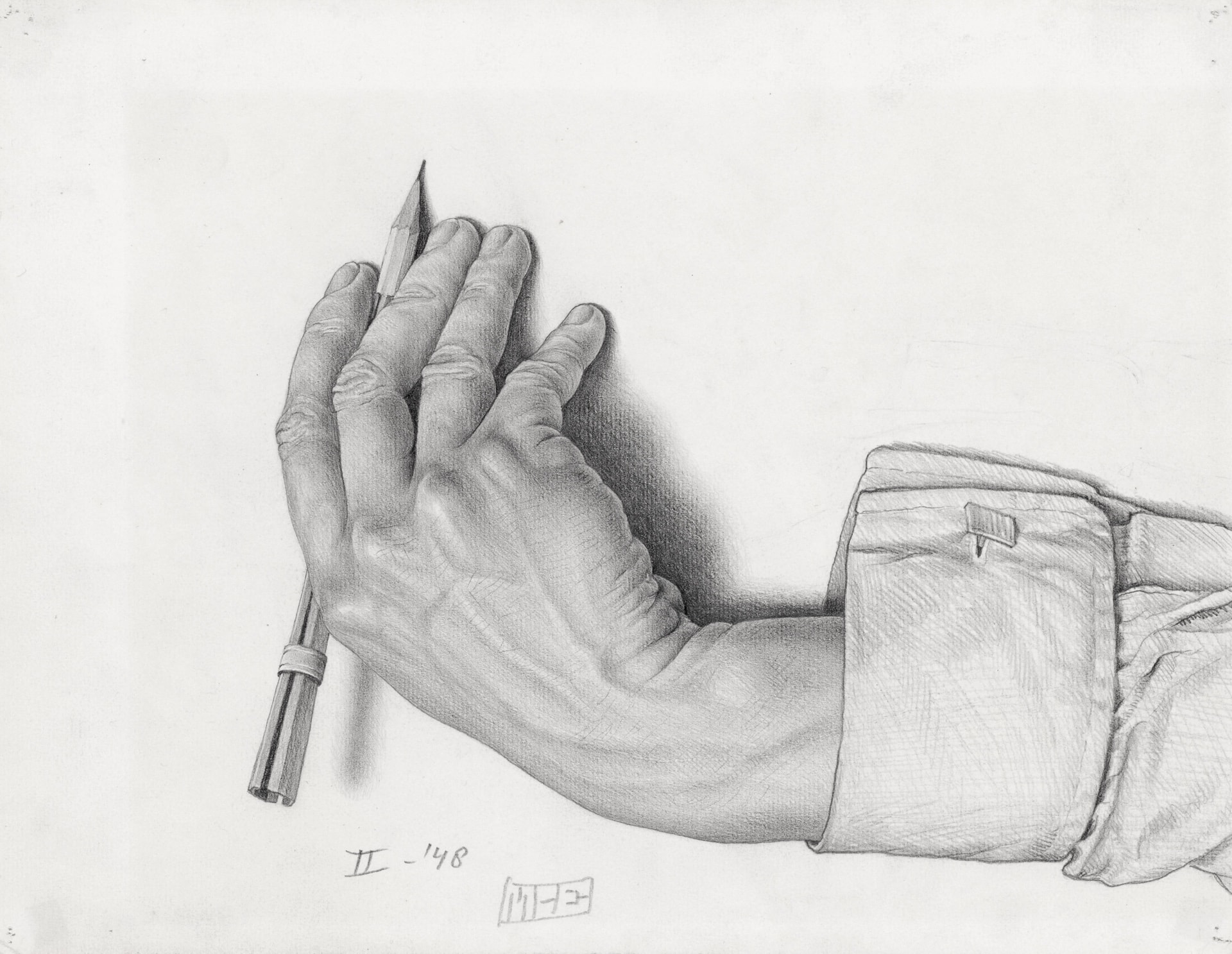


Escher was a printmaker par excellence. He made his first print when he was seventeen and his last when he was seventy-one, mastering a number of complex techniques including woodcut, lithography and mezzotint.
Prints are works produced in multiples by transferring an image from a printing surface, called a matrix, onto paper. Usually the matrix is a block of wood, a metal plate or a lithographic stone. The image drawn onto the matrix is reversed in the process of printing.
Escher’s preferred printing techniques were woodcut and wood engraving, of which he made over 300, all printed by hand using either the back of a small ivory spoon or a rolling pin for larger works – the Dutch inscription eigen druk (‘own printing’) appears in pencil below many of these works. He also made more than seventy lithographs. Escher’s lithographs were made in limited editions that, because of the complexity of the process, were printed by a specialist lithographer.
Escher was attracted to printmaking for three reasons: the desire for multiplication, the beauty of the craft and the imposed limitations of each printing technique – that is, he enjoyed the strict discipline involved in printmaking, which he viewed as order in the face of chaos.