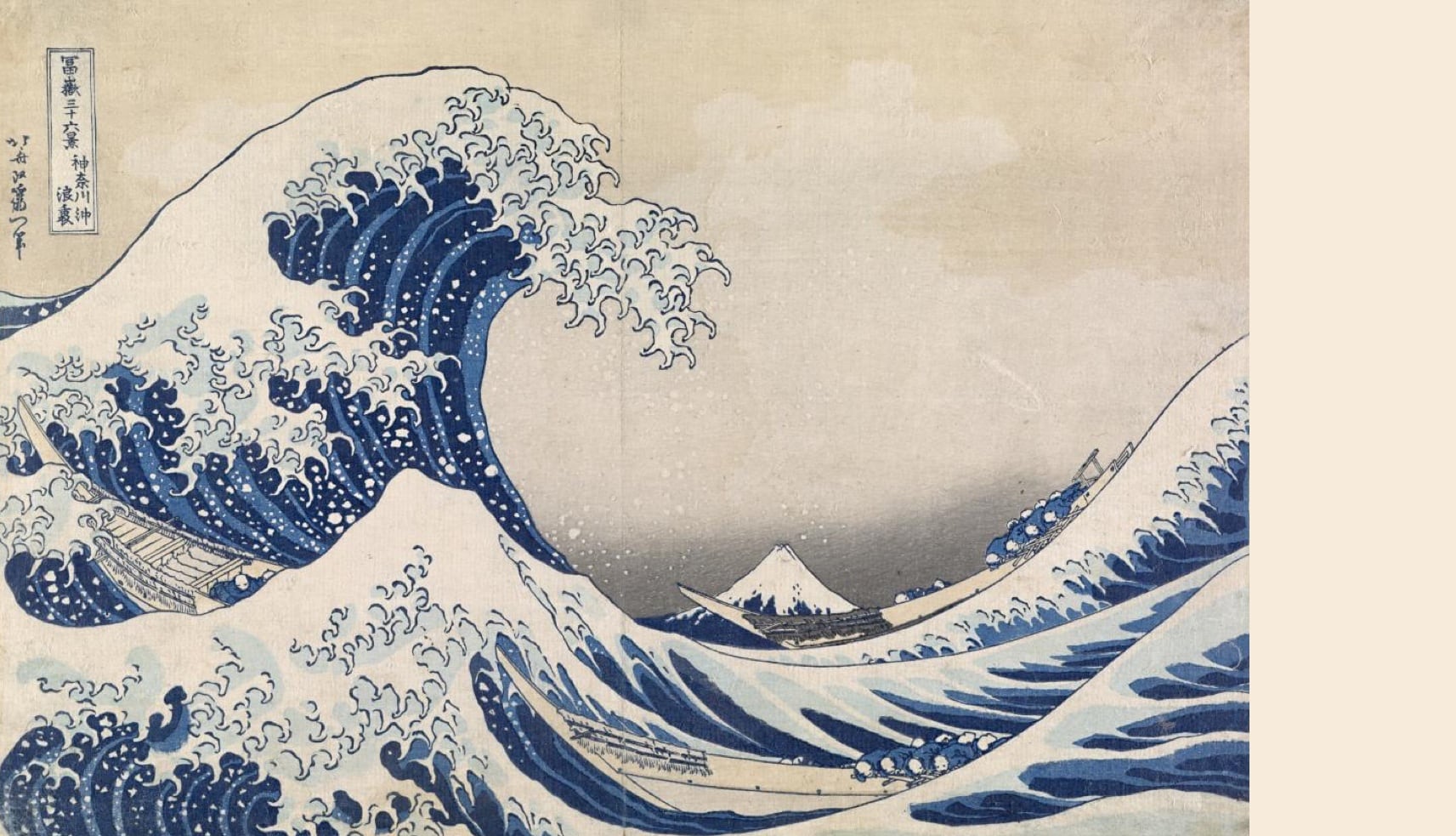


During Hokusai’s long career he constantly experimented with styles, explored new subjects and created new genres. In 1779, at the age of nineteen, he entered the prestigious Katsukawa School studio and for the next fourteen years, using the name Shunrō, produced illustrations for novels; European perspective–style prints; poetry album prints; and single-sheet kabuki portraits in the Katsukawa studio’s style.
After leaving the Katsukawa School in 1793 Hokusai worked as an independent artist under the names
Sori and Kakō. His prints from this time capture intimate and poignant interactions between people set in the natural environment. In many of these works we see the emergence of Mt Fuji as an ever-present backdrop, marking the beginning of Hokusai’s personal obsession with the sacred mountain.
During the early nineteenth century Hokusai’s fascination with European imagery led him to produce woodblock prints that imitated European aesthetics and a wide variety of works depicting human relationships, social situations and popular stories. Throughout this long period of artistic development, Hokusai refined an ability to instil his human figures, animals and landscapes with a realism and personality that brought them to life and set him on a trajectory to produce his groundbreaking series of the 1830s.