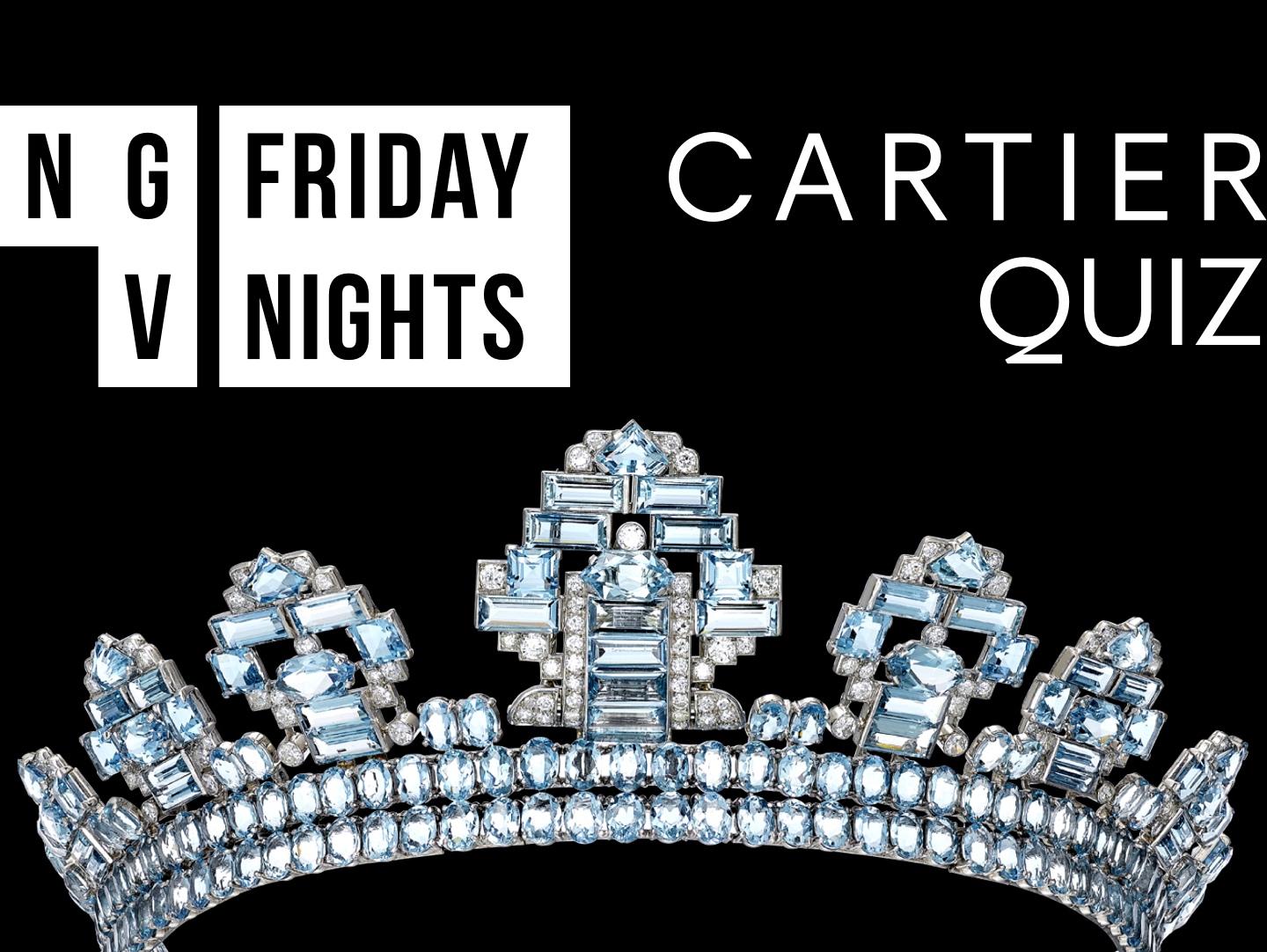
From family workshop to jeweller of kings and queens, test your knowledge of Cartier’s history, designs and iconic motifs.
The Cartier Story
1 Where was the founding Cartier workshop located?
% of people got this right
In 1847 Louis-François Cartier (1819–1904) took over the business of his mentor, Adolphe Picard, and founded a Parisian firm that would one day be recognised the world over. He already had high aspirations for the business and within just ten years could already count Princess Mathilde, the niece of Napoleon I, among his clients, and not long after, the Empress Eugénie herself.
2 What are the names of the three grandsons of Louis-François Cartier?
% of people got this right
Louis-François Cartier’s son Alfred (1841–1925) took over in 1874 at the age of 33. His sons, Louis, Pierre, and Jacques then became a fundamental part of the business.
3 With the 1900s came a new era for Cartier and a new order for the world. Together, the brothers worked into delicate openwork designs into a new style called 'Garland Style'.
What inspired Cartier's 'Garland Style'?
% of people got this right
Louis Cartier was the creative force behind the refined diamond jewellery in the eighteenth-century revival style (named ‘Garland Style’ by Hans Nadelhoffer) that established Cartier’s aesthetic identity around 1900. The style is embodied in a dramatic diamond stomacher brooch (a piece designed to be worn on the centre panel of a woman’s bodice, extending from the neckline to the waist) with drapes, swags and classical wreaths.
4 Three boutiques in Paris, London and New York defined the early years of the maison. What was the unusual asking price that Cartier acquired their Fifth Avenue mansion-turned-boutique for?
% of people got this right
The Cartier team had its eye on the magnificent Plant mansion on Fifth Avenue, and knowing financier Morton Plant’s inclination to sell the building, and his wife’s longing for the finest pearl necklace it had in stock, Pierre – in one of his many astute business negotiations – proposed an exchange.
5 Cartier opened it's first London premises on New Burlington Street in 1902. This opening coincided with the coronation of which monarch?
% of people got this right
Cartier had opened its first London premises, on New Burlington Street, initially under the guidance of the middle brother, Pierre, though it would ultimately fall under the remit of Alfred’s youngest son, Jacques. The opening coincided with the coronation of King Edward VII, and in 1904 the King would go on to grant Cartier a royal warrant (granted as a mark of recognition to people or companies who have regularly supplied goods or services to the Royal Household), which was followed by those of fifteen other countries in the following years.
A World of Inspiration
6 Louis Cartier joined the Maison in 1898. During this time, many of Cartier's stylistic codes were established. What were these stylistic codes?
% of people got this right
The new style gathered pace after 1909, emerging from a collaboration between Louis Cartier and the designer Charles Jacqueau, who joined the Maison in 1909 and who is considered by many one of the architects of Art Deco jewellery style. It was during this time, between 1910 and 1920, that so many of Cartier’s stylistic codes were established: powerful linear silhouettes (sometimes described as a (purity of line’), stylisation and interpretation of cultural influences – including Iranian, Chinese, Japanese, Indian, Gothic and Merovingian – as well as seamless integration of concept, material and technique, and arresting colour combinations.
7 Early 20th century Cartier pieces often featured apprêts, which are ____
% of people got this right
Apprêts are fragments of decorative artefacts or historic jewellery, repurposed into Cartier pieces. Some examples include Egyptian Necklace (1927-28), Lotus Flower Deity Brooch (1927), and Sekhmet Brooch (1925). You can see these works displayed in the CARTIER exhibition.
8 The 1920s saw a flurry of ‘Egyptomania’. This was a design style emerged as a result of ____?
% of people got this right
The 1920s saw a flurry of Egyptomania following the discovery of King Tutankhamun’s tomb. Ancient Egypt was one of the global cultures from which Cartier drew inspiration for its Art Deco designs, often incorporating apprêts (decorative elements from other cultures) to striking effect.
9 Louis Cartier's idea notebooks, now kept in the Cartier archives, reveal the link between various sources of inspiration and the jewellers creative directions. What sort of references are included in these notebooks?
% of people got this right
Louis Cartier’s idea notebooks, with their abundant notes and sketches – which he continuously supplemented – reveal the link between these various sources of inspiration and the jeweller’s creative directions. These notebooks included notes and drawings made in museums he visited, ideas and sketches for new jewels and notes from books Louis kept in his library. These idea notebooks are now kept in the Archives Department in Paris.
10 Cartier’s archives are found in _____ cities, each important repositories of documentation about the Maison’s history
% of people got this right
The Cartier Archives have enjoyed more than a century of stability in their current premises: since 1899 in Paris, 1909 in London and 1917 in New York. The archival collections are a particularly valuable resource for authenticating historical pieces that resurface and may become candidates for the Cartier Collection.
Making Dreams a Reality
11 Louis Cartier said to his salesman, "You must make the client obsessed with ____"
% of people got this right
By 1922, Louis’s instruction was a valid one: the Maison Cartier, now under the leadership of the three brothers, Louis, Pierre and Jacques, had at their fingertips potential access to some of the most spectacular and special stones on the market.
12 The Manchester Tiara was commissioned from Cartier Paris in what year?
% of people got this right
Commissioned from Cartier Paris in 1903 by the Dowager Duchess of Manchester, it captured the zeitgeist of the age. The Duchess – born Consuelo Yznaga in New York – was a Cuban-American heiress to a new fortune who had, some twenty-seven years earlier, married the Viscount Mandeville, British aristocrat and heir to the Duchy of Manchester.
Not only representative of the world that it inhabited, the Manchester tiara also symbolised the aspirations of the family behind its creation, a metaphor for the future of Cartier and the globalisation of the firm in the new century ahead.
13 What cluster of small pierres de couleur made up the iconic Tutti Frutti creation?
% of people got this right
In the 1920s came the luscious clusters of small pierres de couleur: rubies, sapphires and emeralds carved into the shape of leaves and fruits in the Mughal inspired style that came to be called Tutti Frutti – a creation that is indelibly, indissolubly associated with Cartier. The concept was first developed by Cartier Paris in the 1920s, and later fueled by the supply of small, Indian-carved coloured gemstones made possible by Jacques Cartier’s visits to India.
14 What type of cat is Cartier known for?
% of people got this right
In the early twentieth century, panthers and other big cats were a recurring theme in art, design, fashion and interiors. The panther itself, leader of Cartier’s pack of big cats, is an enduring, ever-evolving emblem of the Maison.
At Cartier the panther skin pattern first appeared in 1914, on a lady’s wristwatch, the same year that Louis Cartier commissioned the illustrator George Barbier to create an invitation card, Lady and the Panther, with a black panther lazing at the feet of a woman adorned with a floor-length strand of pearls. In 1948, the first three-dimensional, figural depiction of the panther with yellow gold flecked in black enamel, poised on a colossal emerald, was bought by the Duke of Windsor for the Duchess.
15 Various precious jewels passed through the hands of the Cartier brothers in the first quarter of the twentieth century. What stone held a special place for the brothers?
% of people got this right
When the Paris premises on rue de la Paix were renovated around 1912, a special pearl salon was installed (the only gem with its own exclusive sales space). It was a commercial success: throughout the 1920s, pearls would account for 60 per cent of Cartier’s entire turnover.
Constant Continuity
16 What 2025 film features Cartier pieces?
% of people got this right
Directed by Wes Anderson, Anderson approached Cartier to create Liesl’s bespoke rosary after stumbling upon one of the house’s cross pendants from approximately 1880. Artisans from the Maison recreated the cross on a larger scale, at nearly 5.5 cm, to help enhance visibility onscreen. The ornate white gold cross is inlaid with rose-cut diamonds and a large central ruby cabochon, while the 78.5 cm chain features emerald beads, briolette-, square-, and rose-cut diamonds, along with five ruby cabochons.
17 Which Australian soprano was a Cartier client?
% of people got this right
Dame Nellie Melba GBE was a renowned opera singer, one of few who achieved global celebrity in the era before recorded music. Cartier was Melba’s favourite jeweller. Some pieces were special orders made with gems received as gifts, such as the pendant diamond devant de-corsage or stomacher (today adjusted to be worn as a necklace), which was given to Melba by patrons of the Théâtre de la Monnaie in Brussels.
18 In 1925, the 'S’ Department was established to offer less expensive, albeit still precious items. The 'S’ may have stood for silver, although not everything was made with silver. The 'S’ may have also stood for _____?
% of people got this right
n 1925 Louis established the ‘S’ Department, specifically to offer more affordable and utilitarian objects, such as writing instruments and vanity cases. The ‘S’ may have stood for silver, indicating less valuable materials, although not everything was made of silver. It may also have stood for ‘sac’ (bag) or ‘soir’ (night).
19 One legendary design of Cartier watches is The Tank. The design takes influence from an armoured tank that made it's first appearance in the battlefields in what year?
% of people got this right
The watch borrows its name from the armoured tank that made newspaper headlines around the world after its first appearance on the battlefield of the Somme in 1916 during the First World War. While it may not have been directly inspired by it, the watch recalls certain aspects of the military vehicle’s design. Reduced to its purest graphic form of a rectangle bookended by dual caterpillar tracks, the latter become brancards (part of the watch which traces the two parallel sides, which extend through the strap attachments) which incorporate case and strap in one.
20 Which 1930s Hollywood actress wore her own personal Cartier pieces in films?
% of people got this right
While royals and distinguished aristocrats remained influential, the 1930s saw Hollywood and its top stars setting the trend for Cartier jewels. On-screen style was decadent, sparkling and luxurious: jewels had to be big, bold and exceptionally glittering. Stars would sometimes wear their own pieces on-screen or for publicity photography, such as Cartier client and actress Gloria Swanson, who wore her personal Cartier pieces in the films Perfect Understanding (1933) and later Sunset Boulevard (1950).
Crowning Moment
21 The coronation of George VI in 1937 greatly boosted appetites for ____
% of people got this right
The British court, with its rigid dress conventions, remained an important client base for Cartier. The coronation of George VI in 1937, for instance, greatly boosted appetites for tiaras from Cartier’s aristocratic clients in Britain including Viscount Mandeville, and Beatrice Mills.
22 In 2016, Countess of Essex's Scroll tiara were reinterpreted for which singer-songwriter for W Magazine?
% of people got this right
In 2016 W magazine featured a fashion story based on its creative and fashion director Edward Enninful’s vision of a dystopian future ruled by ‘the last woman on earth, the last warrior on earth’, starring Rihanna and photographed by Steven Klein.
23 On 2 December 1971, Baroness Marie-Hélène de Rothschild and her husband hosted a ball at the Château de Ferrière.
The Baroness wore a tiara designed by Cartier in _____
% of people got this right
The Baroness wore a tiara designed by Cartier in 1914. Inspired by the Russian kokoshnik-style tiaras, this magnificent tiara is a wonderful example of stylised early Art Deco design. It is described in the Cartier Archives as a ‘Diadème … “arbre” onyx calibrés’ (calibré-cut onyx ‘tree’ tiara).
24 Finish this sentence reflecting Cartier's reputation: "Jeweller of kings and the kings of ____"
% of people got this right
King Edward VII, who coined the phrase, was so fond of Cartier that upon his coronation rewarded the Maison with the commission of all its associated orders for tiaras, necklaces and breast ornaments by prominent British families.
25 How many tiaras are in the final room of the CARTIER exhibition?
% of people got this right
King Edward VII, who coined the phrase, was so fond of Cartier that upon his coronation rewarded the Maison with the commission of all its associated orders for tiaras, necklaces and breast ornaments by prominent British families.