CARTIER
Artwork Labels & Didactics
Welcome to CARTIER
Created in partnership with the Victoria and Albert Museum in London, CARTIER features nearly four hundred exceptional jewels and timepieces created by Cartier in the last 125 or so years. The exhibition includes many significant heritage pieces lent by the Cartier Collection, along with important loans from public museums and private collections. It also features a large selection of design drawings, photographs, books and other printed materials from the Cartier Archives in Paris, London and New York. Together, these treasures demonstrate the unique qualities of Cartier creations, characterised by a union of inspired design, exceptional craftsmanship and technical innovation.
Studio Sabine Marcelis and CLOUD
The exhibition design has been conceived by artist and designer Sabine Marcelis, Principal of Studio Sabine Marcelis, and Paul Cournet, Director of multidisciplinary architecture studio CLOUD, both based in Rotterdam. Together they have developed a contemporary design that responds to the mesmerising qualities of Cartier’s jewels, celebrating light, colour and materiality.
Inviting complete immersion into the world of gemstones, the architectural language of the exhibition echoes the structure of Cartier’s creations. ‘We take the concept of a gemstone and expand it to create a distinct spatial volume in each room,’ Cournet says, allowing the stones to ‘inform both the form and the material character of each space’.
Colour and materiality are Marcelis’s focus. Just as gemstones transform and respond to light, the exhibition’s colour palette changes in each room, creating atmospheres that reference the jewels as well as the stories they tell. Leading into the exhibition, and again on its exit, installations created by Marcelis represent her artistic interpretation of a gemstone’s interaction with light. Establishing the tone of the exhibition, these immersive spaces are also signatures of Marcelis’s practice, which explores space, light and colour through the medium of glass.
Sabine Marcelis
Dutch 1985–
Facet, horizontal
2026
laminated, mirrored glass with colour treatment, metal, Multiplex
Commissioned by the National Gallery of Victoria. Courtesy of the artist and Gallery Sally Dan-Cuthbert
This 27-metre-long mirrored volume runs the length of the entrance to CARTIER. It showcases the full colour palette of the exhibition, with each colour corresponding to a room within. A single cut along the volume’s face refracts light the way a gemstone facet does, splitting it across all seven colours of the visible spectrum at once.
Exhibition Sound
The NGV commissioned two award-winning Melbourne-based composers, Ai Yamamoto and Erkki Veltheim, to collaborate on original music for CARTIER.
Ai Yamamoto is a Japanese electronic artist whose practice foregrounds melody, texture and space. She collaborates with choreographers, filmmakers and artists including Hiroshi Sugimoto, Yumi Umiumare and Ben Frost. Finnish composer, performer and conductor Erkki Veltheim operates both inside and outside the music establishment. His practice spans gallery installation, violin performance, screen sound, and production of orchestral arrangements for artists including Gurrumul, Archie Roach and Bic Runga.
Responding to the exhibition design concept of Sabine Marcelis and CLOUD, the composers have created a highly spatialised, non-linear and immersive sound experience. Their compositions also feature live orchestral instrumentation recorded here in Melbourne.
Maison Cartier
Maison Cartier, the firm founded in Paris in 1847 by Louis-François Cartier, is one of the most renowned names in jewellery and watchmaking. This exhibition explores the story of Cartier as it developed from around 1900, when Louis-François’s three grandsons, Louis, Pierre and Jacques, took charge of running the family business. Under their leadership, Cartier became a global company, and its history is entwined with many of the most significant events and influential people of the twentieth century. Its exclusive client list led to Cartier being named ‘the jeweller of kings and the king of jewellers’, likely by the Prince of Wales, Britain’s future King Edward VII.
The Manchester tiara
Cartier Paris, 1903, special order
diamonds, glass paste (end finials), gold, silver
Commissioned by Consuelo Montagu, Dowager Duchess of Manchester
Victoria and Albert Museum, London: M.6:1-2007
Accepted by HM Government in Lieu of Inheritance Tax and allocated to the Victoria and Albert Museum, 2007
The Manchester tiara embodies Maison Cartier’s early aspirations and the global business to come. Consuelo, the Dowager Duchess of Manchester, supplied 1513 diamonds for a design inspired by eighteenth-century French architecture and ironwork. Born in New York to wealthy Cuban American parents, Consuelo was one of many ‘dollar princesses’ who married into the British aristocracy, exchanging their wealth for a title. Consuelo’s grandson Alexander Montagu, Viscount Mandeville (later the 10th Duke of Manchester) married Australian-born Nell Vere Stead, who also once wore this tiara.
Alfred Cartier (second from right) and his three sons (left to right), Pierre, Louis and Jacques, 1922
exhibition print, 2026
Cartier Paris Archives: PF01/FAM/P12
When Louis, Pierre and Jacques Cartier joined their father, Alfred (son of Cartier’s founder, Louis-François), in the family business, they aimed to create the first global jewellery house. By 1909 they had established branches in three major cities: Paris, London and New York.
Letter from Pierre Cartier to Jacques Cartier dated 25 January 1915
Collection of Francesca Cartier Brickell
The Cartier family was a united force. Even when apart, as they frequently were, Alfred and his sons maintained close contact with each other. This letter from Pierre to his brother Jacques demonstrates how regular correspondence not only reinforced their emotional bond but also enabled them to align on strategy across all three international branches of the business. Written during World War One (when writing paper was scarce, necessitating cross-writing), Pierre’s letter reads: ‘my two brothers are everything to me. Together, we dreamed of the greatness of our family business, and together we developed and spread its renown to all four corners of the globe.’
Right to left:
View along the rue de la Paix towards the Place Vendôme, Paris, c. 1924
Robert Desouches (illustrator)
Cartier Paris Archives: MF03/INST/07
Three interiors of the Cartier boutique at 13 rue de la Paix, Paris, c. 1924
Robert Desouches (illustrator)
Cartier Paris Archives: MF03/INST/04-05-06
Three plates from Book of Jewellery Designs Created by Maria and Engraved by Babel, Paris, 1765, reprinted in facsimile, 1904
Cartier Paris Archives: BibCart/173
Soon after becoming partner in 1898, Louis Cartier decided to employ in-house designers rather than buying ready-made stock. Louis encouraged his designers to study jewellery designs from eighteenth-century France, such as these illustrations from a book held in his library.
Early Cartier Jewels
Cartier took early inspiration from the decorative arts of eighteenth-century France and Europe, especially the style of King Louis XVI. Bows, tassels, floral swags and other popular European motifs were incorporated into early Cartier designs. While the original versions were mounted in closed-back settings, later jewels had open backs to allow more light to shine through the gems. Some, like the Cartier bow-knot brooch here, have rings on the reverse to allow them to be stitched directly onto clothing, in the eighteenth-century style.
Right to left:
Pair of earrings
Portugal, 1780–1800
topaz, silver
Victoria and Albert Museum, London: M.104A&B-1930
Bequeathed by Mrs A.E. Stuart
Necklet
Portugal, 1780–1800
topaz, silver
Victoria and Albert Museum, London: M.104-1930
Bequeathed by Mrs A.E. Stuart
Twin cornucopia brooch
Cartier Paris, 1899
diamonds, gold, silver
Cartier Collection: CL 286 A1899
Star brooch
Cartier Paris, 1889
diamonds, gold, silver
Cartier Collection: CL 309 A1889
This star brooch (which could also be worn as a hairpin) has an original black case, stamped ‘CARTIER JOAILLIER-ORFEVRE 9, BD DES ITALIENS’. Having established his jewellery business in 1847, Louis-François Cartier moved it to the boulevard des Italiens in 1859, the same year that his son Alfred joined the business. In 1899, the year after Alfred’s eldest son, Louis, joined the family firm at the age of twenty-three, the Cartier boutique moved to rue de la Paix, a street noted for luxury retailers, located just around the corner from the recently opened Ritz hotel.
Pendant
Cartier Paris, 1902, special order
diamonds, gold, silver
Sold to Jane Hading, French actress and singer
Cartier Collection: PE 20 A02
Bow-knot brooch
Cartier Paris, 1902
diamonds, rose gold, silver
Cartier Collection: CL 284 A02
France and the Garland Style
Eighteenth-century French art and architecture inspired the ‘Garland Style’ in jewellery, characterised by bows and ribbons, as well as floral swags, garlands and wreaths. Cartier became well known for this style, which became the predominant fashion around 1900. The Maison’s designers looked to the architecture of Paris and the Palace of Versailles for inspiration.
At the same time, jewels once set in silver and gold were transformed by the increased use of platinum, preferred for its high tensile strength that allowed for more daring designs, and for the way its shimmering white surface, which does not tarnish over time, made diamonds dazzle. Louis Cartier was instrumental in these developments. Delicate yet strong platinum mounts brought a new lightness to jewellery design.
Dame Nellie Melba
In 1888 Melbourne-born soprano Dame Nellie Melba debuted at Covent Garden, London and in 1891 she was invited to perform before Tsar Alexander III at the Imperial Theatre in St Petersburg. She would sing at all the great opera houses in Europe and America in the next two decades. Cartier was Dame Nellie’s favourite jeweller.
Left to right, from centre:
Corsage ornament (today adjusted to be worn as a necklace)
Cartier Paris, 1902, special order
diamonds, pearls, platinum
Commissioned by Dame Nellie Melba
Private collection
Melba gathered an enviable collection of Cartier jewels during her lifetime. Some pieces were special orders made with gems received as gifts, such as the pendent diamond in this necklace. Melba specially ordered the piece for Edward VII’s coronation concert at London’s Royal Albert Hall in 1902, at which she performed. The diamond was a gift from appreciative patrons of the Théâtre de la Monnaie in Brussels, where she performed over three successive seasons in the 1890s, while the central pearl was a gift from an admirer.
Nellie Melba
Otto Wegener (French, born in Sweden 1849–1922), c. 1904
photograph, gilt-wood, paperboard, fabric
Cartier Collection: OD 17 A04
In 1904 Melba presented this autographed photographic portrait to Pierre Cartier, who kept it on display in his living room throughout his life. The portrait was taken by Otto Wegener, known professionally as Otto, at the height of Melba’s global renown. Otto’s photographic studio, located close to the Opéra Garnier on the place de la Madeleine, was known for its aristocratic and artistic clientele.
Hairpin
Cartier, c. 1912
diamonds, pearls, platinum, celluloid
Owned by Dame Nellie Melba
National Gallery of Australia, Canberra: 2015.564.A-I
Purchased, 2015
Evening clutch bag
Cartier, c. 1925
diamonds, gemstones, silk brocade, satin, mirror, metal
Owned by Dame Nellie Melba
National Gallery of Australia, Canberra: 2015.565.A-F
Purchased, 2015
Dame Nellie Melba
Dame Nellie Melba was a renowned opera singer, one of few who achieved global celebrity in the era before recorded music. Born Helen Porter Mitchell in Richmond, Melbourne in 1861, she was known as Nellie from childhood and took the stage name ‘Melba’ – an homage to her home town – upon her Paris debut in 1886.
Left to right:
Corsage ornament
Cartier Paris, 1902, special order
diamonds, turquoise, platinum, yellow gold
Commissioned by Dame Nellie Melba
Private collection
More was more when it came to jewellery embellishments for a celebrated performer or aristocratic lady’s dress. At a reception hosted by Melbourne’s Lord Mayor during Melba’s return visit in 1902–3, newspapers reported that the diva wore ‘the diamond collar made by Cartier, a diamond and turquoise necklet, a diamond stomacher with a swaying pendant, and elegant brooches of diamond and turquoises’.
Tiara
Cartier Paris, 1908, special order
diamonds, turquoise, platinum, yellow gold
Commissioned by Dame Nellie Melba
Private collection
This piece is transformable and can be worn either as a necklace or as a tiara.
Brooches
Cartier Paris, 1903, special order
diamonds, turquoise, platinum, yellow gold
Commissioned by Dame Nellie Melba
Private collection
This set of brooches is transformable and can be set on a chain, as a necklace.
‘Russian Style’
Cartier’s decision to create jewels, watches and precious objects in what was called the ‘Russian style’ was a strategic business move. Following the success of Russian jeweller Carl Fabergé at the 1900 Paris Universal Exhibition and the popularity in Parisian high society of Fabergé’s luxury objects, the Cartier brothers saw an opportunity to increase their client base. The style, with roots in eighteenth-century French decorative arts, notably employed the techniques of hardstone carving and guilloché enamelling, in which coloured enamels applied to an engine-turned metal surface are then kiln-fired, becoming translucent to reveal the patterning beneath.
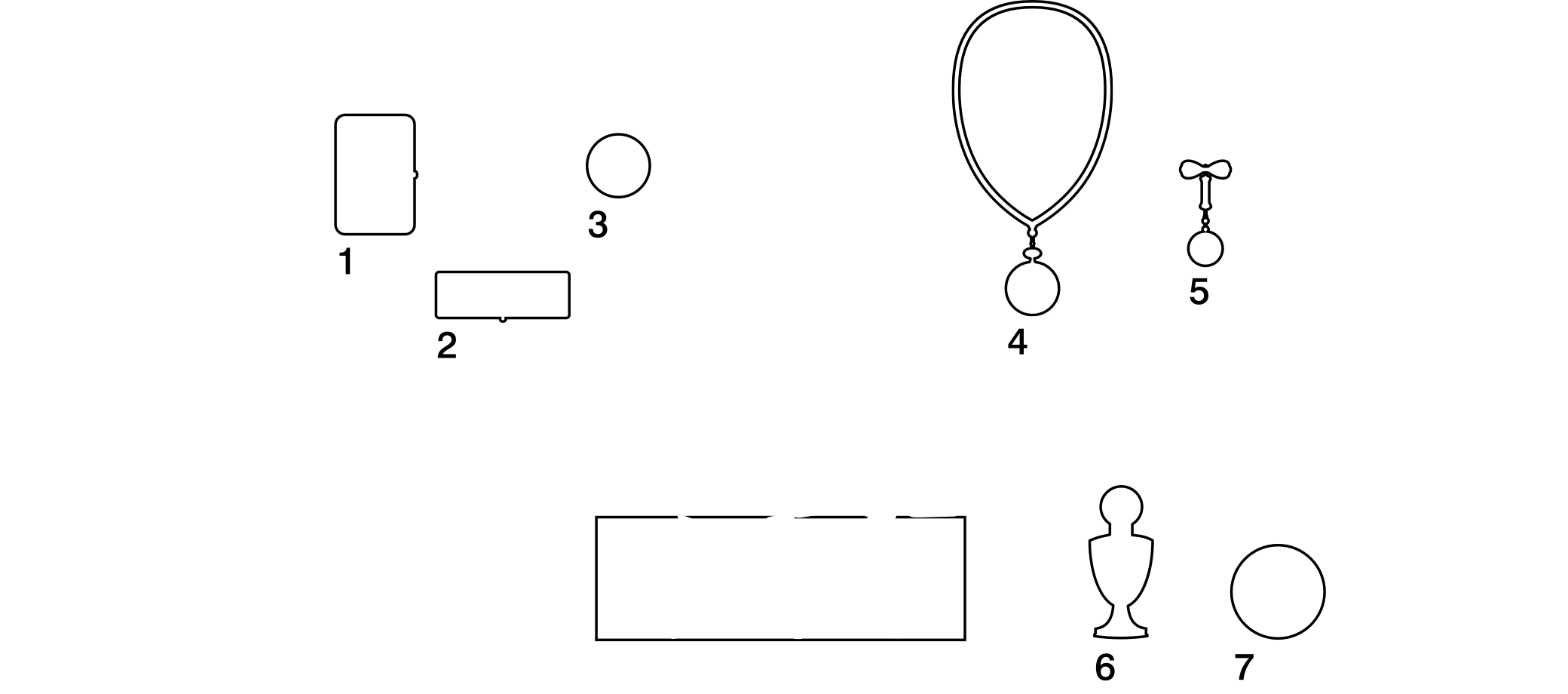
1Cigarette case
Fabergé, St Petersburg, designed by August Hollming, 1896–1908
diamonds, enamel (guilloché), gold
Powerhouse collection: A4431
Gift of Estate of Edmund Sheffield Willoughby Paul, 1953
Edmund Paul migrated from England to Australia with his brother in the 1850s, establishing a wholesaling business in Sydney. He was appointed honorary consul to Russia in Sydney in 1857, a position he held for over fifty years. Paul’s duties included welcoming to Sydney Russian dignitaries and the crews of Russian ships. In 1902 he was personally commended for his services by Tsar Nicholas II, and likely received this cigarette case bearing the Russian Imperial crest on that occasion.
2Cigarette case
Cartier Paris, 1910
sapphire, enamel (guilloché), enamel, gold
Cartier Collection: CC 96 A10
3Powder box
Cartier Paris, 1906
diamonds, enamel (guilloché), enamel, gold, platinum
Cartier Collection: PB 17 A06
4Pocket watch with necklace
Cartier Paris, 1909
diamonds, natural pearls, enamel (guilloché), enamel, platinum, gold
Cartier Collection: WPO 10 A09
5Watch-brooch
Cartier Paris, 1908
emeralds, diamonds, natural pearls, enamel (guilloché), enamel, platinum, gold
Sold to King Edward VII
Cartier Collection: WB 36 A08
In 1904 Britain’s King Edward VII granted Cartier a royal warrant, a mark of recognition to a company that supplies goods or services to the royal household. It was the first of about fifteen royal warrants that Cartier would receive in the following years, from countries including Spain, Portugal, Russia, Siam (Thailand) and Greece.
6Perfume burner
Cartier Paris, 1907
aventurine, enamel (guilloché), enamel, sapphires, silver-gilt
Cartier Collection: FK 16 A07
7Desk clock with strut
Cartier Paris, 1914
diamonds, enamel (guilloché), enamel, platinum, silver, metal
Sold to Mrs J. J. Astor
Cartier Collection: CDS 62 A14
Cartier and Fabergé
Cartier initially used some of the same suppliers as Fabergé and actively targeted the same clients, including the Russian Imperial Family. Cartier opened its first boutique in London in 1902 while Fabergé established its first office there in 1903. They relocated to New Bond Street in 1909 and 1911, respectively. As competitors, they worked with similar techniques, although Cartier favoured less vivid tones, pursuing a pastel colour palette and using materials, such as rose quartz, not used by Fabergé.
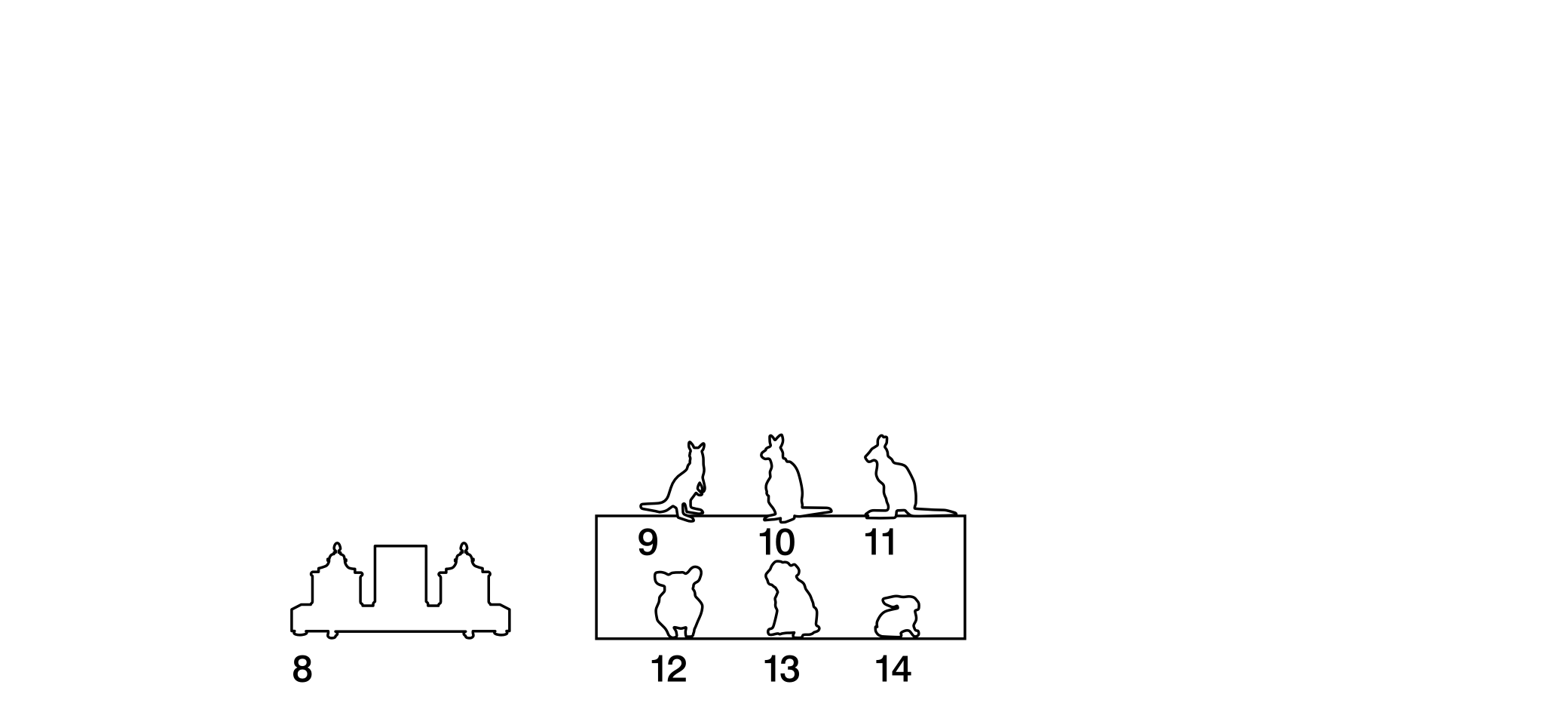
8Desk clock on inkstand
Cartier Paris, 1908
sapphires, diamonds, enamel (guilloché), enamel, gold, platinum, silver-gilt, silver
Cartier Collection: DI 24 A08
9Kangaroo
Fabergé, St Petersburg, c. 1910
agate, diamonds
Victoria and Albert Museum, London: M.7:1,2-2017
Accepted under the Cultural Gifts Scheme by HM Government from Nicholas Snowman and allocated to the Victoria and Albert Museum, 2017
In selecting the hardstone for this kangaroo, Fabergé’s expert carver chose a greyish-brown banded agate, its colours remarkably appropriate for an animal the designer most likely had never seen. Although by the end of the nineteenth century kangaroos were increasingly seen in European zoos and exotic private collections, the source for these kangaroos most probably derived from published illustrations.
10Kangaroo with joeys
Cartier Paris, 1905
grey agate, diamonds
Musée des Arts Décoratifs, Paris: 36247.64
11Kangaroo
Cartier Paris, 1905
nephrite, diamonds
Musée des Arts Décoratifs, Paris: 36247.65
This Cartier kangaroo and the one to its left belonged to Mademoiselle Emilie Yznaga, whose sister Consuelo was the Dowager Duchess of Manchester (owner of the Manchester tiara). Emilie collected carved animals and boxes by Fabergé, and the kangaroos were originally misidentified as Fabergé when they were donated to the Musée des Arts Décoratifs in Paris in 1943.
12Chinchilla nibbling an ear of corn
Fabergé, St Petersburg, c. 1910
chalcedony, sapphires, gold
Victoria and Albert Museum, London: M.3-2017
Accepted under the Cultural Gifts Scheme by HM Government from Nicholas Snowman and allocated to the Victoria and Albert Museum, 2017
13Bulldog
Cartier, c. 1907
smoky quartz, diamonds, gold
Cartier Collection: AN 08 C07
14Rabbit
Cartier, c. 1904
amethyst, rubies, diamonds, silver
Cartier Collection: AN 12 C04
Madame Melba
Rupert Bunny (Australian 1864–1947), c. 1902
oil on canvas
National Gallery of Victoria, Melbourne: A70-1980
Purchased through The Art Foundation of Victoria with the assistance of Dinah and Henry Krongold CBE, Founder Benefactors, 1980
This spectacular full-length portrait of Nellie Melba was made at the height of her fame. It was painted by the Australian artist Rupert Bunny, a contemporary of Melba’s. Bunny has captured the diva in the grand manner of eighteenth-century English society portraiture, taking great care with the details of her dress and her exceptionally long pearl sautoir. In addition to her regular visits to Cartier, Melba was a great patron of French haute couture, commissioning many of her stage costumes from the House of Worth. She is depicted here in the newly adopted ‘S-bend’ silhouette, representing the height of Belle Époque fashion.
Left to right, top to bottom:
Catalogue for Cartier Paris, 1929
Invitation card for Cartier Paris, 1925
Invitation card for Cartier Paris, 1918
Invitation card for an exhibition of Christmas and holiday gifts held at the Cartier boutique, 13 rue de la Paix, Paris, 1920
Cartier Paris Archives: PF14-COM-17-C, PF14-COM-P16-A, PF14-COM-P02-B, PF14-COM-P13-B-02
These four invitation cards show how Cartier’s graphic identity during the early years of the twentieth century emphasised the firm’s international character. The inclusion of addresses for the Paris, London and New York boutiques was a constant in Cartier’s printed materials from 1909, when Pierre Cartier established the New York branch.
Pierre Cartier in Russia, 1904
exhibition print, 2026
Cartier Paris Archives
This photograph was taken during Pierre Cartier’s first visit to Russia in 1904. Pierre returned to St Petersburg and Moscow in 1905, and during these visits made useful connections with workshops with expertise in enamelling and hardstone carving (glyptic techniques). Louis Cartier and designer Charles Jacqueau also visited Russia in subsequent years, learning much from visits to the Hermitage Museum and the collecting tastes of Russian Imperial families. Cartier’s Russia-based business activities came to an end with the outbreak of World War One in 1914 and the Russian Revolution three years later.
Invitation card for an exhibition at the Hôtel de l’Europe, St Petersburg, Russia, 1911
Cartier Paris Archives: PF14-COM-P03-B
Cartier held its first exhibition at the Hôtel de l’Europe in 1907, the same year it received a royal warrant from Russia’s Tsar Nicholas II. Cartier started organising temporary exhibitions in St Petersburg on a yearly basis until 1914. Through such exhibitions, the Maison established a following among aristocratic Russian society, some of whom were also regular visitors to the Paris boutique. This invitation card features six coats of arms representing the royal warrants Cartier had received by 1911, including the Russian Imperial coat of arms at the top.
Deed signed between Alfred Cartier and Gaston and Jean-Philippe Worth regarding the premises shared by both companies at 4 New Burlington Street, London, 1902
Cartier Paris Archives: CORR-PAR-LON01-082
The opening of a Cartier London boutique became almost a necessity when Cartier Paris received a flood of orders for tiaras and other jewels to be worn by guests to the coronation of King Edward VII in 1902. That year, Pierre Cartier oversaw the opening of Cartier’s London branch at 4 New Burlington Street, in the same premises as the haute couture fashion maison House of Worth. Pierre worked with his younger brother Jacques to co-direct the branch until Jacques became sole director in 1906. In 1909 the business moved around the corner to 175–176 New Bond Street, occupying an iconic building in the heart of London’s luxury shopping district Mayfair. Cartier London is still based there today.
Photograph of the premises shared by Worth and Cartier at 4 New Burlington Street, London, 1904
exhibition print, 2026
Cartier Paris Archives: Doc/87192430
The Cartier and Worth families had had relations since the 1860s and this closeness continued through the generations, with Louis Cartier marrying Andrée-Caroline Worth, daughter of Jean-Philippe Worth, in 1898. The family’s proximity to one of Paris’s most successful couturiers provided the firm with introductions to many who would also become loyal Cartier clients in the ensuing years.
Invitation card for Cartier London, c. 1912
George Barbier (French, 1882–1932)
Cartier London Archives: CARLON-01
French illustrator George Barbier created this sleekly sophisticated image for Cartier London. Barbier is best known for illustrating the French fashion journal La Gazette du Bon Ton. In 1914 Barbier would design an invitation (on view later in the exhibition) for Cartier Paris featuring the black panther that is now indissociable from the Maison.
Ground floor plan showing proposed alterations to the Cartier boutique at 175–176 New Bond Street, London, c. 1910
paper, ink, graphite
Cartier London Archives: CARLON-08
Left to right, top to bottom:
Announcement card for Cartier New York, 1916
Invitation card for Cartier New York, c. 1917
Invitation card for Cartier New York, 1920
Catalogue for Cartier New York, c. 1961
Cartier New York Archives: CNYA-INV1916.1, CNYA-INV1917.2, CNYA-INV1920.1, CNYA-INV1920.1
After initial forays to New York were made in 1903 and 1908, Pierre Cartier oversaw the opening of the Fifth Avenue boutique in 1909. The initial premises were located at 712 Fifth Avenue, in a building that Alfred Cartier – who selected the site during his 1908 visit – described as ‘French in appearance’ and ‘Louis XVI in style’. In 1917 the boutique moved four blocks south, to a substantial Renaissance-style mansion at 653 Fifth Avenue, on the corner of East 52nd Street, which it still occupies to this day.
Editorial feature in Life magazine celebrating Cartier’s centenary, 22 December 1947
Cartier New York Archives: CNYA-PRAD-LIFE1947.1.1-1.2
This article in Life magazine marked the 100-year anniversary of Cartier since its original founding by Louis-François Cartier in 1847. Focusing on the New York branch, the article provided readers with an insight into the process of choosing jewellery at the luxuriously appointed Fifth Avenue boutique.
Two studies for Louis XVI decorative motifs after Pierre Ranson
Cartier Paris, c. 1910
graphite, pencil and ink on translucent paper
Cartier Paris Archives: E23, E01
These two sketches by an unidentified Cartier designer refer to the eighteenth-century French designer Pierre Ranson. His work encapsulated key decorative features of the neoclassicism that directly influenced the Garland Style. Ranson engraved textile designs based on flowers and garden structures such as pergolas, and he also designed tapestry and embroidery motifs used in carpets and furniture upholstery. His style featured vases, floral garlands, wreaths and swags, and ornately gilded architectural framing used in mirrors and wall panelling.
Louis Cartier’s ideas notebook
Cartier Paris, 1908–9
hardback notebook, ink, graphite
Cartier Paris Archives: CH04
Louis Cartier kept notebooks such as this one for sketching ideas and taking notes regarding new jewels. The Cartier Paris Archives contain ‘ideas notebooks’ (cahiers d’idées) from the years 1908–9, which notably include Louis’s sketches of key Garland Style motifs, often made during visits to museums or from observations of architectural details around him. These notebooks also evidence Louis’s growing interest in Persian and Islamic decorative motifs in this period. From 1909 Charles Jacqueau joined the Cartier design team, and he developed a close working synergy with Louis in the years that followed.
Plaster cast for a tiara
Cartier Paris, 1906
Cartier Paris Archives: DIA24
These plaster casts were produced as part of Cartier’s early working process, with the majority made between 1905 and 1915. Based on completed pieces of jewellery, the casts provided a three-dimensional counterpart to the photographic record that was also part of the firm’s extensive archival documentation from around 1901.
Plaster cast for a tiara
Cartier Paris, 1909
Cartier Paris Archives: DIA58
This tiara was executed in platinum and diamonds for the Countess of Moy.
Plaster cast for a corsage ornament
Cartier Paris, 1908
Cartier Paris Archives: DC10
The corsage ornament was executed in sapphires, diamonds and platinum for the Grand Duchess Vladimir, a member of Russia’s Imperial Family.
Left to right:
Design for a tiara
Cartier Paris, c. 1905
graphite and ink on translucent paper
Cartier Paris Archives: GII08
Design for a tiara
Cartier Paris, c. 1906
graphite and gouache on translucent paper
Cartier Paris Archives: GII06
Design for a stomacher brooch
Cartier Paris, 1907
graphite, ink and gouache on translucent paper
Cartier Paris Archives: GII18B
All three of the designs displayed here were proposed for creation with diamonds and platinum; only this stomacher brooch was photographed in its finally executed form.
Garland Style sketchbook
Cartier Paris, c. 1910
softcover notebook, ink, gouache
Cartier Paris Archives: CHGIII
The Cartier Paris Archives contain several so-called ‘Garland Style sketchbooks’, which are in fact scrapbooks into which final design drawings for many jewels made from around 1910 have been pasted. They are filled with designs for tiaras, plaque brooches, corsage ornaments, necklace pendants, rings and hair combs – key typologies of the Garland Style. For designs such as tiaras, only half of the design was required to be drawn in detail, as its symmetrical nature meant it could be simply replicated in reverse for the second half.
Stomacher brooch
Cartier Paris, 1907, special order
sapphires (approx. 51 carats total), diamonds, platinum
Cartier Collection: CL 292 A07
Brooch
Cartier Paris, 1905, special order
diamonds, platinum
Cartier Collection: CL 112 A05
The pendant is detachable.
Stomacher brooch
Cartier Paris, 1912, special order
diamonds, platinum
Cartier Collection: CL 122 A12
The central section can be detached and worn as a brooch.
Stomacher brooch
Cartier Paris, 1909, special order
diamonds, platinum
Cartier Collection: CL 208 A09
Lily stomacher brooch
Cartier Paris, 1906, special order
diamonds, platinum
Owned by Mary Scott Townsend, American industrialist heiress and congresswoman
Cartier Collection: CL 134 A06
The two floral sprays articulated around the central diamond can be expanded as widely as desired. According to the Cartier Archives, this jewel could be worn as a corsage ornament, as épaulettes (on the shoulders) and as a tiara.
Sunray brooch
Cartier Paris, 1906
diamonds, platinum
Cartier Collection: CL 100 A06
This radiant sun, edged with a laurel border, was perhaps inspired by decorative motifs at the Château de Versailles, where Louis Cartier used to send his designers for research.
Brooch-pendant
Cartier Paris, 1909, special order
diamonds, platinum
Sold to Grace Vanderbilt, Mrs Cornelius Vanderbilt III, American socialite, as part of a larger necklace
Cartier Collection: CL 269 A09
Lace ribbon brooch
Cartier Paris, 1906
diamonds, platinum, gold
Sold to Sir Ernest Cassel, friend and adviser to King Edward VII
Cartier Collection: CL 144 A06
The large pendent drapery motif is detachable from the brooch.
Stomacher brooch
Cartier Paris, 1913, special order
diamonds, rock crystal, platinum
Cartier Collection: CL 340 A13
The carved colourless rock crystal in this stomacher (a jewel designed for the front of a dress) was probably inspired by Renaissance and Baroque vessels created for the great courts of Europe in the sixteenth and seventeenth century. The rock crystal adds detail and volume to the bow shape, perfectly complementing the delicate and monochrome Garland Style design. The pendant is detachable.
A World of Inspiration
Paris at the turn of the twentieth century was a cosmopolitan centre for art and design from all over the globe. All things ‘oriental’ and ‘exotic’ were in vogue, with the traditions of ancient Egypt, India, Japan, China, Iran and the Islamic world offering new possibilities for form and colour.
For inspiration, Cartier designers were encouraged to study books on the decorative arts and architecture of these cultures, which Louis and Jacques Cartier made available to them. The Maison also acquired ancient fragments, or pieces from disassembled jewellery or other items, creating a resource for the designers to use as reference material or to incorporate into new designs. Called apprêts by Cartier, such artefacts were often collected from antiques dealers, several of which were located near Cartier on the rue de la Paix in Paris.
The Cartier brothers nurtured close relationships with an elite, taste-making clientele. As well as producing pieces for stock, where they could experiment with daring new ideas, Cartier designed bespoke commissions that reflected the Maison’s clients’ individual interests, culture and personality. These collaborations between client and jeweller led to some of the most magnificent pieces ever created by Cartier.
Egypt
Following the discovery of pharaoh Tutankhamun’s tomb in 1922, Egyptomania fired the European imagination with renewed force. Cartier designers distinguished the Maison’s ancient Egyptian–themed creations by their close study of books as well as of antiquities on display at the nearby Louvre Museum. Cartier reinterpreted ancient Egypt’s distinctive colour combinations and motifs in some of the Maison’s most splendid Art Deco creations.

1Sekhmet brooch
Cartier Paris, 1925, special order (Egyptian lion-headed goddess Sekhmet, 664–332 BCE)
emeralds, rubies, diamonds, Egyptian faience, onyx, enamel, platinum, gold
Cartier Collection: CL 278 A25
2Brooch
Cartier London, 1923 (Egyptian lion-headed goddess Sekhmet, around 664 BCE or later)
diamonds, Egyptian faience, lapis lazuli, onyx, enamel, platinum, gold
Cartier Collection: CL 321 A23
3Lotus flower deity brooch
Cartier Paris for Cartier New York, 1927, special order (Egyptian goddess Isis, 664–525 BCE)
emeralds, rubies, diamonds, Egyptian faience, onyx, enamel, platinum, gold
Cartier Collection: CL 161 A27
4Egyptian necklace
Cartier Paris, 1927–28 (Egyptian statue fragment of Isis nursing Horus, 332–30 BCE)
sapphires, emeralds, diamonds, Egyptian faience, carnelian, turquoise, onyx, platinum, gold
Cartier Collection: NE 78 A27-28
5 Egyptian vanity case
Cartier Paris, 1924 (Egyptian figure, 332–30 BCE)
diamonds, Egyptian faience, mother-of-pearl, coral, lapis lazuli, onyx, enamel, leather, platinum, gold
Sold to François Coty, French perfumer
Cartier Collection: VC 64 A24
6Egyptian sarcophagus vanity case
Cartier Paris, 1925 (Egyptian plaque, date unknown)
emeralds, sapphires, diamonds, onyx, enamel, bone, platinum, yellow gold, rose gold
Sold to Florence Meyer, Mrs George Blumenthal, American philanthropist
Cartier Collection: VC 70 A25
The design of this case imitates the shape of sarcophagi (outer stone coffins) from the 26th Dynasty (664–525 BCE) onwards. Every surface is decorated with ancient Egyptian motifs, including lotus flowers and carved emerald sphinxes (mythological creatures with a human head and lion’s body). The carved bone plaque of a standing female figure was taken from Cartier’s stock of ancient Egyptian artefacts. The base features a gold plaque of a female servant figure bearing a basket, possibly containing figs, on her head. This was originally intended to be enamelled, but was ultimately left as is.
Egypt
Cartier frequently incorporated ancient fragments into its creations. Jewels and objects inspired by ancient Egypt often included faience, a type of glazed composition used extensively in ancient Egyptian jewellery, personal objects and inlaid decoration. Cartier called such artefacts apprêts and used this term generally for the Maison’s stock of disassembled jewellery and other fragments originating from Persia, India, China and Japan, as well as ancient Egypt.

7Egyptian striking clock
Cartier Paris, 1927
mother-of-pearl, coral, carnelian, lapis lazuli, green hardstone, enamel, gold, silver-gilt
Owned by Florence Meyer, Mrs George Blumenthal, American philanthropist
Cartier Collection: CDB 21 A27
One of Cartier’s most spectacular Egyptian-inspired objects is this clock in the form of an Egyptian temple entrance gate.
8Egyptian-style pendant
Cartier Paris, 1921, special order
rubies, emeralds, diamonds, one 32.72-grain natural pearl, moonstone, onyx, enamel, silk, platinum, gold
Cartier Collection: NE 21 A21
9Scarab brooch
Cartier London, 1925 (Egyptian scarab, possibly 664–332 BCE)
rubies, emeralds, diamonds, Egyptian faience, citrines, onyx, platinum, gold
Cartier Collection: CL 264 A25
10Horus brooch
Cartier Paris, 1925 (Egyptian falcon-headed god Horus, 664–332 BCE)
diamonds, emerald, Egyptian faience, coral, onyx, enamel, platinum, gold
Cartier Collection: CL 263 A25
11Scarab brooch
Cartier London, 1924 (Egyptian wings, second half of the first millennium BCE)
emeralds, diamonds, Egyptian faience, smoky quartz, enamel, platinum, gold
Cartier Collection: CL 32 A24
12Egyptian cigarette case
Cartier Paris, 1929, special order (Egyptian elements, 4th to 3rd century BCE)
diamonds, Egyptian faience, lapis lazuli, coral, mother-of-pearl, enamel, platinum, gold
Commissioned by Ira Nelson Morris, American diplomat
Cartier Collection: CC 89 A29
India
Part of the British Empire from 1858 to 1947, India became an enduring source of inspiration for Cartier. Alexandra, Queen consort of Britain’s King Edward VII (and also, therefore, Empress of India from 1901 to 1910), ordered an ‘Indian chain’ in 1901, one of the Maison’s first Indian-inspired creations. In 1911 Jacques Cartier attended the Delhi Durbar, a spectacular ceremony marking the succession of King George V and Queen Mary as Emperor and Empress of India. While there, he established important relationships with Indian rulers and with local dealers of carved gems and antiques.
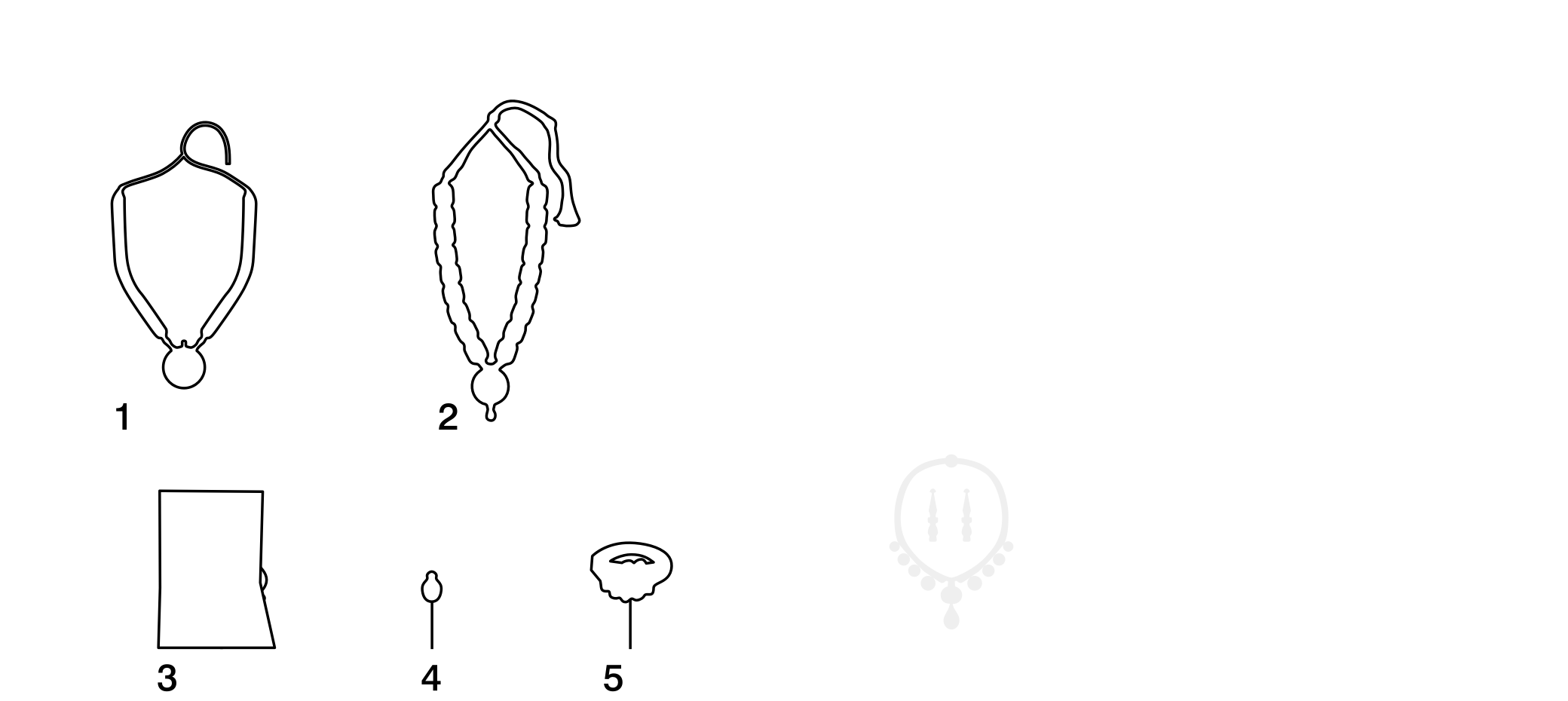
1Necklace
India, 18th–19th century (pendant element early 20th century)
rubies, emeralds, diamonds, spinels, rock crystal, freshwater pearls, gold, enamel, glass, metal, silk
National Gallery of Victoria, Melbourne: AS12-1979
Purchased, 1979
The style of this necklace and the techniques used to create it are typical of India’s Mughal period (16th –19th century). However, skilled Indian artisans largely based in Jaipur (Rajasthan) have since continued to work with the same techniques, making dating these jewels difficult. The crescent moon in the (later) pendant links it to Islamic traditions, while the gold and enamelwork plaques set with gemstones were also traditional to jewellery worn in the largely Hindu Rajasthani courts. The backs of the plaques are decorated with colourful images of birds including parrots and peacocks.
2Indian-style necklace with pendant
Cartier Paris, 1928, special order (Indian pendant and necklace, 18th–19th century)
rubies, emeralds, diamonds, natural pearls, pearl, white jade, enamel, gold, silk
Cartier Collection: NE 34 A28
This necklace of eighteen gold and enamelwork plaques, each set with rubies and diamonds and strung together with five strands of pearls, was originally listed in Cartier’s stock inventory of Islamic jewellery (stock musulman) in 1920. The white jade pendant set with carved rubies and emeralds was part of Louis Cartier’s collection of apprêts. Although the pendant was initially offered for sale attached to a necklace of emerald beads, in 1928 a client requested Cartier join the pendant to a necklace from the stock musulman, creating this piece. It demonstrates the Maison’s central role in selecting the highest quality historical Indian jewels and retailing them to a discerning clientele.
3Mughal dish in Cartier box
India, 18th century
nephrite jade, paper
Victoria and Albert Museum, London: IS.24:1-2-1997
Mr and Mrs Ernest Schwaiger Bequest
Ernest Schwaiger worked as a Cartier London salesman from around 1933 to 1969. His father, Imre Schwaiger, was a prominent Hungarian-born antiques dealer based in Delhi and London. Imre first met Jacques Cartier in 1911, selling him antique Asian jewels and objects that were later offered for sale at Cartier London. These items were often presented to the buyer in a fitted Cartier box, as in this example of a Mughal period jade dish.
4Perfume bottle with stopper
India, 19th century
sapphire, emerald, ruby, diamond, natural pearl, rock crystal, opal, cat’s-eye (possibly chrysoberyl), gold, glass
Victoria and Albert Museum, London: IM.150-1910
Purchased by the V&A from the dealer Mr Imre Schwaiger
Imre Schwaiger sourced many objects from Asia for both Cartier and the Victoria and Albert Museum, including this Indian bottle carved from rock crystal and set with the auspicious navaratna (nine stones) in the Hindu tradition.
5Bangle
Cartier London, 1937 (Indian element, 19th century)
rubies, diamonds, enamel, platinum, gold
The British Museum, London: 2001,0505.4
India
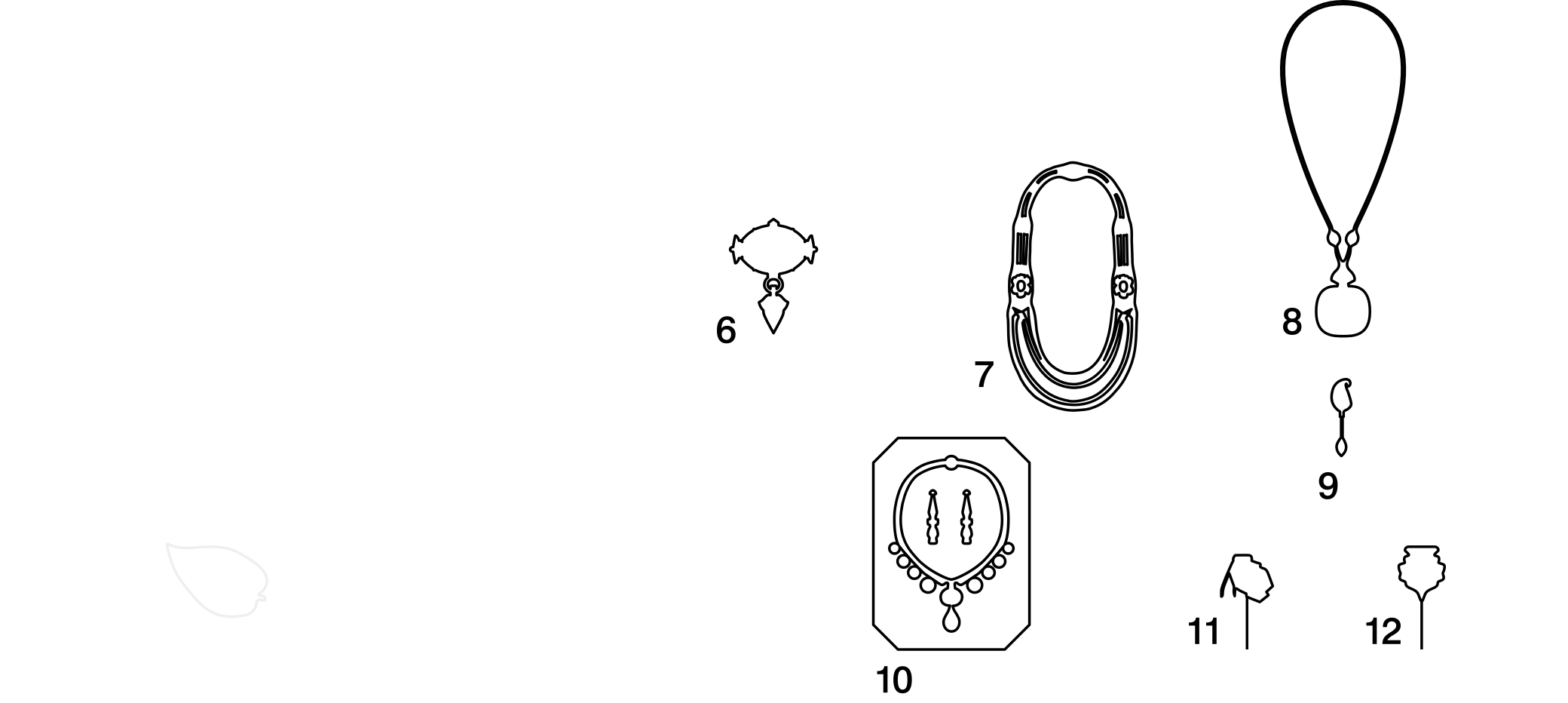
6Bazuband upper-arm bracelet
Cartier Paris for Cartier London, 1922, special order
diamonds, platinum
Sold to Sir Dhunjibhoy Bomanji, British Indian shipping magnate and philanthropist
Cartier Collection: BT 08 A22
Traditionally worn on the upper arm by both men and women, the bazuband was a popular item of jewellery in the Mughal period (16th –19th century). This is the first upper-arm bracelet executed by Cartier, and it features an articulated platinum armature so that it can fit the curve of the upper arm. The client – Sir Dhunjibhoy Bomanji – supplied 859 of his own diamonds, of which only twenty-eight were unused and returned to him. The piece can also be worn as a pendant, brooch or corsage ornament.
7Sautoir
Cartier London, 1930, special order
rubies, diamonds, natural pearls, platinum
Owned by Nancy Lancaster, Mrs Ronald Tree, interior decorator and owner of Colefax & Fowler
Cartier Collection: NE 27 A30
This sautoir, or long necklace, can be broken down into a bracelet and a shorter necklace.
8Pendant
Cartier Paris, 1912
emerald, diamonds, rock crystal, silk, platinum
Acquired by Victoria Sackville-West, Baroness Sackville, and given to her daughter, author Vita Sackville-West
Private Collection
9Boteh cliquet pin
Cartier Paris, 1925
rubies, diamonds, jade, enamel, platinum, gold
Owned by Anne Harriman Sands Rutherfurd, Mrs William K. Vanderbilt, American socialite
Cartier Collection: CL 244 A25
A cliquet pin (broche-cliquet) is made of two separate decorative elements that join together with a pin. The wearer manipulates the pin, permanently fixed to one element, under a small guard or cover on the second, into which the pin ‘clicks’. Highly fashionable in the Art Deco period, cliquet pins could be used to fasten a scarf or a hat, or could be solely decorative, for example as lapel pins. The teardrop or leaf-like shape at the top of the pin is known as a boteh motif. It originated in Iran (formerly Persia) but is also found in Indian Mughal art and later in Europe, where it is sometimes called the paisley motif.
10Necklace and earrings
Cartier London, c. 1930, special order (Indian elements, 19th century)
emeralds, rubies, diamonds, gold, platinum
The British Museum, London: 2001,0505.3.a-c
11Clip brooch
Cartier London, 1936, special order (Indian element, 16th–17th century)
emerald, rubies, diamonds, glass, platinum, gold
The British Museum, London: 2001,0505.7
12Clip brooch
Cartier New York, 1934, modified in 1935 and 1954
emeralds, diamonds, natural pearls, platinum, gold
Owned by Doris Duke, American philanthropist and socialite
Al Dalaliya Collection, care of Symbolic and Chase
Indian Royalty
Many Indian rulers brought some of their treasuries of precious gemstones and jewellery to Paris and London in the 1920s and 1930s to have them set and reset in the latest European fashions. They also acquired a wide range of luxury goods with which to express their status, sophisticated taste and royal splendour. This lifestyle came to an end with Indian independence in 1947, when the maharajas ceded their territories to the modern states of Pakistan and India.

1Tiger’s Eye turban ornament
Cartier London, 1937
fancy intense brownish yellow diamond (61.5 carats), diamonds, platinum
Owned by Sir Digvijaysinhji Ranjitsinhji Jadeja, Maharaja Jam Sahib of Nawanagar
The Al Thani Collection: ATC773.1
This jewel, a stylised interpretation of a turban ornament centring on the 61.5-carat Tiger’s Eye diamond, is the perfect marriage of Indian jewellery traditions and modern European Art Deco design. It was bought by the Maharaja Digvijaysinhji of Nawanagar (now Jamnagar) when he was in London for the coronation of King George VI in 1937. The Jam Sahib Digvijaysinghji continues to be remembered for his leading role in saving 650 Polish orphans in 1942 by arranging to shelter them in his home state in India until they could be returned to Poland at the end of World War Two.
2Elephant mystery clock
Cartier Paris, 1928 (Chinese jade elephant, 18th century)
diamonds, natural pearls, jade, onyx, coral, mother-of-pearl, crystal, enamel, platinum, gold
Owned by Sir Ranjitsinhji Vibhaji II, Maharaja Jam Sahib of Nawanagar
Cartier Collection: CM 20 A28
Maharaja Sir Ranjitsinhji of Nawanagar – known by many simply as ‘Ranji’ – was a legendary cricketer, being the first person of colour to play for England. Ranji’s predecessors ruling the princely state of Nawanagar had made alliances with the colonial British government ruling India from 1858 onwards. Like others in such a position, including his nephew Digvijaysinghji (owner of the Tiger’s Eye turban ornament), Ranji developed an enthusiasm for objects and jewels from Europe’s leading designers, becoming an important patron of firms such as Cartier.
3Pocket watch with transparent back
Cartier Paris, 1925
rock crystal, mother-of-pearl, platinum
Owned by Esme Mary ‘Molly’ Sorrett Fink, Rani of Pudukkottai
Cartier Collection: WPO 42 A25
Born and raised in Melbourne, Molly Fink met Martanda Tondaiman, Rajah of Pudukkottai, at the Hydro Majestic Hotel in the Blue Mountains in April 1915, and they were married five months later. Their marriage was not recognised by the British Indian government of Madras, and they did not live in India following the birth of their only child. Experiencing both prejudice and privilege, the couple lived a glamorous expatriate life in London, Paris, New York and the south of France. In her younger years, Molly was known for her taste in couture fashion and lavish jewellery, and was photographed for Vogue in 1932 by her friend Cecil Beaton.
4Vanity case
Cartier Paris, 1928–30
diamonds, enamel, platinum, gold
Owned by Princess Amrit Kaur of Kapurthala
Cartier Collection: VC 28 A28-30
Indian Royalty
Maharaja Sir Bhupindra Singh’s commission to reset the Patiala royal treasury of gemstones was among the largest in Cartier’s history. It included this ceremonial necklace and choker, mounted in platinum rather than in the Indian tradition of yellow gold. These jewels disappeared after Indian independence in 1947 and were only rediscovered years later, their largest gems missing. These have since been replaced with topazes, quartz, a citrine and other stones, including zirconias and synthetic rubies.

5Choker necklace
Cartier Paris, 1928, special order (restored 2008)
yellow diamonds (76.55 carats total), white diamonds (approx. 83 carats), platinum
Commissioned by Sir Bhupindra Singh, Maharaja of Patiala
Cartier Collection: NE 54 A28
6Necklace
Cartier Paris, 1928, special order (restored 1999–2002)
diamonds, citrine, topazes, smoky quartz, cubic zirconia, zirconias, synthetic rubies, platinum
Commissioned by Sir Bhupindra Singh, Maharaja of Patiala
Cartier Collection: NE 40 A28
7Pair of ear pendants
Cartier Paris, 1935, special order
sapphires, diamonds, platinum
Commissioned by Sir Bhupindra Singh, Maharaja of Patiala
Cartier Collection: EG 48 A35
8Pair of ear pendants
Cartier Paris, 1935, special order
rubies, diamonds, natural pearls, platinum, white gold
Commissioned by Sir Bhupindra Singh, Maharaja of Patiala
Cartier Collection: EG 10 A35
9Brooch
Cartier Paris, 1920
diamonds, onyx, platinum
Owned by Sir Bhupindra Singh, Maharaja of Patiala
Cartier Collection: CL 181 A20
10Belt buckle
Cartier Paris, 1930
diamonds, enamel, platinum, gold
Owned by Sir Bhupindra Singh, Maharaja of Patiala
Cartier Collection: JA 17 A30
11Column gravity clock
Cartier Paris, 1927
emeralds, diamond, lapis lazuli, turquoise, malachite, carnelian, coral, mother-of-pearl, enamel, gold
Owned by Sir Bhupindra Singh, Maharaja of Patiala
Cartier Collection: CS 16 A27
Over the course of eight days, the round clock case slowly descends the column. Its falling motion, driven by gravity, propels the movement. When it reaches the base, the clock case must be moved back to the top by hand.
Japan
Japan’s artistic traditions became fashionable in Europe after the country opened its borders to foreigners in the mid nineteenth century. Cartier interpreted these traditions to beguiling effect. The Maison incorporated obi knots and katagami designs (the stencils used for dyeing textiles) into diamond brooches, and adorned its creations with Japanese flora and fauna.
1Two wisteria brooches
Cartier Paris, 1903
diamonds, platinum
Sold to Sir Ernest Cassel, friend and adviser to King Edward VII
Cartier Collection: CL 114 A03
The design of these two brooches closely follows that of a brocaded silk fragment published in the Parisian art dealer Siegfried Bing’s monthly journal Le Japon Artistique (Artistic Japan). The brooches are fully articulated but can also be placed on a rigid structure to be worn as a tiara. In 1904 the client ordered a setting that allowed them to be worn as a necklace or corsage ornament by turning the sprays outwards.
2Japanese knot brooch
Cartier Paris, 1907
diamonds, rubies, platinum, gold
Cartier Collection: CL 23 A07
3Bracelet
Cartier New York, 1925
emeralds, rubies, diamonds, onyx, platinum
Cartier Collection: BT 141 A25
4Katagami brooch
Cartier Paris, 1908
diamonds, platinum
Cartier Collection: CL 99 A08
Katagami, or stencils, are patterns used in Japan for textile decoration, in particular indigo dyeing. Cartier kept katagami designs as a reference for the Maison’s designers. Two of these are on display, framed, on the wall opposite.
5Choker
Cartier Paris, 1903
diamonds, rose gold, platinum, moire
Cartier Collection: NE 58 A03
6Brooch
Cartier Paris, 1910, special order
sapphires, diamonds, platinum
Sold to Grace Vanderbilt, Mrs Cornelius Vanderbilt III, American socialite
Cartier Collection: CL 202 A10
This brooch with its wave motif was originally part of a hatpin that was made to order for a member of the Rothschild family. It was later remodelled by Cartier Paris as a brooch, and sold to Mrs Grace Vanderbilt, wife of Cornelius ‘Neily’ Vanderbilt III.
Japan
Although none of the three Cartier brothers travelled to Japan, they were – like so many artists and designers – immersed in Japanese aesthetics through the objects and woodblock prints that flooded Paris in the late nineteenth century. Museums, galleries, boutiques, libraries and the International Exhibitions provided many opportunities for Louis Cartier and his design collaborators, such as Charles Jacqueau (who joined Cartier Paris in 1909), to take inspiration from Japanese art.
7Inrō with two compartments
Japan, c. 1890
lacquered wood, silk
Cartier Collection: IO 95 C1890
This traditional inrō (a Japanese container for carrying small objects) was in Louis Cartier’s personal collection. In Japan, the inrō was attached to the belt of a kimono (traditional Japanese robe) and secured with a cord and a netsuke (a small, sculpted figure that serves as a weight to keep the inrō secure).
8Vanity case
Cartier Paris, 1930, special order (Japanese inrō, 18th century)
lacquered and gilt-wood, mother-of-pearl, nephrite jade, tortoiseshell, enamel, silver-gilt, fabric
Cartier Collection: VC 84 A30
Cartier turned inrō into vanity cases that were the perfect accessories for the social whirl of the Roaring Twenties. For this vanity case, the client provided the eighteenth-century inrō, which Cartier adapted with additions such as an internal compartment to hold cigarettes. Beneath the tassel, where normally you would find a netsuke, is a matte silver-gilt lipstick holder.
9Vanity case
Cartier Paris, 1923
emeralds, diamonds, coral, onyx, enamel, platinum, gold
Sold to Virginia Fair, Mrs William K. Vanderbilt II, American socialite
Cartier Collection: VC 01 A23
10Jar with lid
Cartier Paris, 1926
agate, coral, ebonite, enamel, gold
Cartier Collection: OV 02 A26
11Japanese mirror clock
Cartier Paris, 1945
diamonds, coral, mother-of-pearl, glass, enamel, lacquer, platinum, gold, silver
Cartier Collection: CS 18 A45
12Mirror and stand
Japan, 1800–1875
copper, wood, lacquer, gold
Victoria and Albert Museum, London: 95-1898
Given by Mrs Eleanor Watts
In Japan, for the purposes of personal grooming, mirrors, such as this nineteenth-century example, could be held in the hand or positioned on a foldable lacquer stand on the floor or on a low piece of furniture. Cartier took inspiration from this portable accessory and created a clock, replacing the mirror with a dial and adorning the entire object with precious materials. A gold dragon conceals the mechanism that connects the clock hands to the movement inside the mirror-handle.
China
Cartier designs incorporated Chinese apprêts such as lacquer plaques and carved jade, and combined them with onyx, rubies and coral. The Maison also reinterpreted Chinese motifs, including mythical creatures like the dragon and phoenix, fretwork patterns, and symbols of longevity and good fortune, and paid homage to Chinese forms of adornment with tasselled pendants and jade belts.

1Vanity case
Cartier Paris, 1926 (Chinese plaques, 19th century)
ruby, sapphire, emerald, diamonds, lacquer and mother-of-pearl (laque burgauté), coral, enamel, platinum, gold
Cartier Collection: VC 80 A26
This vanity case features two plaques (one on each side) of laque burgauté, originally imported from China or Japan. Laque burgauté is the French term for an East Asian technique of inlaying iridescent blue-green seashell into lacquer.
2Vanity case
Cartier Paris, 1927
ruby, sapphire, diamonds, carnelian, nephrite jade, gems, hardstone, mother-of-pearl, enamel, platinum, gold
Cartier Collection: VC 37 A27
The Paris-based Russian artist Vladimir Makowsky (1884–1966) specialised in lacquer and hardstone chinoiserie, European designs inspired by Chinese decorative traditions. The two intricately detailed plaques on this case are attributed to him. On one side, daytime is depicted in a traditional Chinese coastal scene with a ruby half-cabochon sun, which provides the illusion of a horizon where two juxtaposing panels of mother-of-pearl meet. On the other side, a blue sapphire cabochon represents the moon, which casts a romantic light over the iridescent water.
3Vanity case
Cartier Paris, 1925
sapphires, emeralds, diamonds, mother-of-pearl, enamel, platinum, gold
Cartier Collection: VC 54 A25
4Vanity case
Cartier Paris, 1927
emeralds, sapphires, diamonds, coral, moonstone, topaz, enamel, platinum, yellow gold, rose gold
Cartier Collection: VC 41 A27
5Screen clock
Cartier Paris, 1922 (Chinese jade screen, date unknown)
diamonds, white jade, coral, onyx, enamel, platinum, gold
Cartier Collection: CDB 06 A22
6Pen holder with stand
Cartier, c. 1925
diamonds, coral, ebonite, onyx, enamel, platinum, gold
Cartier Collection: WI 44 C25
7Inkwell
Cartier New York, c. 1927
porcelain, wood, gold
Sold to Countess Mona von Bismarck
Cartier Collection: DI 07 C27
Countess Mona von Bismark – born Mona Travis Strader in Louisville, Kentucky in 1897 – was a fashion icon of her day and great collector of jewellery. Society photographer Cecil Beaton once said of the Countess, ‘Her houses, her furniture, her jewellery, her way of life were little short of a tour de force.’
8Belt
Cartier London, 1930 (Chinese jade medallions, 19th century)
rubies, jade, gold
Owned by Ganna Walska, Polish-born opera singer
Cartier Collection: JA 26 A30
These jade medallions originated in China. They were carved to imitate coins that were specially minted to be attached to belts worn by high-ranking Chinese officials during the reign of Emperor Guangxu (1875–1908). Cartier London set the rubies and sold the belt to Ganna Walska, a prolific collector who owned several Indian- and Chinese-inspired Cartier jewels.
China
Beginning in the late nineteenth century, Europe experienced an influx of art treasures from China, revitalising the European fashion for all things Chinese. The precious objects displayed here demonstrate how Cartier created Chinese-inspired pieces in a variety of ways.

9Chimera bracelet
Cartier Paris, 1929, special order
sapphires, emeralds, diamonds, rock crystal, platinum
Cartier Collection: BT 64 A29
This was the first of Cartier’s Chimera bracelets to be created entirely in platinum and gemstones. The chimera is a mythological beast with a composite body, often with the head of a lion and the tail of a dragon or serpent.
10Yin-yang pendant
Cartier Paris, 1919
emeralds, rubies, diamonds, onyx, enamel, platinum, gold, silk
Cartier Collection: NE 19 A19
11Brooch
Cartier Paris, 1920
emeralds, rubies, diamonds, onyx, platinum
Cartier Collection: CL 335 A20
This brooch was owned by fashion designer Jeanne Paquin, who opened her boutique in 1891 on the fashionable shopping street rue de la Paix. Cartier opened its doors at 13 rue de la Paix in 1899. From 1917 to 1919 Paquin served as President of the Chambre Syndicale de la Haute Couture, the governing body for couturiers, and was the first woman to do so.
12Vanity case
Cartier Paris, 1927
emeralds, diamonds, onyx, enamel, platinum, rose gold
Cartier Collection: VC 69 A27
13Powder compact
Cartier Paris, 1927 (central plaque by Vladimir Makowsky)
diamonds, lapis lazuli, hardstone, malachite, mother-of-pearl, enamel, lacquer, platinum, yellow gold, rose gold
Cartier Collection: PB 21 A27
14Cigarette case
Cartier Paris, 1927
emeralds, diamonds, rose quartz, lapis lazuli, mother-of-pearl, enamel, platinum, gold
Cartier Collection: CC 54 A27
15Flower basket vanity case
Cartier Paris, 1927
emeralds, sapphires, diamonds, onyx, coral, green hardstone, enamel, platinum, gold
Cartier Collection: VC 68 A27
The design for this vanity case is based on a motif popular in Chinese and Japanese ceramic decoration known as ‘flower basket’. You can learn more about the archival source in the display case opposite.
16Set of four ashtrays
Cartier Paris, c. 1923
agate, jade, coral, onyx, silver-gilt
Cartier Collection: SA 03 C23
17Dragon cigarette holder
Cartier Paris, 1925
sapphires, diamonds, nephrite, enamel, galalith, platinum
Cartier Collection: CH 18 A25
This cigarette holder was one of the items displayed by Cartier at the International Exhibition of Modern Decorative and Industrial Arts held in Paris in 1925.
18Cigarette case and lighter
Cartier New York, 1928
diamonds, coral, enamel, platinum, gold
Cartier Collection: CC 75 A28 and LR 49 C28
Iran
Cartier designers drew on Louis’s personal collection of art from Iran (formerly known as Persia), incorporating Persian motifs such as cypress trees, panthers, deer and lobed cartouches from carpet designs and bookbindings.

1Vanity case
Cartier Paris, 1925 (Indian plaques, 20th century)
emeralds, diamonds, mother-of-pearl, galalith, ivory, enamel, platinum, gold
Cartier Collection: VC 53 A25
2Vanity case
Cartier London, 1924 (painting from a Persian book, date unknown)
diamonds, enamel, painting on paper, platinum, gold
Cartier Collection: VC 91 A24
3Music box
Cartier London, 1926 (Iranian plaque, 19th – early 20th century)
emeralds, rubies, diamonds, enamel, platinum, gold
Cartier Collection: BS 12 A26
4Cigarette case
Cartier Paris, 1913
diamonds, rock crystal, onyx, enamel, platinum, gold
Owned by Lucy Bond Work, Mrs Peter Cooper Hewitt
Cartier Collection: CC 80 A13
5Desk clock with stand
Cartier Paris, 1920
rubies, diamonds, ebonite, enamel, platinum, gold, gilt-metal
Sold to Consuelo Vanderbilt, Duchess of Marlborough
Cartier Collection: CDS 87 A20
New York-born Consuelo Vanderbilt was named after her godmother, her mother’s best friend, Consuelo Montagu, Duchess of Manchester. Like her namesake, Vanderbilt became a member of the British peerage, marrying Charles Spencer-Churchill, the 9th Duke of Marlborough in 1895. Her family’s wealth enabled the restoration of Blenheim Palace, the ancestral seat of the Dukes of Marlborough.
Iran
Iran and Mughal India shared many historical and cultural links, and the line was sometimes blurred in Cartier creations in terms of precisely where the inspiration originated.

6Cigarette case
Cartier New York, 1931 (Indian or Iranian plaque, 20th century)
diamonds, enamel, platinum, gold
Cartier Collection: CC 06 A31
7Cigarette case
Cartier Paris for Cartier London, 1926 (Indian medallion, 18th–19th century)
rubies, sapphires, emeralds, diamonds, agate, lapis lazuli, enamel, gold
Cartier Collection: CC 87 A26
8Watch-brooch
Cartier Paris, 1925
diamonds, onyx, coral, enamel, silk, platinum, gold
Cartier Collection: WB 01 A25
The face of this ingeniously designed watch-brooch is hidden by a multicoloured enamel plaque attached to a gold and black enamel ring, which can be swung aside like a stirrup to reveal the dial. The plaque is decorated with what Cartier’s records describe as décor persan (Persian decoration). This is achieved with a technique originating in Iran and perfected in India called meenakari, in which metal is etched with designs, often of birds and flowers, that are then filled with coloured enamel powder and fired at high temperatures to achieve an almost glass-like finish.
9Vanity case
Cartier Paris, 1924
emeralds, diamonds, pearls, turquoise, mother-of-pearl, enamel, platinum, gold
Cartier Collection: VC 34 A24
This vanity case was inspired by a fragment of a nineteenth-century Persian box, or possibly a mirror case, that was part of Louis Cartier’s personal collection. The vanity case was probably designed by Charles Jacqueau, whose sketches are preserved in the Musée des Beaux Arts de la Ville de Paris – Petit Palais. They include his rubbing of the central motif on the front of the box fragment.
The Islamic World
The Islamic world, encompassing Spain and Egypt through the Middle East to India, was another rich source of inspiration for Louis Cartier. He owned several Islamic art books, some personally annotated, which were on hand for Cartier’s designers to study.
1Brooch-pendant
Cartier Paris, c. 1910
diamonds, platinum
Victoria and Albert Museum, London: M.12:1-2019
Accepted under the Cultural Gifts Scheme by HM Government and allocated to the Victoria and Albert Museum, 2019
2Tiara
Cartier Paris, 1912, special order
diamonds, rock crystal, platinum
Commissioned by Baron Pierre de Gunzburg, Franco-Russian banker and philanthropist
Cartier Collection: HO 31 A12
The use of rock crystal and the kokoshnik form of this tiara link it to the ‘Russian style’ popular at the end of the first decade of the twentieth century. The tiara also has stylistic elements influenced by ‘Persian’ or ‘Ottoman’ decorative traditions: the motif engraved into the rock crystal was inspired by a page of arabesque motifs in Owen Jones’s influential book The Grammar of Ornament (1856), a copy of which was in the Cartier reference library. This single tiara demonstrates the fluidity of cultural references in many Cartier productions of this time.
3Brooch (adapted from a pendant)
Cartier Paris, 1913
diamonds, platinum
Sold to Mrs Cornelius Vanderbilt III
Cartier Collection: CL 277 A13
4Brooch-pendant
Cartier Paris, 1912
diamonds, natural pearls, platinum
Owned by Mrs Cornelius Vanderbilt III
Cartier Collection: CL 333 A12
Born in 1870, Grace Wilson married Cornelius Vanderbilt III in 1896. Her husband’s great-grandfather, the first Cornelius Vanderbilt, had accrued vast wealth through railroads and shipping, making the Vanderbilt dynasty one of the wealthiest in American history. In her death notice in 1953, The New York Times reported that Grace Vanderbilt’s ‘fame as a hostess was known across two continents for half a century’ and that ‘she entertained and was entertained by more members of European royal houses than any other woman in America’. Grace Vanderbilt was a devoted Cartier client from the time the Maison opened the rue de la Paix boutique in 1899.
The Islamic World
Abstract geometric shapes, particularly triangles and stars, as well as scrolls, lobes and arches, were all part of the visual culture of the Islamic world. Early pieces inspired by mosques and Islamic metalwork were developed alongside jewels in the Garland Style, sharing a whiteness, delicacy and finesse.
5Bandeau
Cartier Paris, 1911, special order
diamonds, platinum
Cartier Collection: HO 33 A11
The openwork geometric design of this bandeau draws inspiration from Islamic architecture (potentially the façade of the Mshatta Palace built in 743–744 in what is today Jordan) and appears particularly modern for the period. Described in the Cartier Archives as a bandeau oriental, it exemplifies how non-European design was of great interest to Cartier’s designers and influenced new, modern shapes.
6Plaque brooch
Cartier Paris, 1910
diamonds, platinum
Victoria and Albert Museum, London: M.2-2025
Acquired for the Victoria and Albert Museum by Dr Genevieve Davies, former Trustee of the V&A
7Brooch
Cartier Paris, 1910
emeralds, diamonds, platinum, gold
Sold to Grand Duke Paul Alexandrovich of Russia, brother of Tsar Alexander III
Cartier Collection: CL 334 A10
8Bandeau tiara
Cartier Paris, 1923, special order
diamonds, platinum
Cartier Collection: HO 35 A23
9Bracelet
Cartier Paris, 1923, special order
diamonds, platinum
Cartier Collection: JS 10 A23
This bracelet is one of two original bracelets – the second since lost – that could be added to the bandeau displayed above to create a more substantial tiara. The bracelets feature a pattern of ten-pointed stars inset with a lobed flower of round diamonds.
Cartier London advertisement, The Illustrated London News, January 1924
exhibition print, 2026
Image © The Illustrated London News – Mary Evans Picture Library
Ever since Napoleon’s scientific expedition to Egypt from 1798 to 1801, ancient Egyptian design had been fashionable in France, but the discovery of Tutankhamun’s tomb in 1922 sparked a veritable mania for all things Egyptian. This advertisement in The Illustrated London News, published two years after the discovery, illustrates the range of jewellery that Cartier was producing for women who desired ‘to be in the Tutankhamen fashion’.
Design for a vanity case
Cartier Paris, 1923
pencil, ink and gouache on translucent paper
Cartier Paris Archives: ST23-94A
This is an ‘execution drawing’, the final design drawing provided to the jewellery workshop from which Cartier’s skilled artisans – such as jewellers, stone setters, polishers and specialists in inlay, enamel and lacquer – would create the jewel or, in this example, vanity case. The realised piece is displayed in the Egypt case opposite.
Two designs for winged scarab brooches
Cartier London, 1924–25
ink, gouache and pencil on paper
Cartier London Archives: CARLON-02
The finished jewels for these two designs can be seen in the case opposite. The lower design reveals the fact that this brooch was originally designed to be a belt-buckle clasp.
Original drawing for The Grammar of Ornament, 1856
Owen Jones (English, 1809–74)
watercolour with pencil underdrawings on paper
Victoria and Albert Museum, London: 1577
This is the original drawing for Plate IV ‘Egyptian No. 1’ from The Grammar of Ornament by British designer and architect Owen Jones. As one of the most important books in Cartier’s in-house library, it offered a window into a world beyond Paris and inspired Cartier creations from the early 1900s onwards. This drawing offers many studies of lotus flowers and papyrus buds, which appear as stylised forms on many Cartier objects inspired by ancient Egypt.
Designs for brooches in the Egyptian style
Cartier London, 1920–25
ink, gouache and pencil on paper
Cartier London Archives: CARLON-03
Architecture and Decoration in Ancient Egypt. The Ramesside and Saite Temples from the 19th Dynasty to the 30th Dynasty, 1922
Gustave Jéquie (author), Victor de Mestral-Combremont (photographer)
Cartier Paris Archives: BibCart/311
This publication by the Swiss Egyptologist Gustave Jéquier was part of Louis Cartier’s extensive library and illustrates the depth of his interest in ancient Egyptian architecture and design. As well as collecting contemporary publications on the excavations in Egypt, Louis also inherited or acquired well-known nineteenth-century publications on decorative arts.
Portrait of Sir Yadavindra Singh, Maharaja of Patiala, c. 1940
Photo: Unknown / John Fasal Collection
The last Maharaja of Patiala was Sir Yadavindra Singh, whose rule officially ended with Indian independence in 1947. His father, Maharaja Sir Bhupindra Singh, was heavily involved in British India’s social and political life. He represented India at the Imperial War Conference and Cabinet in 1918, and again at the League of Nations Assembly in 1925. That same year Sir Bhupindra asked Cartier Paris to reset the Patiala jewels in Cartier’s modern style, with platinum mounts. His son is photographed wearing the centrepiece of the collection, the Patiala necklace. It featured nearly three thousand diamonds and other precious gems, including the famed 234.65-carat yellow De Beers diamond. Sir Bhupindra had acquired the diamond after it was exhibited at the 1889 Paris Universal Exhibition.
Annotated photograph of a large ceremonial necklace executed for Maharaja Sir Bhupindra Singh of Patiala
1928
gelatin silver print, gouache and ink
Cartier Paris Archives: Patiala-04B
The coloured dots painted over this photograph refer to the stones provided by Cartier for this important commission.
Advertisement featuring jewels made by Cartier Paris for the Maharaja of Patiala, The New York Herald, Paris, 23 December 1928
Cartier Paris Archives: NY Herald-1928
Two designs for necklaces
Cartier Paris, 1935
graphite and gouache on card
Cartier Paris Archives: AT35/131, AT35/258
Both of these necklaces were special orders from the Maharaja of Patiala in 1935, and were created in rubies, pearls, diamonds and platinum. The Cartier Archives note that the design on the right was made for one of the Maharaja’s wives, noted as ‘Maharani Darkoti II’. The Maharaja Sir Bhupindra of Patiala had ten wives, four of whom were sisters from the Himalayan princely state of Darkoti (now part of the northernmost Indian state of Himachal Pradesh).
Advertisement featuring a turban ornament created by Cartier Paris for Maharaja Jagatjit Singh of Kapurthala, The Spur magazine, New York, undated
Cartier Paris Archives: PF18-MOD-P25
Maharaja Jagatjit Singh of Kapurthala was a well-travelled ruler and long-time patron of European jewellery houses. In 1926 he ordered a turban ornament from Cartier Paris for his Golden Jubilee. It was created using emeralds, diamonds and pearls from the Kapurthala treasury.
Rani Sita Devi of Kapurthala, photographed by Cecil Beaton wearing Cartier jewels, British Vogue, 4 September 1935
Cartier Paris Documentation
Page from a workshop ledger with sketches and production details for a tiara and a turban ornament
1937
ink, pencil, gouache and pencil on paper
Cartier London Archives: CARLON-04
The turban ornament illustrated here was created by Cartier London. It has a similar upright form as the traditional sarpech, but the aigrette (feather-like plume) of baguette-cut diamonds is highly stylised, in the manner of late Art Deco design. When the finished piece (displayed in the case opposite) was acquired by the Maharaja of Nawanagar in 1937, he likely chose to have the central white diamond replaced with a cognac-brown diamond now known as the Tiger’s Eye diamond.
Plaster cast from a turban ornament
Cartier Paris, 1912
Cartier Paris Archives: BJT76
This plaster cast records a turban ornament, or sarpech, created by Cartier Paris in 1912. It has a similar form to the traditional Indian sarpech exhibited in the 1913 exhibition at the rue de la Paix boutique, which is documented in the photograph to the right.
Two photographs recording jewels exhibited at Cartier Paris, June 1913
exhibition prints, 2026
Original glass-plate negatives in Cartier Paris Archives: 34443040, 34463040
In the early twentieth century, Cartier Paris’s in-house photographer primarily used glass-plate negatives to document the branch’s jewellery production and other materials relevant to the Maison, such as the items exhibited at this 1913 exhibition. These prints show a selection of the exhibition’s eighty-two Persian, Hindu and Tibetan jewels and objects that were offered for sale.
Maharana Jagat Singh II
India, c. 1740 – c. 1745
opaque watercolour and gold paint on paper
National Gallery of Victoria, Melbourne: AS139-1980
Felton Bequest, 1980
Maharana Jagat Singh II was the Rajput ruler of the kingdom of Mewar in the early eighteenth century. Rulers in this court were given the title Maharana, meaning ‘great king’.
Maharaja Madho Singh I of Jaipur
Attributed to Ramji, c. 1760
opaque watercolour and gold and metallic paint on paper
National Gallery of Victoria, Melbourne: AS44-1980
Felton Bequest, 1980
Exhibition catalogue, Cartier Paris, June 1913
Cartier Paris Archives: PF14-COM-P07-01
This catalogue describes the jewellery exhibited as being ‘Persian, Hindu and Tibetan, adapted to modern fashion’.
Invitation card for the Oriental Jewels and Objets d’Art exhibition, Cartier London, 1912
exhibition print, 2026
Original in Cartier Paris Archives: Invitation-Londres-1912
Following Jacques Cartier’s return from India in 1912, four exhibitions were held in Europe and America, including an exhibition of ‘Oriental jewels and objets d’art recently collected in India’ at Cartier London. With its scrolling arabesques and its loose approximation of Arabic or Sanskrit, this facsimile of the original 1912 invitation (held in the Cartier Paris Archives) shows the influence of a generalised ‘Indo-Persian’ decoration.
The Journal of Indian Art and Industry: Indian Jewellery, 1909
Thomas Holbein Hendley, CIE (author)
Cartier Paris Archives: BibCart-102
Colonel Thomas Hendley CIE was a doctor in the Indian Medical Service in the last decades of the nineteenth century. He was also an amateur art historian interested in the traditional arts of India. This book is an illustrated overview of traditional jewellery found in different regions of India. This copy from Louis Cartier’s personal library contains several annotations, including, as on this page, words suggesting inspiration for new jewels: ‘bonne masse… cou corsage etc’ (good form – neck[piece], corsage [ornament] etc).
Raja Rai Singh
India, late 17th century
opaque watercolour and gold paint on paper
National Gallery of Victoria, Melbourne: AS57-1980
Felton Bequest, 1980
From the sixteenth to the nineteenth century, watercolours such as these were produced by workshops of the Indian Rajput and Mughal courts, portraying courtly refinement and splendour with brilliant colours and bold compositions. These examples depict three eighteenth-century rulers in Rajasthan, in north-western India. Notably, they showcase the traditional jewellery worn by the elite, including bazubands (upper-arm bracelets) and turban ornaments, examples of which can be seen in the case opposite.
Album composed at the time of the Imperial Durbar in Delhi, 1911
Bourne & Shepherd (photography studio), active India 1863–2016
albumen print photographs on card in full red Morocco leather album
Cartier Paris Archives: Alb/Durbar
Bourne & Shepherd was a photographic studio founded in Shimla (Simla) in 1863. Further studios were opened in Kolkata (Calcutta) in 1867 and Mumbai (Bombay) in 1870. The Kolkata studio continued business under the same name until 2016. Bourne & Shepherd was appointed the official photographer of the 1911 Delhi Durbar, and this leather-bound album contributed to the official record of Indian princes attending the event.
Jacques Cartier displaying jewellery during the Imperial Durbar celebrations in Delhi, 1911
exhibition print, 2026
Original glass-plate negative in Cartier Paris Archives: PF21-VOY-P37
Jacques Cartier was among the official visitors to the Imperial Durbar, and stayed in the Imperial Encampment during the fortnight-long ceremony. During this time, he offered Cartier jewellery for sale to the attending maharajas and members of the British Raj. According to jewellery historian Hans Nadelhoffer, Jacques travelled with ‘some 133 pieces of platinum jewellery . . . among them combs, brooches, breast ornaments, an “Egyptian” necklace, and . . . numerous watches’.
Two studies for Arabic patterns
Cartier Paris, c. 1910
graphite and ink on translucent paper
Cartier Paris Archives: E13, E19
Advertisement for Cartier with illustrations by Abel Imbot, British Vogue, 30 October 1935
Cartier Paris Documentation
Designs for a vanity case
Cartier Paris, 1926
pencil, ink and gouache on translucent paper
Cartier Paris Archives: ST26-62B, ST26-62C
Photograph of a vase kept in the so-called ‘Documents’ collection, 1926
exhibition print, 2026
Original glass-plate negative in Cartier Paris Archives: 028394050-DOC639
Design for a cigarette case
Cartier London, c. 1920s
gouache, ink and pencil on paper
Cartier London Archives: CARLON-06
Catalogue for an exhibition held at Cartier New York, 1913
Cartier Paris Archives: PF14-COM-P08
This catalogue was for one of four similar exhibitions held in London, Paris, New York and Boston in 1912 and 1913. It is designed in the manner of illuminated manuscripts from Iran. The exhibition was titled Collection of Jewels Created by Messieurs Cartier from the Hindoo, Persian, Arab, Russian, and Chinese.
Plate from The Mosques of Samarkand, vol. 1, 1905
Imperial Archaeological Commission, St Petersburg, Russia (publisher)
Cartier Paris Archives: BibCart/442/Pl017
Catalogue for an exhibition held at Copley Plaza, Boston, 1913
Cartier New York Archives: CNYA-EPH1913.1
Cartier held exhibitions of Islamic and Persian-inspired jewels, with invitation cards and catalogue cover designs that were directly inspired by motifs and imagery from Louis’s substantial personal collection.
Photograph of a bookbinding, undated
gelatin silver print, paper
Cartier London Archives: CARLON-05
This photograph, kept in an album of similar images for use by designers at Cartier London, documents a bookbinding that was likely created in sixteenth-century Persia. The escutcheon-like central form, filled with scrolling arabesques and with elongated finials at top and bottom, was adapted at Cartier in many ways, appearing on exhibition catalogues and cigarette cases alike.
Arab Decoration: Excerpts from the Great Work Arab Art by Prisse d’Avennes, Chosen, Classified and Arranged by the Editors, undated
Prisse d’Avennes (author), André Daly fils & Cie, Paris (publisher)
Cartier Paris Archives: BibCart-076
A renewed interest in Islamic art in Paris at the beginning of the twentieth century became a central influence on the development of Cartier’s own signature style. Several exhibitions on Islamic art and associated publications at the time provided direct inspiration for Cartier’s designers. Louis Cartier also collected earlier publications on the subject and built his own collection of Iranian (historically referred to as Persian) miniatures, Islamic manuscripts and bookbindings.
Design for a vanity case
Cartier Paris, 1927
pencil, ink and gouache on translucent paper
Cartier Paris Archives: ST27-60A
This is the execution drawing for a vanity case, which is displayed in the case opposite. The drawing is based on the design of the plate shown to the left. The plate’s design has been copied faithfully, with simple adjustments made for translation from painted glazes to enamel and gemstone. A small red stool – not part of the original porcelain design – has been added beneath the vase, which was created with coral. The execution drawing indicates the three-dimensionality of the design in a sectional perspective.
The ‘Documents’ collection in the Cartier Paris Archives contains iconographic material accrued during the long history of the Parisian firm. It consists of visual documentation of a variety of things: sources of inspiration, manufacturing details, apprêts, boutique interiors and more. This photograph and the one of the plate nearby are from this collection. Both have a direct connection to Cartier pieces on display in the case opposite. These photographs perhaps documented objects that were temporarily made available to the designers as inspiration and served to provide a lasting reference once the original object was returned.
Photograph of plate kept in the so-called ‘Documents’ collection, 1926
exhibition print, 2026
Original glass-plate negative in Cartier Paris Archives: 027454050-DOC637
This black-and-white photograph of a plate was used as a reference image by Cartier’s designers. The plate depicts a basket brimming with auspicious flowers: lotus, peonies and chrysanthemums.
Design for a vanity case
Cartier Paris, 1925
pencil, ink and gouache on translucent paper
Cartier Paris Archives: ST24-77B-B
Plates from Fabrics of China: Textiles and Embroidery, 1915
Jean-Henri d’Ardenne de Tizac (author), A. Calavas, Librairie des Arts Décoratifs, Paris (publisher)
Cartier Paris Archives: BibCart/046
Fabrics of China: Textiles and Embroidery, 1915
Jean-Henri d’Ardenne de Tizac (author), A. Calavas, Librairie des Arts Décoratifs, Paris (publisher)
Cartier Paris Archives: BibCart-046
This folio, Les étoffes de la Chine, documents a variety of Chinese textiles, gathered together by the director of the Musée Cernuschi (a Paris museum specialising in Asian art). Many of the textiles are from the personal collections of prominent French collectors. The photographs provided Cartier designers with plentiful examples of Chinese visual motifs that were translated in various ways to become decorative ornaments on vanity cases and other precious and jewelled objects.
Catalogue for the Jade Amulets exhibition held at Liberty’s department store, London, 1919
Cartier London Archives: CARLON-07
This catalogue was part of Jacques Cartier’s library in London.
Design for a card, 1921
Charles Jacqueau (French, 1885–1968)
lithographic print, gouache
Cartier Paris Archives: PF14-Jacqueau
Invitation addressed to Louis Cartier for a dinner held in Paris by the Friends of Japanese Art, 1910
relief print on wove paper
Cartier Paris Archives: PF22-DIV-P03-B
Louis Cartier was a member of the Amis de l’art Japonais (Friends of Japanese Art), an association of connoisseurs that organised dinners in Paris. He collected Japanese antiquities, and in the 1910s–20s likely patronised specialist dealers such as Paul Mallon, an antiques dealer based on the avenue des Champs-Elysées and later rue du Cirque, not far from rue de la Paix.
Le Japon Artistique: Documents d’Art et d’Industrie, vol. 3, 1888–91
Siegfried Bing (editor), Librairie centrale des beaux-arts, Paris (publisher)
Cartier Paris Archives: BibCart-033-Vol3
Illustrative once more of Louis Cartier’s deep interest in the artistic traditions of other cultures, this volume was part of his library. Paris was the centre for dealers in Japonisme – Western artists’ interpretation of Japanese art – and by the 1890s Siegfried Bing had become the leading dealer in Japonisme across Europe and North America. His monthly journal Le Japon Artistique (Artistic Japan) was launched in 1888 and contained articles by a wide range of artists, critics and collectors, with the aim of increasing awareness of and enthusiasm for Japanese art.
Le Japon Artistique: Documents d’Art et d’Industrie, vol. 1, 1888–91
Siegfried Bing (editor), Librairie centrale des beaux-arts, Paris (publisher)
National Gallery of Australia, Canberra: 377780
Each issue of Le Japon Artistique included one main article with colour plates and a cover featuring a colour image of a Japanese woodblock print. This image of a brocaded silk fragment depicting delicate wisteria flowers was the inspiration for the pair of brooches on display in the case opposite. The Japanese reverence for nature was enormously influential on European designers in the 1880s and 1890s in all forms of decorative art and design.
Katagami stencils
Japan, undated
Japanese washi paper
Cartier Paris Archives: Kata/31, Kata/30
The traditional Japanese dyeing technique katazome uses katagami, or paper stencils into which fine patterns have been cut. The paper is waterproofed with persimmon juice. In the mid 1800s, katagami became available in Parisian shops that specialised in East Asian wares and artist materials. They were used by artists and designers as inspiration for patterns on a wide range of objects. These two stencils are from a reference album of different katagami patterns that was made available to Cartier’s designers.
Original drawing for The Grammar of Ornament, 1856
Owen Jones (English, 1809–74)
ink, watercolour and gouache on paper
Victoria and Albert Museum, London: 1605
As one of the most important books in Cartier’s in-house library, The Grammar of Ornament by British designer and architect Owen Jones offered a window into a world beyond Paris and inspired Cartier creations from the early 1900s onwards. This is Jones’s original drawing for a plate in the ‘Arabian’ section of his seminal work, and is one of several original drawings by Jones held in the collection of the Victoria and Albert Museum, London.
The Cartier Style
Maison Cartier combined the art of global traditions with lively imagination as part of a broader design approach. Just as neighbouring cultures often inspired one another’s artistic output in the past, Cartier in turn explored and reinterpreted aesthetics from around the world to create its own inimitable yet modern style. The Maison’s strikingly bold and modern designs came to international prominence at the International Exhibition of Modern Decorative and Industrial Arts, held in Paris in 1925. This exhibition, which made Art Deco a global sensation, was the culmination of years of experimentation and design innovation for Cartier.
Underpinning its creative success was Cartier’s design approach, which constantly pushes the boundaries of creativity and continues to find expression in Cartier creations today. Hard to define but instantly recognisable, Cartier pieces combine recurrent design motifs, a purity of line, bold colour combinations and a harmony of space and volume with exceptionally high-quality materials and craftsmanship.
Necklace
Cartier London, 1932, special order
emerald (143.23 carats), diamonds, platinum
Commissioned by Beatrice Mills, Countess of Granard
Cartier Collection: NE 25 A32
Beatrice Mills, daughter of American financier and philanthropist Ogden Mills, married the 8th Earl of Granard in 1909. Lady Granard, as she became known, was a loyal client of Cartier London and was famous for her extravagant jewellery collection. According to the society diarist Henry ‘Chips’ Channon, ‘Lady Granard could scarcely walk for jewels’ while attending one of his dinner parties in 1938. This spectacular necklace was created from stones entirely supplied by the Countess. It is in the style of the heavier but shorter collar necklaces popular in the 1930s, with its powerful S-shaped diamond-set scrolls surrounding the magnificent emerald in the centre.
Design for a necklace
Cartier Paris, 1938
graphite and gouache on translucent paper
executed in emeralds, rubies, sapphires, pearls, diamonds, platinum and gold
Cartier Paris Archives: AT39/172
Design for a bracelet
Cartier Paris, 1929
graphite and gouache on translucent paper
Cartier Paris Archives: ST28/38B
The bracelet made following this design was created in platinum, diamonds, sapphires, emeralds and rubies, and was sold to French socialite Daisy Fellowes. It was later taken apart, with nearly all the stones reused in her Tutti Frutti necklace, which is on display opposite.
Design for a necklace
Cartier Paris, 2017
graphite, watercolour, gouache and ink on translucent paper
executed in platinum, emeralds, sapphires, rubies and diamonds
Cartier Paris Archives: JOA-054905
Design for a headband
Cartier Paris, 2014
graphite, watercolour, gouache and ink on translucent paper
Cartier Paris Archives: JOA-052135
This design was executed in platinum, emeralds, sapphires, rubies, onyx and diamonds, with a silk cord. The design drawing shows that the headband can also be worn as a bracelet or a choker.
Tutti Frutti
Some of the most striking designs in the Cartier pantheon during the 1920s were inspired by Jacques Cartier’s travels to India. Now referred to as ‘Tutti Frutti’, these creations are composed of carved emerald, ruby and sapphire leaves densely set among diamonds.
In India, the red and green of rubies and emeralds was a popular pairing, but sapphires were not generally included due to beliefs that the blue gemstone was dangerously powerful. The addition of sapphires to this colour combination was a modern construct by Cartier and was considered exceptional at the time. The design was initially called feuillages (French for ‘foliage’) in the 1920s, with the term Tutti Frutti coined in the 1970s.
Tutti Frutti

1Tutti Frutti strap bracelet
Cartier Paris, 1929
emeralds, rubies, sapphires, diamonds, platinum
Sold to Linda Lee Thomas, Mrs Cole Porter
Cartier Collection: BT 111 A29
2Tutti Frutti double-clip brooch
Cartier Paris, 1935, special order
emeralds, rubies, sapphires, diamonds, platinum, osmior
Sold to Linda Lee Thomas, Mrs Cole Porter
Cartier Collection: CL 266 A35
Linda Lee Thomas married the famous American composer and lyricist Cole Porter in 1919. She was considered one of the most stylish women of her day and owned several Egyptian- and Indian-inspired Cartier jewels, including several Tutti Frutti pieces. This double-clip brooch, a versatile style that was fashionable throughout the 1930s, was created using osmior (a platinum-like alloy of gold, copper, nickel and zinc) and stones from an earlier Cartier belt-buckle brooch Thomas commissioned in 1927.
3Tutti Frutti strap bracelet
Cartier Paris, 1925
emeralds, rubies, sapphires, diamonds, onyx, enamel, platinum
Sold to Linda Lee Thomas, Mrs Cole Porter
Cartier Collection: BT 110 A25
Tutti Frutti

4Mountbatten bandeau
Cartier London, 1928
emeralds, rubies, sapphires, diamonds, platinum
Owned by Edwina Mountbatten, Countess Mountbatten of Burma
Victoria and Albert Museum, London
Lent through the generosity of William & Judith, Douglas and James Bollinger
This bandeau was bought from stock by Countess Mountbatten, who would later become the last Vicereine of India through her marriage to Louis, 1st Earl Mountbatten of Burma. Set with carved emerald, ruby and sapphire leaves on a diamond-set branch, this was likely the only Tutti Frutti jewel created to be worn as a bandeau tiara at the time. It also converts into a pair of bracelets.
5Brooch
Cartier London, 1930
emeralds, sapphires, rubies, diamonds, platinum, gold
Sold to Queen Mary, wife of King George V
Cartier Collection: CL 349 A30
6Tutti Frutti strap bracelet
Cartier New York, 1928, special order, modified in 1929
emeralds, rubies, sapphires, diamonds, enamel, platinum
Cartier Collection: BT 12 A28
7Pair of Tutti Frutti clip brooches
Cartier New York, 1929
rubies, emeralds, diamonds, enamel, platinum, white gold
Cartier Collection: CL 31 A29
8Tutti Frutti bracelet-watch
Cartier Paris, 1929
emeralds (42.38 carats total) rubies, sapphires, diamonds, platinum
Cartier Collection: WWL 99 A29
9Secret watch
Cartier, 2024
emeralds (including one of 17.02 carats), sapphires, rubies, diamonds, onyx, white gold
Collection of Mrs. Lolita Younes
Necklace
Cartier Paris, 1936, special order, modified in 1963
sapphires (240.15 carats total), emeralds, rubies, diamonds, platinum, white gold
Cartier Collection: NE 28 A36
This necklace is generally regarded as the most spectacular example of Tutti Frutti jewellery ever created by Cartier. Recorded in the Cartier Archives as ‘Hindou’, the necklace was originally mounted on a long Indian-style cord so that it would sit lower down. Daisy Fellowes supplied Cartier with jewels from her own collection (including from a Tutti Frutti bracelet, the design sketch for which is displayed on the wall opposite). Her daughter the Comtesse de Castéja had the necklace remodelled by Cartier in 1963.
Portrait of Daisy Fellowes, 1937
Photo: Cecil Beaton / Condé Nast
The daughter of French aristocrat Jean-Élie, 3rd Duke of Decazes and American Isabelle Singer, heiress to the Singer sewing machine fortune, Daisy Fellowes was often named ‘the world’s most elegant woman’ by magazines of the 1920s and 1930s. As a prominent Parisian socialite, Daisy was regarded as a leader in fashion and taste, particularly when she became Paris correspondent for the influential American fashion magazine Harper’s Bazaar from 1933 to 1935.
Colour Combinations
From the early twentieth century onwards, Cartier’s designers introduced contrasting and unexpected colour combinations in their designs. The materials used to achieve these effects often mixed texture and transparency as well as hue.
‘Most original is the combination of carved coral … with large uncut emeralds, diamonds and onyx. This daring colour harmony is another Cartier invention, which is gradually growing in popularity. It, however, requires very careful handling, the combination being rather dangerous.’
This observation by a Harper’s Bazaar journalist was made in reference to Cartier’s jewels at the 1925 International Exhibition of Modern Decorative and Industrial Arts in Paris, and perfectly captures the sensation that Cartier’s daring colour combinations were creating. Some combinations, like blue and green, had been introduced earlier but all were present at the Exhibition and illustrative of the bold approach that Cartier was embracing.
Black, White and Red
Cartier’s combination of black, white and red was highly fashionable during the 1920s, and was used in the Maison’s jewellery, vanity cases and make-up accessories. The combination may have been inspired by the arts of China and Japan, with coral or rubies used for the red elements, pearls sometimes substituted for diamonds, and onyx, enamel or lacquer employed for the black elements.
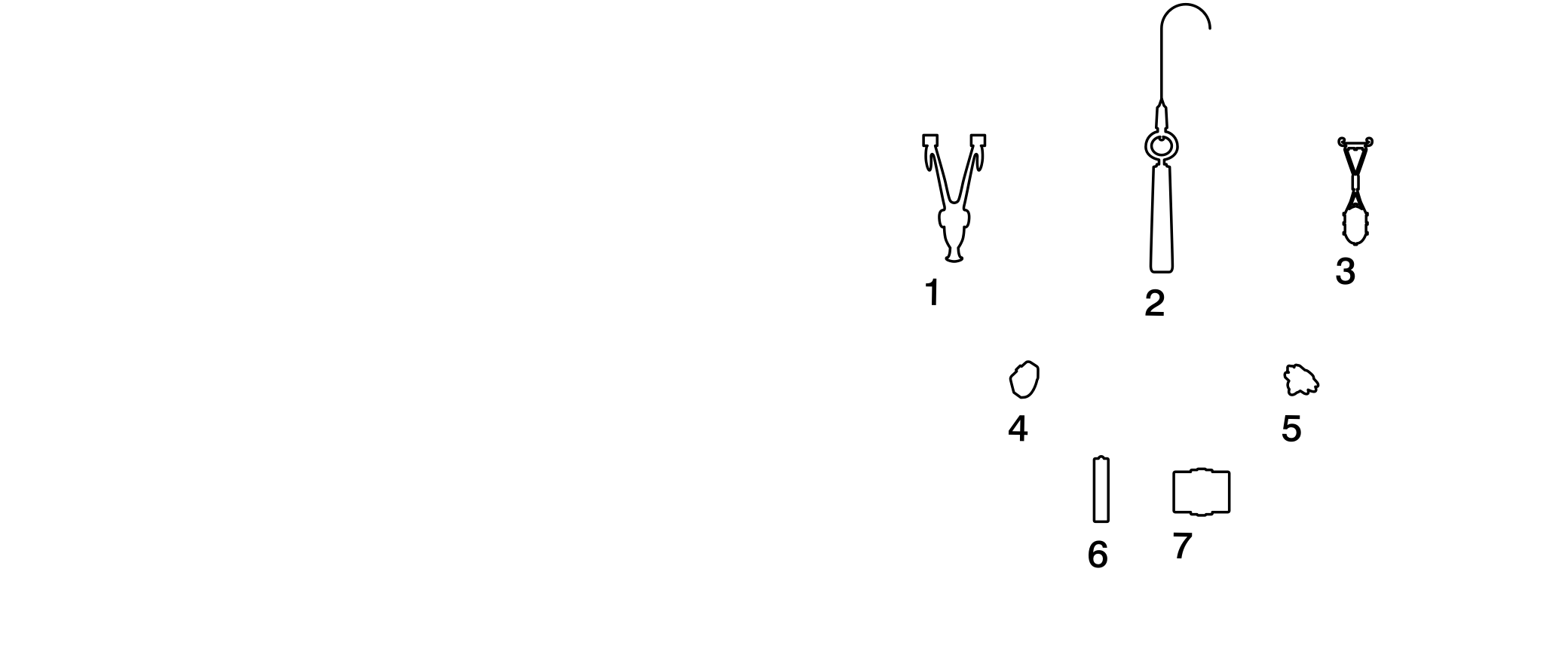
1Brooch-pendant
Cartier Paris, 1922, special order
diamonds, coral, onyx, platinum
Cartier Collection: CL 259 A22
2Pendant
Cartier Paris, 1922
diamonds, coral, onyx, emerald, natural pearls, silk, platinum
Sold to Grace Elvina Curzon (nee Hinds), Marchioness Curzon of Kedleston, second wife of Lord Curzon, Viceroy of India 1898–1905
Cartier Collection: NE 03 A22
3Watch-brooch
Cartier Paris, 1923
diamonds, coral, onyx, enamel, silk, platinum, gold
Cartier Collection: WB 16 A23
4Ring
Cartier Paris, 1974
diamonds, coral, onyx, platinum, white gold
Cartier Collection: RG 06 A74
5Ring
Cartier New York, 1933, special order
diamonds, coral, onyx, platinum
Sold to Marjorie Merriweather Post, American businesswoman, heir to the Post breakfast cereal firm and founder of Hillwood Museum and Gardens, Washington, D.C.
Cartier Collection: RG 01 A33
6Lipstick holder with watch
Cartier Paris, 1935
diamonds, coral, lacquer, platinum, silver
Cartier Collection: AL 122 A35
7Powder compact
Cartier Paris for Cartier London, S Department, 1930
diamonds, coral, lacquer, platinum, silver, silver-gilt
Cartier Collection: PB 09 A30
In 1925 Louis Cartier established the S Department to offer more affordable and utilitarian objects, such as writing instruments, handbags and vanity cases.The ‘S’ possibly stood for ‘silver’, ‘soir’ (evening) or ‘sac’ (bag). Run by Jeanne Toussaint, the Maison’s future Creative Director, the S Department produced creations that retained Cartier’s signature style and quality of craftsmanship but utilised lower-priced albeit still luxurious materials such as silver and lacquer. This strategy was well timed: the Wall Street crash followed in 1929. Shortly afterwards, Cartier New York started advertising goods such as stationery for as little as US$1 (about A$27 today).
Black, White and Green
Black, white and green was another striking colour combination that Cartier pioneered. Comprising emeralds, diamonds and onyx or enamel, the combination was introduced during the 1910s and became particularly fashionable during the 1920s. However, by the late 1920s the trend had returned once again to the pairing of emeralds and diamonds alone.
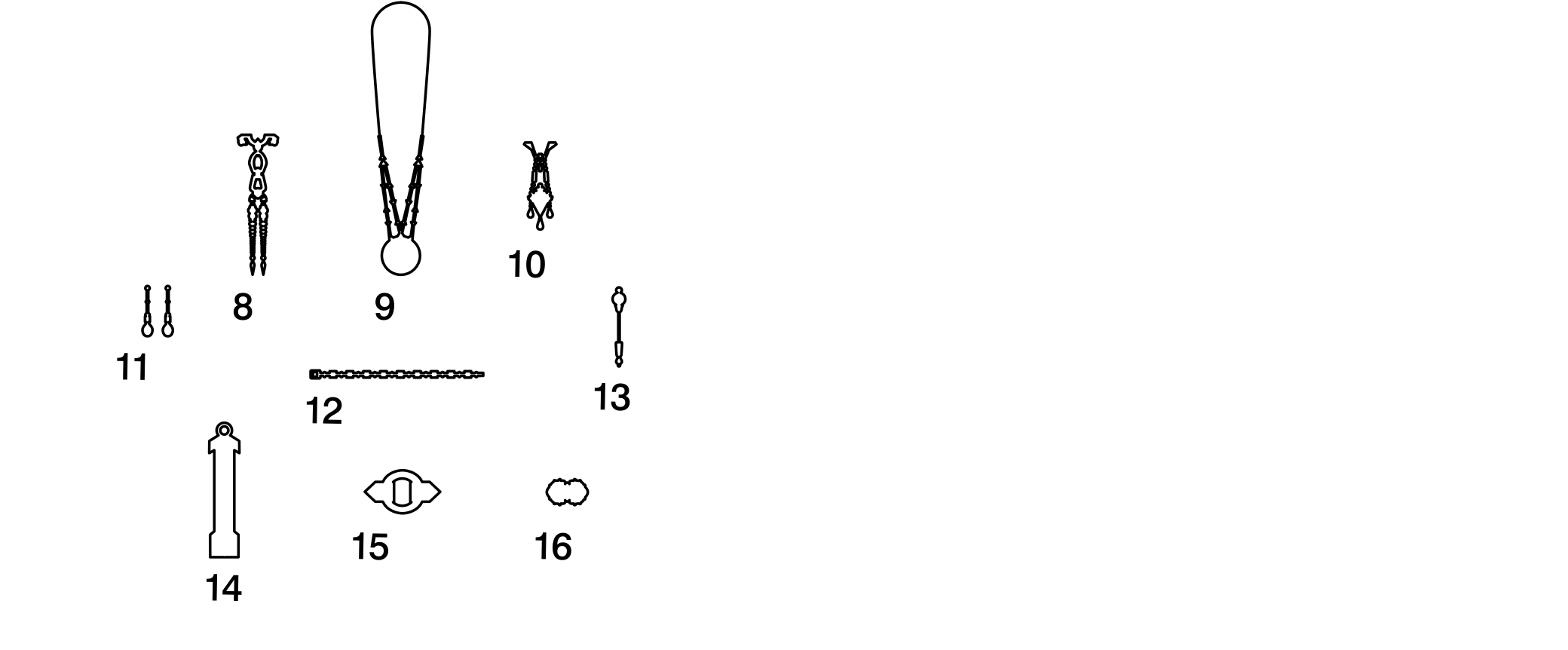
8Brooch
Cartier Paris, 1922
emeralds, diamonds, onyx, platinum
Cartier Collection: CL 138 A22
Cartier often employed black enamel or onyx to create a shadowed effect along one edge, as seen in this brooch.
9Pillbox necklace
Cartier, 2016
emeralds, diamonds, lacquer, white gold
Cartier Collection: NE 67 A2016
10Brooch
Cartier Paris, 1913
emeralds (including one of 11.9 carats), diamonds, natural pearls, onyx, platinum
Cartier Collection: CL 183 A13
11Pair of ear pendants
Cartier Paris, 1922
emeralds (including two of 26.6 carats total), diamonds, onyx, platinum
Previously owned by Mrs René Révillon (née Anne-Marie Cartier), daughter of Louis Cartier and his first wife, Andrée-Caroline Worth
Cartier Collection: EG 05 A22
12Bracelet
Cartier Paris, 1922
emeralds, diamonds, onyx, platinum
Cartier Collection: BT 55 A22
13Cliquet pin
Cartier Paris, 1924
emeralds, diamonds, onyx, platinum
Sold to Countess Mona von Bismarck
Cartier Collection: CL 95 A24
A cliquet pin is a double-ended pin with one end fixed and the other removable, which then clicks into place. Cartier began creating cliquet pins in the lead up to the First World War, their function having evolved from securing a man’s cravat to becoming an entirely ornamental jewel for women’s lapels or cloche hats.
14Telescopic mechanical pencil
Cartier Paris, 1929
emeralds, diamonds, enamel, platinum, gold
Sold to Ira Nelson Morris, American diplomat
Cartier Collection: WI 41 A29
15Belt brooch
Cartier Paris, 1923
emeralds, diamonds, rock crystal, onyx, platinum
Cartier Collection: CL 66 A23
16Brooch
Cartier Paris, 1926
emeralds, diamonds, onyx, platinum
Cartier Collection: CL 196 A26
Black and White
While onyx and diamonds were previously mostly associated with mourning jewels, in one of his ideas notebooks from 1910, Louis Cartier suggests using the combination in daywear jewellery. Striking black and white jewels for daywear were among Cartier’s important contributions to the 1925 International Exhibition of Modern Decorative and Industrial Arts. By 1930, however, this combination had become the epitome of evening glamour. In 1935 the social critic Chips Channon described a young woman who was ‘already out and is chic and sleek and onyx-y’.

1Brooch
Cartier Paris, 1924, special order
diamonds, cultured pearl (24.62 carats), rock crystal, onyx, platinum
Cartier Collection: CL 235 A24
2Brooch
Cartier New York, c. 1925
diamonds, enamel, platinum, gold
Cartier Collection: CL 50 C25
Cartier’s jewels of the Art Deco period were characterised by an elegant restraint. A perfect balance of design elements to create a minimalist aesthetic is known in French as rien de trop, or ‘no unnecessary extras’.
3Necklace
Cartier, 2022
diamonds, onyx, white gold
Private collection
4Bracelet
Cartier Paris, 1924
diamonds, onyx, platinum
Cartier Collection: BT 29 A24
5Necklace
Cartier Paris, 1919
diamonds, onyx, silk, platinum
Owned by William Fox, founder of the Fox Film Corporation
Cartier Collection: NE 66 A19
6Knot brooch
Cartier Paris, 1913
diamonds, onyx, platinum, yellow gold
Cartier Collection: CL 362 A13
7Brooch
Cartier New York, 1926
diamonds, rock crystal, enamel, platinum, white gold
Cartier Collection: CL 15 A26
From the early years of the twentieth century, Cartier was incorporating rock crystal into its jewels to create a more subtle and sleek black and white colour combination. The rock crystal was carved into smooth rings and rectangles, either polished or matt, and these elements could form the basis for bold brooches, hat ornaments and belt clasps.
8Egyptian-style pendant
Cartier Paris, 1913
diamonds, onyx, platinum, silk cord
Cartier Collection: NE 01 A13
This pendant takes the form of an ancient Egyptian pylon from a temple entrance, with cavetto cornicing (an architectural feature) across the top. The pylon shape is taken directly from ancient Egyptian pectorals, or chest pendants, but the vase motif with drooping flowers is a twentieth-century Cartier construct.
Black, White and Blue
Although not a combination of colours exclusive to Cartier, sapphire and rock crystal paired with black lacquer, onyx or enamel was another of Cartier’s highly fashionable colour combinations during the Art Deco period.

9Brooch
Cartier New York, 1920
sapphires, diamonds, onyx, platinum
Cartier Collection: CL 07 A20
10Bracelet
Cartier, 2014
diamonds, tanzanite (79.52 carats), rock crystal, onyx, white gold
Cartier Collection: BT 172 A2014
In this contemporary piece, an intense sapphire-blue hue with hints of violet is provided by a cabochon tanzanite gem. A variety of the mineral zoisite first discovered in the foothills of Tanzania’s Mt Kilimanjaro in 1967, tanzanite has since become a highly valued gemstone in contemporary jewellery.
11Brooch
Cartier Paris, 1924
sapphire (approx. 57.6 carats), diamonds, natural pearls, rock crystal, mother-of-pearl, enamel, platinum, gold
Cartier Collection: CL 02 A24
Blue and Green
A notable favourite of Cartier’s designers, the combination of blue and green was introduced from around 1910 onwards. Particular inspiration came from Persian art and architecture, as documented in Louis Cartier’s library and personal collection. Also significant were Léon Bakst’s sensational costumes and set designs for the Ballets Russes’s groundbreaking 1909 production Scheherazade, which had a deep impact on both Louis and the designer Charles Jacqueau. During the 1920s and 1930s Cartier experimented with combinations of different stones, including sapphires and emeralds, jade and sapphires, and lapis lazuli and turquoise.
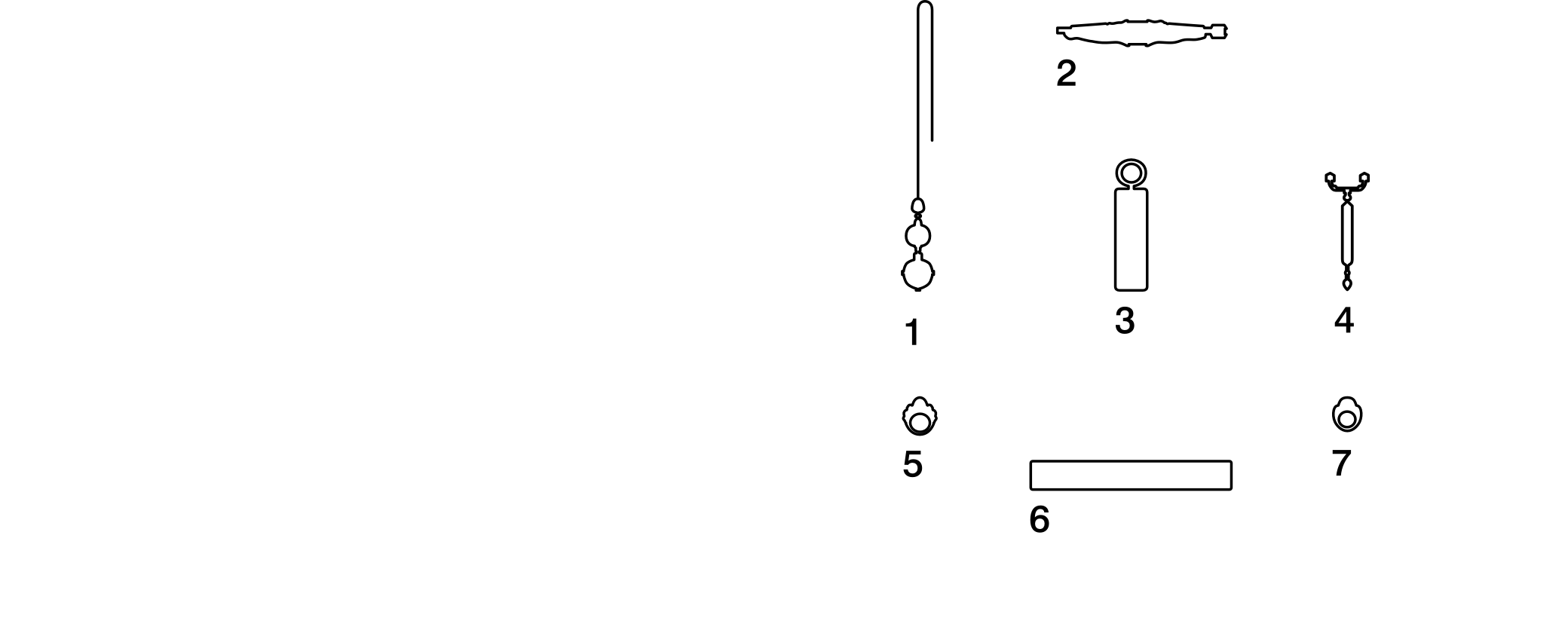
1Pendant
Cartier Paris, 1923, special order
emeralds (49.02 carats total), sapphires (including one of 121.02 carats), diamonds, platinum
Cartier Collection: NE 24 A23
2Bracelet
Cartier New York, 1927
sapphires (including one of 59.39 carats), emeralds, diamonds, platinum
Sold to Millicent Veronica Wilson, Mrs William Randolph Hearst, American philanthropist
Cartier Collection: BT 77 A27
3Vanity case
Cartier New York, c.1925 (Chinese jade disc, 18th or 19th century)
sapphires, diamonds, jade, rock crystal, enamel, platinum, gold
Cartier Collection: VC 20 C25
This vanity case is enamelled in royal blue and light blue, the two tones setting off the green of the Chinese jade disc in the centre. Carved with fruit and leaves, the disc has had a hole cut in the centre, enabling it to be further ornamented with diamonds around a cabochon sapphire.
4Brooch-pendant
Cartier Paris, 1913
sapphires, diamonds, natural pearl, jade, turquoise, platinum
Cartier Collection: CL 193 A13
5Ring
Cartier, 2017
sapphire (32.35 carats), emeralds, diamonds, white gold
Private collection
6Belt buckle
Cartier Paris, 1928
sapphires, jade, turquoise, enamel, gold, moire silk
Cartier Collection: JA 05 A28
This belt buckle comprises a carved green jade plaque with deep-blue enamelled mounts and slides on each side. The jade plaque is set with four sapphires, one in each corner, and two turquoise stones engraved with Arabic script in the centre.
7Dome ring
Cartier New York, 1968
jade, turquoise, gold
Cartier Collection: RG 38 A68
Red and Green
Red and green was another innovative colour combination that became particularly popular during the 1920s. With its carved emeralds, rubies and spinels, the historical jewellery of India was a major source of inspiration, while coral also became highly fashionable with Cartier’s designers, who often paired it with emeralds or jade. While coral had been used for millennia in body adornment, it became extremely popular during the nineteenth century and began to appear with increasing frequency during the early twentieth century in daytime jewellery. Another Cartier innovation, the combination of coral with green and black gems such as emeralds, malachite, jade and onyx resulted in renewed interest in coral jewellery throughout the 1920s.
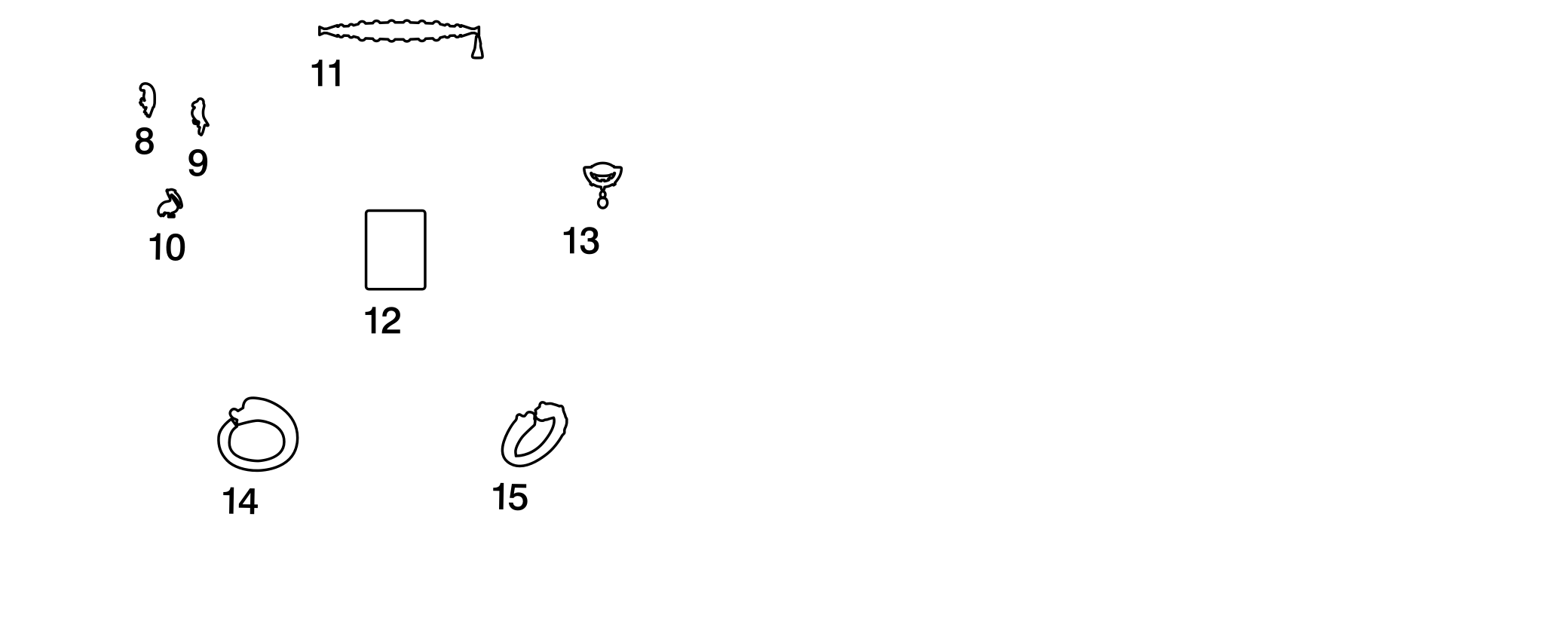
8Parrot brooch
Cartier Paris, 1928
sapphires, emeralds, diamonds, jade, coral, enamel, platinum
Cartier Collection: CL 101 A28
9Parrot brooch
Cartier Paris, 1929
sapphires, diamonds, jade, coral, enamel, platinum, gold
Cartier Collection: CL 142 A29
10Pelican brooch
Cartier Paris, 1929
sapphires, diamonds, jade, coral, platinum
Cartier Collection: CL 351 A29
11Bracelet
Cartier, 2019
diamonds, coral, malachite, agate,
white gold
Private collection
12Vanity case
Cartier Paris, 1929 (Chinese carved jade plaques, 19th century)
diamonds, jade, coral, mother-of-pearl, enamel, platinum, gold
Cartier Collection: VC 73 A29
Throughout the 1920s, Cartier mounted eighteenth- and nineteenth-century Chinese carved jade plaques into its vanity cases. Often combined with lapis lazuli or blue enamel to create the fashionable ‘peacock’ effect of blue and green, jade is used here with coral to create the striking combination of red and green.
13Brooch
Cartier New York, 1925, special order
emerald (15.12 carats), diamonds, coral, enamel, platinum
Cartier Collection: CL 262 A25
14Chimera bangle
Cartier Paris, 1972, special order
emeralds, diamonds, coral, gold
Commissioned by María Félix, Mexican actress and singer
Cartier Collection: BT 157 A72
15Twin chimera-head bangle
Cartier Paris, 1961
emeralds, diamonds, coral, platinum, white gold, yellow gold
Sold to Daisy Fellowes, French socialite
Cartier Collection: BT 52 A61
These two coral bracelets are ornamented with chimeras, mythical creatures with dragon-like heads with origins in both Asian cultures and classical antiquity. They are each made from a different species of coral, as indicated by their darker red and pale pink colours. Coral was a favourite stone of Jeanne Toussaint, Creative Director of Cartier Paris from 1933 until 1970, who had a particular interest in jewels made of carved coral and hardstones for daytime wear. In each example, the chimera heads swivel to open and close the bangle.
The 1925 International Exhibition of Modern Decorative and Industrial Arts, Paris
Cartier appeared at the forefront of contemporary design with its bold presentation at the 1925 International Exhibition of Modern Decorative and Industrial Arts in Paris. The Maison had two stands at the Paris Exhibition, one in the Grand Palais, where there were four hundred exhibiting jewellers, and one in the Pavillon de l’Élégance, devoted to the haute couture of France’s four leading fashion designers: Lanvin, Worth, Jenny and Callot Soeurs.
Of the 150 Cartier pieces on display, some of which were made expressly for the occasion, about thirty were broken up afterwards, including the famous Bérénice emerald shoulder ornament. The piece’s central emerald is on display here, now integrated into a contemporary Cartier tiara.
International Exhibition of Modern Decorative and Industrial Arts, 1925
Robert Bonfils (French 1886–1972)
poster: colour lithograph
National Gallery of Victoria, Melbourne: 2021.561
Purchased NGV Foundation, 2021
Top to bottom, left to right:
Design for a brooch
Cartier Paris, 1925
graphite, ink and gouache on translucent paper
executed in platinum, pearls, enamel, emeralds and diamonds
Cartier Paris Archives: ST25/05B
Design for a belt brooch
Cartier Paris, 1925
graphite, ink and gouache on translucent paper
executed in platinum, rock crystal and diamonds
Cartier Paris Archives: ST25/07A
Design for a belt brooch
Cartier Paris, 1924
graphite, ink and gouache on translucent paper
executed in platinum, rock crystal, onyx, rubies, pearls and diamonds
Cartier Paris Archives: ST24/08S
Design for a brooch
Cartier Paris, 1924
graphite, ink and gouache on translucent paper
executed in platinum, emeralds, onyx and diamonds
Cartier Paris Archives: ST24/18C
Design for a brooch
Cartier Paris, 1924
graphite, ink and gouache on translucent paper
executed in platinum, emeralds, pearls, onyx and diamonds
Cartier Paris Archives: ST24/18B
Designs for two upper-arm bracelets
Cartier Paris, 1923
graphite and gouache on translucent paper
Cartier Paris Archives: ST23/34C, ST23/34B
These bazubands, or upper-arm bracelets, were executed in carved emeralds, onyx, coral, diamonds and platinum.
Bérénice emerald tiara
Cartier, 2012
emerald (141.13 carats), diamonds, platinum
Collection of Ms. Pansy Ho
Emeralds carved in the Indian Mughal style were often engraved with floral motifs and shaped to follow the natural hexagonal outline of the emerald crystal. One of the most impressive was mounted by Cartier as part of a set for the 1925 Paris Exhibition that became known as the Bérénice emerald. The bandeau tiara, brooch and shoulder ornament, in which this emerald was originally centrally mounted, were displayed on a wax mannequin at Cartier’s stand in the Grand Palais. The display was featured in a special edition of the luxury fashion magazine Gazette du Bon Ton focusing on the Pavillon de l’Élégance. In 2012 the emerald was remounted by Cartier in this tiara.
La Gazette du Bon Ton, no. 10, special edition, 1925
hand-coloured etching
National Gallery of Victoria, Shaw Research Library
Campbell-Pretty Fashion Research Collection
Several pages in this special edition of the monthly fashion magazine La Gazette du Bon Ton were dedicated to Cartier’s jewels in the 1925 Paris Exhibition, with a particular focus on the Bérénice set.
Cross-Cultural Motifs
Certain motifs are the result of historical cross-cultural exchange. A Chinese hinge, for example, might recall South-East Asian and Middle Eastern metalwork. The ancient Iranian boteh (teardrop-shaped design) is also found in Indian Mughal art and was exported to Europe. Scrolling hooks resemble the Chinese ruyi pattern, but also Middle Eastern and Indian ornament. These motifs and others have been developed into more stylised elements that have become recognisable parts of the broader Cartier design lexicon.
1Brooch
Cartier New York, 1928, special order
diamonds, platinum
Owned by Sir Elton John
Cartier Collection: CL 178 A28
Just as all jewellery reflects the personality of its owner, this Art Deco brooch embodies the flamboyant and discerning taste of Sir Elton John. Designed as a shoulder brooch of graduated Islamic-inspired S-shaped scroll motifs, this piece typifies the 1920s–30s fashion for jewels that could be worn in unconventional ways.
2Cliquet pin
Cartier New York, 1928
diamonds, platinum
Cartier Collection: CL 243 A28
3Sautoir
Cartier Paris, 1928 (pendant), 1929 (chain)
diamonds, platinum
Cartier Collection: NE 14 A29
This sautoir necklace could be broken down and worn as four bracelets or be paired as a collar-style necklace and two bracelets. This is the way it was worn in the 1930s, once the fashion for long sautoir necklaces had passed.
4Cliquet pin
Cartier New York, 1928
diamonds, platinum
Cartier Collection: CL 211 A28
5Head ornament
Cartier New York, c. 1924 (briolette diamonds, headband and feathers later additions)
diamonds (9.23 carats total), feathers, platinum, white gold, rose gold
Cartier Collection: HO 34 C24
6Brooch
Cartier London, 1941, special order
diamonds, platinum
Victoria and Albert Museum, London: M.36-1994
Bequeathed by Mr and Mrs Ernest Schwaiger
7Bracelet
Cartier Paris, 1935, special order
diamonds, lacquer, platinum, white gold
Owned by Princess Paule Murat, great-grandniece of Napoleon Bonaparte
Cartier Collection: BT 155 A35
The two clip brooches are detachable.
8Pyramid clip brooch
Cartier Paris, 1935, special order
diamonds (including one approx. 4.2 carats), platinum
Cartier Collection: CL 63 A35
Balance between space and volume is an essential aesthetic in Cartier jewels. The use of empty space around jewelled elements was already important in the more two-dimensional designs of the early twentieth century. From the 1930s onwards, more sculptural forms took centre stage, like the Pyramid clip brooch here, allowing for added contrast with depth and relief.
Brooch, originally set as a head ornament
Cartier Paris, 1925, modified in 1927
diamonds, onyx, enamel, platinum, gold
Cartier Collection: CL 367 A25
Bracelet
Cartier Paris, 1922
emeralds, diamonds, coral, onyx, platinum
Cartier Collection: BT 56 A22
Bracelet
Cartier Paris, 1925
diamonds, coral, onyx, platinum
Cartier Collection: BT 05 A25
This onyx and diamond orchid brooch was on display at the 1925 Paris Exhibition as one of four orchid flowers mounted as a pair of hair ornaments. The coral, onyx and diamond bracelet was also displayed at the exhibition, along with an identical example of the bracelet with coral and emeralds. They exemplify Cartier’s innovative colour combinations and striking geometric designs.
An Obsession with Stones
The Cartier brothers set out to source the world’s finest gems, and established the firm’s reputation for cutting and mounting new or historically significant gemstones in the Cartier style. Jacques, the gem expert, travelled to the Middle East, India and Sri Lanka in search of stones and local connections. Important gems were also supplied directly via a strong trade network and wealthy clientele, and Pierre in particular was known for acquiring historically significant gems such as the Hope diamond.
Historically, in some parts of the world, the extraction and trade of raw materials – notably, diamonds, rubies and jade – has been a fraught industry, with colonialist practices and complex issues around transparency in traceability. In other countries, such as Sri Lanka, where sapphire mining has long followed sustainable practices and supported local communities, it has also had a positive impact. Today the global landscape continues to evolve. In 2005 Maison Cartier became a founding member of the Responsible Jewellery Council, established to develop ethical and sustainable standards. It collaborates with industry and business partners to promote best practices, traceability and transparency across the full supply chain.
Portrait of HRH The Princess Margaret, 1955
Photo: Cecil Beaton / Victoria and Albert Museum, London
Fashion photographer Cecil Beaton created memorable portraits of the British royal family for nearly forty years. His glamorous 1950s photographs of Queen Elizabeth II and Princess Margaret defined modern British royalty during these mid-century years. Princess Margaret wears her rose brooch by Cartier Paris in this photographic portrait taken to mark her twenty-fifth birthday.
Rose clip brooch
Cartier London, 1938
diamonds, platinum
Owned by HRH The Princess Margaret, Countess of Snowdon
Cartier Collection: CL 296 A38
This brooch was given to Princess Margaret by the British company Vickers-Armstrongs during her visit to its naval yard in Newcastle upon Tyne in 1952. The Princess had a lifelong interest in botany and her middle name was Rose. She wore the jewel on many public occasions, the most significant being the coronation of her sister, Queen Elizabeth II, in 1953.
Jeanne Toussaint
Jeanne Toussaint’s contribution to the development of Cartier’s stylistic identity is immeasurable. Through her own innate creativity, she continued to build on the foundations of the Cartier style and developed a unique design aesthetic that was informed by diverse cultural influences and her deep desire to create jewels with sculptural volume, flair and flexibility for the modern woman. So recognisable were her designs that they were referred to as being in the goût Toussaint – the ‘Toussaint taste’.
Toussaint began designing leather goods for Cartier in the early 1920s. By 1925 she was running the S Department, which Louis Cartier established to produce utilitarian objects such as writing instruments, handbags and vanity cases, using lower-priced, albeit precious, materials. In 1933, recognising her creative talent, Louis appointed Toussaint Creative Director, a position that she held until her retirement in 1970.
In 1917 Louis gifted Toussaint a diamond and onyx vanity case that was decorated with a panther; it was the first Cartier jewel to figuratively represent the big cat. Toussaint was captivated by the animal – she was allegedly nicknamed La Panthère – and went on to drive the inspiration behind many of the iconic big cat designs that have now become so deeply associated with Cartier.
Portrait of Jeanne Toussaint, 1962
Photo: Cecil Beaton / Condé Nast
The Toussaint Taste

1Panther vanity case
Cartier Paris, 1927
emeralds, rubies, diamonds, onyx, enamel, platinum, gold
Cartier Collection: VC 43 A27
2Cigarette case
Cartier Paris, 1949 (made from a 1929 vanity case)
diamonds, coral, mother-of-pearl, enamel, platinum, gold
Sold to Pierre Cartier, who gifted it to Jeanne Toussaint
Cartier Collection: PB 23 A49
3Cigarette case
Cartier Paris, 1925, special order
enamel, gold
Cartier Collection: CC 20 A25
This cigarette case was commissioned by Jeanne Toussaint in 1925.
4Forget-me-not lipstick holder
Cartier Paris, S Department, 1938
black lacquer, enamel, onyx, gold, silver
Sold to a member of Monaco’s princely family
Cartier Collection: AL 68 A38
5Powder compact
Cartier Paris for Cartier London, S Department, c. 1930
diamonds, coral, lacquer, silver, silver-gilt
Cartier Collection: PB 32 C30
6Bracelet
Cartier Paris, 1936
lapis lazuli, gold
Cartier Collection: BT 162 A36
7Gas pipe bracelet
Cartier Paris, 1945
sapphire (23.37 carats), rubies, diamonds, platinum, gold
Cartier Collection: BT 11 A45
8Bracelet
Cartier Paris, 1945
yellow gold, rose gold
Cartier Collection: BT 63 A45
9Inkwell
Cartier Paris, S Department, 1927
jade, carnelian, onyx, enamel, gold, silver
Cartier Collection: DI 31 A27
10Paper knife with watch
Cartier Paris, S Department, 1930, special order
agate, lapis lazuli, gold, silver
Cartier Collection: DI 04 A30
11Evening clutch bag
Cartier Paris, 1924
diamonds, natural pearls, onyx, enamel, platinum, silver, satin
Sold to Louis Cartier
Cartier Collection: EB 28 A24
The Toussaint Taste

12Brooch with Cross of Lorraine medal
Cartier Paris, c. 1944
yellow gold, rose gold
Owned by Jeanne Toussaint
Cartier Collection: CHA 40 C44
Following Germany’s occupation of France in June 1940, General Charles de Gaulle led the French government-in-exile in London until 1944. De Gaulle chose the Cross of Lorraine as the symbol of this resistance movement. The double-barred cross appeared on the uniforms of the Free French troops under De Gaulle’s command, and on badges worn by civilians in allied countries in support of the cause. During the occupation, Etienne Bellenger, then head of the London branch, provided General de Gaulle with an office in London from which to work.
13Caged bird clip brooch
Cartier Paris, 1942
sapphire, emerald, diamonds, platinum, gold
Cartier Collection: CL 371 A42
14Freed bird brooch
Cartier Paris, 1944
sapphire, diamonds, lapis lazuli, galalith, platinum, gold
Cartier Collection: CL 77 A44
Under Jeanne Toussaint’s direction, Cartier created the Oiseau Libéré (freed bird) brooch to commemorate the liberation of France in 1944. It followed several designs of caged songbirds created in silent protest during the German occupation. They were most likely by the designer Peter Lemarchand, who joined Cartier in 1927 and worked closely with Toussaint, contributing to many iconic Cartier designs.
15Panther clip brooch
Cartier Paris, c. 1969
emeralds, lapis lazuli, lacquer, enamel, gold
Cartier Collection: CL 347 C69
16Panther cliquet pin
Cartier Paris, 1957
sapphires, diamonds, garnets, platinum, white gold
Owned by Nina Dyer, wife of Sadruddin Aga Khan
Cartier Collection: JS 02 A57–58
17Panther bangle
Cartier Paris, 1958
sapphires, emeralds, diamonds, onyx, platinum, white gold
Owned by Nina Dyer, wife of Sadruddin Aga Khan
Cartier Collection: JS 02 A57–58
The Toussaint Taste
1Indian-style clip brooch
Cartier Paris, 1938
sapphires, rubies, emeralds, diamonds, round and baroque natural pearls, turquoise, enamel, gold
Cartier Collection: CL 58 A38
Jeanne Toussaint shared Louis Cartier’s interest in Indian ornamentation, and her taste encouraged a renewed enthusiasm for gold (the traditional metal in Indian jewellery) in jewels of the early 1930s, challenging the dominance of platinum. The form of this brooch is similar to the Indian turah, a turban ornament made from gold and precious stones bunched together and suspended on fine threads.
2Necklace
Cartier Paris, 1940
rubies, emeralds, diamonds, round and baroque natural pearls, turquoise, enamel, platinum, gold
Cartier Collection: NE 70 A40
The chain, crescent, olive motifs and gold beads come from Cartier’s stock of apprêts, which included fragments from disassembled jewelry and other objects, such as ancient items from Iran, India, China, and Egypt.
3Clutch bag
Cartier Paris, c. 1928
emeralds, diamonds, coral, brocade, platinum
Cartier Collection: EB 43 C28
4Coffee bean necklace
Cartier Paris, 1956, special order
diamonds, platinum, gold
Cartier Collection: NE 72 A56
The Grain de Café (coffee bean) became a classic Cartier design during the mid-century period, when its fame was amplified by Princess Grace of Monaco, who received a Grain de Café parure (necklace, earrings and bracelet) as a gift upon her marriage to Rainier III, Prince of Monaco, in 1956. It first appeared, however, in 1938 under the direction of Jeanne Toussaint.
5Bracelet
Cartier Paris, 1938
rubies, diamonds, platinum, gold
Cartier Collection: BT 164 A38
6Laurel leaves clip brooch
Cartier Paris, 1943
sapphires, diamonds, platinum, gold
Cartier Collection: CL 180 A43
The Toussaint Taste
7Lizard clip brooch
Cartier Paris, 1958, special order
rubies, brown diamonds, white diamonds, gold
Owned by Jacqueline Delubac, French actor and art collector
Cartier Collection: CL 368 A58
Reptiles were perhaps the creatures that Cartier designers were most compelled to create in metal and gemstones. An early photograph taken of a Cartier Paris boutique window, displaying jewellery commissioned to celebrate the 1902 wedding of Princess Marie Bonaparte and Prince George of Greece, includes a lizard brooch – so this 1958 brooch is part of a long tradition. This lizard reflects the ‘Toussaint taste’ for jewels representing flora and fauna and has a head that swivels and an articulated tail.
8Flower clip brooch
Cartier Paris, 1941, special order
diamonds, platinum, white gold
Cartier Collection: CL 236 A41
9Bird clip brooch
Cartier Paris, 1944–47
ruby (43.2 carats), emerald, diamonds, platinum, gold
Cartier Collection: CL 126 A47
10Dragonfly clip brooch
Cartier Paris, 1953
emerald, rubies, diamonds, platinum, gold
Cartier Collection: CL 54 A53
The openwork wings are each attached to the dragonfly’s body by a spring that allows them to flutter at the tiniest movement.
11Boule ring
Cartier Paris, 1948
rubies, gold
Sold to Daisy Fellowes, French socialite and heiress
Cartier Collection: RG 39 A48
12Bracelet
Cartier Paris, 1956
rubies, gold
Sold to a member of the Rothschild family
Cartier Collection: BT 102 A56
The Duchess of Windsor
The Duke and Duchess of Windsor built one of the greatest jewellery collections of the twentieth century. When they met in 1931, the Duke was heir to the British throne. He became King and abdicated in 1936 to marry Wallis Simpson, a twice-divorced American. Wallis, now a Duchess, became a fashion icon. The couple worked closely with Cartier, especially Jeanne Toussaint, often supplying stones from older pieces for new designs and forming a famous collection of ‘big cat’ jewels.
Left to right, top to bottom:
Necklace and pendant
Cartier Paris, necklace clasp, 1956; pendant, 1950, modified in 1960, special order
slightly baroque natural pearl (190.6 grains), natural pearls, diamonds, platinum, white gold
Private collection
In 1950 Cartier mounted a large natural pearl for the Duchess of Windsor. She wore it on a strand of twenty-eight natural pearls reportedly given to the Duke by his mother, Queen Mary, restrung with a new clasp by Cartier in 1956. When sold for charity in 1987, it was purchased by fashion designer Calvin Klein. Six more pearls were later added.
Panther clip brooch
Cartier Paris, 1949
sapphire (152.35 carats), sapphires, yellow diamonds, white diamonds, platinum, white gold
Cartier Collection: CL 53 A49
Flamingo brooch
Cartier Paris, 1940, special order
rubies, sapphires, emeralds, diamonds, citrine, platinum, gold
Cartier Collection: CL 312 A40
As Cartier Paris’s Creative Director, Jeanne Toussaint worked closely with designers who would help realise her aesthetic vision. Cartier designer Peter Lemarchand, who shared Toussaint’s love of animals and birds, contributed the design for this iconic brooch. The brooch is pavé-set with brilliant-cut diamonds, while the plumage features calibré-cut emeralds, rubies and sapphires. Many of the stones came from older jewels supplied by the Duchess.
Tiger lorgnette
Cartier Paris, 1954, special order
emeralds, enamel, gold
Cartier Collection: OI 08 A54
Pug’s head clip brooch
Cartier Paris, 1955
citrines, enamel, gold
Cartier Collection: CL 251 A55
Bangle
Cartier Paris, 1938
rubies, diamonds, platinum
Private collection
For their first wedding anniversary in 1938, the Duke of Windsor presented the Duchess with this ruby and diamond bangle, which was inscribed to mark the occasion: ‘For our first anniversary of June third’. The two Burmese rubies were originally part of a 1937 necklace, which Cartier remounted as terminals of this penannular (incomplete circle) bangle.
Tiger bracelet
Cartier Paris, 1956, special order
emeralds, diamonds ranging from fancy intense yellow to white, onyx, gold
Private collection
Tiger clip brooch
Cartier Paris, 1968, special order
emeralds, diamonds, onyx, gold
Private collection
Bib necklace
Cartier Paris, 1947, special order
amethysts, turquoise, diamonds, platinum, gold
Commissioned by the Duke of Windsor, who supplied the amethysts and diamonds, for the Duchess of Windsor
Cartier Collection: NE 09 A47
Portrait of Wallis Simpson, Duchess of Windsor, 1939
Photo: Cecil Beaton / Condé Nast
Born in the US city of Baltimore, Wallis Warfield first married Earl Winfield Spencer, followed by a wealthy American businessman, Ernest Simpson. Then, in 1931, she met Edward, Prince of Wales. They met again on several occasions, then more and more often up until 1934, at which point their relationship could no longer be ignored. Following Edward’s accession to the throne in 1936 and Wallis’s second divorce, Edward VIII was forced to abdicate in December so that they could marry. In March 1937, the new king, George VI, named his brother Duke of Windsor. Wallis and Edward married in France in June and moved to Paris, where they lived for the rest of their lives.
Studio portrait of Barbara Hutton, photographed by the Pach Brothers, New York, 1933
photographic print on card
Cartier Paris Archives: MF02-CL-12-1
Granddaughter of multi-millionaire retailer F. W. Woolworth, Barbara Hutton was famous for her vast inherited fortune, extravagant jewellery collection and seven marriages – including one to actor Cary Grant. She was reportedly introduced to jadeite – the finest of which was known as ‘imperial jade’ – at the San Francisco store Gump’s, which stocked decorative objects sourced in Asia. This alluring gemstone inspired Barbara to write the poem ‘Bowl of Jade’, published in 1939:
I bring you a bowl of jade
For your slender hands to hold,
Green as the mountain waters,
And infinitely old.
I pray you to place it gently
On a table of gold brocade,
Like an emerald glowing
In either sun or shade.
Then, should you strike it softly,
The music that you will hear
Will be clear as the bells of heaven
Ringing in your ear.
The texture is smooth as petals
And cool beneath your touch;
It will soothe away all sorrow
Should you caress it much.
I bring you my poor dreams
Caught in a green jade bowl,
Carved untold years ago
Out of a Chinese soul.
Jade
‘Jade’ is the umbrella term for two different stones, jadeite and nephrite. Although made from different minerals, these two stones have similar physical properties, including their suitability for carving. Jade of both varieties was used widely in Cartier’s creations throughout the twentieth century, particularly in Chinese-inspired vanity cases, smoking and writing instruments, and mystery clocks. Burma (later Myanmar) was the main source of jadeite in the time of the Cartier brothers.
Necklace
Cartier Paris, 1934, special order
jadeite, rubies, diamonds, platinum, gold
Owned by Barbara Hutton, American heiress and socialite
Cartier Collection: NE 53 A34
The exceptional colour and translucency of these matching twenty-seven jadeite beads make this necklace one of the finest jade jewels ever made. In 1933 Alexis Mdivani, the first husband of American heiress Barbara Hutton, brought these beads to Cartier New York to add a diamond clasp, which Hutton swapped the following year for the current ruby and diamond mounting by Cartier Paris.
Top to bottom, left to right:
Design for a clasp
Cartier Paris, 1934
graphite and gouache on translucent paper
Design for a ring
Cartier Paris, 1933
graphite and gouache on translucent paper
Design for an earring
Cartier Paris, 1934
graphite and gouache on card
Design for a ring
Cartier Paris, 1934
graphite and gouache on card
Design for a bracelet
Cartier Paris, 1933
graphite and gouache on translucent paper
Cartier Paris Archives: AT33-224, AT32-318, AT33-199, AT33-200, AT32-317
Barbara Hutton commissioned several jewels from Cartier Paris showcasing translucent green jade. All the jewels combined jade with rubies and diamonds, on mounts made from both platinum and gold. The combination of green and red was a trademark of Cartier’s style and a nod to a Chinese-inspired colour palette.
Striking Colours
The striking use of coloured gemstones has become a Cartier signature. Following the predominance of more traditional gems in earlier decades, in the 1930s Cartier turned to a broader range of gemstones such as blue aquamarines, purple amethysts, yellow citrines and even green peridots, which could be found in greater quantity and larger sizes. As fashions and the economic environment shifted, bolder jewels with more volume and impact were in greater demand.
Left to right, top to bottom:
Necklace and bracelet
Cartier London, 1936, special order
peridots (approx. 325 carats total), diamonds, platinum
Commissioned by Edith Beatty, later Lady Beatty
Cartier Collection: JS 06 A36
Edith Stone (nee Dunn) was the second wife of the Irish American mining engineer and collector Sir Alfred Chester Beatty. Although the Cartier London Archives record that the peridots were provided by the client, it does not note their geological origin. The Chester Beatty family regularly spent the winter months in Egypt between 1914 and 1939, and it is possible that some of the peridots in this set were acquired in Egypt, a significant source of peridots since ancient times.
Tiara
Cartier London, 1937
aquamarines, diamonds, platinum
Cartier Collection: HO 12 A37
Cartier London made an unprecedented number of tiaras in 1937. This aquamarine example was made and sold in April that year, just before the coronation of King George VI in May. The central motif can be removed and worn as a brooch. A second row of oval aquamarines was added to the first band five months after it was made.
Necklace
Cartier Paris, 1937
dark citrines, light citrines, gold
Cartier Collection: NE 63 A37
Citrine became a very fashionable stone in the 1930s, mounted in yellow gold that matched its warm natural tones. It became especially popular following the outbreak of the Second World War in 1939, when platinum was declared a strategic material considered vital for the war effort. The five elements on this necklace can be detached to be worn as brooches.
Orchid brooch
Cartier Paris, 1937, special order
amethysts, aquamarines, enamel, white gold
Cartier Collection: CL 132 A37
Brooch
Cartier London, c. 1933
sapphires, diamonds, amethyst, platinum
Owned by the family of Jacques Cartier
Cartier Collection: CL 239 C33
This brooch is said to symbolise the family of Jacques Cartier through its stones. The amethyst at the centre represents his wife, Nelly, amethyst being her birthstone, and the diamond corners stand for their four children. Enveloping the whole, the sapphire edges personify Jacques himself.
Handcuff bracelet
Cartier Paris, 1939
citrines, amethysts, gold
Cartier Collection: BT 105 A39
Three archive photographs of pearls delivered in lots to the Maison Cartier, Paris, 1921
exhibition prints, 2026
Cartier Paris Archives: 368-DOC075, 365-DOC008, 366-DOC075
These photographs show how natural pearls were delivered to Cartier Paris during the first few decades of the twentieth century, when demand for natural pearls was at its height. Although some pearls were sourced from Australia and South America, at the turn of the century the main source of the finest natural white pearls was Bahrain in the Persian Gulf. Supply went via Mumbai (then Bombay), before being traded across the globe.
The polishers and pearl stringers working at Cartier London, 1930
exhibition print, 2026
Original in Cartier London Archives: London-Photo-01
Cartier’s Paris, London and New York branches each maintained a distinct salon devoted to pearl jewellery within the main section of the boutique. Customers could bring their necklaces to the pearl salon to be polished or restrung with additional pearls.
‘A Trip Through Cartier’s. The Lustrous Gems in Occidental surroundings’, The Spur, New York, 1 November 1928
Cartier Paris Archives: PF16-COM-P08-A
Catalogue extract describing the various departments and services to be found in the Cartier New York boutique, 1922
photomechanical print on paper
Cartier Paris Archives: PF15-COM-P20-E/ P20-F/ P21-A/ P21-B
Cartier New York catalogue, 1922
Cartier New York Archives: CNYA-CATNY1921.1
Following his trip to India in 1911, and in anticipation of cultivating new clients among the maharajas he met there, Jacques Cartier advocated for the establishment of a Cartier branch in India. Although this never eventuated, the Maison did maintain a permanent representative in Mumbai, who reported directly to London, Paris and New York on the state of the pearl trade and would arrange for pearls to be sent to Europe.
Cartier New York catalogue, 1922
Cartier Paris Archives: PF15-COM-P24-B
Jacques Cartier during his trip to the Persian Gulf, 1912
gelatin print
Cartier Paris Archives: PF21-VOY-P26-B
Part of Cartier’s success came from the Maison’s careful accumulation of sufficient stocks of natural pearls to ensure strands could be made with pearls of matching (or graduated) size, shape, colour and lustre.
Jacques Cartier meeting with Bahraini pearl merchants during his trip to the Persian Gulf, March 1912
gelatin silver print
Cartier Paris Archives: Inv. PF21-VOY-P28-B
In 1912, following his travels in India, Jacques Cartier visited the Kingdom of Bahrain in the Persian Gulf, a region renowned for its natural pearls. His mission, he wrote to his brothers Louis and Pierre, was ‘to investigate the pearl market and determine the best way to source them’. This expedition strengthened Cartier’s enduring connection to some of the rarest gems in the world.
Façade of the Cartier boutique at 653 Fifth Avenue, New York, 1922
exhibition print, 2026
Original etching in Cartier Paris Archives: PF15-COM-P20-C
The impressive Renaissance-style mansion at 653 Fifth Avenue was built as a townhouse in 1905 for Morton F. Plant, a businessman whose inherited wealth came from steamships and railroads, and which he continued to build through shrewd investments. In 1914 he married his second wife, Mae (‘Maisie’) Caldwell Manwaring. In 1917 Morton Plant and Pierre Cartier negotiated an unconventional deal: Cartier would buy the Plant mansion in exchange for a two-strand pearl necklace that Mrs Maisie Plant had her heart set on. In 1917 this necklace of 128 of the finest matched and graduated natural pearls was valued at one million dollars.
Pearls
In the twentieth century, Cartier acquired, mounted or sold some of the most important or renowned pearls in history. Long associated with natural perfection, power and purity, pearls have been prized since antiquity. The demand for these gems reached new heights in the early twentieth century, when the global trade in natural pearls expanded and supply to Parisian jewellers increased. The advent of marine-cultured pearls – invented by Kokichi Mikimoto in Japan in the late nineteenth century and becoming widely available from the mid 1920s – dramatically changed the international market in pearls.
Left to right, top to bottom:
Necklace
Cartier Paris, 1911, special order
natural pearls, diamonds, platinum
Cartier Collection: NE 05 A11
Necklace
Cartier, c. 1930
natural black pearls, diamonds, platinum, white gold
Fondation Pierre Cartier: FPC 22
Sautoir
Cartier Paris, 1907
natural pearls, diamonds, platinum
Cartier Collection: NE 33 A07
Baroda bracelet
Cartier London, 1953, special order
natural black pearls, diamonds, platinum
Commissioned by Sita Devi, Maharani of Baroda
Collection of Ms. Pansy Ho
Sita Devi was married to one of India’s richest princes, Maharaja Pratap Singh Gaekwad of Baroda (a kingdom in present-day Gujarat). The Baroda Royal Treasury was famous for its historical collection of jewels, including astonishing numbers of pearls. Following Indian independence in 1947, the couple settled in Monaco, where the glamorous Sita Devi was dubbed ‘the Indian Wallis Simpson’ by western media. In 1953 she commissioned this bracelet, which incorporated her collection of rare natural black pearls, probably from French Polynesia.
Pair of ear pendants
Cartier New York, c. 1930
natural pearls, diamonds, platinum
Fondation Pierre Cartier: FPC 21
Bracelet
Cartier Paris, 1927, special order
conch pearls, diamonds, onyx, platinum
Commissioned by Queen Victoria Eugenia of Spain
Private collection
Considered one of the ocean’s rarest gems, the pink conch pearl is found primarily in the Caribbean Sea and the waters around Bermuda. This 1927 bracelet represents a unique selection of materials in a design similar to that of Cartier’s Tutti Frutti bracelets being made at the same time. Queen Victoria Eugenia of Spain, granddaughter of Queen Victoria, supplied the conch pearls herself.
Design for a bracelet
Cartier Paris, 2013
graphite, watercolour, gouache and ink on translucent paper
Cartier Paris Archives: JOA-052035
This design is for the 2015 opal bracelet displayed in the case to the right.
Design for a bracelet
Cartier New York, 1928, special order
graphite, ink and gouache on paper
Cartier New York Archives: CNYA-CF.CWA1928.31
Opals
The Cartier Archives document the Maison’s sales of jewels containing opals from the early 1900s, including Australian soprano Dame Nellie Melba’s acquisition of an ‘opal heart pendant’ in 1903. The opal’s presence in Cartier creations has increased in recent decades, with new finds being discovered and age-old superstitions around the stone replaced with appreciation for its myriad colours.
Rich deposits of what was once called ‘Hungarian opal’ were mined in present-day Slovakia from at least the sixteenth century, when this territory was part of the Kingdom of Hungary. This was the main source of opals until the 1880s, when Australian opals – first discovered around 1850 in South Australia – started being extracted in sufficient quantity to supply the majority (around 90%) of the world’s opals. In recent years, Ethiopia has emerged as a significant alternative source of opals for jewellery production, which has further increased the gem’s global popularity.
Clockwise from left:
Bracelet
Cartier, 2015
opal (189.345 carats), blue sapphires, purple sapphires, emeralds, diamonds, white gold
Cartier Collection: BT 168 A2015
This 189.345-carat black opal is certified as sourced in Australia. The original design drawing, dated 2013, is displayed on the adjacent wall.
Brooch
Cartier London, 1956
opal (approx. 50.55 carats), sapphires, ruby, diamonds, amethysts, platinum, gold
Collection of Ms. Pansy Ho
Bracelet
Cartier, 2018
opals, diamonds, tourmalines, onyx, platinum, white gold
Cartier Collection: BT 170 A2018
In recent decades, Cartier’s designers have embraced the opal’s remarkable ability to display an alluring and vast array of colours in their high jewellery collections, including 2018’s Coloratura de Cartier, of which this bracelet was part, and 2015’s Etourdissant Cartier, which included the bracelet displayed to the left.
Bracelet
Cartier New York, 1928, special order
black opals, diamonds, platinum
Private collection
While the origin of the opals in this 1928 bracelet is not documented in Cartier’s New York Archives (which holds the original design drawing, displayed on the adjacent wall), Lightning Ridge in New South Wales is widely recognised as the world’s leading source of stunning, rare black opals – and was the only source of such stones in the 1920s. Named for their dark body, against which a play of colour is dramatically highlighted, black opals are prized for their beauty and rarity.
Jeanne Toussaint posing for a fashion article, Paris, 1920s
Cartier Paris Archives: PRSO-JT-1
Diamonds
Many of the world’s earliest diamonds came from the ancient Indian mines of Golconda. Some of the most famous, such as the Hope diamond, passed through the hands of Cartier, sealing the Maison’s reputation as a jeweller of renown. Diamonds were also discovered in Brazil around 1720. Following this, Brazil became the world’s largest diamond producer – and the origin of many famous gems – until the late nineteenth century. The discovery of abundant diamond deposits in South Africa in 1867 marked a turning point for the gem industry, making the country the leading diamond producer of the twentieth century.
Necklace
Cartier London, 1934, special order
diamonds (148 carats total), platinum
Owned by a member of the Sassoon family
Cartier Collection: NE 79 A34
This spectacular necklace exemplifies Cartier’s diamond jewellery of the 1930s. The use of graduating pendent diamonds and different stone cuts lends it a balance that was a particular feature of Cartier’s jewels of the late Art Deco period.
The Sassoon family began as successful merchants in Baghdad, where they also served as treasurers for the Ottoman pashas. They later established themselves as important traders in Mumbai. Branching out to Kolkata, Karachi and east to China and Malaysia, the family prospered. A branch was later set up in London, where, by the mid-nineteenth century, they occupied a prominent position in political and social life.
Sapphires
Known in Sanskrit as Ratna Dweepa (‘the Island of Gems’), Sri Lanka was historically a source of sapphires. Jacques Cartier visited Sri Lanka, then named Ceylon, in 1926. Sri Lankan mines have consistently yielded larger gem-quality sapphires than any other place in the world. Among the most prized is the star sapphire, a phenomenal gem that appears to show a six-rayed star floating over the surface when polished as a curved cabochon. This appearance is caused by perfectly aligned crystal inclusions within the stone.
Sautoir
Cartier Paris, 1911
star sapphires (346.48 carats total), diamonds, platinum, white gold, yellow gold
Swiss Private Collection
The larger star sapphire in this sautoir of 311.33 carats was one of the largest known when Cartier set it in 1911. The necklace was made for Cartier stock in 1911 (when extravagant, long sautoirs were the height of luxury fashion) and sold in 1912 to Grand Duke Kirill Vladimirovich (a grandson of Tsar Alexander II). He gave it to his wife, Princess Victoria Melita (a granddaughter of Tsar Alexander II and also of Queen Victoria). Later, when living in exile from Russia, Princess Victoria sold the necklace to Queen Marie of Romania, who had lost her own jewels during the 1917 Russian Revolution.
Ring
Cartier London, 1919
sapphire (18.87 carats), diamonds, platinum
Cartier Collection: RG 03 A19
Rubies
Historically, the finest bright-red ‘pigeon blood’ rubies originated in Burma (later Myanmar). They were sourced by the Cartier brothers through their clients and trade networks. Rubies are almost only ever seen in gem-quality material in smaller sizes, so a well-matched collection can take years to assemble. These jewels are testament to Maison Cartier’s client base as well as to its high standing in the gem trade. Cartier no longer sources stones from Myanmar.
Left to right:
Necklace
Cartier London, 1936
rubies (97.72 carats total), diamonds, platinum
Cartier Collection: NE 32 A36
Palm tree clip brooch
Cartier Paris, 1957, special order
rubies (23.10 carats total), diamonds, platinum, white gold
Cartier Collection: CL 34 A57
The seven Burmese rubies in this clip brooch were supplied by the client and are of exceptional quality. This piece has extraordinary three-dimensionality and movement. The trunk of the palm tree, set with brilliant- and baguette-cut diamonds, is articulated.
Necklace
Cartier Paris, 1951, special order
rubies, diamonds, platinum, gold
Commissioned by Lydia, Lady Deterding
Cartier Collection: JS 11 A51
Born in Tashkent, the capital of Russian Turkestan, Lydia Koudoyaroff became Lady Deterding upon her marriage to Dutch British industrialist Sir Henri Deterding in 1924. She became known for her extensive collection of important jewels, many of which she had Cartier mount or redesign. For example, Lady Deterding owned a pearl and diamond pendant once worn by Empress Maria Feodorovna of Russia, and several emeralds previously owned by Princess Anastasia of Greece and Denmark. This necklace of sensational rare Burmese rubies and diamonds features detachable motifs that can also be worn as brooches.
Emeralds
From the sixteenth to the twentieth century, the world’s most important emeralds came from Colombia. Many were brought to the Mughal courts in India during the 1700s–1800s, where they were engraved with mostly floral and foliate motifs. These carved gems later gained widespread popularity in Europe and North America when they were reset in jewels of the early twentieth century. Their outline frequently follows the natural hexagonal outline of the emerald crystal.
Clockwise from left:
Clip brooch
Cartier New York, 1937, special order
emeralds, diamonds, platinum
Sold to Ellin Mackay, Mrs Irving Berlin
Cartier Collection: CL 267 A37
Ellin Mackay was a published author when she married the celebrated songwriter Irving Berlin in 1926. She was the only daughter in her Roman Catholic family, and her choice of an immigrant Russian Jewish husband outraged her father, who initially threatened to disinherit her. Ellin’s father was head of the American Post and Telegraph company, while her Irish-born grandfather made a fortune from the Comstock Lode, a large deposit of silver ore found in Nevada in 1859. Ellin commissioned Cartier to mount emeralds from her family’s collection on several occasions.
Sautoir
Cartier New York, 1925, special order
emeralds (602.6 carats total), diamonds, natural pearls, platinum
Cartier Collection: NE 42 A25
The fifty emerald melon beads in this sautoir, each separated by a pearl, were possibly carved in India. The central hexagonal emerald of 85.6 carats in the pendant was probably carved with its floral and leaf motifs in India in the nineteenth century.
Necklace clasp
Cartier Paris, 1961
emerald (14.66 carats), diamonds, platinum, white gold, yellow gold
Fondation Pierre Cartier: FPC 24
Ring
Cartier New York, 1934, special order
emerald (12.08 carats), emeralds, platinum
Cartier Collection: RG 37 A34
Cartier’s Panther: Evolution of a Motif
Now intrinsically associated with Cartier, the panther has been part of the Maison’s iconography since 1914, when it appeared in its earliest inception as a wristwatch with onyx spots evoking a panther’s patterned fur. Within the Maison’s design lexicon, the term ‘panther’ refers to both the leopard with its distinctive rosette markings (Panthera pardus), and to the dark-coloured variants of the leopard and the jaguar (Panthera onca).
Representing strength and elegance in equal measure, the wild cat has been reimagined by Cartier in innumerable ways, from depictions of its patterned fur to figurative portrayals of the creature at rest and play. In this section of the exhibition, a selection of panther jewels, from the earliest to some of the most recent, are displayed in a context that focuses on the design and creation process. The savoir faire, or ‘know-how’, that goes into the Maison’s creations is illuminated through this most distinctive Cartier motif.
The Panther
Cartier’s panther is as enduring as its appeal to the women who have seen something of themselves in this alluring wild cat. Created between 1914 and 1989, several of the jewels in this case represent the panther-skin motif in abstract form, while others model the wild cat with varying degrees of naturalism. All illustrate the longstanding continuity of this motif within the Cartier design lexicon.

1Panther-pattern wristwatch
Cartier Paris, 1914
diamonds, onyx, platinum, rose gold, moire
Cartier Collection: WWL 98 A14
This watch is the earliest example of the panther-skin motif in a Cartier creation. Its irregular onyx spots set within a surface of pavé-set diamonds suggest a more naturalistic source of inspiration than the geometric patterns on other Cartier jewels from the same time. One of the first Cartier designers to work with the panther motif was Charles Jacqueau, whose sketchbooks include drawings of panthers as early as 1913.
2Panther-pattern watch-brooch
Cartier Paris, 1915
diamonds, onyx, platinum, silk
Sold to Pierre Cartier
Cartier Collection: WB 33 A15
3Panther vanity case
Cartier Paris, 1928
emeralds, rubies, diamonds, onyx, enamel, platinum, gold
Cartier Collection: VC 08 A28
This early example of the figurative depiction of a panther by Cartier was part of a series of cigarette and vanity cases that featured different animals, including panthers, dogs and gazelles. While also evoking some of the scenes depicted on Iranian objects in Louis Cartier’s collection, the image of the panther in profile is reminiscent of the prowling panther wrought in iron that featured in a balustrade in the Pavillon de l’Élegance in 1925.
4Necklace
Cartier Paris, 1935, special order
star rubies (82.13 carats total), rubies, enamel, gold
Cartier Collection: NE 48 A35
This necklace, which is similar in form to a torque from ancient times, is described in the Cartier archives as an ‘oriental necklace with black and white enamel decoration’. The gold is set with fourteen star rubies of exceptional quality.
The Panther

5Panther clip brooch
Cartier Paris, 1949
sapphires, emeralds, diamonds, platinum, white gold
Owned by Daisy Fellowes, French socialite and heiress
Private collection
This brooch is one of the earliest panther jewels created under Jeanne Toussaint’s direction, and with the wild cat rendered fully in three dimensions. A central ring set with baguette-cut diamonds supports the panther’s suspended body, while its nearly invisibly jointed neck and legs enable its limbs to ripple gently when its wearer moves. The form was likely inspired by the toison d’or, the heraldic symbol associated with the chivalric Order of the Golden Fleece, and a design iteration featuring a snow leopard can be seen in a drawing displayed opposite.
6Panther necklace and brooch
Cartier Paris, 1988
sapphires, emeralds, diamonds, onyx, platinum, white gold
Cartier Collection: NE 71 A88
The motif at the centre of this necklace can be detached and worn as a brooch.
7Panther bangle
Cartier Paris, 1978
emeralds, diamonds, onyx, platinum, white gold
Cartier Collection: BT 165 A78
8Bangle
Cartier Paris, 1964
diamonds, coral, onyx, platinum, white gold
Cartier Collection: BT 194 A64
9Panther brooch
Cartier Paris, 1989
sapphires, emeralds, diamonds, onyx, coral, platinum, white gold
Cartier Collection: CL 369 A89
The Panther
Although platinum and onyx are the materials in which the Cartier panther was first created, the jewels in this case show the evolution of the motif in more recent decades. The aesthetics of the 1990s generated a new form of the wild cat, with sleek golden ‘fur’ and geometric lacquer markings. The ring, necklace and bracelet at the centre of this case each represent Cartier’s revival of the ancient art of glyptics, or hardstone carving.

1Double panther-head bangle
Cartier, 1990
emeralds, onyx, lacquer, gold
Cartier Collection: ST-BT 80 A90
2Panther-patterned necklace
Cartier, 1991
yellow gold, white gold
Cartier Collection: ST-NE 13 A91
3Panther brooch
Cartier Paris, 2001
sapphires, emeralds, diamonds, onyx, gold
Cartier Collection: ST-CL 17 A2001
4Ring
Cartier, 2015
sculpted black jasper, emeralds, yellow gold, rose gold
Private collection
5Necklace
Cartier, 2014
greenish yellow beryl (121.8 carats), green sapphire (4.31 carats), diamonds, natural pearls, sculpted black jade, onyx, platinum
Cartier Collection: NE 80 A2014
This necklace, with its diamond and onyx chain, is inspired by the Art Deco sautoirs of the 1920s. The black panther is carved from a piece of Australian nephrite, which is on display in the case opposite.
6Bracelet
Cartier, 2015
emeralds, diamonds, sculpted black jasper, onyx, white gold
Private collection
7Necklace
Cartier, 2023
emeralds, diamonds, onyx, platinum
Private collection of TT
8Bracelet
Cartier, 2014
emeralds (including one of 34.27 carats), diamonds, onyx, platinum
Private collection
Cartier’s Glyptics Workshop
Glyptics is an extremely specialised skill involving the carving and engraving of hardstones such as jade, agate, jasper, quartz and even petrified wood. The creation of a jewel begins with a thorough examination of a stone’s unique characteristics, its natural colours and patterns and its complex layers and irregularity.
The glyptician’s talent lies in their ability to read this three-dimensional material and create something that enhances the natural beauty of the stone. Hours are spent delicately sculpting, carving and refining the form until it finally comes to life. Today, the art of hardstone carving is at risk of being lost. Cartier is the only major jeweller to maintain an in-house glyptics workshop, thus enabling this artisanal tradition to be passed on to the next generation.
Design for a necklace
Cartier Paris, 2012
graphite, watercolour, gouache and ink on translucent paper
Cartier Paris Archives: JOA-051062
This necklace, which features a panther carved from Australian nephrite (black jade), is on display in the case nearby.
Cartier Glyptics workshop
The stones displayed here are normally found in the Cartier Glyptics workshop, ready to inspire a new design and become part of a jewel. Cartier sources hard and precious stones from all over the world. Often inspiration will be found in a singular piece of stone, reflecting its unique journey through time and place. The examples in this case all originate in Australia and represent the great diversity of colours and patterns that the natural world provides as inspiration for Cartier’s designers and jewellers. As with its sourcing of gemstones, Cartier has committed to sourcing precious materials like hardstones in a responsible manner, by adhering to the highest standards and by ensuring long-term relationships with suppliers who share Cartier’s values and approach.
Nephrite
Nephrite is one of two stones that come under the umbrella term jade; the other is jadeite. Although Australia does not have known deposits of jadeite, it is one of the major sources of nephrite in the world, with the majority found in South Australia. Nephrite can be white, yellow, green and brown to black, depending on the amount of iron and magnesium it contains. This piece of nephrite, from which the panther in the necklace displayed opposite (in the centre of the case) was carved, is of the variety called ‘black jade’.
Panther, two models in plaster
Panther, one model in wax and metal
Courtesy of the Cartier Glyptics workshop
These plaster and wax models relate to the creation of the panther necklace on display in the centre of the case opposite. They illustrate some of the many stages of work that go into creating a jewel. First a design is sketched, which may go through many rounds of reworking before a final design drawing is approved by the design committee responsible for approving the creations. Next, a plaster model of the main glyptic element is created to develop the three-dimensional modelling of the motif, in this case a striding panther. This is further refined in a wax model that is made at a scale of 1:1. Here the wax model is also set on a metal frame that replicates the platinum frame which will hold the 121.8-carat fancy-cut greenish yellow beryl in the final creation.
Boulder opal
In Australia, opals were formed some 120 to 65 million years ago, during the Cretaceous period, when concretions of ironstone interacted with a sedimentary layer through which water permeated. Silicates from the sediment mixed with the water, creating a gel that ultimately hardened to become opal. The most prized variety of opal is known as ‘precious’ opal, which possesses what gemmologists term a ‘play of colour’, a pattern of spectral colours that appears across the opal’s surface as it moves. Boulder opal contains a thin layer of precious opal within an ironstone matrix, from which the opal cannot be separated. As seen in this example, boulder opals can be cut and polished to produce beautiful and contrasting patterns and colours.
Chrysoprase
These are three specimens of chrysoprase, a variant of chalcedony prized for its bright apple-green colour that derives from its nickel content. Chrysoprase can be translucent or nearly opaque, and some examples contain dendrites, inclusions of mineral oxides that form beautiful fern-like patterns. While the stone is found in several countries around the world, Australia provides the largest volume globally of chrysoprase, from large deposits in Western Australia and Queensland. Overseas, it is often given the name ‘Australian jade’, a gemmological misnomer that hints at its use in jewellery made in the Chinese tradition of carved jade.
Zebra stone
Zebra stone – so named for its characteristic white and brown stripes – is a sedimentary rock predominantly found in the East Kimberley region of Western Australia. These five examples, two of them polished and three unpolished, show the variation in patterning that such mineral rocks can possess. The markings are due to the presence of iron oxide (hematite), which stands out against the white matrix largely composed of quartz and mica. Such pattern variations present a challenge to the glyptician (gem carver), who must determine how to create a three-dimensional motif out of a material that may change or lose its pattern as the stone is cut and carved. The largest piece of unpolished zebra stone has a circular pencil mark on its surface, perhaps indicating where a glyptician may be considering cutting the stone.
Design for a bracelet
Cartier Paris, 1988
pencil, gouache and ink on paper
Cartier Paris Archives: JOA-011755
Design for a brooch
Cartier Paris, 1988
pencil, gouache and ink on paper
Cartier Paris Archives: Inv. JOA-011269
The practice of directly annotating designs in pencil was part of the working process in Cartier Paris’s high jewellery atelier in the 1980s and 1990s. These annotations include the atelier director’s comments on the pieces throughout various stages of the creative process, from the initial drawing and the green wax model to the final metal version. Comments on the bracelet design (right) include, for example: Vu maquette argent le 29.6.88. Diminuer épaisseur sous les pattes. Voir dessin plus élégant, which translates as ‘Silver maquette seen on 29.6.88. Reduce thickness under the paws. Refer to the drawing, more elegant’.
Design for a snow leopard brooch
Cartier Paris, 1970
pencil, ink, pen and gouache on paper
Cartier Paris Archives: ST70-BR019327
Two designs for panther bracelets
Cartier Paris, 1958
pencil and gouache on paper
Cartier Paris Archives: ST58-BRA02, ST58-BRA01
Both of these bracelets were executed in platinum, emeralds, onyx and diamonds. A similar bracelet to the lower design, set with sapphires instead of onyx, was created in 1958 and sold to the Prince Sadruddin Aga Khan.
Design for a tiger bracelet
Cartier Paris, 1956
pencil, ink and gouache on paper
Cartier Paris Archives: AT53-214
This design was created for the Duchess of Windsor in gold, yellow diamonds, emeralds and onyx.
Memoirs published by the members of the French Institute of Oriental Archaeology in Cairo under the direction of Mr. E. Chassinat, vol. 2, Egyptian Jewelry by Mr Emile Vernier, Cairo, 1907
Cartier Paris Archives: BibCart-086
Jeanne Toussaint’s handwritten note in Emile Vernier’s book
c. 1950
Cartier Paris Archives: BibCart-086-Insert
This handwritten note by Creative Director Jeanne Toussaint was recently found in the Cartier Paris Archives, tucked into this book about ancient Egyptian jewellery that was part of Louis Cartier’s library. Translated from the original French, Toussaint’s note reads: ‘2 panther heads for necklace clasp, Emile Vernier book, plate XVI’. She is referring to the ancient Egyptian stone necklace clasp in the form of two panther heads, seen on the lower right of the page. The double panther heads on Cartier’s bracelets have become one of the most recognised designs in the Maison’s menagerie of panther jewels.
Plates from Animal Studies (Études d’animaux), 1911
Mathurin Méheut (artist–illustrator), Librairie centrale des Beaux-arts, Paris, Emile Lévy (publisher), vol. 2
Cartier Paris Archives: BibCart-224-Vol2-035 -038, -037
Woman with a panther, 1914
George Barbier (French, 1882–1932)
Cartier Paris Archives: PF14-COM-P09-02
Cartier commissioned George Barbier, an artist-illustrator known for his Art Deco aesthetic, to create this invitation card for a 1914 exhibition of pearls and other jewels held at Cartier’s rue de la Paix boutique.
Technical Ingenuity: Timepieces
At Cartier, imaginative design and technical engineering have always been part of the same process. The Maison’s workshops are laboratories for experimentation and innovation, for both Cartier’s own creations and for audacious commissions embodying the personalities of its exacting clients. Whether through its visually alluring Mystery clocks – first created in 1912 and continuing to be made today – or its experimentation with the form of the wristwatch, Cartier has always put technical invention at the service of aesthetics.
Equal parts jeweller and watchmaker, Cartier elevated timepieces from functional items to elegant objects of desire. The history of timepieces at Cartier emerged from collaborations with talented clock and watchmakers including Maurice Coüet and Edmond Jaeger. They developed new mechanical forms that freed the Maison’s creative imagination and allowed it to experiment with shape and design.
The Shape of Time
Louis Cartier recognised that the future of watches lay in the wristwatch. The style was previously restricted to women’s timepieces and pocket watches strapped to the wrist by soldiers for ease of use on the battlefield.
In 1904 Cartier created the world’s first modern wristwatch, the Santos. It was developed for aviation pioneer Alberto Santos-Dumont, who needed a watch to glance at mid-flight without taking his hands off the controls. With its seamlessly integrated strap and distinctive square case, the Santos heralded a modern new design from which all future Cartier watches would follow. Shape became a defining feature, making these timepieces among the Maison’s most instantly recognisable creations.
The Cartier watchmaking workshop, Paris, 1928
photographic print on card
Cartier Paris Archives: PF07/AT/P053, PF07/AT/P045
The Cartier brothers demanded the absolute best from their craftspeople who, in turn, continually pushed the boundaries of what was deemed technically possible. At the maker’s bench, jewels came to life and clocks appeared to work as if by magic. These archival photographs show the watchmaking workshop headed by Maurice Couët, the master clockmaker who produced clocks exclusively for Cartier from 1911. Couët and his workshop of around thirty talented craftspeople not only produced highly complex technical masterpieces, but were also masterful in the creation of beautiful, decorative timepieces. The 1927 Egyptian striking clock, on view in a previous gallery, can be seen in the background of the photograph on the left. The two women in the right-hand photograph are printing dials onto clock or watch faces.
Early Innovations
Louis Cartier’s imagination for timepieces was propelled by a collaboration with the French watchmaker Edmond Jaeger. Jaeger’s ultra-thin watch movements allowed the Maison to focus on shape and essential line in the case design. The Santos wristwatch is regarded as the first purpose-built watch in that it was designed with lugs – the elements to which the leather strap is attached – fully integrated within the case. Early wristwatch designs show efforts to smooth the edges of the square case in the Santos and Tank models, and to depart from it with the introduction of considered curves in the Tonneau and Tortue designs.

1Jeton watch
Cartier Paris, 1908
sapphires, enamel, gold
Cartier Collection: WPO 07 A08
2Pocket watch with double chapter ring
Cartier Paris, 1911
sapphires, platinum
Cartier Collection: WPO 66 A11
3Santos wristwatch
Cartier Paris, 1915
sapphire, yellow gold, rose gold, leather
Cartier Collection: WCL 87 A15
This Santos wristwatch was made in 1915 – eleven years after its invention – and it features a boucle déployante (folding buckle). Created by Jaeger in 1909 and patented for Cartier in 1910, this practical innovation replaced the less reliable pin buckle on the watchstrap, ensuring an even smoother way to secure the watch to the wrist.
4Tonneau wristwatch
Cartier Paris, 1915
sapphires, yellow gold, rose gold, leather
Owned by King Constantine I of Greece
Cartier Collection: WCL 144 A15
5Tortue single-button chronograph wristwatch
Cartier New York, 1929
gold, leather
Sold to Edsel Ford, son of American industrialist Henry Ford
Cartier Collection, WCL 42 A29
The Tank and its Variations
Created in 1917, the Tank is one of Cartier’s most instantly recognisable timepieces. The name was inspired by the armoured military vehicle developed by the British and first deployed in the Battle of the Somme in 1916. The watch’s shape recalls the combat tank’s body, which is bound by parallel caterpillar tracks instead of separate wheels. Cartier’s Tank echoes that silhouette, being a simple square dial within two brancards (parallel metal bars – sometimes set with diamonds – that integrate the lugs), allowing seamless connection to the strap. The resulting design has been ripe for reimagination ever since.

6Tank wristwatch
Cartier Paris, 1920
sapphire, platinum, gold, leather
Cartier Collection: WCL 115 A20
This particularly rare Tank from 1920 was made only one year after the model was first commercialised by Cartier.
7Tank wristwatch
Cartier Paris, 1934
sapphire, rose gold, platinum
Sold to the Prince of Nepal
Cartier Collection: WCL 30 A34
8Tank wristwatch
Cartier Paris for Cartier New York, 1962
sapphire, yellow gold, rose gold, leather
Cartier Collection: WCL 153 A62
Jacqueline Kennedy received this Tank wristwatch as a gift from her then brother-in-law Prince Stanislaw Radziwill in 1963, after members of the family completed a 50-mile hike in Palm Beach, Florida. It is engraved on the back of the case ‘Stas to Jackie, 23 feb. 63, 2:05 A.M. to 9:35 P.M.’ The watch was later acquired by media personality Kim Kardashian.
9Tank Cintrée wristwatch
Cartier Paris, 1924
sapphire, platinum, yellow gold, rose gold, leather
Cartier Collection: WCL 34 A24
10Tank Chinoise wristwatch
Cartier London, 1926
sapphire, gold, leather
Sold to Edwina Ashley, later Countess Mountbatten of Burma
Cartier Collection: WCL 145 A26
11Tank à Guichets wristwatch
Cartier Paris, 1928
yellow gold, rose gold, leather
Sold to Sir Bhupindra Singh, Maharaja of Patiala
Cartier Collection: WCL 31 A28
The French word guichets refers to the narrow windows common in old-fashioned ticket booths, which the narrow slots in this wristwatch’s metal cover evoke. The slots reveal the hour and the minute, which rotate on two discrete dials.
12Tank Étanche wristwatch
Cartier Paris, 1931
gold
Cartier Collection: WCL 152 A31
Appearing in 1931, the Tank Étanche was Cartier’s first waterproof wristwatch. Heiress Barbara Hutton gave this watch to her second husband, the Danish Count Court von Haugwitz-Reventlow, whom she married in 1935.
13Losange wristwatch
Cartier Paris, 1936
gold, leather
Cartier Collection: WCL 109 A36
Also known as the Tank Asymétrique this 1936 watch represents a significant jump in the evolution of Cartier’s Tank model. Its oblique case suggests a more playful approach to the wristwatch, which would be extended further in following decades – in particular with Cartier London’s 1967 Crash watch.
Cartier London in the Swinging Sixties
The creative freedom of 1960s London inspired some of the Maison’s most distinctive timepieces. Under the leadership of watch enthusiast Jean-Jacques Cartier, the designers at Cartier London continued to experiment with shape and form, including ways of strapping watches to the wrist and exaggerating proportions. The Maison’s most famous creation from this period, the Crash wristwatch, stretches and distorts an oval dial, displaying a playfulness and disregard for convention, balanced by the discipline of the Cartier style.

14Maxi Oval wristwatch
Cartier London, 1969
sapphire, gold, leather
Cartier Collection: WCL 28 A69
15Large Pebble wristwatch
Cartier London, 1972
sapphire, yellow gold, rose gold, leather
Cartier Collection: WCL 147 A72
16Crash wristwatch
Cartier London, 1967
sapphire, yellow gold, rose gold, leather
Cartier Collection: WCL 53 A67
Tradition holds that this model was designed as an interpretation of a watch damaged in a car crash.
17Wristwatch
Cartier London, 1967
sapphire, gold, leather
Purchased by Mr Vanson, senior salesman at Cartier London
Collection of Francesca Cartier Brickell
18Double strap wristwatch
Cartier London, 1970
sapphire, gold, leather
Cartier Collection: WWL 74 A70
New Models Since 1977
In the late 1970s, when Cartier was once again a global company under single ownership, the Maison renewed its dedication to timepieces. Cartier adopted a consistent approach to wristwatches as the creative expression of technical ingenuity combined with aesthetic rigour and luxury finesse.

1Santos de Cartier wristwatch with self-winding movement
Cartier, 1981
spinel, gold, steel
Cartier Collection: ST-WCL 253 A81
This Santos de Cartier model was launched in 1978.
2Tank Française wristwatch with self-winding movement
Cartier, c. 1996
sapphire, gold
Cartier Collection: ST-WCL 247 C96
The Tank Française was launched in 1996. It was a model favoured by Diana, Princess of Wales, who owned a version in 18-carat gold. The Princess owned several Cartier wristwatches, including a classic Tank and a Panthère de Cartier.
3Pasha de Cartier wristwatch with self-winding movement and rotating bezel
Cartier, 1986
sapphire, gold, leather
Cartier Collection: ST-WCL 526 A86
The Pasha de Cartier was launched in 1985, and this is one of the earliest examples. With its 38 mm bezel, the Pasha initiated a fashion for larger wristwatches, which in the 1980s were mostly worn by men. A ladies’ version was introduced in 1998. The winding crown is covered by a notched screw cap (finished with Cartier’s distinctive sapphire cabochon), which seals the watch case, making it waterproof and suited to diving. The rotating bezel allows the diver to assess time spent underwater.
4Tank L.C. Must de Cartier wristwatch
Cartier, c. 1977
spinel, silver-gilt, lacquer, leather
Cartier Collection: ST-WCL 245 C77
In 1973 Cartier launched the Must de Cartier line, and this Tank L.C. Must de Cartier appeared in 1977. With all the features of the original Tank L.C. (the slightly rectangular case of which diverts from the Tank normale’s near-square) the Must de Cartier version was made of silver-gilt rather than solid gold. This example is a variation with a coloured lacquer dial.
5Quadrant wristwatch
Cartier Paris, c. 1987
sapphire, gold, enamel, leather
Tyler Okonma Collection
Among recording artist, producer, director and designer Tyler, The Creator’s personal collections, which include cars, jewellery and print media, is his collection of vintage Cartier watches. ‘They bring me joy,’ he told Robb Report in 2022. His passion for the Maison’s shaped watches has brought Cartier’s watchmaking heritage to the attention of new audiences. This model was launched in 1984 as part of the ‘Collection Louis Cartier’ by Cartier Paris.
6Panthère de Cartier wristwatch
Cartier, 1983
sapphire, gold
Cartier Collection: ST-WCL 327 A83
This is one of the earliest examples of the Panthère de Cartier, a model launched in 1983. In the 1980s, it was considered an archetypal ladies’ watch.
7Roadster wristwatch with self-winding movement
Cartier, 2008
gold, stainless steel
Cartier Collection: ST-WCL 395 A2008
This Roadster model was launched in 2004.
8Ballon Bleu de Cartier wristwatch
Cartier, 2008
sapphire, white gold, leather
Owned by Albert II, Prince of Monaco
Collections of H.S.H. the Prince of Monaco
9Santos Dumont skeleton wristwatch
Cartier, c. 2010
sapphire, white gold, leather
Cartier Collection: ST-WCL 486 C2010
When a Watch is a Jewel
While all of Cartier’s timepieces balance the microengineering practicalities of watchmaking with precious gems and decoration, some declare their status as jewels more overtly. This selection of watches showcases Cartier’s great skill in bringing jewellery styles, such as the Garland Style, to the wristwatch, and exploring different forms for timepieces, including rings, brooches and bracelets.
In the years following World War Two, the return of platinum to the jeweller’s bench led to new innovations with diamond timepieces, while the continued popularity of gold jewellery – encouraged under Jeanne Toussaint’s creative direction – also allowed for a rich seam of innovation using colourful gemstones and hybrid forms. In recent years, Cartier’s specialist watchmaking ateliers in La Chaux-de-Fonds, Switzerland have led innovations in exciting contemporary directions.

10Wristwatch
Cartier Paris, 1909
sapphires, diamonds, enamel (guilloché), gold, platinum, leather
Cartier Collection: WWL 32 A09
11Wristwatch
Cartier Paris, 1913
diamonds, rock crystal, onyx, platinum, rose gold, moire
Cartier Collection, WWL 43 A13
12Acanthus-pattern wristwatch
Cartier Paris, 1912
diamonds, natural pearls, onyx, yellow gold, rose gold, platinum
Owned by Princess Orlova
Cartier Collection: WWL 02 A12
13Watch-ring
Cartier Paris, 1925
diamonds, onyx, platinum
Cartier Collection: WR 03 A25
14Watch-brooch
Cartier Paris, 1920
diamonds, onyx, enamel, platinum, gold, moire
Cartier Collection: WB 28 A20
15Bracelet-watch with cover
Cartier Paris, 1929
diamonds, platinum
Cartier Collection: WWL 66 A29
16Baguette bracelet-watch
Cartier Paris, 1950
diamonds, platinum
Cartier Collection: WWL 57 A50
17Bracelet-watch
Cartier Paris, 1938
dark citrines, light citrines, gold
Cartier Collection: WWL 71 A38
18Coffee bean watch-brooch
Cartier New York, 1947
diamonds, platinum, gold
Cartier Collection: WB 38 A47
19Baignoire bracelet-watch
Cartier, 1992
diamonds, gold
Cartier Collection: ST-WCL 130 A92
Also called Casque d’Or, this model was launched in 1992.
20Watch
Cartier, 2022
sapphires, diamonds, spinels, coral, chrysoprases, rose gold
Cartier Collection
21Panthère Mystérieuse wristwatch
Cartier, 2016
emeralds, diamonds, lacquer, white gold, leather
Cartier Collection: ST-WCL 586 A2016
22Carabiner watch
Cartier, 2024
sapphires, emeralds, rubies, diamonds, spinels, chrysoprase, lapis lazuli, turquoise, white gold
Brough Family Collection
23Rotonde de Cartier wristwatch
Cartier, 2012
diamonds, yellow gold, rhodiumised white gold, straw, leather
Cartier Collection: ST-WCL 463 A2012
A superb demonstration of the ancient technique of straw marquetry, this wristwatch is part of a numbered series of twenty (of which it is number nine), launched in 2012. Although the depiction of Australian wildlife in Cartier jewels is rare, it is not a recent phenomenon. Australia’s iconic kangaroo appeared in jewels made as early as 1905, while the Cartier Archives contain designers’ scrapbooks from the 1930s that feature images of wildlife from around the world, including Australia.
The Mystery Clock
Cartier’s mystery clocks have hands that appear to turn as if by magic. The first, the so-called Model A, was created in collaboration with clockmaker Maurice Coüet in 1912. The clock’s purity of form belies the complexity of its making. Between two pieces of transparent rock crystal, invisible, metal-rimmed glass discs rotate the hands, powered by a movement hidden inside the clock’s base.
The Model A’s aesthetic simplicity was in keeping with the essential design philosophy Cartier was then developing. In the 1920s, mystery clocks became expansive canvases for myriad forms of decoration. Exquisitely wrought and decorated with the finest materials, in designs that were marvels of artistic imagination, the mystery clock is among Louis Cartier’s greatest contributions to Cartier’s heritage.
Left to right:
Model A mystery clock
Cartier Paris, 1914
sapphires, diamonds, agate, rock crystal, enamel, platinum, gold
Cartier Collection: CM 19 A14
Mystery clock with single axle
Cartier Paris, 1921
diamonds, citrine, onyx, enamel, platinum, gold
Owned by José Yves Limantour, Mexican Minister of Finance
Cartier Collection: CM 30 A21
Mystery clock with single axle
Cartier Paris, c. 1921
diamonds, citrine, ebonite, enamel, gold, platinum
Cartier Collection: CM 29 C21
Mystery clock with single axle
Cartier New York, 1921
diamonds, rock crystal, ebonite, obsidian, turquoise, enamel, platinum, gold
Cartier Collection: CM 06 A21
Screen mystery clock
Cartier Paris, 1923
diamonds, jade, onyx, crystal, enamel, platinum, gold
Cartier Collection: CM 07 A23
Large Portico mystery clock
Cartier Paris, 1923
diamonds, rock crystal, onyx, galalith (originally coral), enamel, gold, platinum
Sold to Ganna Walska, Polish-born opera singer
Cartier Collection: CM 09 A23
This clock is in the form of a torii (a Japanese Shinto shrine gate), called a Portique (portico) in Cartier’s records. It was the first of a series of six made between 1923 and 1925, each of which was unique. In 1973 Cartier acquired this example at auction. It was the first acquisition for the permanent collection of extraordinary creations that became known as the Cartier Collection in 1983.
Marvels of Horology
Technical innovations continued. In 1920 Cartier introduced a single-axle version of the mystery clock, rather than the original double-axle. In these, the movement hidden in the base is connected to the dial via a single axle concealed inside a supporting post.
Described by the French fashion magazine La Gazette du Bon Ton in 1925 as ‘marvels of horology’, mystery clocks took more than a year to complete, thanks to their inclusion of precious materials, their complex engineering and the level of craftsmanship required to make them. As such, they have only ever been produced in limited quantities and have become among Cartier’s most sought-after creations, with individual designs reflecting the times in which they were made. Previous owners include Queen Mary, wife of King George V, Maharaja Bhupindra of Patiala, and Barbara Hutton.
Left to right:
Model A mystery clock
Cartier Paris,1937
diamonds, rock crystal, onyx, enamel, platinum, white gold
Cartier Collection: CM 33 A37
Model A mystery clock
Cartier Paris, 1949
ruby, diamonds, rock crystal, platinum, yellow gold, white gold
Cartier Collection: CM 26 A49
Mystery clock with single axle
Cartier Paris, 1956
diamonds, smoky quartz, platinum, gold
Cartier Collection: CM 15 A56
Mystery clock with single axle
Cartier Paris, 1967
diamonds, lapis lazuli, rock crystal, platinum, gold
Owned by Barbara Hutton, American socialite and heiress
Cartier Collection: CM 17 A67
Mystery clock with single axle
Cartier, 2023
emeralds, diamonds, rock crystal, obsidian, chrysoprase, onyx, white gold
Cartier Collection: CM 34 A2023
Cartier and Film
In the 1920s and 1930s, the rapidly growing motion picture industry provided a far-reaching platform for Cartier to spread its reputation, throughout the United States and beyond. Rudolph Valentino became the first actor to wear a piece by Cartier on-screen, in the 1926 silent film The Son of the Sheikh. As movie stars replaced high society as the tastemakers of the day, Cartier jewels and watches became symbols of individuality, refinement and glamour.
In the golden age of Hollywood, film stars served as Cartier’s best ambassadors, wearing their personal jewels in publicity stills and on camera, as well as in their private lives. Several prominent actors were important Cartier clients, including Oscar-winning actresses Grace Kelly and Elizabeth Taylor.
In addition to such starring roles, today Cartier is also active behind the scenes. In recent years, the Maison has collaborated with filmmakers on special projects in which a Cartier jewel is a necessary part of the film’s narrative by making a replica or even creating a new design. In exceptional cases, original creations from the heritage Cartier Collection have been made available to be worn on-screen.
Snake necklace
Cartier Paris, 1968, special order
emeralds, diamonds (178.21 carats total), enamel, platinum, white gold, yellow gold
Cartier Collection: NE 10 A68
Mexican film star María Félix commissioned this necklace from Cartier Paris in 1968. Bold and audacious, the necklace encapsulates the Maison’s ability to combine artistic originality and technical prowess. The sinuous, lifelike movement of a snake was achieved by creating a complex articulated structure of platinum that wraps around the wearer’s neck. With 2473 diamonds and scales enamelled in the colours of the Mexican flag, it is the perfect example of a client and jeweller collaboration.
Left to right:
Panther clip brooch
Cartier Paris, 1971
emeralds, chalcedony, lacquer, gold
Cartier Collection: CL 339 A71
Maria Callas owned a similar brooch.
Open-and-shut rose clip brooch
Cartier Paris, 1972
emeralds, sapphires, rubies, diamonds, yellow gold, rose gold, platinum
Owned by Maria Callas
Cartier Collection: CL 345 A72
Originally designed in 1962, this brooch features petals that can be opened by pressing and then sliding the emerald between the leaves. The gems are set on a stem that allows them to tremble (a setting called en tremblant in French).
Brooch
Cartier Paris, 1965, special order
ruby (approx. 30 carats), diamonds, platinum, gold
Cartier Collection: CL 307 A65
Legendary Greek American operatic diva Maria Callas conjured drama, intrigue and awe when performing onstage. Offstage, in pursuit of success, she cultivated a persona of beauty, intensity and elegance. Callas’s often tragic life was depicted in the 2024 film Maria, directed by Pablo Larraín and starring Angelina Jolie in the titular role. The Cartier Collection lent jewels – some of which were originally owned by ‘La Divina’, as Callas was known – to the production, which Jolie wore on-screen and also while promoting the film.
Toussaint necklace (replica)
Cartier, 2018
cubic zirconias, white gold
Cartier Collection: REP 11
Created for the 2018 film Ocean’s 8 (directed by Gary Ross), this jewel was inspired by a 1931 Cartier diamond necklace. The original necklace was designed by Cartier London for Maharaja Ranjitsinhji of Nawanagar and featured ‘the most precious cascade of coloured diamonds known to history’. It now exists only in a design drawing and photographs held in the Cartier Archives. This near replica starred – alongside eight female actors including Awkwafina, Cate Blanchett and Sandra Bullock – as the multi-million-dollar target of a jewellery heist. It was named the Toussaint necklace, in honour of the legendary Creative Director who led Cartier Paris from 1933 to 1970, Jeanne Toussaint.
Ring (replica)
Cartier, 2013
cubic zirconias, platinum
The original engagement ring given to Grace Kelly by Prince Rainier III was made by Cartier Paris in 1956. This replica was created for the film Grace of Monaco, directed by Olivier Dahan and released in 2014.
Rosary
Cartier, 2024
emeralds, rubies, diamonds, white gold
Cartier Collection: NE 76 A2024
This rosary was made as a special order for Wes Anderson’s film The Phoenician Scheme, which premiered at the Cannes Film Festival in 2025. The rosary’s design was inspired by a nineteenth-century jewel held in the Cartier Collection.
Bracelet (replica)
Cartier, 2010
coloured crystal, cubic zirconias, rhodium silver
Cartier Collection: REP 08
Directed by Madonna, the 2011 film W.E. is partly based on the story of Wallis Simpson and the former Edward VIII’s relationship following the latter’s abdication. The film included real jewels once owned by the Duchess, lent by the Cartier Collection. In addition, Cartier created replicas, including this one of the bracelet reputedly designed by the Duke of Windsor and made by Cartier Paris around 1935. The original featured nine jewelled crosses, each inscribed and dated in coded reference to events of personal significance to the couple.
Cartier on Film
Over the course of the twentieth century, film stars replaced royalty and aristocracy as the world’s style icons. The appearance of Cartier creations on the big screen was at times serendipitous, such as when actors Rudolph Valentino and Gloria Swanson wore their own pieces on camera. At other times it was the result of a fruitful collaboration, such when Cartier provided diamonds for a scene in Jean Cocteau’s La Belle et la Bête (Beauty and the Beast).
This sequence of clips represents a small selection of Cartier’s appearances on film over the past one hundred years – from The Son of the Sheik in 1926 to The Phoenician Scheme, which premiered at Cannes in 2025.
The Son of the Sheik 1926 Dir. George Fitzmaurice
Lifeboat 1944 Dir. Alfred Hitchcock
Beauty and the Beast 1946 Dir. Jean Cocteau
Sunset Boulevard 1950 Dir. Billy Wilder
High Society 1956 Dir. Charles Walters
The Great Gatsby 1974 Dir. Jack Clayton
Wall Street 1987 Dir. Oliver Stone
Arsène Lupin 2004 Dir. Jean-Paul Salomé
Ocean’s 8 2018 Dir. Gary Ross
Maria 2024 Dir. Pablo Larraín
The Phoenician Scheme 2025 Dir. Wes Anderson
HSH Princess Grace in A Look at Monaco
Footage: L’Institut audiovisuel de Monaco
Grace Kelly became Her Serene Highness Princess Grace of Monaco when she wed Prince Rainier III in 1956. In 1963 Princess Grace returned to the screen for a television special entitled A Look at Monaco, in which she provided American and Canadian audiences with an hour-long tour of the principality. This screen shows excerpts from camera tests in which Princess Grace wears the two necklaces on display, along with the bracelet and earrings that form part of each parure. Also included are excerpts from the documentary itself: the Princess is seen returning to the Prince’s Palace of Monaco by car, and then with Prince Rainier at the Opéra de Monte-Carlo, formally attired and wearing her three-strand diamond necklace, made by Cartier Paris in 1953.
Top row, left to right:
Necklace
Cartier Paris, 1957, special order
coloured gemstones, gold
Collections of H.S.H. the Prince of Monaco
Necklace
Cartier Paris, 1958
diamonds, pearls, coral, platinum, gold
Collections of H.S.H. the Prince of Monaco
Both of these necklaces were acquired by Rainier III, Prince of Monaco, for his wife, Grace Kelly. Each was part of a parure, a set that included earrings and a bracelet as well as the necklace. Prince Rainier acquired the multi-strand pearl and coral parure from Cartier Paris, while he specially commissioned the parure that included the ‘gold leaves’ necklace set with various coloured gemstones.
Actress Grace Kelly was already famous when she became engaged to Rainier III, Prince of Monaco, in 1955. Before they married the following April, she starred in her final film, High Society (1956), in which she wore her emerald-cut diamond engagement ring – by Cartier, of course – securing its place in cinematic history. It was one of many Cartier jewels that the newly titled Princess Grace was to own. Some were grand diamond jewels to be worn on formal occasions, while others – such as the jewels displayed here – were intended for daytime wear. This selection reflects Princess Grace’s personal style. The Princess was fond of whimsical animal-themed brooches and collected a jewelled menagerie by Cartier that included several birds, as well as poodles in honour of her favourite pet, Oliver.
Bottom row, left to right:
Rooster brooch
Cartier Paris, 1957
diamonds, aventurine, coral, platinum, gold
Collections of H.S.H. the Prince of Monaco
Bird brooch
Cartier Paris, 1955
diamonds, platinum, gold
Collections of H.S.H. the Prince of Monaco
Hen brooch
Cartier Paris, 1957
emerald, diamonds, cultured pearls, coral, mother-of-pearl, platinum, gold
Collections of H.S.H. the Prince of Monaco
Seated poodle brooch
Cartier London, 1960
rubies, pearls, onyx, platinum, gold
Collections of H.S.H. the Prince of Monaco
Portrait of Gloria Swanson, c. 1930
Photo: Unknown / Documentation Cartier Paris
Bracelets
Cartier Paris, 1930
diamonds, rock crystal, platinum
Cartier Collection: BT 27 A30 & BT 28 A30
Actress Gloria Swanson bought these matching but non-identical bracelets in 1932, at the height of her fame. Like many film stars of the era, she frequently wore her own jewels on-screen. These bracelets, typical of the period for their play on volume, had a starring role in Perfect Understanding (1933) and Sunset Boulevard (1950). Swanson received an Academy Award nomination for Best Actress for her legendary depiction of the delusional, faded silent movie star Norma Desmond in the latter film.
Necklace
Cartier Paris, 1951, modified in 1953
rubies, diamonds, platinum, yellow gold, white gold
Cartier Collection: NE 49 A51
One of the most famous jewellery collectors of the twentieth century, actress Elizabeth Taylor received this necklace from her third husband, film producer Mike Todd. ‘It was like the sun – lit up and made of red fire,’ she later recalled of the piece. Originally part of a parure, or set of matching jewels, the necklace features exceptional Burmese rubies nestled within a latticework of diamonds.
Elizabeth Taylor and Mike Todd, Saint Jean Cap Ferrat, 1957
Footage: Schuyler Johnson via Getty Images
Elizabeth Taylor wearing her ruby and diamond necklace, June 1958
Photo: PictureLux / The Hollywood Archive / Alamy
Crocodile necklace
Cartier Paris, 1975, special order
emeralds (66.86 carats total), fancy intense yellow diamonds (60.02 carats total), rubies, gold
Cartier Collection: NE 43 A75
Legend has it that when María Félix arrived at Cartier’s rue de la Paix boutique to commission this remarkable jewel, she brought with her a live baby crocodile to serve as a model for the Maison’s designers. Félix wanted to make it clear that she expected her reptile jewellery to be opulent, precious and above all realistic. Entirely articulated, this necklace’s two crocodiles – one covered with fancy intense yellow diamonds, the other with emeralds – can be worn separately as brooches or together as a necklace. When the crocodiles are worn around the neck, their feet can be replaced by clawless paws that will not irritate the wearer’s skin.
Portrait of María Félix in Deauville, 1980
Photo: Lord Snowdon / Trunk Archive
Described by Jean Cocteau as ‘so beautiful it’s painful’, María Félix is one of the most celebrated actors of twentieth-century Latin American cinema. Known as ‘La Doña’ after her first great career success in Doña Bárbara (1943), which cast her as a vengeful femme fatale, Félix was a cultural phenomenon, and her image – including her couture fashion and jewellery – was inseparable from her strong personality and defiant gaze. Her most iconic Cartier commissions were made in 1968 and 1975, in the twilight of her acting career. La Doña’s bold persona is reflected in the wild and dangerous reptilian necklaces Cartier created for her, which also encapsulate her fierce pride in her Mexican identity.
A Philosophy of Design: Constant Reinvention
The late 1960s and early 1970s was a time of considerable change, both in the world at large and within Cartier’s global business structure. Jacques and Louis Cartier had died in 1941 and 1942, respectively, while Pierre retired in 1947. The next generation of the Cartier family oversaw the individual sale of each of the three branches of the business in the 1960s and 1970s. By 1976, a group of investors had acquired all three branches, making Cartier an international entity once again.
Throughout Maison Cartier’s history, the central pillars of its design language, including clean lines, innovative colour combinations and sculptural volume, have provided a framework in which universal curiosity inspires new design directions. Louis Cartier established the creative foundations for this stylistic approach that is able to evolve yet still remain relevant over time. Jeanne Toussaint continued this evolution from the 1930s to the 1960s. In 1973, in New York, an Italian American designer named Aldo Cipullo contributed his own unique approach, transforming Cartier’s legacy once more. Today, Cartier’s designers continue to be inspired by these foundational principles in their quest for contemporary expression.
Sautoir
Cartier Paris, 1973, special order
diamonds, onyx, coral, platinum, gold
Owned by Hélène Rochas, French socialite and entrepreneur
Cartier Collection: NE 55 A73
Hélène Rochas met her future husband, French fashion designer Marcel Rochas, on the Paris Métro during the German occupation, and soon became his lifelong muse. Following Marcel’s death in 1955, Hélène became the chief executive of his label Rochas before selling the business in 1970. She is often described as the personification of French elegance and chic, with impeccable taste in furniture, art, clothing and jewellery. This Cartier Paris sautoir, which represents a modern take on the pearl sautoirs of the 1910s, was sold at auction following her death in 2011.
Trinity bracelet
Cartier Paris, 1962
yellow gold, rose gold, white gold
Sold to Claude Cartier, Louis Cartier’s son
Cartier Collection: BT 145 A62
In 1924 Cartier created a ring and bracelet with three interlinking bands of tri-coloured gold. Known as Trinity, this iconic piece of jewellery has appealed to men and women since its creation, and was notably worn by the Duke of Windsor, interior decorator Elsie de Wolfe, and actors Clark Gable, Gary Cooper and Grace Kelly. This Trinity bracelet was acquired by Louis Cartier’s son, Claude, who headed the firm’s American branch from 1947 to 1962.
Love pin
Designed by Aldo Cipullo for Cartier New York, 1972
galalith, yellow gold, rose gold
Cartier Collection: CL 290 A72
Love pin
Designed by Aldo Cipullo for Cartier New York, 1973
yellow gold, rose gold
Cartier Collection: CL 319 A73
In 1969 Cartier New York engaged the Italian-born designer Aldo Cipullo to design jewellery that invested the Cartier aesthetic with a new spirit. Cipullo designed bold contemporary pieces such as the Love bracelet and the Nail bangle that were available at lower prices than those traditionally commanded by Cartier jewels These modern, everyday-wearable jewels of genderless style were true to Cartier’s ethos of essential design while also reflective of the great social and cultural change that characterised the era. In 1970 Cipullo told Women’s Wear Daily, ‘I believe in a radical change in jewellery. It should be more fun!’
Love bracelet
Designed by Aldo Cipullo for Cartier New York, 1969
gold
Owned by Michael Thomas, CEO of Cartier Inc. from the late 1960s until 1973
Cartier Collection: BT 153 A69
Created in New York City in 1969, Cartier’s Love bracelet embodies the character of its times. Formed from two elliptical halves of 18-carat gold held together with screws, which need to be secured with a small screwdriver, the bracelet could only be fastened or released by someone other than the wearer. It is said that Aldo Cipullo’s inspiration for this symbol of inseparability was bitter regret for a broken love affair; for its many wearers among the international jet-set who made it famous, the bracelet was a symbol of a love that would be forever secure.
Nail bangle
Designed by Aldo Cipullo for Cartier New York, 1971
gold
Cartier Collection: BT 119 A71
New York City’s hardware stores provided the most obvious inspiration for Aldo Cipullo’s designs featuring bolts and screws, and for the Nail bangle. Cipullo also found more technical precedents in Cartier’s history: in the visible screws around the bezel of Cartier’s 1904 Santos watch, or even the small silver-gilt screwdrivers that were historically fitted by Cartier into its famous tooled red-leather cases, used to alter the Maison’s ingenious convertible jewels.
Pair of pendant ear clips
Designed by Aldo Cipullo for Cartier New York, 1972
carnelian, gold
Cartier Collection: EG 23 A72
In addition to the prevalence of yellow gold, Cipullo’s early Cartier designs are notable for their eschewal of the ‘big four’ precious gems in favour of hardstones, such as carnelian, as seen here.
Bracelet
Designed by Aldo Cipullo for Cartier New York, 1972
carnelian, gold
Private collection
After designing the Love bracelet in 1969, Aldo Cipullo entered a two-year agreement to create exclusive designs for Cartier New York. The Nail bangle of 1971 followed the success of the Love bracelet, proving the appeal of Cipullo’s aesthetic to a younger generation that wanted high-quality fashionable jewellery with an edge. Cartier renewed Cipullo’s contract in 1972, and he continued to create distinctive jewels for the Maison until 1974, after which he designed exclusively for his own label until his death, at the age of forty-eight, in 1984.
Pair of ear clips
Designed by Aldo Cipullo for Cartier New York, c. 1971
gold
Cartier Collection: EG 39 C71
Aldo Cipullo designed jewels for the ‘Seventies Woman’, as one of his early Cartier collections was called. Although he completed designs for ornate statement pieces, it is perhaps a reflection of the times that many of the realised designs were more casually wearable items such as gold bangles – Cipullo favoured the wearing of at least two at a time on one arm – and ear clips.
Bangle
Designed by Aldo Cipullo for Cartier New York, 1973
gold
Cartier Collection: BT 191 A73
Contemporary Innovation
One of the great successes in Cartier creations is an ability to embody an elegance and simplicity of design. This approach can be seen in jewels from as early as the beginning of the twentieth century to contemporary creations. Hard to define but instantly recognisable, the Cartier style combines recurring design approaches, purity of line, bold colour combinations and harmony of space and volume, along with exceptionally high-quality materials and craftsmanship. It is an approach that constantly pushes the boundaries of creativity.

1Hair ornament
Cartier Paris, 1902
diamonds, platinum
Owned by Lila Vanderbilt Sloane, Mrs William Field
Cartier Collection: HO 25 A02
This early hair ornament was designed to be worn at the back of the head with the hair up. It is articulated to allow it to fit closely to the curve of the head. The ornament’s clean, undulating lines make it an early precursor to Cartier’s contemporary jewels.
2Bangle with clip brooch
Cartier Paris, 1934
diamonds, rock crystal, platinum, osmior
Cartier Collection: BT 70 A34
The central motif of this bangle can be detached and worn as a brooch.
3Ring
Cartier, 2012
diamonds, lacquer, white gold
Cartier Collection: ST-RG 176 A2012
Balance between space and volume is an essential aesthetic in Cartier jewels. The use of empty space around jewelled elements was already important in the more two-dimensional designs of the early twentieth century, and this approach continues in the design aesthetic of Cartier’s contemporary creations.
4Cuff bracelet
Cartier, 1999
diamonds, white gold, black finished white gold
Cartier Collection: ST-BT 60 A99
5Bracelet
Cartier, 2014
diamonds, lacquer, white gold
Cartier Collection: BT 176 A2014
6Ring
Cartier, 2009
diamonds, white gold, black finished white gold
Cartier Collection: ST-RG 132 A2009
7Bracelet
Cartier, 2009
diamonds, fabric, white gold, black finished white gold
Cartier Collection: ST-BT 39 A2009
These four contemporary bracelets and rings take their inspiration from Cartier’s black-and-white jewels of the 1910s and 1920s. However, these contemporary iterations are more organic in their curved forms and supple lines.
Contemporary Innovation

8Necklace
Cartier, 2017
rubies, diamonds, tourmalines, peridots, rubellites, garnets, moonstones, onyx, yellow gold, white gold
Cartier Collection : NE 68 A2017
The use of decoratively carved stones in this necklace pays homage to Cartier’s Tutti Frutti jewels of the 1920s, while the variety of gemstones used in its creation possess a complementarity of tones and hues that generates a sense of harmony.
9Bracelet
Cartier, 2019
amethyst (58.21 carats), pink sapphires, rubies, diamonds, garnets, platinum, white gold
Cartier Collection: BT 190 A2019
This bracelet takes inspiration from the 1954 turquoise and amethyst bracelet displayed alongside. In this contemporary interpretation, the colours of the stones are more complimentary in their warm tones rather than striking in their difference, as was characteristic of jewels created earlier in the twentieth century.
10Bracelet
Cartier Paris, 1954
diamonds, amethysts (including one of 45.98 carats), turquoise, platinum, yellow gold, rose gold
Sold to the Duke of Windsor for the Duchess of Windsor
Cartier Collection: BT 151 A54
Developed by Jeanne Toussaint, the combination of purple amethyst and blue turquoise is one of Cartier’s most recognised colour combinations in the post-1945 period.
11Ring
Cartier, 2016
diamonds, citrines, tourmalines, rubellites, onyx, gold
Cartier Collection: RG 57 A2016
12Bracelet
Cartier, 2016
diamonds, rubellites, citrines, tourmalines, onyx, gold
Cartier Collection: BT 178 A2016
Free to choose platinum or yellow, rose or white gold in the Maison’s contemporary creations, Cartier’s designers can select from the full spectrum of coloured stones to create new combinations.
13Bracelet
Cartier, 2016
coloured sapphires, diamonds, onyx, lacquer, white gold
Cartier Collection: BT 169 A2016
14Pair of ear pendants
Cartier, 2016
coloured sapphires, diamonds, onyx, lacquer, white gold
Cartier Collection: EG 54 A2016
The bow knots featured in this set were possibly inspired by the decorative tradition of knotting in Korea known as maedeup. In maedeup tradition, the design must be symmetrical and identical from the left and right to back and front, creating a sense of balance.
15Snake necklace
Cartier Paris, 1919
diamonds, platinum
Cartier Collection: NE 20 A19
Playing with glittering diamond patterning and reptilian sinuousness, this highly resolved 1919 design evokes the snake with a timeless modernism. The clasp is placed at the point where the tail entwines, and although rigid when in place, the body of the snake is sufficiently flexible to be opened and slipped around the neck.
16Necklace
Cartier, 1990
diamonds, platinum, white gold
Cartier Collection: NE 61 A90
Compared to the 1919 necklace to its right, this necklace takes a more abstract approach to the representation of scales, which fan out in cascading tiers.
17Bracelet
Cartier, 2014
emeralds, diamonds, onyx, white gold
Cartier Collection: BT 173 A2014
18Bracelet
Cartier, 2016
rubellites (41.09 carats total), diamonds, lacquer, white gold
Cartier Collection: BT 174 A2016
This bracelet was inspired by the Quetzalcoatl, the feathered serpent deity that features in the belief systems of several Indigenous Mesoamerican cultures.
19Bracelet
Cartier, 2014
emeralds (including one of 53.78 carats), diamonds, platinum
Cartier Collection: BT 175 A2014
The head of the snake is articulated.
Design for a bracelet
Cartier Paris, 2013
graphite, watercolour, gouache and ink on translucent paper
Cartier Paris Archives: JOA-051240
This contemporary bracelet was executed in platinum mounted with an opal, diamonds and variously coloured sapphires. It was part of the Cartier Royal collection, presented in 2014 at the Paris Biennale des Antiquaires.
Necklace
Cartier, 2008
tanzanites (797.97 carats total), emeralds, diamonds, platinum, white gold
Cartier Collection: NE 81 A2008
The Chinese dragon motif in this necklace is seen not only in the elegant diamond-set head, but also in the twisted strands of lavender-blue tanzanite beads, which may be interpreted as the dragon’s elongated body. Fauna of all types – some exotic, some mythological, some figured with greater realism, others more abstract – have interested Cartier’s designers over the years. Along with the jewels inspired by feathered and scaled creatures displayed nearby, this necklace is a contemporary addition to Cartier’s mythological bestiary.
Rihanna as ‘Tomorrow’, photographed by Steven Klein, styled by Edward Enninful on the cover of W Magazine, September 2016
Photo: Steven Klein / Trunk Archive
Successive generations of influential creatives continue to reimagine Cartier and its legacy. In 2016 W Magazine put actor, singer and businesswoman Rihanna on the cover, in dazzling image. With art direction by Edward Enninful and photography by Steven Klein, Rihanna was transformed into ‘Tomorrow’, described by Enninful as the ‘last woman on earth and the ruling warrior queen in a dark, dystopian future’. Her fierce, futuristic fashion was paired with a 1902 tiara and 1906 choker in Cartier’s Garland Style. At first glance, these elaborate, historical jewels seem incongruous in such a fantastical setting, but they confirm the singer’s regal status among her peers, just as real-life queens inherit the jewels of their predecessors.
Rihanna on the cover of W Magazine, September 2016
Photo: Steven Klein / Trunk Archive
Successive generations of influential creatives continue to reimagine Cartier and its legacy. In 2016 W Magazine ran a cover story starring Rihanna as a warrior queen in a dystopian future. Her fierce, futuristic fashion was paired with a 1902 tiara and 1906 choker in the Garland Style. At first glance, such elaborate, historic jewels seem incongruous in such a fantastical setting, but they confirm the singer’s regal status among her peers, just as real-life queens inherit the jewels of their predecessors.
Tiaras: Pinnacle of the Jeweller’s Art
Tiaras have long been the ultimate symbol of status and style. With symbolic links to celestial halos and laurel wreaths of classical antiquity, the tiara occupies a position at the very apex in the hierarchy of jewellery forms. Tiaras have been worn for centuries and, being located on the wearer’s head, are charged with the most potent symbolism, associated with royal crowns and their nearness to the divine. The tiara also represents the highest expression of a jeweller’s creative imagination and technical skill.
Maison Cartier became a master of tiaras at a time when members of high society wore them to the most glittering events in the social calendar. Long associated with marriage, tiaras, particularly during the early decades of the twentieth century, were considered an essential element of a lady’s jewellery ensemble when attending a royal or aristocratic wedding. Demand for these head ornaments persisted longest in London, where they were a requirement of Royal Court dress. In 1937, the year of King George VI’s coronation, Cartier London made more tiaras than in any year before or since. Today, while few occasions demand a tiara, they remain the pinnacle of Maison Cartier’s glamour, romance and artistry.
Tiaras in the Cartier Archives
Created by Cartier Paris between 1901 and 1913, the tiaras shown here were photographed in the in-house studio established by the Maison around 1901. Jewels were often photographed at 1:1 scale on glass plates following their production, resulting in highly detailed and accurate records of early Cartier creations.
As far as we know, none of these tiaras exists today. It could be that they were transformed at some stage, perhaps turned into different pieces of jewellery. Their ornate and at times fantastical designs remain as evidence of the imagination and creativity of Cartier’s designers.
Sun tiara
Cartier Paris, 1907 (current fancy intense yellow diamond set in 2013)
fancy intense yellow diamond (32.58 carats), diamonds, platinum, gold
The Al Thani Collection: ATC376a_ATC388
This tiara’s central yellow diamond surrounded by splaying lines of diamonds evokes the idea of rays of light being cast from the central stone. The central rays of diamonds also form the shape of an eye, which is further emphasised by the central stone. This tiara was likely worn low on the forehead, so the central stone would have rested just above the brow.
In cylindrical showcase:
1Tiara
Cartier Paris, 1913, special order
diamonds, synthetic rubies, platinum
Victoria and Albert Museum, London: M.12:1-2015
Placed on loan by Irène, Lady Logan, daughter of Alexandra Calvocoressi-Comnène Everts, in memory of her mother, 2003; accepted by HM Government in lieu of Inheritance Tax and allocated to the Victoria and Albert Museum, 2015
Alexandra Calvocoressi-Comnène, an artist of Greek descent living in Italy, wore this tiara when she married Robert Everts, a Belgian diplomat, in November 1913. Alexandra visited Paris two months earlier to assemble her wedding trousseau, commissioning Cartier to make her tiara. The design was supplied by the bride, as were most of the stones, including the three synthetic rubies.
2Tiara
Cartier Paris, 1908
diamonds, natural pearls, platinum
Cartier Collection: HO 03 A08
This tiara is one of the earliest examples of the muguet (lily-of-the-valley) setting. This refers to the flower motifs above the pendent diamonds that each contain a central large brilliant diamond surrounded by tightly packed smaller diamonds to create the impression of a single stone. The muguet setting was perfected by Cartier around 1910.
Tiara
Cartier London, 1930
diamonds, turquoise, platinum
Owned by Nancy Astor, Viscountess Astor, American-born British politician
Courtesy of The Jewellery Trading Room, London, on behalf of a Private Collection
This tiara was owned by American-born Nancy Astor, who, along with her sister, Phyllis Brand – who owned the turquoise and diamond tiara in the adjacent case – was a core member of London’s influential social and political circles in the early twentieth century. Nancy married Viscount Astor in 1906, and in 1919 became Britain’s first female MP. Their tiaras – brought together here for the first time in decades – are among the most inspirationally diverse jewels ever made by Cartier.
The carved turquoise element at the front of this tiara is of Egyptian influence, while the line of foliate motifs recalls the Indian Tutti Frutti leaves in other Cartier creations. The curved terminals take the form of traditional Thai and Cambodian headdresses, and the turquoise itself was a Middle Eastern material from Iran. The tiara was designed by Cartier London for the Jewels of the Empire Ball held in London in 1930, and subsequently purchased by Viscount Astor as a gift for Lady Astor.
Tiara
Cartier London, 1936, special order
diamonds, turquoise, platinum
Commissioned by the Hon. Robert Henry Brand, British civil servant and businessman
Cartier Collection: HO 06 A36
The overall silhouette of this tiara illustrates Cartier’s inventiveness, with a combination of cultural influences inspiring its design. The teardrop-shaped Boteh motif originated in Iran, where turquoise was originally mined, but also has links to Mughal Indian jewellery. The tiara’s distinctive scrolling terminals were also likely influenced by headdresses traditionally worn in Thailand and Cambodia.
This tiara was commissioned by the Hon. Robert Brand for his wife, Phyllis (nee Langhorne), a famed horsewoman from Virginia who, along with her sisters, Irene, Nancy, Nora and Lizzie, were all considered to personify the ‘Gibson Girl’. Tall, athletic and charming, independent and often well educated, the Gibson Girl was created around 1891 by Irene Langhorne’s first husband, illustrator Charles Dana Gibson, and she endured for several decades in American culture as a feminine ideal.
Halo tiara
Cartier London, 1934
diamonds, platinum
Owned by the Begum Andrée Aga Khan, wife of Sir Sultan Mahomed Shah Aga Khan III
Cartier Collection: HO 10 A34
This tiara is an example of Egyptomania, the craze for ancient Egyptian decoration that persisted for many years following Howard Carter’s discovery of Tutankhamun’s tomb in 1922. Stylised lotus flowers sit above a line of zigzag motifs, which can be detached and worn alone as a bandeau. The tiara was owned by Princess Andrée Aga Khan, the third wife of Aga Khan III. The latter was the forty-eighth Imam of the Ismaili Muslims, and a descendent of the Fatimid Caliphs of Egypt. The halo style of tiara was particularly popular in London during the 1930s.
Tiara
Cartier London, 1937
citrines (including one of 62.35 carats), diamonds, platinum, gold
Cartier Collection: HO 14 A37
Citrine became a very fashionable stone in the 1930s. It was often misdescribed as ‘topaz’ due to its similarity in colour, as was the case in the Cartier record books with this tiara. The central citrine in this detachable clip brooch was recorded as a ‘topaz’ weighing 62.35 carats. The tiara was one of many created in London in 1937, the year of the coronation of George VI.
In cylindrical showcase:
1Tiara
Cartier Paris, 1912
diamonds, gold, platinum
Cartier Collection
Both tiaras in this case were inspired by Islamic design traditions. The 1923 bandeau employs geometric ornament while this 1912 tiara references plant motifs from the natural world. Cartier’s rich sources of inspiration included Louis Cartier’s library of books on architecture, art history and decorative arts, including Owen Jones’s 1856 publication The Grammar of Ornament. The vegetal ornament in this tiara’s design recalls forms illustrated in the plate titled ‘Arabian No. 2’ in Jones’s volume.
2Bandeau
Cartier Paris, 1923, special order
diamonds, platinum
Commissioned by María de la Luz Ossa Concha, wife of Gustavo Ross, Chilean Minister of Finance
Cartier Collection: HO 05 A23
The geometric patterning on this bandeau tiara was inspired by Islamic architecture, in particular the carved wooden latticework seen in window portals known as mashrabiya. The diamonds have been set in an openwork frame of triangles, creating a play of light between each geometric element. The lower part of the bandeau can be detached and worn as two bracelets. María de la Luz Ossa Concha and her husband formed part of the South American elite living in Paris in the 1920s.
In cylindrical showcase:
1Tiara
Cartier Paris, 1909
diamonds, natural pearls, platinum
Owned by Lady Allan
Cartier Collection: HO 30 A09
This tiara was a gift from the Canadian businessman Sir Hugh Montagu Allan to his wife, Lady Marguerite Ethel Allan, nee Mackenzie. It was with her on the ill-fated final voyage of the RMS Lusitania in May 1915, which was sunk by a German U-boat, thereby indirectly contributing to the entry of the United States into World War I. The tiara was with Lady Allan’s maids when they were rescued from the wreckage.
2 Bandeau
Cartier New York, 1924, special order
diamonds, natural pearl, platinum
Owned by Nanaline Duke and passed down to her daughter, American philanthropist and socialite Doris Duke
Cartier Collection: HO 28 A24
The openwork geometric design of this bandeau was inspired by a head ornament in Thomas Holbein Hendley’s book Indian Jewellery, published in 1909. Louis Cartier kept a copy of the book in his library. It contains an annotation of a small cross in his own hand next to the image of a traditional Indian jewel with similar motifs. This tiara was formerly in the collection of Doris Duke, one of the twentieth century’s great jewellery collectors.
Tiara
Cartier, 2017
emerald (140.21 carats), diamonds, white gold
Private collection
Cartier has always championed the adaptability of jewels to suit multiple purposes. This contemporary tiara can also be worn as a necklace with the tiered diamonds pointing downwards. Drawing on the design history of the Maison, many contemporary Cartier jewels echo the designs of the early twentieth century. This tiara is particularly reminiscent of Lady Granard’s 1932 necklace seen earlier in the exhibition, which also features a central emerald of over 140 carats surrounded by diamonds.
Tiara
Cartier Paris, 1949, special order
diamonds, pearls, platinum, white gold
Owned by Princess Charlotte of Monaco
Collections of H.S.H. the Prince of Monaco
Despite the fashion for tiaras declining after the Second World War, Cartier continued to create bespoke pieces for high-society clients and, most notably, members of European royal families for whom the head ornament was an essential part of regal dress at formal and state occasions. Featuring thirteen large drop pearls, this dazzling tiara was ordered from Cartier in 1949 for Princess Charlotte of Monaco, the mother of Prince Rainier III. Notably, Princess Charlotte wore it at the gala celebration following her son’s marriage to Hollywood actress Grace Kelly in 1956.
In cylindrical showcase:
1Tiara
Cartier Paris, 1909
diamonds, pearls, platinum
Collection of Queen Azizah of Pahang, Malaysia
The design of this tiara is in the form of a Roman-style diadem, or band. Its compact geometric design of interlaced lozenges is framed by bands of pearls around the top and bottom, the upper band with alternating larger and smaller pearls. This tiara was worn by Queen Azizah of Pahang (who was also Queen Consort of Malaysia from 2019 to 2024) during her tenure as Crown Princess of Pahang. It featured prominently in her formal state portrait taken prior to her accession as Queen.
2Tiara
Cartier Paris, 1907, special order
diamonds, natural pearls, platinum
Owned by Princess Marie Bonaparte, great-grandniece of Napoleon Bonaparte
Cartier Collection: HO 26 A07
Laurel wreaths were worn by emperors, poets and champions as emblems of achievement and prestige. This classical tradition was revived by Napoleon I during his reign as Emperor of France (1804–14). Appropriately for its creation as part of the trousseau for Princess Marie Bonaparte’s wedding to Prince George of Greece and Denmark, this tiara’s design draws on both classical and Napoleonic decorative traditions.
Tiara
Cartier Paris, 1908
diamonds, platinum
Sold to Edward Townsend Stotesbury, American investment banker
Cartier Collection: HO 29 A08
This tiara is another example of the adaptability of Cartier’s jewels, as it could be worn as either a tiara or a stomacher brooch. It was acquired by Edward Stotesbury, an American investment banker and J. P. Morgan’s business partner. The tiara was likely acquired for his second wife, Eva Stotesbury, a famed society hostess from Philadelphia and a noted jewellery collector.
Tiara
Cartier Paris, 1905, special order
diamonds, platinum
Owned by Mary Scott Townsend, American industrialist heiress and congresswoman
Cartier Collection: HO 09 A05
Renowned jewellery collector Mary Scott Townsend was an eminent member of Washington’s high society at the turn of the twentieth century. She also once owned the choker necklace displayed to the right.
In cylindrical showcase:
1Tiara
Attributed to Cartier, c. 1910
diamonds, platinum
Qatar Museums/National Collection of Qatar, Doha – Qatar: PJM.TI.0446
This tiara is made in the Russian style known as kokoshnik. The name comes from a traditional form of headdress that is shaped like a bandeau and rises to a pinnacle in the centre. While the traditional headdress was made of textile, the kokoshnik tiara style was fashionable across Europe during the early years of the twentieth century. The openwork form of this tiara is framed by a band of round diamonds around the base and a laurel-leaf wreath above. Laurel wreaths were symbolic of victory in antiquity, and such neoclassical inspiration informed the design of numerous Cartier tiaras at the time.
2Tiara
Cartier London, 1938
diamonds, aquamarines, platinum
Owned by Christian Mary McEwen, Lady Hesketh, British politician and historian
Qatar Museums/National Collection of Qatar, Doha – Qatar: PJM.TI.0459
The popularity of aquamarines in tiaras and other jewels reached its peak in the late 1930s, when Cartier London produced a number of pieces incorporating the stone for events celebrating King George VI’s coronation in 1937. This aquamarine tiara was once owned by Christian Mary ‘Kisty’ Fermor-Hesketh, Lady Hesketh, a Scottish-born historian, local politician and passionate rugby fan.
Scroll tiara
Cartier Paris, 1902, special order
diamonds, silver, gold
Sold to the Countess of Essex
Cartier Collection: H0 08 A02
Choker necklace
Cartier Paris, 1906, special order
diamonds, platinum
Commissioned for Mary Scott Townsend, American industrialist heiress and congresswoman
Cartier Collection: NE 39 A06
This tiara in the Garland Style features more than a thousand diamonds. Unlike most Cartier jewels of the period, this piece is mounted in silver and gold rather than platinum. It was commissioned in 1902 for Adele, Countess of Essex, and later worn by Lady Clementine Churchill, wife of British Prime Minister Sir Winston Churchill, to the coronation of Elizabeth II in June 1953.
In cylindrical showcase:
1Scroll tiara
Cartier Paris, 1910, modified in 1912
diamonds, platinum
Sold to Elisabeth, Queen of the Belgians
Cartier Collection: HO 02 A10
Designed in the Garland Style, this tiara was altered to be worn as a bandeau, low on the brow. Elisabeth, Queen of the Belgians wore it to the weddings of her son, the future King Léopold III, in 1926, and her daughter, Marie-José, the future Queen of Italy, in 1930.
2Tiara
Cartier Paris, 1911, special order
diamonds, platinum
Cartier Collection: HO 07 A11
The design of this tiara in the Garland Style, with its interlocking scrolls and central floral swag, is a superb illustration of the inspiration that Cartier’s designers took from eighteenth-century wrought-iron balconies in Paris and balustrades in the Petit Trianon at the Château de Versailles.
In cylindrical showcase:
1Tiara
Cartier Paris, 1914
diamonds, natural pearls, onyx, enamel, platinum
Cartier Collection: HO 27 A14
Inspired by Russian kokoshnik tiaras, this tiara is an early example of the emerging Art Deco style of the 1920s. The use of black onyx leaves interwoven with pavé-set brilliant-cut white diamonds and surmounted with pearls perfectly encapsulates the sophisticated black-and-white palette and modernist aesthetic that would characterise the period. In the 1970s the tiara was worn by Baroness Marie-Hélène de Rothschild, renowned society hostess and wife of the banker Baron Guy de Rothschild. In 1973 the Baroness attended the gala of the ‘Grand Jeu’ revue at the Lido cabaret in Paris, on which occasion she wore the tiara turned upside-down as a choker.
2Tiara
Cartier Paris, 1914, special order
rubies, diamonds, platinum, blackened steel
Owned by Suzanne Crets, Lady Avery, later Madame Marghiloman
Cartier Collection: HO 11 A14
This tiara made in the kokoshnik style makes a feature of blackened steel. Cartier produced several steel tiaras of this type during the early twentieth century. The pear-shaped diamonds and calibré-cut rubies in this example were originally mounted in a necklace made for stock in 1906 and sold to Lady Avery. In 1914 they were remounted into this tiara.
Sabine Marcelis
Dutch 1985–
Facet, vertical
2026
laminated, mirrored glass with colour treatment, metal
Commissioned by the National Gallery of Victoria. Courtesy of the artist and Gallery Sally Dan-Cuthbert
Positioned along the passage towards the exhibition exit, three mirrored columns reflect the colours of CARTIER back to the viewer one last time. These facets form a vertical counterpart to the horizontal work at the entrance.