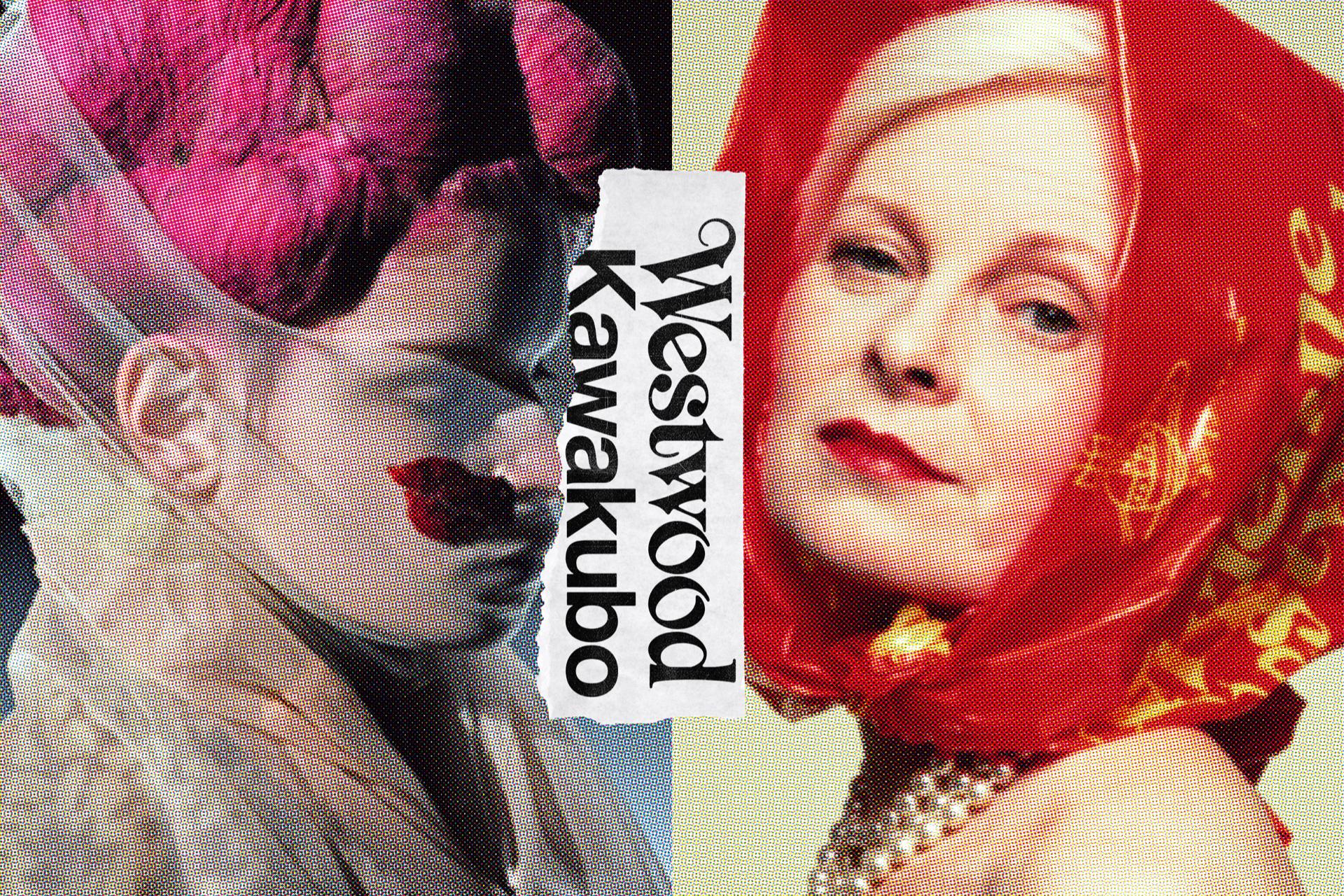
Westwood | Kawakubo
Artwork Labels & Didactics
Artwork Labels & Didactics
Exhibition Introduction
Vivienne Westwood (1941–2022) and Rei Kawakubo (1942–) of Comme des Garçons are two of the most visionary and influential designers in recent fashion history. Emerging in the 1970s, both rebelled against rigid social expectations to find artistic and economic freedom through fashion. Self-taught iconoclasts who challenged the ‘rules’ of dress, their work is grounded in the desire for change.
Throughout their careers, Westwood and Kawakubo have reframed ideas of beauty, gender and the relationship between body and garment through their rejection of fashion norms. By experimenting with cut, form and function, each designer has reimagined the traditions of tailoring and dressmaking. Today, their material, technical and conceptual innovations continue to disrupt the status quo and shape the way we dress.
Spanning four decades of practice, Westwood’s and Kawakubo’s work is placed into dialogue, highlighting how their shared concerns, contrasting philosophies and distinctive design methodologies have profoundly transformed contemporary fashion.
Rei Kawakubo
Born in Tokyo in 1942, Rei Kawakubo graduated from Keio University in 1964 with a degree in fine art and aesthetics. After working as a stylist, she began designing her own clothes and, in 1969, founded the label Comme des Garçons. In 1981, Kawakubo made her Paris debut – the first in a series of presentations that would establish her as one of the most radical and uncompromising voices in fashion.
From the outset, Kawakubo was determined to make clothes that, in her words, ‘did not exist before’. Her designs have subverted the norms of garment shape and function, reframed ideas of beauty, and proposed a new relationship between body and dress. Throughout the 1980s, her use of black, distressed fabrics and asymmetrical forms introduced a new visual and conceptual vocabulary to fashion. Her 1996 collection Body Meets Dress–Dress Meets Body collapsed the boundary between body and garment, radically distorting the silhouette.
Today, Kawakubo continues to test the limits of fashion through pioneering concepts and innovative design methods. Her recent runway collections are defined by enveloping and abstract ‘objects for the body’ that question what clothing can be. In its powerful originality, Kawakubo’s work defies convention, reframing how we see and think about fashion, beauty, agency and identity.
Vivienne Westwood
Vivienne Westwood was born Vivienne Isabel Swire in Derbyshire in 1941. Moving to London as a teenager, she briefly attended Harrow Art School before training as a teacher and working in a primary school. In the 1970s, after meeting Malcolm McLaren, the pair became creative collaborators and opened a series of boutiques on the King’s Road in Chelsea – spaces that became a youth fashion mecca with a radical influence on international fashion. The pair later shifted from street fashion to the industry’s heartland, presenting collections at London and Paris fashion weeks.
From 1984, Westwood began designing independently, presenting her first solo collection in 1985 and ushering in a new era that fused punk’s anti-fashion spirit with the craftsmanship of haute couture. From this period onwards, her work reimagined Savile Row bespoke tailoring and British textiles, using parody and provocation to challenge accepted ideas of taste and gender.
Westwood revived the corset, crinoline and bustle, transforming symbols of restriction into emblems of subversion. Her rebellious and provocative designs revealed not a rejection but a deep engagement with history, drawing inspiration from art and fashion archives, including those of London’s Victoria and Albert Museum and the Wallace Collection. In later decades, Westwood channelled her creative platform into activism, passionately campaigning for environmental and social causes, generating a lasting anti-authoritarian impact on and off the runway.
Punk and Provocation
‘We weren’t only rejecting the values of the older generation; we were rejecting their taboos as well.’
– Westwood, 2004
‘I’ve always felt an affinity with the punk spirit. I like that word. Every collection is that. Punk is against flattery, and that’s what I like about it.’
– Kawakubo, 2013
From their earliest collections, Westwood and Kawakubo positioned themselves as provocateurs – designers who challenged the hierarchies of fashion and the politics of beauty and taste.
In the mid 1970s, Westwood, along with her then-partner Malcolm McLaren, brought the visual language of punk into fashion. Rips, tartan, bondage-wear and confrontational graphics transformed clothing into protest – emblems of anarchic, anti-authoritarian style.
A decade later, Kawakubo declared she would ‘start from zero’ and ‘do things not done before’. Like Westwood, she created without compromise, introducing asymmetry, enveloping volumes and the use of black and distressed fabrics into Western fashion vernacular.
Original garments from Westwood and McLaren’s stores SEX and Seditionaries highlight early punk style and demonstrate how Westwood transformed clothing into a tool to claim agency and power. Contemporary and conceptual works by Kawakubo show how she continues to channel punk’s spirit of rebellion – not simply its visual language, but also its ethos of transgression and defiance.
Seditionaries, London retailer
England 1976–79
Vivienne Westwood designer
England 1941–2022
Malcolm McLaren designer
England 1946 – Switzerland 2010
Parachute shirt
c. 1977
cotton, silk, plastic (fastenings)
Purchased through the NGV Foundation with the assistance of Ms Kerry Gardner, Member, 2001
2001.17
SEX, London retailer
England 1974–76
Vivienne Westwood designer
England 1941–2022
Malcolm McLaren designer
England 1946 – Switzerland 2010
Bondage trousers
c. 1974
wool, cotton, leather, metal, plastic
Purchased through the NGV Foundation with the assistance of Ms Kerry Gardner, Member, 2001
2001.18
Display headpiece by Stephen Jones
‘I didn’t see myself as a fashion designer but as someone who wished to confront the rotten status quo through the way I dressed and dressed others. Eventually this sequence of ideas culminated in punk.’ – Westwood, 2014
Westwood’s foray into fashion began while she was working as a primary school teacher. With her then-partner, Malcolm McLaren, she began designing and selling clothes from her London flat, evolving from teddy boy, rocker and biker styles to bondage rubber, leather and latex pieces drawing from the city’s underground fetish scene.
SEX, London retailer
England 1976–79
Vivienne Westwood designer
England 1941–2022
Malcolm McLaren designer
England 1946 – Switzerland 2010
Cowboys, T-shirt
c. 1975
cotton (jersey)
Gift of Krystyna Campbell-Pretty AM and Family through the Australian Government’s Cultural Gifts Program, 2024
2024.979
Westwood and McLaren’s clothing was designed to provoke. In 1975, they printed this T-shirt depicting two cowboys naked from the waist down. One of the shop assistants at Seditionaries was arrested and fined for indecency after they wore the design, and Westwood and McLaren were prosecuted under the Obscene Publications Act 1959. Their response was characteristically defiant – they produced more T-shirts emblazoned with hardcore and subversive imagery.
New acquisition
Seditionaries, London retailer
England 1976–79
Vivienne Westwood designer
England 1941–2022
Malcolm McLaren designer
England 1946 – Switzerland 2010
Bondage trousers
c. 1976–78
cotton, metal (fastenings)
National Gallery of Australia, Canberra
Purchased 1995
95.990.A-C
Display headpiece by Stephen Jones
Between 1974 and 1980, Westwood and McLaren’s King’s Road boutique – first called SEX and later Seditionaries – became the epicentre of London’s punk scene. Together, the duo helped define and commercialise the punk aesthetic. Their infamous muslin Anarchy, Destroy and Tits straitjacket shirts, along with bondage trousers and hangman sweaters, became enduring emblems of punk after they were worn onstage by members of the Sex Pistols and Siouxsie and the Banshees.
Seditionaries, London retailer
England 1976–79
Vivienne Westwood designer
England 1941–2022
Malcolm McLaren designer
England 1946 – Switzerland 2010
Shirt
c. 1976
cotton
The Metropolitan Museum of Art, New York
Gift of Barbara and Gregory Reynolds, 1985
1985.375.6
Seditionaries, London retailer
England 1976–79
Vivienne Westwood designer
England 1941–2022
Malcolm McLaren designer
England 1946 – Switzerland 2010
Bondage trousers and bum flap
1976–80
cotton, metal, wool
The Metropolitan Museum of Art, New York
Purchased, Richard Martin Bequest, 2003
203.479a-d
Display headpiece by Stephen Jones
Seditionaries, London retailer
England 1976–79
Vivienne Westwood designer
England 1941–2022
Malcolm McLaren designer
England 1946 – Switzerland 2010
Anarchy flag, shirt
c. 1976
cotton
Purchased, 2000
2000.12
Seditionaries, London retailer
England 1976–79
Vivienne Westwood designer
England 1941–2022
Malcolm McLaren designer
England 1946 – Switzerland 2010
Bondage trousers
c. 1977
wool, cotton, metal and nylon (fastenings)
Gift of Krystyna Campbell-Pretty AM and Family through the Australian Government’s Cultural Gifts Program, 2025
Display headpiece by Stephen Jones
New acquisition
Seditionaries, London retailer
England 1976–79
Vivienne Westwood designer
England 1941–2022
Malcolm McLaren designer
England 1946 – Switzerland 2010
God save the Queen, shirt
c. 1976
cotton (muslin), metal
Victoria and Albert Museum, London
Purchased with Art Fund support and assistance from the Friends of the V&A, the Elsbeth Evans Trust, and the Dorothy Hughes Bequest
T.93-2002
BOY, London fashion house
England est. 1976
Bondage trousers and kilt
1976
cotton, metal (fastenings)
Victoria and Albert Museum, London
Purchased with Art Fund support and assistance from the Friends of the V&A, the Elsbeth Evans Trust, and the Dorothy Hughes Bequest
T.91:2 to 4-2002
Display headpiece by Stephen Jones
SEX, London retailer
England 1974–76
Vivienne Westwood designer
England 1941–2022
Malcolm McLaren designer
England 1946 – Switzerland 2010
Court shoes
1974–76
leather, metal, rubber
Purchased, 1985
CT18.c-d-1985
For Westwood, punk was a way to confront traditional gender roles and beauty ideals. In 1970s London, she became an icon of punk style through the clothing she and McLaren created for their boutique SEX. DIY in spirit, their designs drew heavily from queer and sadomasochistic subcultures to provoke and disrupt. By transforming cheap, accessible materials into confronting garments featuring offensive and explicit graphics, Westwood showed how fashion could become a tool for resistance, used to claim agency and power.
Seditionaries, London retailer
England 1974–76
Vivienne Westwood designer
England 1941–2022
Malcolm McLaren designer
England 1946 – Switzerland 2010
Tits, shirt
1977
muslin, metal
Victoria and Albert Museum, London
Purchased with Art Fund support and assistance from the Friends of the V&A, the Elsbeth Evans Trust, and the Dorothy Hughes Bequest
T.90-2002, T.91:2 to 4-2002
SEX, London retailer
England 1974–76
Vivienne Westwood designer
England 1941–2022
Malcolm McLaren designer
England 1946 – Switzerland 2010
Trousers
1976
cotton, metal
The Metropolitan Museum of Art, New York
Purchased, Friends of The Costume Institute Gifts, 2018
2018.799.a-d
Display headpiece by Stephen Jones
Comme des Garçons, Tokyo fashion house
Japan est. 1969
Rei Kawakubo designer
Japan born 1942
Look 10, dress
2024
Anger collection, autumn–winter 2024–25
polyurethane, polyester cotton, rayon, polyester, acrylic, cupra, polyester
Gift of the artist, 2025
For her 2024 Anger collection, Kawakubo drew on the symbolism of black to express her feelings of frustration at the world and with herself. In the 1980s, when runways were dominated by colourful, body-conscious clothes, Kawakubo used distressed fabrics, asymmetry and black to challenge Western aesthetic values. Here, in combination with motifs of graffiti, barbed wire and chains, exposed zips and vinyl leathers, black represents a state of punk-fuelled disaffection.
New acquisition
Comme des Garçons, Tokyo fashion house
Japan est. 1969
Rei Kawakubo designer
Japan born 1942
Look 1, jacket and skirt
2019
The Gathering of Shadows collection, autumn–winter 2019–20
cotton (velvet), nylon, polyvinylchloride
Collection of Octavius La Rosa, dot COMME, Paris
Comme des Garçons, Tokyo fashion house
Japan est. 1969
Rei Kawakubo designer
Japan born 1942
Look 42, dress
2008
Bad Taste collection, autumn–winter 2008
nylon, elastic, metal (fastenings)
Collection of Octavius La Rosa, dot COMME, Paris
‘I’ve always liked the [punk] spirit in the sense that it’s against the run-of-the-mill, the normal way of doing things … Punk is against flattery.’ – Kawakubo, 2013
Kawakubo’s Bad Taste collection rejected established fashion hierarchies by parodying conventional notions of taste. The designer combined cheap materials and kitsch details – including satin-style underwear, polka dot negligees and garter-belt frills – to create an impression of deliberate disarray. The final runway look, this nylon dress overlays a ballerina’s tutu with black bondage-like harnessing, juxtaposing high art with subcultural style. As Kawakubo put it, ‘Bad taste done by Comme des Garçons becomes good taste.’
Comme des Garçons, Tokyo fashion house
Japan est. 1969
Rei Kawakubo designer
Japan born 1942
Look 7, dress
2016
Invisible Clothes collection, spring–summer 2017
wool polyester, cupra
Collection of Octavius La Rosa, dot COMME, Paris
The contemporary anti-establishment associations of tartan can be traced to Westwood and McLaren’s designs of the late 1970s. Here Kawakubo cleverly references this legacy of punk style as well as its precursor, the traditional Scottish kilt – a garment constructed from flat panels of pleated and unpleated fabric. In Kawakubo’s hands, the kilt is transformed into an oversized, abstracted form that reimagines the relationship between body and clothing.
Rupture
In 1981, Kawakubo presented her first international runway in Paris with a collection now known as Pirates. That same year, Westwood made her runway debut in London at the Olympia, with her similarly titled Pirate collection. These collections marked distinct creative ruptures: each representing a new design manifesto that would define their work for decades to come.
For Westwood, Pirate marked the beginning of a lifelong fascination with historical cutting techniques, innovative fabric treatments and the destabilisation of gendered dress. Across her 1981–85 collections, she fused references from antiquity, historical and global dress, streetwear, art and queer culture, creating an eclectic and intellectually curious fashion vocabulary.
For Kawakubo, Pirates – and the groundbreaking collections that followed – embodied her modernist spirit and commitment to the new and original, realised through experimental patternmaking, the creation of specialist textiles and the continual questioning of clothing forms and gender codes.
Yet it is Kawakubo’s refusal to look backwards, and her conceptual resolve to ‘break the idea of clothes’, that define her work in the twenty-first century. From 2014 onwards, her collections – made solely for the runway or to order – illuminate her singular design language. Exaggerated and sculptural forms, freed from the body, represent the purest expression of her pursuit of the new and ongoing recalibration of fashion.
Worlds End, London retailer
England 1979–84
Vivienne Westwood designer
England 1941–2022
Malcolm McLaren designer
England 1946 – Switzerland 2010
Jacket, doublet, shirt, trousers, sash, belt, hat and shoes
1981
Pirate collection, autumn–winter 1981–82
cotton polyester (brocade, satin damask), cotton (brushed, thread, grosgrain), synthetic fabric (satin), wool (felt), nylon (lace), card, leather and plastic and metal (fastenings)
Gift of Krystyna Campbell-Pretty AM and Family through the Australian Government’s Cultural Gifts Program, 2024
2024.747
Westwood’s runway debut, Pirate, caused a sensation with its mix of New Romantic flamboyance, bold prints and historical cuts. It set the scene for her future shows: exuberant non-professional models, a blending of men’s and womenswear and street-savvy connections to contemporary club culture. The collection celebrated clothing as something adventurous and playful. As the press release put it: ‘These clothes are made to go hunting and fishing in, climbing trees and running through the wilderness – cassette pack on your back, loincloth between your legs, gold braids in your hair, a modern-day pirate.’
New acquisition
Worlds End, London retailer
England 1979–84
Vivienne Westwood designer
England 1941–2022
Malcolm McLaren designer
England 1946 – Switzerland 2010
Dress
1981
Pirate collection, autumn–winter 1981–82
cotton, metal
Purchased through The Art Foundation of Victoria with the assistance of Just Jeans Pty Ltd, Member, 1999
1999.361
Display headpiece by Stephen Jones
In 1981 Westwood and McLaren presented their first runway collection, Pirate, in London. That same year, their King’s Road shop was renamed Worlds End, after a historic pub in Chelsea. The boutique was theatrically redesigned as a cross between an eighteenth-century galleon and an old-world curiosity shop, reflecting both the historicism and whimsy of the Pirate collection and the label’s shift away from punk. Worlds End featured tiny windows, a sloping floor, low ceilings, a chandelier and a slate gable adorned with a large clock that moved backwards through thirteen hours – a playful token of Westwood and McLaren’s subversive vision.
Worlds End, London retailer
England 1979–84
Vivienne Westwood designer
England 1941–2022
Malcolm McLaren designer
England 1946 – Switzerland 2010
Shirt, breeches and sash
1981
Pirate collection, autumn–winter 1981–82
cotton, metal
Purchased through The Art Foundation of Victoria with the assistance of Just Jeans Pty Ltd, Member, 1999
1999.360.a, 1999.359.b-c
Display headpiece by Stephen Jones
In 1980 Westwood began exploring images of seventeenth- and eighteenth-century menswear, delving into the historical dress of pirates, highwaymen, buccaneers and dandies. She drew on books such as Norah Waugh’s The Cut of Men’s Clothes (1964) and Douglas Bottling’s The Pirates (1979), intrigued by garments that hung suggestively, billowing out rather than clinging to the body. This research culminated in Westwood’s Pirate collection, the first of many instances in which the designer would reimagine historical menswear for contemporary fashion.
Worlds End, London retailer
England 1979–84
Vivienne Westwood designer
England 1941–2022
Malcolm McLaren designer
England 1946 – Switzerland 2010
Shirt, sash and breeches
1981
Pirate collection, autumn–winter 1981–82
cotton, plastic (button), leather, wood, metal (fastenings)
Gift of Krystyna Campbell-Pretty AM and family through the Australian Government’s Cultural Gifts Program, 2025
Display headpiece by Stephen Jones
With Pirate, Westwood drew on historical and global references to craft a radically new aesthetic – one unlike anything she or the fashion world had seen before. In keeping with this new direction, the label adopted a new logo: an arm brandishing a cutlass, inspired by the flag of seventeenth-century English privateer-turned-pirate Thomas Tew. The Pirate collection quickly gained cult status before crossing over into the mainstream. It also helped to define the look of London’s New Romantic scene, epitomised by musicians such as Steve Strange, Boy George and Adam Ant.
New acquisition
Worlds End, London retailer
England 1979–84
Vivienne Westwood designer
England 1941–2022
Malcolm McLaren designer
England 1946 – Switzerland 2010
Hat
1982
Nostalgia of Mud collection, autumn–winter 1982–83
wool (felt)
Purchased through The Art Foundation of Victoria with the assistance of Just Jeans Pty Ltd, Member, 1999
1999.364
Also known as ‘Buffalo’, Nostalgia of Mud stands as one of Westwood’s most influential collections. Presented both in London and Paris to the soundtrack of McLaren’s scratch hit single ‘Buffalo Gals’, it was notably the first time Westwood used underwear as outerwear: vintage satin bras were worn over tops and layered dresses and skirts. Overdyed sheepskin jackets, along with stencilled and tattered fabrics signalled Westwood’s new ‘raggamuffin’ aesthetic, a look that drew from the ‘ragga’ styles associated with Jamaican dancehall culture.
Worlds End, London retailer
England 1979–84
Vivienne Westwood designer
England 1941–2022
Malcolm McLaren designer
England 1946 – Switzerland 2010
Coat, vest, skirt, hat, socks and sandals
1982
Nostalgia of Mud collection, autumn–winter 1982–83
sheepskin, leather, cotton (jersey)
Private collection of Steven Philip, Brighton
Nostalgia of Mud was both the title of Westwood and McLaren’s 1982 autumn–winter collection and, briefly, the name of their second London store. Its facade and interior were deliberately uninviting: a cave-like stage set resembling an archaeological dig, complete with exterior scaffolding, rusty hanging racks, draped brown tarpaulin and a 3D relief of a map of the world in mud and plaster. This raw environment set the tone for their challenging and radical designs and signalled their intent to disrupt conventional retail spaces.
Worlds End, London retailer
England 1979–84
Vivienne Westwood designer
England 1941–2022
Malcolm McLaren designer
England 1946 – Switzerland 2010
Top, bra, overskirt, underskirt and
leggings
1982
Nostalgia of Mud collection, autumn–winter 1982–83
cotton, wool, leather
Gift of Robyn Beeche, 1992
CT6.a-i-1992
Worlds End, London retailer
England 1979–84
Vivienne Westwood designer
England 1941–2022
Malcolm McLaren designer
England 1946 – Switzerland 2010
Hat
1982
Nostalgia of Mud collection, autumn–winter 1982–83
wool (felt)
Purchased through The Art Foundation of Victoria with the assistance of Just Jeans Pty Ltd, Member, 1999
1999.370
Worlds End, London retailer
England 1979–84
Vivienne Westwood designer
England 1941–2022
Malcolm McLaren designer
England 1946 – Switzerland 2010
Jacket, toga dress and stockings
1982
Nostalgia of Mud collection, autumn–winter 1982–83
sheepskin, cotton (jersey, perforated)
Gift of Krystyna Campbell-Pretty AM and Family through the Australian Government’s Cultural Gifts Program, 2025
2025.584.a-d
In an era of widespread global sampling and appropriation, Westwood’s early 1980s collections actively drew on numerous cross-cultural references. Westwood sought to broaden fashion’s terms of reference along class and geographic lines. From Matisse cut-outs and ancient Grecian togas to patterns, fabrics and construction techniques from West African, Native American, Peruvian, Rastafarian and Dominican sources, these collections were a deliberate rejection of the very Anglocentric references that she would later embrace.
New acquisition
Worlds End, London retailer
England 1979–84
Vivienne Westwood designer
England 1941–2022
Malcolm McLaren designer
England 1946 – Switzerland 2010
Cardigan
1983
Punkature collection, spring–summer 1983
cotton, wool, metal
Gift of Krystyna Campbell-Pretty AM and family through the Australian Government’s Cultural Gifts Program, 2025
2025.592
New acquisition
Worlds End, London retailer
England 1979–84
Vivienne Westwood designer
England 1941–2022
Malcolm McLaren designer
England 1946 – Switzerland 2010
Dress, shirt, socks and shoes
1983
Punkature collection, spring–summer 1983
cotton, wool, plastic (button), metal (fastenings), leather
Gift of Krystyna Campbell-Pretty AM and family through the Australian Government’s Cultural Gifts Program, 2025
Display headpiece by Stephen Jones
Although Westwood had moved away from punk by the early 1980s, she continued to embrace its spirit, challenging the hierarchies of high fashion in bold and unexpected ways. Her Punkature collection – a play on ‘punk’ and ‘couture’ – elevated everyday and discarded materials, featuring distressed cardigans made from hand-dyed dishcloth fabric and upcycled tin lids. The print on this dress combines an unlikely mix of eighteenth-century Toile de Jouy fabric designs and photographic stills from Ridley Scott’s 1982 film Blade Runner.
New acquisition
Worlds End, London retailer
England 1979–84
Vivienne Westwood designer
England 1941–2022
Malcolm McLaren designer
England 1946 – Switzerland 2010
Shirt, trousers and shoes
1983
Punkature collection, spring–summer 1983
cotton (plain, cord), linen, leather, rubber and metal (fastenings)
Purchased with funds donated by Krystyna Campbell-Pretty AM and Family, 2024
2024.990
Display headpiece by Stephen Jones
New acquisition
Worlds End, London retailer
England 1979–84
Vivienne Westwood designer
England 1941–2022
Malcolm McLaren designer
England 1946 – Switzerland 2010
Mud flap dress and petti-shorts
1981
Savage collection, spring–summer 1981–82
cotton, cotton (jersey), metal and plastic (fastenings)
Gift of Krystyna Campbell-Pretty AM and Family through the Australian Government’s Cultural Gifts Program, 2025
2025.589.a-b
Display headpiece by Stephen Jones
New acquisition
Worlds End, London retailer
England 1979–84
Vivienne Westwood designer
England 1941–2022
Malcolm McLaren designer
England 1946 – Switzerland 2010
Sweater and leggings
1981
Savage collection, spring–summer 1981–82
cotton, leather, metal
Purchased, 2011
2001.411.a-c
Worlds End, London retailer
England 1979–84
Vivienne Westwood designer
England 1941–2022
Malcolm McLaren designer
England 1946 – Switzerland 2010
Tunic and shorts
1981
Savage collection, spring–summer 1981–82
cotton (plain, mesh, drawstring), metal and plastic (fastenings)
Gift of Krystyna Campbell-Pretty AM and Family through the Australian Government’s Cultural Gifts Program, 2025
2025.590.a-b
Display headpiece by Stephen Jones
New acquisition
Worlds End, London retailer
England 1979–84
Vivienne Westwood designer
England 1941–2022
Malcolm McLaren designer
England 1946 – Switzerland 2010
Dress ‘rock’ and shoes
1981
Savage collection, spring–summer 1981–82
cotton, leather, metal (buckles)
Gift of Robyn Beeche, 1992
CT7.a-c-1992
Display headpiece by Stephen Jones
‘I realised after Pirate that I didn’t have to qualify my ideas. I could do anything I liked; it was only a question of how I did it that would make it original. I realised then that I could go on forever.’ – Westwood, 1987
Following the breakthrough of Pirate, Westwood entered a decade of bold experimentation. Her 1980s collections combined inventive cutting and construction techniques with historical details and references from around the world. This dress is one of several screenprinted with words in block-capitals such as ‘CHILLY’, ‘DRESSROCK’ and ‘BREAKER’ from the patois dialect spoken by New York’s Jamaican diaspora. This community would have a lasting influence on the work of both Westwood and McLaren following their first trip to the city in 1973.
Worlds End, London retailer
England 1979–84
Vivienne Westwood designer
England 1941–2022
Malcolm McLaren designer
England 1946 – Switzerland 2010
Toga dress
1981
Savage collection, spring–summer 1981–82
screenprinted cotton
Gift of Robyn Beeche, 1992
CT8-1992
Display headpiece by Stephen Jones
Worlds End, London retailer
England 1979–84
Vivienne Westwood designer
England 1941–2022
Top and pants
1983
Hypnos collection, spring–summer 1984
nylon jersey, polyester, cotton, plastic
Purchased through The Art Foundation of Victoria with the assistance of Just Jeans Pty Ltd, Member, 1999
1999.373.a-b
Display headpiece by Stephen Jones
In 1984 Westwood designed her first collection independently of McLaren. Dubbed ‘the porno Olympics’ by The Face magazine, Hypnos – named after the Greek god of sleep – featured brightly coloured, cleverly draped jersey ensembles distorted by elasticated ribbing, kneepads and jockstraps. Manufactured in Italy and presented in Paris, the collection fused a range of disparate references, from the first Olympics to gay subcultural style.
Worlds End, London retailer
England 1979–84
Vivienne Westwood designer
England 1941–2022
Top and pants
1983
Hypnos collection, spring–summer 1984
nylon jersey, polyester, cotton, plastic
Purchased through The Art Foundation of Victoria with the assistance of Just Jeans Pty Ltd, Member, 1999
1999.372.a-b
Display headpiece by Stephen Jones
Worlds End, London retailer
England 1979–84
Vivienne Westwood designer
England 1941–2022
Malcolm McLaren designer
England 1946 – Switzerland 2010
Jacket
1983
Hypnos collection, spring–summer 1984
nylon jersey, polyester, cotton, plastic, rubber
Promised gift of Krystyna Campbell-Pretty AM and Family
Worlds End, London retailer
England 1979–84
Vivienne Westwood designer
England 1941–2022
Malcolm McLaren designer
England 1946 – Switzerland 2010
Dress
1983
Hypnos collection, spring–summer 1984
polyester, nylon
Purchased through The Art Foundation of Victoria with the assistance of Just Jeans Pty Ltd, Member, 1999
1999.374
Display headpiece by Stephen Jones
Worlds End, London retailer
England 1979–84
Vivienne Westwood designer
England 1941–2022
Dress
1983
Hypnos collection, spring–summer 1984
nylon jersey, polyester, cotton, plastic
Gift of Krystyna Campbell-Pretty AM and Family through the Australian Government’s Cultural Gifts Program, 2024
2024.1064
Display headpiece by Stephen Jones
New acquisition
Worlds End, London retailer
England 1979–84
Vivienne Westwood designer
England 1941–2022
Malcolm McLaren designer
England 1946 – Switzerland 2010
Coat
1983
Witches collection, autumn–winter 1983–84
nylon
Gerstl Bequest, 2001
2001.19
Display headpiece by Stephen Jones
Worlds End, London retailer
England 1979–84
Vivienne Westwood designer
England 1941–2022
Malcolm McLaren designer
England 1946 – Switzerland 2010
Keith Haring
United States 1958–90
Top
1983
Witches collection, autumn–winter 1983–84
cotton
Purchased through The Art Foundation of Victoria with the assistance of Just Jeans Pty Ltd, Member, 1999
1999.366.b
Worlds End, London retailer
England 1979–84
Vivienne Westwood designer
England 1941–2022
Malcolm McLaren designer
England 1946 – Switzerland 2010
Three-tongue black trainers
1983
Witches collection, autumn–winter 1983–84
leather
Gift of Krystyna Campbell-Pretty AM and family through the Australian Government’s Cultural Gifts Program, 2025
New acquisition
Worlds End, London retailer
England 1979–84
Vivienne Westwood designer
England 1941–2022
Malcolm McLaren designer
England 1946 – Switzerland 2010
Keith Haring
United States 1958–90
Skirt
1983
Witches collection, autumn–winter 1983–84
cotton
The Metropolitan Museum of Art, New York
Gift of Timothy Luce, 1993
1993.15
In 1983 Westwood debuted her three-tongued trainers during her iconic Witches show – the first time sport shoes appeared on a runway. The collection broke with convention, blending high fashion with street culture. Many garments featured neon-pink graphics by New York artist Keith Haring, whom Westwood had met the previous year. The collection drew on American hip-hop culture and was partly inspired by Jean Kerboull’s book Voodoo and Magic Practices (1978), which also informed Haring’s own esoteric designs.
Worlds End, London retailer
England 1979–84
Vivienne Westwood designer
England 1941–2022
Malcolm McLaren designer
England 1946 – Switzerland 2010
Hat, jacket and two tube skirts
1983
Witches collection, autumn–winter 1983–84
wool, linen, polyester, cotton, horn (toggles)
Purchased through The Art Foundation of Victoria with the assistance of Just Jeans Pty Ltd, Member, 1999
1999.367; 1999.365.a-c
Worlds End, London retailer
England 1979–84
Vivienne Westwood designer
England 1941–2022
Malcolm McLaren designer
England 1946 – Switzerland 2010
Hat
1983
Witches collection, autumn–winter 1983–84
wool (felt)
Purchased through The Art Foundation of Victoria with the assistance of Just Jeans Pty Ltd, Member, 1999
1999.367
Comme des Garçons, Tokyo fashion house
Japan est. 1969
Rei Kawakubo designer
Japan born 1942
Look 20, top, belt, pants and headpiece
2020
Neo Future collection, autumn–winter 2020–21
polyester (jersey, padding, plain), nylon (netting, tulle), cotton, plastic, wool polyester, plastic, polyvinyl chloride
Gift of the artist, 2025
Echoing the colour palette and divided proportions of Look 1, dress, this neon-pink ensemble was the striking finale of the Neo Future runway. Layers of softly gathered polyester combine with padded, sculptural forms, capturing some of the themes that have underwritten Kawakubo’s practice in recent decades. Driven by a constant search for the new, she overturns fabric hierarchies and conventional patternmaking, playing with scale and distortion to challenge conventional notions of what is considered beautiful.
New acquisition
Comme des Garçons, Tokyo fashion house
Japan est. 1969
Rei Kawakubo designer
Japan born 1942
Look 13, dress and headpiece
2020
Neo Future collection, autumn–winter 2020–21
polyester, silk/rayon/nylon/polyurethane/polyester/cotton, nylon, polyvinyl chloride
Gift of the artist, 2025
New acquisition
Comme des Garçons, Tokyo fashion house
Japan est. 1969
Rei Kawakubo designer
Japan born 1942
Look 8, dress
2020
Neo Future collection, autumn–winter 2020–21
polyester, polyester wool, polyester cotton, nylon, polyvinyl chloride, metal and plastic (fastenings)
Gift of the artist, 2025
Kawakubo’s runway presentations often feature striking headpieces and hairstyles, the result of her nearly forty-year collaboration with avant-garde French hairstylist Julien d’Ys. Given very little direction – often seeing the garments only a day before the show – d’Ys responds spontaneously to Kawakubo’s designs. For the Neo Future collection, each look was paired with a distinctive headpiece and its own soundtrack. Using perspex, transparent lace veiling and clouds of piled nylon tulle, d’Ys’ headpieces lend a sense of ceremony, balancing out the eccentric, seemingly illogical forms of Kawakubo’s garments.
New acquisition
Comme des Garçons, Tokyo fashion house
Japan est. 1969
Rei Kawakubo designer
Japan born 1942
Look 3, dress and headpiece
2020
Neo Future collection, autumn–winter 2020–21
polyester/polyurethane, polyester, nylon, plastic
Gift of the artist, 2025
New acquisition
Comme des Garçons, Tokyo fashion house
Japan est. 1969
Rei Kawakubo designer
Japan born 1942
Look 1, hat
2020
Neo Future collection, autumn–winter 2020–21
nylon (tulle), polyvinyl chloride
Gift of the artist, 2025
New acquisition
Look 1, dress
2020
Neo Future collection, autumn–winter 2020–21
wool (bouclé), cotton (canvas), polyester, metal and nylon (fastenings)
Gift of Takamasa Takahashi through the Australian Government’s Cultural Gifts Program, 2019
2019.423.a
Kawakubo challenges herself to create garments that have not been seen before, working without direct reference to history, culture, art or politics. This process is demanding, but the result is always something that defies expectation and invites viewers to rethink what clothing can be. These five works from her Neo Future collection highlight her distinct design vocabulary: exaggerated proportions, a disregard for function, strident colour and sculptural forms freed from the body.
Comme des Garçons, Tokyo fashion house
Japan est. 1969
Rei Kawakubo designer
Japan born 1942
Look 1, dress and harness
2013
Not Making Clothing collection, spring–summer 2014
cotton, nylon (mesh), polyester, elastic (rubber)
Collection of Octavius La Rosa, dot COMME, Paris
In September 2013 Kawakubo unveiled her Not Making Clothing collection, setting out to, in her words, ‘break the idea of clothes’. In a manifesto published in System magazine, she explained: ‘I wanted to change the usual route in my head. I tried to look at everything I look at in a different way. I thought a way to do this was to start out with the intention of not even trying to make clothes.’ From this point on, Kawakubo’s Paris runway presentations have become increasingly conceptual, conceived as pure expressions of her ideas rather than as collections produced for retail sale.
Comme des Garçons, Tokyo fashion house
Japan est. 1969
Rei Kawakubo designer
Japan born 1942
Look 11, playsuit
2013
Not Making Clothing collection, spring–summer 2014
silk, cotton, nylon (tulle), polyester, elastic (rubber)
Gift of Takamasa Takahashi through the Australian Government’s Cultural Gifts Program, 2019
2019.423.a
In addition to breaking down the rules of clothing, Not Making Clothing also explored design as an expression of pure form. On the runway, illogical garments redefined the contours of the body, often bearing little or no relation to the figure underneath. To critics who asked, ‘Where could you wear that?’ or ‘Who would wear that?’, Kawakubo responded, ‘It’s just a sign that someone is missing the point.’
Reinvention – History
A study of Westwood’s and Kawakubo’s work reveals a tension between tradition and transgression. Both demonstrate a deep understanding of the fundamentals of fashion – tailoring, dressmaking and textiles – even as they resist and rewrite these orthodoxies.
Westwood’s work often looked to art and fashion history for inspiration. Through study of museum archives and historical pattern books, her 1990s collections reinterpreted the opulence of the eighteenth and nineteenth centuries, reclaiming the corset and crinoline as symbols of sexual liberty.
Kawakubo rarely quotes the past so directly. Her references, if present, are always abstracted. In 18th-Century Punk, she borrows silhouettes and fabrics from the period only to recalibrate them, denying familiarity and embracing transformation.
Comme des Garçons, Tokyo fashion house
Japan est. 1969
Rei Kawakubo designer
Japan born 1942
Look 1, top and shorts
2016
18th-Century Punk collection, autumn–winter 2016–17
acetate polyester nylon (brocaded), polyester, polyester silk acetate (brocaded), polyester silk, cotton polyester triacetate (brocaded), metal (fastenings)
Gift of the artist, 2025
New acquisition
Comme des Garçons, Tokyo fashion house
Japan est. 1969
Rei Kawakubo designer
Japan born 1942
Look 12, jumpsuit
2016
18th-Century Punk collection, autumn–winter 2016–17
silk polyester (brocaded), polyester rayon (brocaded), polyester acetate (brocaded), polyester rayon nylon acrylic (brocaded), cotton polyester triacetate (brocaded), metal (fastenings)
Gift of the artist, 2025
In eighteenth-century France, luxurious silks woven by artisans in Tours and Lyon formed the foundation of aristocratic women’s dress. Naturalistic and stylised floral designs, typical of Rococo taste, were highly fashionable and also inspired the embroidery on men’s frock coats and waistcoats. Drawing on these traditions, Kawakubo worked with Italian, French and Swiss makers to recreate archival dress and furnishing fabrics, which she uses here in deliberately anachronistic ways.
New acquisition
Comme des Garçons, Tokyo fashion house
Japan est. 1969
Rei Kawakubo designer
Japan born 1942
Look 7, dress and shoulder holster
2016
18th-Century Punk collection, autumn–winter 2016–17
silk polyester (brocaded), polyester rayon (brocaded), polyester acetate (brocaded), polyester rayon nylon acrylic (brocaded), cotton polyester triacetate (brocaded), metal (fastenings)
Gift of the artist, 2025
New acquisition
Comme des Garçons, Tokyo fashion house
Japan est. 1969
Rei Kawakubo designer
Japan born 1942
Look 14, dress
2016
18th-Century Punk collection, autumn–winter 2016–17
polyester
Collection of Octavius La Rosa, dot COMME, Paris
Vivienne Westwood, London fashion house
England est. 1984
Vivienne Westwood designer
England 1941–2022
Corset gown
1998
Dressed to Scale collection, autumn–winter 1998–99
silk (plain, organza, taffeta), nylon (tulle), metal (fastening)
Gift of Krystyna Campbell-Pretty AM and Family through the Australian Government’s Cultural Gifts Program, 2024
2024.1044
New acquisition
Vivienne Westwood, London fashion house
England est. 1984
Vivienne Westwood designer
England 1941–2022
Look 97, Watteau Grand dress and gloves
1995
Les Femmes ne Connaissent pas toute leur Coquetterie collection, spring–summer 1996
silk (taffeta), leather
Vivienne Westwood Heritage, London
Vivienne Westwood, London fashion house
England est. 1984
Vivienne Westwood designer
England 1941–2022
Fragonard
1990
Cut, Slash and Pull collection, spring–summer 1991
silk (taffeta)
Palais Galliera – Musée de la Mode de La Ville de Paris, France
Purchased 1991
GAL1991.311.1
Art history and historical dress were great sources of inspiration for Westwood. In particular, she drew on eighteenth- and nineteenth-century crinolines and corsetry, which created the exaggerated proportions and dramatic volume that let the wearer occupy space. During a visit to London’s Wallace Collection, Westwood discovered the paintings of François Fragonard. His sensuous imagery appealed to her love of the classical and reinforced her belief in the connection between fashion and art. She later incorporated manipulated photographic prints of paintings such as Daphnis and Chloe, 1743, and Hercules and Omphale, 1735, throughout her collections.
Comme des Garçons, Tokyo fashion house
Japan est. 1969
Rei Kawakubo designer
Japan born 1942
Look 17, dress and jacket
2016
18th-Century Punk collection, autumn–winter 2016–17
polyurethane leather
Victoria and Albert Museum, London
Purchase funded by the Lee Alexander McQueen Fund for Fashion
T:39:1, 2-2017
‘I was thinking that there had to be women in the eighteenth century who wanted to live strongly. So, I designed what I imagined this type of woman would have worn and called it 18th-Century Punk.’ – Kawakubo, 2016
In line with the collection’s title, this striking ensemble recalls the frills, flounces and extravagant panniered silhouettes of eighteenth-century dress, as well as the era’s fondness for pastel pink. Kawakubo, however, replaces what would have been finely woven and embroidered silk with glossy PVC and baring cut-away sections – a reference to the hallmarks of punk.
Vivienne Westwood, London fashion house
England est. 1984
Vivienne Westwood designer
England 1941–2022
Watteau (Evening dress)
1995
Les Femmes ne Connaissent pas toute leur Coquetterie collection, spring–summer 1996
silk (taffeta)
Victoria and Albert Museum, London
Given by the designer
T.438.1 – 4-1996
This collection offers a modern take on Rococo-era fashions depicted in paintings by eighteenth-century French artists such as Jean-Antoine Watteau and Jean-Honoré Fragonard. A frequent visitor to museum collections, Westwood studied the cut and construction of historical garments. Here, the voluminous eighteenth-century ‘sack back’ gown is reimagined as a tightly corseted, one-sleeved dress that accentuates the wearer’s sensuality. Corsetry became central to many of Westwood’s most dramatic creations, their silk-taffeta drapery and sculptural silhouettes directly inspired by the grandeur of French court dress.
Reinvention – Tailoring
Both Westwood and Kawakubo share an interest in Western tailoring traditions and menswear. Throughout their careers, they have interrogated the cultural tropes of tailoring, sexual politics and gender codes through innovative pattern-cutting and unorthodox material choices.
In the late 1980s, Westwood revived English wools, tweeds and Scottish tartans, embracing tailoring techniques associated with mid-century French couture and the bespoke suiting of Savile Row. Her precisely cinched and close-fitting cuts celebrated and exaggerated the body’s curves to empower rather than constrain the ‘feminine’ form.
Kawakubo has long examined what she calls ‘the basics of clothing’ found in menswear: trousers, shirts, shorts and blazers. Through deconstruction and fusion, the rejection of function or repositioning of pattern pieces, she subverts every aspect of the tailoring process. Her work often juxtaposes utility with typically ‘feminine’ ornament to further destabilise gender binaries and expectations of fit and form.
Comme des Garçons, Tokyo fashion house
Japan est. 1969
Rei Kawakubo designer
Japan born 1942
Look 4, suit dress
2022
Black Rose collection, autumn–winter 2022–23
nylon (lace, tulle), cupra (lining), polyester (dacron), plastic (boning) plastic, nylon and metal (fastenings)
Gift of the artist, 2025
New acquisition
Vivienne Westwood, London fashion house
England est. 1984
Vivienne Westwood designer
England 1941–2022
Jacket and skirt
1996
Storm in a Teacup collection, autumn–winter 1996–97
wool, cotton, acetate, polyester, metal, plastic
Purchased 1998
1998.296.a-b
Display headpiece by Stephen Jones
Vivienne Westwood, London fashion house
England est. 1984
Vivienne Westwood designer
England 1941–2022
Jacket and shorts
1996
Storm in a Teacup collection, autumn–winter 1996–97
wool, metal and plastic (fastenings)
Purchased with funds donated by George Kokkinos and Melissa Tonkin, 2025
2025.533.a-b
Many outfits in this collection were constructed from a patchwork of skilfully arranged pieces in different fabrics and colours. This tartan suit, for example, demonstrates Westwood’s mastery of tailoring, transforming a wardrobe classic through asymmetrical reconstruction. Nearby, a spliced coat of red barathea wool with contrasting faux leopard fur creates the effect of two disparate garments playfully merged.
New acquisition
Vivienne Westwood, London fashion house
England est. 1984
Vivienne Westwood designer
England 1941–2022
Jacket, skirt and pumps
1987
Harris Tweed collection, autumn–winter 1987–88
wool, acetate viscose, cotton, nylon (tulle), metal (fastening), plastic (buttons), leather, rubber
Gift of Krystyna Campbell-Pretty AM and family through the Australian Government’s Cultural Gifts Program, 2025
Display headpiece by Stephen Jones
New acquisition
Vivienne Westwood, London fashion house
England est. 1984
Vivienne Westwood designer
England 1941–2022
Look 51, Cocotte jacket, blouse, Bag skirt, bum pad, hat, shoes and gloves
1995
Vive la Cocotte collection, autumn–winter 1995–96
wool, cotton, silk, leather (patent)
Vivienne Westwood Heritage, London
Westwood’s Vive la Cocotte collection was inspired by the seventeenth-century courtesan, author and libertine Ninon de l’Enclos. The garments demonstrate Westwood’s mastery of couture techniques through complex historical cuts and fabric treatments. Padded breasts, sculpted waists and built-out hiplines created an unapologetic show of exaggerated sexuality, countering the more androgynous styles prevalent at the time. Reflecting on the collection, Westwood remarked: ‘I was able finally to produce a silhouette that had never been done before, nor could it have been, because it was a synthesis put together in the present.’
Vivienne Westwood, London fashion house
England est. 1984
Vivienne Westwood designer
England 1941–2022
Look 45, Booze jacket, Hangover skirt and shoes
1999
Summertime collection, spring–summer 2000
wool, polyester, leather (suede)
Vivienne Westwood Heritage, London
Display headpiece by Stephen Jones
Vivienne Westwood, London fashion house
England est. 1984
Vivienne Westwood designer
England 1941–2022
Look 2, Metropolitan suit, hat and gloves
1995
Vive la Cocotte collection, autumn–winter 1995–96
wool (felt), cotton, silk, leather
Vivienne Westwood Heritage, London
During the 1990s, Westwood’s tailoring reflected the influence of mid-century couturiers such as Christian Dior and Charles James. Seeking to develop her own interpretation of the idealised hourglass figure, she created foundation garments that sculpted and extended the body’s line. The dramatic silhouettes were not for everyone, so she produced two versions of the collection: the unapologetic runway designs of her Gold Label and a more wearable diffusion, Red Label, for those less inclined towards such extreme shapes.
Comme des Garçons, Tokyo fashion house
Japan est. 1969
Rei Kawakubo designer
Japan born 1942
Look 2, jacket and dress
2025
Smaller is Stronger collection, autumn–winter 2025–26
wool, cupra (lining), plastic and metal (fastenings)
Lynn Kaye Rooney Bequest, 2025
New acquisition
Comme des Garçons, Tokyo fashion house
Japan est. 1969
Rei Kawakubo designer
Japan born 1942
Look 1, jacket and dress
2025
Smaller is Stronger collection, autumn–winter 2025–26
wool silk polyester, cupra (lining), plastic and metal (fastenings)
Lynn Kaye Rooney Bequest, 2025
The Smaller is Stronger collection marked a return to key concerns in Kawakubo’s practice: tailoring codes, suiting and patternmaking. Over the course of her career, she has exploded Western tailoring traditions through strategies of displacement, fusion, collage and deconstruction. This outfit, as well as the work beside it, uses classic menswear fabrics – navy pinstripe and Prince of Wales check – to create complex sculptural forms that both reference and recalibrate outdated gender codes. As ‘power suits’ of sorts, these works, and the collection’s title, reflect Kawakubo’s critique of corporate dominance and patriarchal systems.
New acquisition
Comme des Garçons, Tokyo fashion house
Japan est. 1969
Rei Kawakubo designer
Japan born 1942
Look 18, jumpsuit
2025
Smaller is Stronger collection, autumn–winter 2025–26
polyester, plastic and metal (fastenings)
Lynn Kaye Rooney Bequest, 2025
This bright red all-in-one exemplifies Kawakubo’s innovative approach to construction, showing how a single mode of expression can be explored to poetic effect. Her collections are always conceptual, questioning the foundations of traditional garment design and are often challenging to realise for her team of patternmakers. Here, dense pleating is used in unconventional ways to create a jumpsuit with attached, suspended jacket forms, highlighting the interplay between function and non-function that is characteristic of Kawakubo’s practice.
New acquisition
Comme des Garçons, Tokyo fashion house
Japan est. 1969
Rei Kawakubo designer
Japan born 1942
Look 9, jacket and trousers
2013
The Infinity of Tailoring collection, autumn–winter 2013–14
wool, acetate, metal and plastic (fastenings)
Collection of Octavius La Rosa, dot COMME, Paris
Throughout her career, Kawakubo has questioned conventional ideas about gender and power. In this work, traditionally ‘feminine’ decorative tropes – large three-dimensional rosettes – are combined with ‘masculine’ suiting and fabrics to create a new hybrid. Explosions of fabric appear to erupt from the surface of the jacket and trousers, as if grafted on. In other examples from The Infinity of Tailoring collection, bows, ruffles, knots, fabric swatches and padded pillows form part of the construction, demonstrating the endless possibilities of design.
Comme des Garçons, Tokyo fashion house
Japan est. 1969
Rei Kawakubo designer
Japan born 1942
Look 16, jacket, belt and trousers
2013
The Infinity of Tailoring collection, autumn–winter 2013–14
wool, metal and plastic (fastenings)
Palais Galliera – Musée de la Mode de La Ville de Paris, France
GAL2013.9.1.0
Comme des Garçons, Tokyo fashion house
Japan est. 1969
Rei Kawakubo designer
Japan born 1942
Look 1, coat dress
2022
Black Rose collection, autumn–winter 2022–23
wool (quilted, felt), polyester cotton, polyester (felt), metal and plastic (fastenings)
Gift of the artist, 2025
Presented in Tokyo rather than Paris, Kawakubo’s Black Rose collection opened with this enveloping, sculptural ensemble. Ostensibly a coat dress of exaggerated proportions, it is distinguished by a large cutaway below the waist. Raw seams frame thick panels of felted grey fabric that burst from within, revealing the garment’s inner structure while maintaining its silhouette. In the 1990s, Kawakubo, alongside Belgian designer Martin Margiela, was at the forefront of the deconstructionist movement, exploring ‘unfinished’ garments and the reconfiguration of established dressmaking conventions.
New acquisition
Reinvention – Design Methods
As self-taught designers, both Westwood and Kawakubo began their careers without formal training, which has enabled an expansive freedom in their approaches to making.
Kawakubo’s design process is driven by a continual search for new aesthetic ideas and a refusal to accept convention as a creative limit. In the past, a collection could emerge from an abstract phrase, a photograph
or something as unexpected as a crumpled piece of paper. Today, it might emerge from an emotion or a moment of introspection. Whatever the source, Kawakubo’s designs always resist the logics of fashion: they reject function, explode form and scale, and demand new methods of construction. Colour is central, as is challenging the traditional hierarchies of materials – elevating those that might once have been dismissed as kitsch, cheap or overly feminine.
Westwood often sought inspiration from the past. In the 1980s and 90s, she conflated time periods – ancient Greece and Rome, Tudor England, eighteenth-century France – crafting narratives, characters, silhouettes and decorative techniques that celebrated and subverted tradition. Nothing was off limits. In service of her longstanding critique of the establishment, Westwood parodied the clichés of Britishness – aristocratic and royal dress, twinsets and pearls, schoolboy stripes, hunting attire and tartan – producing collections that playfully mocked class and conformity.
Westwood
Vivienne Westwood, London fashion house
England est. 1984
Vivienne Westwood designer
England 1941–2022
Propaganda, gown
2005
Propaganda collection, autumn–winter 2005–06
silk
The Metropolitan Museum of Art, New York
Purchased, Friends of The Costume Institute Gifts, 2006
2006.197a–f
Display headpiece by Stephen Jones
Shown on the catwalk in a rich chocolate brown, this voluminous gown highlights Westwood’s exceptional skill in construction and drapery. At its core is a rigid, boned bodice encircled by metres of heavy silk taffeta that spiral around the body in a continuous line. The design is a technically daring example of Westwood’s dressmaking prowess.
Vivienne Westwood, London fashion house
England est. 1984
Vivienne Westwood designer
England 1941–2022
Look 46, Bird of Paradise dress and Can heels
2004
Ultra Femininity collection, spring–summer 2005
silk (taffeta) leather, aluminium
Vivienne Westwood Heritage, London
Display headpiece by Stephen Jones
Reminiscent of the swirling, eighteenth-century-inspired creations of Westwood’s collections a decade earlier, asymmetric interpretations of court dress were given a contemporary update in her Ultra Femininity collection. While rooted in history, the airy, curvaceous dresses – like this one accessorised with beer cans – feel unmistakably modern.
Vivienne Westwood, London fashion house
England est. 1984
Vivienne Westwood designer
England 1941–2022
Jacket, jeans and codpiece
1991
Cut and Slash collection, menswear, spring–summer 1991
cotton, polyester (satin), metal (buttons)
Purchased, 1995
1995.15.a-c
Display headpiece by Stephen Jones
For her first men’s collection, Westwood took inspiration from a historical slashing technique she discovered while researching at London’s Victoria and Albert Museum. Originating in mid sixteenth-century Germany and popularised in Renaissance courts, the method involved making deliberate cuts to outer garments, revealing luxurious silk beneath. Westwood reinterpreted this method using denim and gauzy cotton, often exposing bare flesh instead of fabric.
Vivienne Westwood, London fashion house
England est. 1984
Vivienne Westwood designer
England 1941–2022
Sunwheel dress
1991
Cut and Slash collection, menswear, spring–summer 1991
cotton, polyester (satin), metal (buttons)
Gift of Krystyna Campbell-Pretty AM and Family through the Australian Government’s Cultural Gifts Program, 2020
2020.607
Display headpiece by Stephen Jones
Vivienne Westwood, London fashion house
England est. 1984
Vivienne Westwood designer
England 1941–2022
Columbine, corset top and mini-crini,
1989
Voyage to Cythera collection, autumn–winter 1989–90
viscose (crepe), polyester, elastane, plastic (boning), nylon and metal (fastening)
Promised gift of Krystyna Campbell-Pretty AM and Family
Display headpiece by Stephen Jones
Colliding antiquity and modernity, Westwood named this collection after Jean-Antoine Watteau’s 1717 painting The embarkation for Cythera. In Greek mythology, Cythera is the birthplace of Aphrodite, goddess of love. The collection also drew from Watteau’s depictions of commedia dell’arte characters, a popular eighteenth-century theatre form. This outfit, with its distinctive diamond pattern, is titled Columbine after Harlequin’s lover. The final look on the runway, it was worn by Westwood’s favourite model of the era, Sara Stockbridge, while Susie Cave (then Bick) wore Harlequin, a similarly patterned bodysuit. Stepping through a gilt frame onto the catwalk, the pair walked to the end of the runway and kissed.
Worlds End, London retailer
England 1979–84
Vivienne Westwood designer
England 1941–2022
Malcolm McLaren designer
England 1946 – Switzerland 2010
Dress
1983
Hypnos collection, spring–summer 1984
silk (taffeta), nylon (devore lace)
Gift of Krystyna Campbell-Pretty AM and Family through the Australian Government’s Cultural Gifts Program, 2024
2024.1064
Display headpiece by Stephen Jones
Inspired by the classical toga, this dress is constructed from two floating silk taffeta panels that remain open at the sides. On the catwalk, the model draped the floor-length front panel over her arm, allowing the ruffled rear panel to trail behind. The upper bodice incorporates a treasured piece of vintage lace from Westwood’s personal collection.
New acquisition
Vivienne Westwood, London fashion house
England est. 1984
Vivienne Westwood designer
England 1941–2022
Dress
2007
Wake Up, Cave Girl collection, autumn–winter 2007–08
silk, nylon (tulle, mesh), plastic (sequins), metallic thread, nylon and metal (fastenings)
Gift of Krystyna Campbell-Pretty AM and family through the Australian Government’s Cultural Gifts Program, 2025
2025.595.a-b
Display headpiece by Stephen Jones
New acquisition
Vivienne Westwood, London fashion house
England est. 1984
Vivienne Westwood designer
England 1941–2022
Dress
1997
Five Centuries Ago collection, autumn–winter 1997–98
metallic thread, cotton, plastic (fastenings)
Gift of Krystyna Campbell-Pretty AM and Family through the Australian Government’s Cultural Gifts Program, 2024
2024.1042
Display headpiece by Stephen Jones
New acquisition
Vivienne Westwood, London fashion house
England est. 1984
Vivienne Westwood designer
England 1941–2022
Corset and skirt
1992
Always on Camera collection, autumn–winter 1992–93
cotton (denim), metal (fastenings), plastic (crin, buttons), elastane
Gift of Krystyna Campbell-Pretty AM and family through the Australian Government’s Cultural Gifts Program, 2025
Display headpiece by Stephen Jones
Westwood embraced prints and decorative embellishments that countered the pared-back minimalism of fashion in the 1990s, as seen in the ornate lace patterning on this denim ensemble. Much of the Always on Camera collection riffed on 1930s Hollywood glamour and queer icons such as Marlene Dietrich, with several pieces featuring the actress’s likeness – and even her Rolls Royce. The delicate Hapsburg lace motif here directly references the Germanic heritage shared by Dietrich and Westwood’s new husband, Andreas Kronthaler, who began working alongside her the previous year.
New acquisition
Vivienne Westwood, London fashion house
England est. 1984
Vivienne Westwood designer
England 1941–2022
Jacket, breeches, ruff, hat and shoes
1988
Time Machine collection, autumn–winter 1988–89
cotton (plain, broidery, velvet), polyester (boning), acetate, nylon (tulle), viscose (jersey), gilt-metal and plastic (fastenings)
Gift of Krystyna Campbell-Pretty AM and Family through the Australian Government’s Cultural Gifts Program, 2024
2024.1066.a,d,e,f
New acquisition
Vivienne Westwood, London fashion house
England est. 1984
Vivienne Westwood designer
England 1941–2022
Jacket, shirt and skirt
1997
Five Centuries Ago collection, autumn–winter 1997–98
wool (flannel), polyester (satin), cotton, metal, plastic and nylon (fastenings)
Gift of Krystyna Campbell-Pretty AM and Family through the Australian Government’s Cultural Gifts Program, 2024
2024.1041
Display headpiece by Stephen Jones
The Five Centuries Ago collection was partly influenced by Tudor and Jacobean portraiture that Westwood saw at the 1996 Dynasties exhibition at Tate, London. Fascinated by the Elizabethan age, she even posed as Queen Elizabeth I in full regalia for the campaign associated with the collection. This skilfully tailored skirt suit from Westwood’s own wardrobe features a square-cut neckline, standing collar and Tudor rose cast buttons. She wore it when taking her bow on the runway for the Tied to the Mast collection the following year.
New acquisition
Vivienne Westwood, London fashion house
England est. 1984
Vivienne Westwood designer
England 1941–2022
Jacket and kilt
1988
Time Machine collection, autumn–winter 1988–89
leather, acetate, cotton, wool (tartan), metal (fastenings)
Gift of Krystyna Campbell-Pretty AM and Family through the Australian Government’s Cultural Gifts Program, 2024
2024.1067
Display headpiece by Stephen Jones
New acquisition
Vivienne Westwood, London fashion house
England est. 1984
Vivienne Westwood designer
England 1941–2022
Jacket, shirt, trousers, cap and tie
1988
Civilizade collection, spring–summer 1988
wool, cotton, rayon, metal, plastic
National Gallery of Australia, Canberra
Purchased 1989
89.1263.1.A-B-C
Vivienne Westwood, London fashion house
England est. 1984
Vivienne Westwood designer
England 1941–2022
Suit
1988
Time Machine collection, autumn–winter 1988–89
wool (tweed), viscose, metallic thread, cotton polyester (thread), plastic and metal (fastenings)
Gift of Krystyna Campbell-Pretty AM and Family through the Australian Government’s Cultural Gifts Program, 2024
2024.750
Display headpiece by Stephen Jones
‘Fashion design is almost like mathematics. You have to have a vocabulary of ideas, which you have to add to and subtract from in order to come up with an equation that is right for the times.’ – Westwood, 1987
Westwood’s ability to understand how historical clothing could be reworked into something contemporary and highly desirable was one of her most powerful design skills. For her Time Machine collection, inspired by the 1895 H.G. Wells novel of the same name, Westwood created a series of innovative articulated tweed and leather suits based on her study of early sixteenth-century armour.
New acquisition
Vivienne Westwood, London fashion house
England est. 1984
Vivienne Westwood designer
England 1941–2022
Jacket, camisole and skirt
1998
Tied to the Mast collection, spring–summer 1998
linen, silk (taffeta, organza, crepe de Chine), shell, metal and nylon (fastenings)
Gift of Krystyna Campbell-Pretty AM and Family through the Australian Government’s Cultural Gifts Program, 2024
2024.1043
Display headpiece by Stephen Jones
New acquisition
Vivienne Westwood, London fashion house
England est. 1984
Vivienne Westwood designer
England 1941–2022
Dress
1990
Portrait collection, spring–summer 1990
polyester (velvet), foil, nylon (fastenings)
Gift of Krystyna Campbell-Pretty AM and Family through the Australian Government’s Cultural Gifts Program, 2024
2024.1068
Display headpiece by Stephen Jones
In preparation for the Portrait collection, Westwood visited London art museum the Wallace Collection, where she was captivated by the ornate casing and gold detailing of a framed mirror by French cabinet-maker André-Charles Boulle. She adapted these elaborate patterns for her designs, incorporating her iconic Orb logo and naming the print ‘Boulle’. First appearing in Portrait, the print was subsequently used across her 1990s collections on dresses, corsets, leggings, bodysuits and jackets in multiple colour variations.
New acquisition
Vivienne Westwood, London fashion house
England est. 1984
Vivienne Westwood designer
England 1941–2022
Loden turf waistcoat
2007
Wake Up, Cave Girl collection, autumn–winter 2007–08
wool, satin
Vivienne Westwood Heritage, London
Kawakubo
Comme des Garçons, Tokyo fashion house
Japan est. 1969
Rei Kawakubo designer
Japan born 1942
Look 1, jacket and shorts
2022
Lamentation collection, spring–summer 2023
wool rayon polyester, cotton, crin, polyester,
cupra (lining), metal (fastenings)
Gift of the artist, 2025
New acquisition
Comme des Garçons, Tokyo fashion house
Japan est. 1969
Rei Kawakubo designer
Japan born 1942
Look 3, jacket and jumpsuit
2022
Lamentation collection, spring–summer 2023
polyester polyurethane, polyester, cotton, plastic
Gift of the artist, 2025
The first three looks in the Lamentation runway presentation emerged as cocoon-like silhouettes in a restrained palette of black and white, layered with felted and painted lace. The show’s statement framed the collection as ‘A lamentation for the sorrow in the world today’ and an expression of the desire for unity. Presented shortly after Russia’s invasion of Ukraine, the collection was inevitably seen as a response to the war. Yet Kawakubo resists fixed meanings, insisting that fashion is ‘something you attach to yourself, put on, and through that interaction, the meaning of it is born’.
New acquisition
Comme des Garçons, Tokyo fashion house
Japan est. 1969
Rei Kawakubo designer
Japan born 1942
Look 6, top and skirt
2023
Return to the Source collection, autumn–winter 2023–24
wool, nylon (tulle), plastic and metal fastenings
Gift of the artist, 2025
‘A feeling of wanting to go back to the starting point working with free patterns, using basic materials.’ – Kawakubo, 2023
Kawakubo is known for setting herself and her team technical challenges or restraints – for example, making without stitching or constructing entire garments from a single repeated pattern piece. This outfit is formed from panels of black wool that have been looped and stitched into asymmetrical horizontal tubes, each packed with bands of gathered white nylon tulle. The result is a strikingly original work created from a seemingly simple concept that Kawakubo expressed as ‘a feeling of wanting to go back to the starting point’.
New acquisition
Comme des Garçons, Tokyo fashion house
Japan est. 1969
Rei Kawakubo designer
Japan born 1942
Look 16, top and skirt
2023
Return to the Source collection, autumn–winter 2023–24
wool, nylon (tulle), polyester (satin) plastic and metal fastenings
Gift of the artist, 2025
New acquisition
Comme des Garçons, Tokyo fashion house
Japan est. 1969
Rei Kawakubo designer
Japan born 1942
Look 15, dress
2021
No Theme collection, spring–summer 2022
wool polyester, polyester, cotton, nylon, plastic
Gift of the artist, 2025
New acquisition
Comme des Garçons, Tokyo fashion house
Japan est. 1969
Rei Kawakubo designer
Japan born 1942
Look 16, dress
2021
No Theme collection, spring–summer 2022
nylon (tulle), polyester (satin), cotton
Gift of the artist, 2025
Kawakubo strives to design without historical and geographical references, guided instead by deep emotion and feeling. Many of her collections begin with a conceptual idea that is also a technical challenge. In this collection, she sought to strip her designs of what she felt unnecessary: intricate fabrics, complicated colours, patterns that define the body and even the very intention to make clothes. Rather than relying on embroidery, sequins or time-consuming beadwork, Kawakubo lets the fabric itself serve as embellishment, using long lengths of tulle knotted into bundles to create form, texture and movement.
New acquisition
Comme des Garçons, Tokyo fashion house
Japan est. 1969
Rei Kawakubo designer
Japan born 1942
Look 12, dress
2019
Orlando (Act two) collection, spring–summer 2020
polyester
Collection of Octavius La Rosa, dot COMME, Paris
In 2019 Kawakubo designed the costumes for the Vienna State Opera production of Orlando. Based on Virgina Woolf’s novel of the same name, the opera follows a three-hundred-year-old time-travelling, transgender poet. Kawakubo’s involvement in the project resulted in a thematic trilogy: a men’s collection, a women’s collection and the opera costumes, all inspired by Woolf’s novel. Given Kawakubo’s longstanding pursuit of freedom from rigid societal and fashion conventions, her engagement with Woolf’s exploration of gender and sexual identity is unsurprising. As in the story, the runway show traced four distinct periods: Elizabethan, the eighteenth and nineteenth century, the modern age and the future.
Comme des Garçons, Tokyo fashion house
Japan est. 1969
Rei Kawakubo designer
Japan born 1942
Look 8, dress
2023
Break Free collection, spring–summer 2024
polyester, nylon, cupra, cotton, polyvinyl chloride, metal (fastenings)
Gift of the artist, 2025
New acquisition
Comme des Garçons, Tokyo fashion house
Japan est. 1969
Rei Kawakubo designer
Japan born 1942
Look 5, dress
2023
Break Free collection, spring–summer 2024
polyester, cupra, metal (fastenings)
Gift of the artist, 2025
Since the beginning of her career, Kawakubo has been very particular about materials. In the 1980s and 90s, she collaborated with specialist Japanese textile manufacturers to create custom fabrics in distinctive weights, textures and dyes. More recently, Kawakubo has shifted her focus from production to composition, using readily available synthetics in a wide range of prints, colours and finishes. Break Free revels in this visual chaos, challenging the idea that fabrics must ‘match’ and instead achieving a riotous synergy through sheer creative freedom.
New acquisition
Comme des Garçons, Tokyo fashion house
Japan est. 1969
Rei Kawakubo designer
Japan born 1942
Look 3, coat dress
2023
Break Free collection, spring–summer 2024
nylon (tulle), polyester (twill, crepe, satin), cupra, polyvinyl chloride, cotton, metal and nylon (fastenings)
Gift of the artist, 2025
New acquisition
Comme des Garçons, Tokyo fashion house
Japan est. 1969
Rei Kawakubo designer
Japan born 1942
Look 1, dress
2015
Blue Witch collection, spring–summer 2016
polyester triacetate cotton, acrylic, polyester, goose feathers
Collection of Octavius La Rosa, dot COMME, Paris
For Kawakubo, a witch is a powerful, misunderstood woman with special powers. In 2016, Kawakubo stated that ‘our world needs beings like witches’ and produced a collection that embodied this spirit through cloaking silhouettes, black textured fabrics and spidery embellishments. These uncanny forms reject traditional codes of beauty and celebrate those who refuse to abide by the rules, transforming the witch into a modern symbol of defiance and defiant creativity.
Comme des Garçons, Tokyo fashion house
Japan est. 1969
Rei Kawakubo designer
Japan born 1942
Look 14, coat
2015
Blue Witch collection, spring–summer 2016
polyester cotton rayon, polyester cotton triacetate, nylon, goose feathers
Collection of Octavius La Rosa, dot COMME, Paris
The sixteen looks comprising Kawakubo’s Blue Witch collection were crafted from synthetic velvets, furs and feathers, with the final seven presented in this rich blue. Although Kawakubo’s collections are rarely narrative driven, on this runway the models walked to remixed tracks from the soundtrack of David Lynch’s neo-noir film Blue Velvet (1986). The music evoked the film’s unsettling opening credits and dark scenes, while the works themselves remained deliberately enigmatic and open to interpretation.
Comme des Garçons, Tokyo fashion house
Japan est. 1969
Rei Kawakubo designer
Japan born 1942
Look 11, coat
2017
Multidimensional Graffiti collection, spring–summer 2018
polyester nylon
Collection of Octavius La Rosa, dot COMME, Paris
The theme of this collection is expressed through vibrant surface prints by nine artists from different eras. Inspirations range from the dreamy illustrations of Japanese painter Macoto Takahashi to eighteenth-century Italian painter Giuseppe Arcimboldo’s portraits composed of fruit and vegetables. A leading figure of Japan’s shojo (girls’) style, Takahashi was known for depicting starry-eyed girls among flowers, as seen on this coat. A precursor to kawaii culture, shojo aesthetics – referring to cuteness and femininity – are combined here with Kawakubo’s own interpretation of ‘sweetness’, taken to such an extreme that it becomes almost overpowering.
Comme des Garçons, Tokyo fashion house
Japan est. 1969
Rei Kawakubo designer
Japan born 1942
Look 10, dress
2015
Blue Witch collection, spring–summer 2016
polyester cotton rayon, nylon, cotton rayon, polyester, cotton
Collection of Octavius La Rosa, dot COMME, Paris
Comme des Garçons, Tokyo fashion house
Japan est. 1969
Rei Kawakubo designer
Japan born 1942
Look 4, top and tights
2014
MONSTER collection, autumn–winter 2014–15
wool, nylon, polyester, synthetic fabric, elastane
Collection of Takamasa Takahashi and David Tune
When presenting her MONSTER collection, Kawakubo described it as a reaction to ‘the craziness of humanity, the fear we all have, the feeling of going beyond common sense, the absence of ordinariness’. Born of the unfamiliar, this sense of unease has surfaced throughout her work since the 1980s. Driven to question contemporary ideals of beauty and the body, she creates forms that unsettle as much as they intrigue. Here, a jumper sprouts dangling tubular appendages, exaggerating its monstrous form while defying any obvious function.
Comme des Garçons, Tokyo fashion house
Japan est. 1969
Rei Kawakubo designer
Japan born 1942
Look 1, jacket, dress and tights
2014
MONSTER collection, autumn–winter 2014–15
wool (plaid), wool acrylic, cupra plastic (fastenings), polyester, elastane
Gift of Takamasa Takahashi and David Tune, 2025
New acquisition
Reinvention – Textiles
Comme des Garçons, Tokyo fashion house
Japan est. 1969
Rei Kawakubo designer
Japan born 1942
Look 1, coat
2014,
Blood and Roses collection, spring–summer 2015
wool cashmere, cotton, polyester, cupra (lining)
Gift of the artist, 2025
This outfit features recurring motifs in Kawakubo’s work: flowers (or rosettes) and the colour red. This rich vermillion first appeared in her collections in 1988 and, in Japan, is associated with Shinto shrines and the ink pads used for ivory signature seals. For Kawakubo, the collection expressed ‘a deeper significance of roses, typically happy and pretty’, a reference to the flower’s historical associations with blood, wars, political conflict, religious strife and power struggles.
New acquisition
Comme des Garçons, Tokyo fashion house
Japan est. 1969
Rei Kawakubo designer
Japan born 1942
Look 2, coat
2014
Blood and Roses collection, spring–summer 2015
synthetic leather, plastic (buttons)
Gift of the artist, 2025
New acquisition
Comme des Garçons, Tokyo fashion house
Japan est. 1969
Rei Kawakubo designer
Japan born 1942
Look 4, cape and shorts
2014
Blood and Roses collection, spring–summer 2015
cotton, polyester, synthetic leather, nylon, plastic, elastic, rubber
Gift of Takamasa Takahashi and David Tune, 2020
2020.815a-b
Constructed from linear panels of flocked velvet, this cape encircles the body like a protective carapace. In Kawakubo’s words: ‘You need to occasionally wear something strong, and that can feel strange. It makes you aware of your existence and can reaffirm your relationship with society … When you put on clothes that are fighting against something, you can feel your courage grow.’
Comme des Garçons, Tokyo fashion house
Japan est. 1969
Rei Kawakubo designer
Japan born 1942
Look 10, top and pinafore
2014
Blood and Roses collection, spring–summer 2015
polyurethane resin, cotton, nylon, polyester
Collection of Octavius La Rosa, dot COMME, Paris
Comme des Garçons, Tokyo fashion house
Japan est. 1969
Rei Kawakubo designer
Japan born 1942
Look 12, hood and dress/cape
2015
Blood and Roses collection, spring–summer 2015
polyurethane resin, polyester, cotton, metal, nylon
Collection of Octavius La Rosa, dot COMME, Paris
‘Blood is the state of being alive.’ – Kawakubo, 2015
In keeping with the theme of violence and beauty, the runway presentation of Blood and Roses was accompanied by a heavy, distorted soundtrack that lent an ominous tone to the show. The works themselves present a visceral mix of texture, materiality, technique, form and scale: some echo punk aesthetics, while others are highly poetic or sculptural.
Comme des Garçons, Tokyo fashion house
Japan est. 1969
Rei Kawakubo designer
Japan born 1942
Look 13, top and pinafore
2014
Blood and Roses collection, spring–summer 2015
wool, nylon, polyester, cotton, plastic (polyurethane), polyester, cotton
Collection of Octavius La Rosa, dot COMME, Paris
Comme des Garçons, Tokyo fashion house
Japan est. 1969
Rei Kawakubo designer
Japan born 1942
Look 21, coat
2014
Blood and Roses collection, spring–summer 2015
polyurethane resin, polyester
Gift of the artist, 2025
At the time, Kawakubo described this collection as her attempt to ‘make a symbol for Comme des Garçons, to capture it’s power at a higher level’. The resulting work is deeply personal and emotional, reflecting recurring themes and preoccupations in her practice. This glossy vinyl coat is constructed from a single-breasted jacket sliced into narrow horizontal belts that buckle tightly or hang loosely around the body, emulating the bondage-style aesthetics of punk.
New acquisition
Paolo Roversi
Italy born 1947, worked in France 1973–
Anna, Paris
2017
pigment print
ed. 1/9
Purchased with funds donated by Andis & Deborah Salins, 2025
Fashion photographer Paolo Roversi has collaborated with Comme des Garçons since the early 1980s, producing lookbooks and editorial imagery for the label. Anna, Paris highlights his distinctive photographic style, achieved through long exposures and specialist printing techniques. In this ethereal image, model Anna Cleveland appears in Look 4 from the Blood and Roses collection. Emerging from a black background, she turns back to the camera in a moment charged with tension and anticipation.
New acquisition
Vivienne Westwood, London fashion house
England est. 1984
Vivienne Westwood designer
England 1941–2022
Orb, handbag
c.1989
plastic, metal, imitation jewels, opaque synthetic polymer resin, leather
Purchased, 1996
1996.714
The encircled orb, ringed like Saturn, is an instantly recognisable logo for Vivienne Westwood. Adapted from the Scottish heritage brand Harris Tweed, it was transformed by Westwood to embody her driving motivation: to take tradition into the future. First seen in her 1987 Harris Tweed collection as embroideries and buttons, the orb has since been used for the house label, jewellery and accessories. The symbol remains a powerful totem, playfully referencing royalty, tradition and forward-looking innovation, and reflecting Westwood’s self-proclaimed status as the ‘Queen of Fashion’.
Vivienne Westwood, London fashion house
England est. 1984
Vivienne Westwood designer
England 1941–2022
Capelet
1987
Harris Tweed collection, autumn–winter 1987–88
polyester (fur, ribbon), acetate (lining)
Gift of Krystyna Campbell-Pretty AM and Family through the Australian Government’s Cultural Gifts Program, 20242024.748
New acquisition
Corset and skirt
1988
Time Machine collection, autumn–winter 1988–89
cotton (plain, broidery, velvet), polyester (boning), acetate, nylon (tulle), viscose (jersey), gilt-metal and plastic (fastenings)
Gift of Krystyna Campbell-Pretty AM and Family through the Australian Government’s Cultural Gifts Program, 2024
2024.1066.b-c
New acquisition
Vivienne Westwood, London fashion house
England est. 1984
Vivienne Westwood designer
England 1941–2022
Rocking horse ballerina shoes
1987
Harris Tweed collection, autumn–winter 1987–88
leather, wood, rubber
Gift of Krystyna Campbell-Pretty AM and Family through the Australian Government’s Cultural Gifts Program, 2023
2023.716.c-d
New acquisition
Vivienne Westwood, London fashion house
England est. 1984
Vivienne Westwood designer
England 1941–2022
Skirt
1987
Harris Tweed collection, autumn–winter 1987–88
wool (tweed), polyester, rayon (lining), metal (button)
Purchased with funds donated by Fair Shen, 2025
2025.8
From the late 1980s, Englishness became a defining element of Westwood’s design language, reflecting both her love of tradition and her appetite for transgression. She playfully parodied notions of royalty and the dress of the upper classes and was outspoken against British conservatism in service of her long-standing critique of the establishment. At the same time, Westwood championed British fabrics and the artisans who produced them, drawing on the fine tailoring of London’s Savile Row and the craftsmanship of Scottish and English tweed workshops to commission unique textiles for her collections.
New acquisition
Vivienne Westwood, London fashion house
England est. 1984
Vivienne Westwood designer
England 1941–2022
Hat and jacket
1987
Harris Tweed collection, autumn–winter 1987–88
wool (felt, barathea), cotton, cotton (velvet), polyester, acetate, metal (buttons)
Purchased with funds donated by Fair Shen, 2024
2024.109.a-b
New acquisition
Vivienne Westwood, London fashion house
England est. 1984
Vivienne Westwood designer
England 1941–2022
Rocking horse boots
1987
Harris Tweed collection, autumn–winter 1987–88
leather, wood, rubber, metal
Gift of Krystyna Campbell-Pretty AM and Family through the Australian Government’s Cultural Gifts Program, 2023
2023.718.c-d
New acquisition
Vivienne Westwood, London fashion house
England est. 1984
Vivienne Westwood designer
England 1941–2022
Look 26, Bruce of Kinnaird tartan jacket, shirt, skirt, kilt, sporran, leggings, hat and shoes
1993
Anglomania collection, autumn–winter 1993–94
wool, silk, leather
Vivienne Westwood Heritage, London
For her 1993 Anglomania collection, Westwood looked to the eighteenth-century French fascination with English culture and style. Adopting quintessentially British materials – tweed, argyle knits and tartans in silk, wool and mohair – she combined historical references with her expert cutting and tailoring techniques to create padded, cinched and exaggerated silhouettes. For Westwood, tartan evoked both British tradition and the rebellious spirit of punk.
Vivienne Westwood, London fashion house
England est. 1984
Vivienne Westwood designer
England 1941–2022
Jacket, blouse and brooch
1993
Anglomania collection, autumn–winter 1993–94
cotton (velvet), silk, acetate, plastic and gilt metal (fastenings)
Gift of Krystyna Campbell-Pretty AM and Family through the Australian Government’s Cultural Gifts Program, 2024
2024.1040
New acquisition
Vivienne Westwood, London fashion house
England est. 1984
Vivienne Westwood designer
England 1941–2022
Kilt
1993
Anglomania collection, autumn–winter 1993–94
wool
Vivienne Westwood Heritage, London
Vivienne Westwood, London fashion house
England est. 1984
Vivienne Westwood designer
England 1941–2022
Super elevated Ghillies
1993
Anglomania collection, autumn–winter 1993–94
leather, rubber, satin (ribbon)
Purchased with funds donated by Krystyna Campbell-Pretty AM and Family, 2025
Display headpiece by Stephen Jones
Extreme footwear played an important role in Westwood’s designs. In 1987 she debuted her rocking horse platforms, but it was the towering electric-blue mock-crocodile ghillies that became infamous when model Naomi Campbell famously took a tumble while wearing them on the runway. Surprisingly, this mishap was caused by the slipperiness of Campbell’s latex stockings and not the shoe itself. The blouse and jacket are from Westwood’s own wardrobe and were originally worn by her with a full-length kilt. Here, they are displayed alongside the original kilt worn by Campbell on the runway.
New acquisition
Vivienne Westwood, London fashion house
England est. 1984
Vivienne Westwood designer
England 1941–2022
Wedding ensemble
1993
Anglomania collection, autumn–winter 1993–94
silk (taffeta), nylon (tulle), crin, metal
National Gallery of Australia, Canberra
Gift of Vivienne Westwood, 1994
94.278.1-4.A-B
For the Anglomania collection, Westwood collaborated with traditional weavers Lochcarron of Scotland to create her own clan tartan, which she named MacAndreas after her husband and design partner, Andreas Kronthaler. The tartan was formally added to the Scottish Register of Tartans in 1993. This striking taffeta gown, the final look from the Anglomania collection, was worn on the runway by 90s supermodel Kate Moss. The presentation also marked the renaming of Westwood’s catwalk line to Gold Label, signalling the demi-couture production standards applied to each design.
Vivienne Westwood, London fashion house
England est. 1984
Vivienne Westwood designer
England 1941–2022
Stephen Jones milliner
England born 1957
Crown
1987
Harris Tweed collection, autumn–winter 1987–88
wool, polyester (fur), silk (satin)
Gift of Krystyna Campbell-Pretty AM and Family through the Australian Government’s Cultural Gifts Program, 2023
2023.717
Westwood played a key role in the revival of an upper-class ‘British’ style, beginning with her 1987 Harris Tweed collection. Often referred to as her ‘royal’ collection, it was inspired in part by the childhood wardrobes of Princesses Elizabeth and Margaret, featuring English tweeds, red wool barathea, twin sets and striped schoolboy blazers. Westwood even presented a royal crown sculpted in tweed and faux fur, designed in collaboration with milliner Stephen Jones. The collection also introduced model Sara Stockbridge, whose blend of ‘English rose’ and 1950s pin-up looks embodied Westwood’s ideal woman at that time.
New acquisition
The Body
Across their careers Westwood and Kawakubo have reimagined the relationship between fashion and the body. In distinct, but equally radical ways both have questioned social constructs, challenged fashion industry standards, and explored the tension between freedom and constraint, comfort and objectification.
For Kawakubo, the body has long been a site of conceptual exploration. Her Body Meets Dress–Dress Meets Body collection, presented in 1996, used irregular padding to distort the silhouette and blur the boundary between body and garment. In 2012, she used two-dimensional pattern-cutting to create ‘flat’ clothing that disregarded the contours of the body altogether. Most recently, her collections have evolved into ‘wearable objects’: extreme, sculptural works that abandon comfort and function to critique socially constructed ideas of clothing forms and beauty.
Westwood has similarly contested precepts of sexual expression and the ‘fashionable body’ but did so through irony and exaggeration. Rejecting the minimalist ‘waif’ aesthetic of the early 1990s, she created hyper-feminine silhouettes through padding and compression, infusing her designs with a provocative sensibility. By bringing historical undergarments such as the corset and bustle to the outside, Westwood both exposed and satirised the artifice of femininity, transforming it into a form of sexual agency.
Comme des Garçons, Tokyo fashion house
Japan est. 1969
Rei Kawakubo designer
Japan born 1942
Look 2, dress
2017
Invisible Clothes collection, spring–summer 2017
wool, cotton, polyester/cotton/triacetate, cotton, cupra, nylon, metal and plastic (fastenings)
Gift of the artist, 2025
‘If you say clothes are to be worn, then perhaps they are not really clothes … They are not art, but they don’t have to be clothes either.’ – Kawakubo, 2015
Driven by a constant ‘search for something new’, Kawakubo’s recent work has shifted towards abstracted sculptural form. Constructed from two separate dress ‘halves’ in stiff, heavy fused fabric, this design typifies that exploration. Each piece of fabric has been sliced vertically through the centre front and back, then reassembled in overlapping, offset layers.
New acquisition
Comme des Garçons, Tokyo fashion house
Japan est. 1969
Rei Kawakubo designer
Japan born 1942
Look 1, dress
2017
Invisible Clothes collection, spring–summer 2017
cupra nylon, nylon (tulle), cotton (velvet), polyester (neoprene, lining, netting)
Gift of the artist, 2025
New acquisition
Comme des Garçons, Tokyo fashion house
Japan est. 1969
Rei Kawakubo designer
Japan born 1942
Look 11, dress
2017
Invisible Clothes collection, spring–summer 2017
wool cotton nylon, polyester, cupra, nylon and metal (fastening)
Gift of the artist, 2025
Kawakubo’s Invisible Clothes collection featured enormous black dresses and obscuring three-dimensional forms. Challenged to describe it, fashion journalist Sarah Mower wondered whether the show’s true subject was ‘the invisibility of women, rather than clothes’. By defying expectations of what a garment should be and stripping away associations of desire or ‘sexual overkill’, Kawakubo proposes a different mode of embodiment, reminding us that beauty has no single, fixed definition.
New acquisition
Comme des Garçons, Tokyo fashion house
Japan est. 1969
Rei Kawakubo designer
Japan born 1942
Look 6, dress and hat
2017
Invisible Clothes collection, spring–summer 2017
wool, polyester, cotton, elastane
Gift of the artist, 2025
New acquisition
Comme des Garçons, Tokyo fashion house
Japan est. 1969
Rei Kawakubo designer
Japan born 1942
Look 10, dress
2017
Invisible Clothes collection, spring–summer 2017
polyester wool, cotton polyester nylon, cupra (lining), crin (plastic)
Gift of the artist, 2025
New acquisition
Comme des Garçons, Tokyo fashion house
Japan est. 1969
Rei Kawakubo designer
Japan born 1942
Look 1, coat
2012
2 Dimensions collection, autumn–winter 2012–13
wool, polyester
Collection of Octavius La Rosa, dot COMME, Paris
This outfit encapsulates Kawakubo’s career-length exploration of the relationship between two- and three-dimensional form. Generally, garments begin as flat pattern pieces which are fitted to the body with darts, pleats or gathers. This coat remains flat even when worn. Its structure comes from stiff polyester felt and an outline hem that emphasises the garment’s straight edges. The collection is testament to the creative freedom that comes from not being formally ‘taught’ how to design.
Comme des Garçons, Tokyo fashion house
Japan est. 1969
Rei Kawakubo designer
Japan born 1942
Look 28, dress
2012
2 Dimensions collection, autumn–winter 2012–13
polyester (felt), cotton
Gift of Anastasia Kogan through the Australian Government’s Cultural Gifts Program, 2025
New acquisition
Comme des Garçons, Tokyo fashion house
Japan est. 1969
Rei Kawakubo designer
Japan born 1942
Look 9, coat and trousers
2012
2 Dimensions collection, autumn–winter 2012–13
polyester, cotton
Gift of Takamasa Takahashi and David Tune, 2025
New acquisition
Vivienne Westwood, London fashion house
England est. 1984
Vivienne Westwood designer
England 1941–2022
Bodice, skirt and rocking horse boots
1987
Britain Must Go Pagan collection, spring–summer 1988
lamé, silk (satin, grosgrain), viscose acetate (jersey), nylon polyester (boning), leather, wood, rubber, plastic (fastenings), metal (fastenings, safety pins)
Gift of Krystyna Campbell-Pretty AM and Family through the Australian Government’s Cultural Gifts Program, 2023
2023.719.a-e
New acquisition
Boater
1987
Britain Must Go Pagan collection, spring–summer 1988
nylon (net), polyester (grosgrain), straw
Gift of Krystyna Campbell-Pretty AM and Family through the Australian Government’s Cultural Gifts Program, 2025
2025.585
New acquisition
Referencing the elevated sixteenth-century Venetian chopine shoes and Japanese wooden geta sandals, Westwood created her infamous rocking horse shoes to transform the wearer’s posture and gait. Their name comes from the distinctive rocking motion from heel to toe they demand. This dramatic style stood in stark contrast to the modest ballet flats, pumps and trainers that were the norm at the time.
Vivienne Westwood, London fashion house
England est. 1984
Vivienne Westwood designer
England 1941–2022
Tunic and skirt
1987
Britain Must Go Pagan collection, spring–summer 1988
wool, polyester elastane, cotton (tape), leather, wood, rubber, metal and plastic (fastenings)
Gift of Krystyna Campbell-Pretty AM and Family through the Australian Government’s Cultural Gifts Program, 2023
2023.718.a-b
Display headpiece by Stephen Jones
New acquisition
Vivienne Westwood, London fashion house
England est. 1984
Vivienne Westwood designer
England 1941–2022
Centaurella corset, skirt, rocking horse shoes and gloves
1987
Britain Must Go Pagan collection, spring–summer 1988
silk, wool, nylon, leather, wood
Collection of Alexander Fury, London
Display headpiece by Stephen Jones
Westwood often looked to the past for inspiration. Ancient Greece and Rome influenced a series of late-1980s collections, including Britain Must Go Pagan and Civilizade (spring–summer 1989), for which she designed winged sandals, toga-inspired drapery, and bustle skirts titled Centaur and Centaurella.
Vivienne Westwood, London fashion house
England est. 1984
Vivienne Westwood designer
England 1941–2022
Shirt, skirt and belt
1985
Mini-Crini collection, spring–summer 1986
silk, cotton (velour), cotton (ties), leather
Rocking horse shoes
1987
Harris Tweed collection, autumn–winter 1987–88
leather, metal, wool, rubber
Purchased with funds donated by Krystyna Campbell-Pretty AM and Family, 2025
Display headpiece by Stephen Jones
New acquisition
Vivienne Westwood, London fashion house
England est. 1984
Vivienne Westwood designer
England 1941–2022
Top and skirt
1985
Mini-Crini collection, spring–summer 1986
silk, cotton, nylon polyester (boning)
Gift of Krystyna Campbell-Pretty AM and Family through the Australian Government’s Cultural Gifts Program, 2023
2023.716.a-b
At a time when women were embracing tight-fitting, body-conscious clothing and power suits, Westwood unveiled her iconic Mini-Crini collection. Offering a playful alternative, she drew inspiration from the ballet Petrushka and childhood imagery of the young queen in skirt suits. The runway featured girlish looks with leotards, short bell-shaped crinolines, bloomers, Disney-inspired polka dot prints, and schoolgirl blazers. The collection became highly influential and was widely emulated by other designers.
New acquisition
Vivienne Westwood, London fashion house
England est. 1984
Vivienne Westwood designer
England 1941–2022
Corset, jean shorts, leggings and court shoes
1992
Salon collection, spring–summer 1992
cotton, elastane, metal (fastenings), plastic (faux pearls)
National Gallery of Australia, Canberra
Purchased 1992 with funds donated by Eva and Marc Besen through the Besen Charitable Foundation
92.1586.1-5
Display headpiece by Stephen Jones
Westwood reimagined the flattened corsets worn by eighteenth-century society women to create a design that accentuates the breasts. The emphasis was not only on sexuality, but also on the thrill of wearing it. London-based fashion designer Bella Freud, who worked with Westwood, recalls:
Wearing Vivienne’s clothes was like being shielded in a suit of armour. They were beautiful and unlike anything else. They attracted attention, but even when people shouted abuse and mockery, I never felt I had made a mistake.
Vivienne Westwood, London fashion house
England est. 1984
Vivienne Westwood designer
England 1941–2022
Corset
1990
Portrait collection, autumn–winter 1990–91
viscose (jersey), silk, elastane, cotton polyester, synthetic leather, polyester (boning,) metal (fastenings)
Gift of Krystyna Campbell-Pretty AM and family through the Australian Government’s Cultural Gifts Program, 2025
2025.594
Display headpiece by Stephen Jones
This design is from Westwood’s Portrait collection, inspired by eighteenth-century art from the Wallace Collection. On the corset’s front, Westwood reproduced a 1743–45 painting by François Boucher known as Shepherd watching a sleeping shepherdess. The garment subverts the voyeuristic male gaze of Boucher’s original work by placing the erotic scene on a piece of clothing traditionally worn as a woman’s undergarment. As if to reinforce this, during the runway presentation models Susie Bick and Sara Stockbridge, each wearing the Boucher corset, linked arms and kissed.
New acquisition
Vivienne Westwood, London fashion house
England est. 1984
Vivienne Westwood designer
England 1941–2022
Leggings
1990
Portrait collection, autumn–winter 1990–91
polyamide acetate lycra, metallic foil, elastane
Gift of Krystyna Campbell-Pretty AM and family through the Australian Government’s Cultural Gifts Program, 2025
2025.593.b
New acquisition
Vivienne Westwood, London fashion house
England est. 1984
Vivienne Westwood designer
England 1941–2022
Look 19, Mistress of the hunt
1994
On Liberty collection, autumn–winter 1992–93
wool, cotton, silk, leather, wood, horsehair
Vivienne Westwood Heritage, London
From the early 1980s, Westwood brought typically hidden aspects of dress into view, making them a hallmark of her work. Her corsets and bustles introduced a provocative sensibility that ran counter to the androgynous waif look of the early 1990s. These shapes recast and satirised idealised femininity, exposing its artifice and transforming it into a bold expression of sexual agency.
Vivienne Westwood, London fashion house
England est. 1984
Vivienne Westwood designer
England 1941–2022
Dress, hat and shoes
1994
On Liberty collection, autumn–winter 1994–95
metallic thread, elastane, polyacrylic, nylon polyester (boning), cotton, viscose acetate, leather, rubber, metal (fastenings)
Gift of Krystyna Campbell-Pretty AM and Family through the Australian Government’s Cultural Gifts Program, 2023
2023.721.a-f
This knitted and crocheted dress was one of Westwood’s most beloved designs – so much so that she owned and wore it regularly. Its delicate floral pattern and motifs were inspired by research into the archives of the House of Liberty; the London department store and fabric print house established 120 years earlier. Multiple colourways and variations appeared throughout the collection, with the nearby full-length metallic version, featuring a ruffled train, serving as the finale look on the runway.
New acquisition
Vivienne Westwood, London fashion house
England est. 1984
Vivienne Westwood designer
England 1941–2022
Socks
1994
On Liberty collection, autumn–winter 1994–95
cotton (herringbone)
Collection of Salon Archive, Melbourne
Vivienne Westwood, London fashion house
England est. 1984
Vivienne Westwood designer
England 1941–2022
Look 34, Bettina cape jacket, tricorn hat, shirt, knickers, boots and hat
1994
On Liberty collection, autumn–winter 1992–93
wool (Breanish tweed), cotton, felt, feather
Vivienne Westwood Heritage, London
Vivienne Westwood, London fashion house
England est. 1984
Vivienne Westwood designer
England 1941–2022
Look 78, Gilded wedding dress, bum pad and shoes
1994
On Liberty collection, autumn–winter 1992–93
viscose polyester, silk, leather
Vivienne Westwood Heritage, London
Display headpiece by Stephen Jones
Vivienne Westwood, London fashion house
England est. 1984
Vivienne Westwood designer
England 1941–2022
Look 87, crystal evening dress, bolero, dress and bum pad
1994
Erotic Zones collection, spring–summer 1995
nylon (tulle) glass (crystal), plastic, cotton
Vivienne Westwood Heritage, London
Display headpiece by Stephen Jones
Drawing on the power of female sexuality, Westwood’s 1994 Erotic Zones collection explored extreme silhouettes and exaggerated proportions designed to provoke and delight. This gleaming evening gown contrasts a narrow waist with voluptuous hips and a fishtail, carefully balancing the designer’s contradictory desire to both reveal and conceal the body beneath. As Westwood herself observed, ‘the most erotic zone is the imagination’.
Comme des Garçons, Tokyo fashion house
Japan est. 1969
Rei Kawakubo designer
Japan born 1942
Look 1, top
1996
Body Meets Dress–Dress Meets Body collection, spring–summer 1997
nylon, polyurethane, cotton, down
Presented through the NGV Foundation by Takamasa Takahashi, Fellow, 2005
2005.376.a-c
The first look in Kawakubo’s radical Body Meets Dress–Dress Meets Body collection, this work marries transparency, lightness and floating volume with small kidney-shaped insets at the shoulder blades. At the time of its presentation, journalists both praised and criticised the collection, coining it ‘lumps and bumps’ for its distorted, padded forms. Kawakubo sought to work without restriction, collapsing the boundary between body and garment and proposing a state of unity in which clothing becomes the body and the body becomes clothing.
Look 1, skirt
1996
Body Meets Dress–Dress Meets Body collection, spring–summer 1997
cupra, polyester, metal
Gift of Takamasa Takahashi through the Australian Government’s Cultural Gifts Program, 2017
2017.142.a-b
Comme des Garçons, Tokyo fashion house
Japan est. 1969
Rei Kawakubo designer
Japan born 1942
Top and skirt
1996
Body Meets Dress–Dress Meets Body collection, spring–summer 1997
nylon, polyurethane, cotton, down
National Gallery of Australia, Canberra
Purchased 1997 with funds donated by Eva and Marc Besen through the Besen Foundation
97.1389.1-3.A-B
Although known for its misshapen, padded silhouettes, this collection is also notable for Kawakubo’s deliberate use of gingham, a fabric traditionally associated with domesticity. Beyond questioning the boundaries of the so-called ‘fashionable body’, the collection contests Western ideas of femininity. The gingham in this skirt is a specially woven stretch nylon, designed to bulge, pucker and allow movement, reflecting the designer’s exploration of form and function.
Comme des Garçons, Tokyo fashion house
Japan est. 1969
Rei Kawakubo designer
Japan born 1942
Dress
1996
Body Meets Dress–Dress Meets Body collection, spring–summer 1997
nylon, polyurethane, cotton, down
Collection of Octavius La Rosa, dot COMME, Paris
Comme des Garçons, Tokyo fashion house
Japan est. 1969
Rei Kawakubo designer
Japan born 1942
Look 26, top and skirt
2011
White Drama collection, spring–summer 2012
acrylic, nylon, rayon, cotton/polyester, viscose rayon
The Metropolitan Museum of Art, New York
Gift of Comme des Garçons, in honor of Harold Koda, 2016
2016.297b-c only
White Drama was an all-white collection evoking the feminine rituals of birth, marriage and death while questioning notions of commitment and obligation. In this work, Kawakubo marries the symbolism of white lace with historical form. Crin – a flexible tape used to create structure – is employed to create the lobed silhouette of an 1880s bustle, then multiplied to form the separate panels of the skirt, bringing the internal structure to the exterior.
Comme des Garçons, Tokyo fashion house
Japan est. 1969
Rei Kawakubo designer
Japan born 1942
Look 1, dress
2017
The Future of Silhouette collection, autumn–winter 2017–18
polyester, polyester cotton, nylon (filling)
Collection of Octavius La Rosa, dot COMME, Paris
One of Kawakubo’s most groundbreaking collections remains Body Meets Dress–Dress Meets Body, 1997, which collapsed the boundaries between body and garment. More than twenty years later, she continued this exploration with The Future of Silhouette, critiquing the limits of the natural body. This white dacron dress presents an exaggerated, misshapen form that both parodies and rejects the symmetry of the ‘ideal’ hourglass figure. One of thirteen runway looks without openings for the arms, it epitomises Kawakubo’s refusal of fashion ‘logics’ and her embrace of clothing as sculptural form.
Comme des Garçons, Tokyo fashion house
Japan est. 1969
Rei Kawakubo designer
Japan born 1942
Look 6, dress
2017
The Future of Silhouette collection, autumn–winter 2017–18
synthetic leather, polyester, polyester nylon cotton, polyester (lining and padding)
Gift of the artist, 2025
New acquisition
Vivienne Westwood, London fashion house
England est. 1984
Vivienne Westwood designer
England 1941–2022
Corset
1992
Always on Camera collection, autumn–winter 1992–93
polyester, silk, metal (fastening)
Gift of Krystyna Campbell-Pretty AM and Family through the Australian Government’s Cultural Gifts Program, 2024
2024.752
Westwood’s corset is one of her most iconic and transformative designs. Inspired by a nineteenth-century corset belonging to her friend and mentor, art historian Gary Ness, she developed her own version after a visit to the costume department of the National Theatre. Based on an eighteenth-century example, Westwood’s corset features elements to make it more wearable, such as stretch panels on the sides and zip fastenings in place of lacing. Debuting on the catwalk in her 1987 Harris Tweed collection, it remains a signature for the house today.
New acquisition
Vivienne Westwood, London fashion house
England est. 1984
Vivienne Westwood designer
England 1941–2022
Corset, cage and knickers
1994
Erotic Zones collection, spring–summer 1995
nylon, crin, metal, elastic
Private collection of Steven Philip, Brighton
Westwood challenged ‘acceptable’ sexuality and the ‘desirable’ body by amplifying hyper-feminine forms. Many of her collections from the mid 1990s feature padding and detachable bustles that exaggerate or distort the silhouette, creating cartoonish, maximalist hips, bottoms and breasts. This wire bustle was made by Westwood’s father-in-law, who used his skills as a blacksmith to forge it. Based on the metal bustles of the late 1800s, this contemporary version was designed to be lighter, more compact and easier to wear.
Vivienne Westwood, London fashion house
England est. 1984
Vivienne Westwood designer
England 1941–2022
Bustle pad
1994
On Liberty collection, autumn–winter 1994–95
cotton (herringbone), gilt metal
Gift of Krystyna Campbell-Pretty AM and Family through the Australian Government’s Cultural Gifts Program, 2024
2024.1070
New acquisition
Vivienne Westwood, London fashion house
England est. 1984
Vivienne Westwood designer
England 1941–2022
Shirt, leggings and shoes
1989
Voyage to Cythera collection, autumn–winter 1989–90
cotton, elastane, perspex, leather
Palais Galliera – Musée de la Mode de La Ville de Paris, France
GAL1991.311.2.0
Westwood revelled in challenging the status quo, often using nudity and its charged associations to mock prudish attitudes towards the body. For her Voyage to Cythera collection, she sent models down the runway in flesh-coloured leggings and bodysuits adorned with a single, strategically placed fig leaf. The looks emulated both the idealised nudity of classical Greek statues and the tight-fitting breeches of nineteenth-century menswear. The tabloid press responded with enthusiasm, generating widespread attention. Reflecting later, Westwood admitted, ‘It’s very difficult to come up with something shocking and original … I surprised myself by making a garment that shocked me.’
Vivienne Westwood, London fashion house
England est. 1984
Vivienne Westwood designer
England 1941–2022
Pirate hat and shoes
1993
Café Society collection, spring–summer 1994
wool (felt), leather, feather (goose)
Vivienne Westwood Heritage, London
Hipster crotch mini skirt
1993
Café Society collection, spring–summer 1994
cotton
Collection of Alexander Fury, London
‘It’s just a question of adjusting the eyes. It’s only perverse because it’s unexpected.’ – Westwood, 1994
This topless micro-mini ensemble was famously modelled by Kate Moss, who walked the runway eating a Magnum ice cream. This defining moment epitomised the collection’s provocative tone and Westwood’s rebellious spirit. Satire extended beyond the clothes to hair and make-up, with models styled in Elizabethan-inspired curly coifs, powdered faces, rosy lips and faux beauty marks.
Supermodels Helena Christensen, Nadja Auermann, Christy Turlington, Naomi Campbell and Yasmin Le Bon also walked in the show, while Cindy Crawford, John Paul Gaultier and John Galliano looked on from the front row.
Vivienne Westwood, London fashion house
England est. 1984
Vivienne Westwood designer
England 1941–2022
Look 58, Lilly from the Valley dress
2007
Wake Up, Cave Girl collection, autumn–winter 2007–08
silk (satin)
Vivienne Westwood Heritage, London
Often referred to as the ‘cloud dress’, this work was modelled by Kenyan model Ajuma Nasanyana as the finale look at Paris Fashion Week in February 2007. It showcases Westwood’s signature ‘diamond’ cutting technique, which creates layered, asymmetrical shapes that generate volume and movement when worn. The dress gained further fame when a custom version was worn by Carrie Bradshaw (played by Sarah Jessica Parker) in the 2008 film Sex and the City: The Movie, cementing its place as one of the most recognisable wedding dresses in pop culture.
Comme des Garçons, Tokyo fashion house
Japan est. 1969
Rei Kawakubo designer
Japan born 1942
Look 35, coat
2012
2 Dimensions collection, autumn–winter 2012–13
polyester, cotton
Gift of Krystyna Campbell-Pretty AM and Family through the Australian Government’s Cultural Gifts Program, 2020
2020.106
The playful naivety of the 2 Dimensions collection is expressed through bright colours, polka dots and florals, recalling the cut-out paper dolls of childhood. Kawakubo described her approach as ‘design without designing’, working with a simple concept to demonstrate its limitless applications. Each oversized silhouette explores planarity: this work collapses dimension sideways rather than from front to back.
Ceremony of Separation
For Kawakubo, her Ceremony of Separation collection, 2015, expressed ‘how the beauty and power of ceremony can alleviate the pain of separating, for the one departing as well as for the one saying goodbye’. The materials and palette – laces and white, black and gold – were chosen for their layered meanings and connotations in both Eastern and Western cultures. Works made from large, knotted bundles emulate Japanese furoshiki bags, used to carry belongings or gifts, or for long pilgrimages.
The runway presentation was accompanied by a work by neo-classical British composer Max Richter. Sparing and minimal, the soundtrack echoed the collection’s melancholic tenor, as did the veil-like hairstyles created by Kawakubo’s longtime collaborator Julien d’Ys. The theme of separation was further underscored by the choreography, which saw models face off at the centre of the runway before turning in a half circle and walking away.
Comme des Garçons, Tokyo fashion house
Japan est. 1969
Rei Kawakubo designer
Japan born 1942
Look 1, dress
2015
Ceremony of Separation collection, autumn–winter 2015–16
cotton, nylon
Collection of Octavius La Rosa, dot COMME, Paris
Comme des Garçons, Tokyo fashion house
Japan est. 1969
Rei Kawakubo designer
Japan born 1942
Look 8, dress
2015
Ceremony of Separation collection, autumn–winter 2015–16
wool nylon, cupra, synthetic leather, polyester
Gift of the artist, 2025
New acquisition
Comme des Garçons, Tokyo fashion house
Japan est. 1969
Rei Kawakubo designer
Japan born 1942
Look 10, dress
2015
Ceremony of Separation collection, autumn–winter 2015–16
wool, acrylic, nylon (lace), cupra, cotton, nylon and metal (fastenings)
Gift of the artist, 2025
New acquisition
Comme des Garçons, Tokyo fashion house
Japan est. 1969
Rei Kawakubo designer
Japan born 1942
Look 15, dress and shorts
2015
Ceremony of Separation collection, autumn–winter 2015–16
nylon/polyester/rayon, polyester/nylon/silk, acrylic, satin, velvet, nylon, polyester, silk (lining)
Gift of the artist, 2025
New acquisition
Comme des Garçons, Tokyo fashion house
Japan est. 1969
Rei Kawakubo designer
Japan born 1942
Look 14, dress
2015
Ceremony of Separation collection, autumn–winter 2015–16
wool, acrylic, polyester (fur), nylon (lace), cupra, cotton, nylon and metal (fastenings)
Gift of the artist, 2025
New acquisition
Comme des Garçons, Tokyo fashion house
Japan est. 1969
Rei Kawakubo designer
Japan born 1942
Look 9, dress
2015
Ceremony of Separation collection, autumn–winter 2015–16
cotton polyester nylon rayon (lace), nylon (tulle, padding)
Gift of the artist, 2025
New acquisition
Comme des Garçons, Tokyo fashion house
Japan est. 1969
Rei Kawakubo designer
Japan born 1942
Look 5, dress
2015
Ceremony of Separation collection, autumn–winter 2015–16
polyester, rayon/nylon, acrylic, wool, cotton,
Gift of the artist, 2025
New acquisition
The Power of Clothes
Over the course of their careers, Westwood and Kawakubo have each harnessed fashion as a tool for questioning convention and expressing their own values or political concerns.
For Westwood, this became especially pronounced from 2005 onwards, when her collections and runway presentations became inseparable from her activism. She campaigned fiercely for humanitarian and ecological causes, and her garments often featured painted and printed slogans and graphics, reviving the agitprop of her early punk years.
Kawakubo’s work is similarly charged with ideas of freedom and revolution. While she remains resistant to explaining the ‘meaning’ of her collections, she has in recent years issued written statements intimating their themes. These statements reveal many collections are creative expressions of her response to broader global issues and the state of humanity.
Together, Westwood’s and Kawakubo’s legacies are defined by creative courage, technical mastery and an unyielding belief in fashion as an agent for change. Their designs continue to inform contemporary approaches to fashion and inspire the pursuit of artistic and ideological freedom.
Comme des Garçons, Tokyo fashion house
Japan est. 1969
Rei Kawakubo designer
Japan born 1942
Look 13, top and skirt
2025
Uncertain Future collection, spring–summer 2025
nylon, polyester, polyester acrylic silk wool (jacquard), elastane
Gift of the artist, 2025
New acquisition
Comme des Garçons, Tokyo fashion house
Japan est. 1969
Rei Kawakubo designer
Japan born 1942
Look 5, dress
2025
Uncertain Future collection, spring–summer 2025
nylon, polyester, rayon polyester silk, wool nylon silk, cotton (lining), plastic and metal (fastenings)
Gift of the artist, 2025
Kawakubo’s work is rarely didactic, and she consistently resists defining its meaning. Yet in recent years, her collections have increasingly grappled with questions of individual and collective power, and the sense of powerlessness in the face of global crises. Previously her Black Rose collection called for ‘courage, resistance and freedom’, while Lamentation mourned the world’s sorrows and urged solidarity. In this outfit, protest banners advocating for environmental and LGBTQIA+ rights appear faintly beneath a layer of black glittery netting.
New acquisition
Comme des Garçons, Tokyo fashion house
Japan est. 1969
Rei Kawakubo designer
Japan born 1942
Look 4, dress
2025
Uncertain Future collection, spring–summer 2025
nylon, polyester, rayon polyester silk, cotton, plastic and metal (fastenings)
Lynn Kaye Rooney Bequest, 2025
Look 4, dress is a key design that embodies one of the collection’s central themes: the search for hope in a chaotic world. The dress is photo-printed with imagery of tents and temporary housing structures, evoking scenes from refugee camps and sites of humanitarian crises. The runway presentation was set to the music of John Luther Adams – an environmental activist and composer whose work in the 1970s and 80s was fuelled by an urgent concern for the planet and the future of humanity.
New acquisition
Vivienne Westwood, London fashion house
England est. 1984
Vivienne Westwood designer
England 1941–2022
Look 41, dress, necklace and shoes
2008
Chaos Point collection, autumn–winter 2008–09
viscose silk (handpainted) leather, brass, crystal
Vivienne Westwood Heritage, London
Display headpiece by Stephen Jones
Trained as a teacher, Westwood was always comfortable in public-facing roles and was a vocal advocate for political and social causes throughout her career. In her later years, she became especially well-known for her ecological activism, founding Climate Revolution in 2012. For Chaos Point, Westwood invited students from Portland School, Nottingham to illustrate an imaginary tale of ecowarriors and freedom fighters. Their artworks were printed and painted directly onto the fabrics used in the collection, and the students were given VIP front-row seats to watch the presentation.
Vivienne Westwood, London fashion house
England est. 1984
Vivienne Westwood designer
England 1941–2022
Dress
2005
Propaganda collection, autumn–winter 2005–06
viscose, silk, cotton, metal and plastic (fastenings)
Gift of Krystyna Campbell-Pretty AM and Family through the Australian Government’s Cultural Gifts Program, 2024
2024.1045
Display headpiece by Stephen Jones
Propaganda featured garments and headbands printed with graphics and slogans of political and social critique, setting the stage for the activism that would define Westwood’s later work. In 2016, her Mirror the World collection, inspired by the effects of climate change on Venice, concluded with models carrying ‘Climate Revolution’ placards in protest. Two years later, during London Fashion Week, she took models off the runway and into the streets to join activists in an anti-fracking demonstration against a British petrochemical firm.
New acquisition
Vivienne Westwood, London fashion house
England est. 1984
Vivienne Westwood designer
England 1941–2022
Look 56, 56 dress
2007
56 collection, spring–summer 2008
silk (twill), leather, crystal
Vivienne Westwood Heritage, London
Display headpiece by Stephen Jones
Titled 56, this collection takes its name from the proposal put forward by the British Labour government in 2007, to allow terror suspects to be held without trial for 56 days – twice the existing limit. The legislation was ultimately defeated in the House of Lords the following year. The text printed on this dress responds directly to the issue, opening with the lines: ‘I haven’t a clue/ What to do/ About fifty-six/ Forget politics /It’s all a matter/ Of life and theft/ Don’t flatter Yourself /You left with the key/ To democracy …’
Vivienne Westwood, London fashion house
England est. 1984
Vivienne Westwood designer
England 1941–2022
Top and skirt
2008
Chaos Point collection, autumn–winter 2008–09
wool (handpainted), plastic (buttons)
Promised gift of Krystyna Campbell-Pretty AM and Family
Vivienne Westwood, London fashion house
England est. 1984
Vivienne Westwood designer
England 1941–2022
Shoes
2008
Chaos Point collection, autumn–winter 2008–09
leather
Vivienne Westwood Heritage, London