Contents
- About the International Audience Engagement Network
- Forming connections through collaboration & communication
Introduction
- New principles for audience engagement in museums
How to use this guide
Recommendations
Success indicators
Four principles
- The art of evaluation: Understanding & learning from our audiences
Ways of learning
- Thank you from the IAE Network
IAE Network Steering Group 2024-2025
- Museum reading and resources
- International Audience Engagement Network Meeting group
- Thank you from the IAE Network
New Principles for
Audience
Engagement
in Museums
Forming Connections throughCollaboration & Communication
Published by the International Audience Engagement (IAE) Network, 2025
About the International Audience Engagement Network
The International Audience Engagement (IAE) Network was established in 2018 as an initiative of a steering group of audience engagement professionals based in museums worldwide. The Network was formed as a response to one of the biggest priorities facing museums and cultural institutions today – achieving and maintaining relevance and sustainability, and nurturing authentic connections in order to engage diverse audiences and stakeholders across all parts of the museum experience, from service and communications, to collections and programs.
Facilitating opportunities for museum professionals in audience-focused fields to connect with and learn from one another is central to the work of the Network. Since its formation, the Network has convened three international working meetings, hosted digital briefings on museum audience engagement, and participated in international conferences and talks.
New Principles for Audience Engagement in Museums: Forming Connections through Collaboration & Communication is the third volume in a series published by the Network. The publications are developed in collaboration with contributing Network members and are designed to offer both practical and aspirational recommendations for museum and cultural industry professionals who are looking to begin, or strengthen, their commitment to audiences.
Discover IAE publicationsOur mission is to create a global network of museum leaders committed to advancing the public value of museums through supporting authentic internal and external focus on the audience experience.
Our purpose is to create a museum culture centered around audiences.
Audience engagement champions the emotional and social relationship between audiences and museums to sustain their future
– IAE Network
Forming Connections Through Collaboration & Communication
In 1996, Harvard University published a book by the University’s business school professor John P. Kotter, Leading Change, in which Kotter outlines eight recommended steps to create lasting change within a company. As with any business, including museums and cultural institutions, lasting, positive change is necessary for ongoing innovation, sustainability and success.
Yet for many, driving change at any level can be challenging. Add to this, the everyday responsibilities of museum professionals, such as managing busy schedules, and planning and delivering projects reporting and communicating with staff and stakeholders, navigating complex projects or relationships, through to responding to unexpected challenges, and it can seem as though achieving meaningful change is an impossible dream.
But change is important. Change is a necessary process that, if done well and with purpose, leads to innovation, growth, learning, new ideas and outcomes that have incredibly positive impacts – from economic to social. For museums or cultural organisations, the need for change is commonly driven by needs in the wider community – for instance equity and inclusion, or health and wellbeing.
As public-facing entities, museums today face increasingly high expectations from all fronts, including sponsors, donors, boards, governing bodies, visitors, artists and communities. Museums must make complex decisions around their exhibitions, collections, programs and business practices. But amid all of this, it’s valuable to remember that at its heart, a museum is a civic space with a responsibility to welcome everybody. A museum, when functioning at its best, is a space for joyful learning, for contemplation and wonder, and for connections between people and ideas.
Considered through this lens, a museum becomes a potentially transformative gateway to other worlds and worldviews and a place that people feel welcome and confident to engage. It also becomes an inclusive and contemporary space that is reflective of the many people, perspectives and creative narratives that make up our diverse community. But where and how to start on a journey towards becoming a transformed – and transformative – museum?
This publication proposes a framework with broad principles for approaching questions such as these. It was produced as an outcome of the third working meeting of the International Audience Engagement (IAE) Network, hosted by the National Gallery of Victoria in Melbourne, Australia, in March 2024.
The meeting brought together senior audience engagement representatives from museums in Australia, Asia, Europe and the United States to explore opportunities and challenges around the theme, Connections are formed through collaboration and communication.
Connection is an important concept with many iterations. Think about connections with other museum staff, or with audiences, partners or other organisations. Meaningful connections are vital – they build trust, create space for new ideas and ways of working, and can lead to innovation and change.
But connections can be hard to establish and even harder to maintain, especially as museums – and communities at large – recover from the impacts of the Covid-19 pandemic and other emerging crises around the world.
Two key enablers of strong connections emerged as part of discussions during the IAE Network meeting – collaboration and communication. To make lasting connections with audiences, museums must collaborate – internally within the museum; and outside, for example with community members, artists, partners, or other stakeholders. Likewise, relevant, sustained, sincere, open-minded and respectful lines of communication are crucial to forging strong connections and relationships.
As you read over these principles and recommended actions, consider one of John Kotter’s eight steps for change – ‘create a sense of urgency’. Those in attendance at the 2024 IAE Network meeting spoke of the need to address certain pressing priorities in the museum, and meeting the challenge of prioritising the most important.
When considering the possibilities of collaboration and communication, also consider your own work and that of your colleagues. It’s possible that an individual can accomplish something alone, but it is highly unlikely the project would be the best it can be. Museum work cannot be done in a vacuum. Instead, it requires the input, consideration and collective experience of others to be realised. Successful museum work, especially audience-focused efforts, is best done in, and as, a community – as members of the IAE Network attest.
Kotter’s second step, to ‘build a coalition,’ reaffirms this idea, especially if the goal is to create lasting and meaningful change. As you read this publication, we hope that you will consider those in your institutions, across the museum space, and the IAE Network, as members of your coalition for change.
‘A museum is a space for joyful learning, for contemplation and wonder, and for connections with people and ideas.’
New Principles For Audience Engagement In Museums: Forming Connections Through Collaboration & Communication
How to use this guide
The four principles outlined here can be used by anyone, in any museum or cultural organisation. They are designed to be flexible and adaptable according to your team or museum’s priorities and where you are in your journey – whether your museum already has a strong focus on planning with audiences in mind, or is just starting out in this process.
Recommendations
Each principle is followed by short term recommendations (‘quick wins’ and small things to try now) and medium to longer-term recommendations (goals to work towards or that may require time to plan and negotiate).
Recommendations loosely follow a path – from principle to short term to longer-term recommendations – but you can choose any short or longer-term recommendation as a goal to work towards or action to take.
Success indicators
A success indicator is a tangible sign that you have achieved or are progressing towards a goal. It means you are seeing a positive impact – a change or an outcome – as a result of the work you are doing.
It may be useful to write down what you think success looks like (your success indicator) in relation to your goals or projects. You can use these to track the progress, evaluate and guide planning of projects. Knowing the impact and outcomes you wish to achieve also helps with decision-making and prioritising what’s important.
Not all success indicators need to be about numbers, such as attendance to an exhibition or program, ticket sales, subscriber numbers or social media reach.
A note on terms
Projects: You will see terms like projects or programs throughout recommendations – this can include all types of projects, from a public or education program to an exhibition or display, through to digital engagement, communications, publishing and interpretation. A project here is anything developed for, to enhance the experience of, a museum’s audiences or intended audiences.
Museum: We refer to museums throughout but this guide is for any cultural organisation, museum, gallery or institution.
Stakeholder: This is anyone involved or in some way invested in a project or initiative and may include museum staff at any level, contributing artists or creators, community members or organisations, or financial or collaborative partners.
Initiate and embrace change to support innovation
Principle 1
Change and innovation are crucial for a museum to make relevant and meaningful contributions to the communities it serves – socially, culturally and economically. Museums that embrace change and plan for innovation are more likely to develop and sustain strong audience connections, but this can sometimes require a shift in focus and approach.
Short term – Things to try now
-
Why is this change needed? Identify the problem or opportunity, then provide context, vision and reason for introducing or proposing change. This could be in meetings, discussions, proposals or presentations.
-
Add a step into research, planning and development that looks at what is going on in the world or your community or region and identifies relevance or connections to the project.
This could be as simple as asking:
- What is happening in our community/region/world right now and how can we explore or connect with this?
- Does this approach or project reflect or align with what’s important to community, or could it be perceived as outdated thinking?
-
In meetings, or when reviewing projects, ask questions such as:
- Is this still working for us?
- What value does it add?
- Can we do this differently/better?
- Does it align with community or visitor expectations?
- What is the risk if we do/don’t do this?
-
Spend time ‘on the floor’ in your museum. You can simply observe, or (with a colleague or on your own) introduce yourself, welcome a visitor or group and ask a few short questions such as:
- Why did you choose to visit today?
- What do you hope to see, learn or do while here?
Try doing this with colleagues from different teams and areas of work, to introduce new and different perspectives.
Longer term – May need more planning
-
Identify opportunities for different teams to collaborate on a project. New ways of working, and with a range of people and perspectives creates space for fresh thinking, experimentation and innovation.
TIP: A good way to identify opportunities for collaboration is to consider how the input of others might improve or enhance a project – and that good ideas can come from anyone.
Remember that for any change to be embedded, it needs to be integrated into your museum’s business strategy or strategic objectives.
-
Seek to determine which projects (such as exhibitions, displays, programs, communications or resources) should or could be aligned with contemporary themes that resonate with the community.
-
Assess your department’s strategic goals, asking: Are they still relevant or do they need to change?
If you don’t have strategic goals, work collaboratively to identify your unique purpose and what goals might enable you to achieve this – strategic goals provide purpose, guide decisions and support the argument for change. How can these goals also align with the museum’s overarching vision and mission?
-
Review anecdotal or formal feedback from audiences to consider where change should occur.
Feedback might come in the form of surveys, comments on social media, or through the museum’s communication channels, conversations with visitors, or observing visitor patterns or behaviours in your museum. But keep in mind audiences don’t always like change, so it’s critical to bring them on the journey too.
Success Indicators – Signs you are progressing towards your goals or seeing positive impact
-
Projects regularly involve cross-departmental team members and advice.
-
Projects are more innovative or experimental – evidenced through creative thinking, responsiveness and alignment with the museum’s needs and goals.
-
People in your museum are open and responsive to change, or are confident to initiate/suggest new ideas.
-
Projects have relevance or connection to your community or the world at large.
-
Audiences feel content is relevant to or reflects the world around them.
-
All new or ongoing projects align with your strategic goals.
-
You see that project outcomes are helping to achieve your strategic goals.
-
Team members show more awareness or knowledge about audiences and apply this in planning and review of projects.
-
Audiences show positive response or satisfaction in relation to changes implemented.
-
If the change or a project is in response to recurring negative audience feedback, an indicator of success might be a decrease in this feedback.
Keep in Mind
-
Identify the reason for change (the problem or opportunity you are addressing) and what innovation and impact the change can achieve. This includes finding ways to encourage staff to have a deeper understanding of the world outside your museum.
-
Motivate and engage others in your museum to embrace and support change, including making it clear that change is natural and necessary for any organisation. Communication is key in ensuring buy-in across your museum, particularly for major change, so ensure everyone understands what’s happening and why.
-
Monitor the impact of the change you are driving, to document and celebrate, or to adapt as required.
Build trust through mutually beneficial relationships
Principle 2
Building trust with the individuals and organisations we work with is foundational to successful working relationships and authentic collaborations that have positive and lasting outcomes. Ensuring relationships are mutually beneficial is a key strategy for building trust.
Short term – Things to try now
-
At the beginning of a project identify valuable stakeholders from within or external to your museum, such as:
-
Audiences: especially particular communities or people you wish to engage, and why.
-
Staff who can add value through their ideas, skills or perspectives.
-
Contributors, such as artists, subject specialists, community collaborators or co- presenters.
-
Other organisations. To identify who to include in a project, consider:
What skills, knowledge, or networks would the project benefit from?
What audiences do you wish to engage and do you already have connections, trust or visibility in their communities?
-
-
Initiate a conversation with specific community leaders to introduce yourself and your museum, and learn about what they do.
-
If working with a community partner or collaborator, early in the project establish mutually agreed goals, objectives and desired outcomes. While you may have different goals, identifying and acknowledging these can avoid breakdowns in communication and trust.
TIP: Consider defining roles and responsibilities and any limitations or ‘no-go’ areas.
-
Acknowledge contributors and collaborators, including staff and stakeholders and celebrate successes and wins.
Longer term – May need more planning
-
Invest time learning about the people in your museum’s region – both the resident population and visitors. Consider:
-
Who makes up this community?
-
What are their priorities and interests?
-
Does your museum have visibility and trust among these groups?
-
Is the community reflected or represented in your museum’s collection?
-
Are there any key members of the community your museum is not reaching?
-
Who visits your city or town and are there opportunities to connect with visiting audiences as well as local? This may include tourists; international, interstate or regional students; or people visiting for business.
-
Is your community changing? How?
-
-
Review all projects and collaborations to identify:
-
Key learnings, including success stories and areas for improvement.
-
Do the projects or collaborations align with your strategic priorities?
-
Is this a ‘nice-to-do’ project or does it support an important goal or purpose?
-
Are there opportunities to expand or evolve? Is there anything missing?
-
-
Foster a culture of learning and respect in your museum, which values different perspectives and good ideas no matter where they come from. This might include:
-
Creating a shared online space for team members to share relevant research and ideas, and refer to this regularly.
-
Encouraging team members to seek ideas from a cross-section of colleagues and sources, and creating time to consider these ideas.
-
-
Allow time for new relationships with partners and collaborators to grow and find their rhythm.
Success Indicators – Signs you are progressing towards your goals or seeing positive impact
Partnerships and collaborations have positive outcomes such as:
-
New revenue streams as a result of the partnership (e.g. grants, ticket sales).
-
New audiences/communities or higher visitation/ engagement.
-
New opportunities/future projects.
-
Increased visibility of your museum in community or parts of community.
-
Increased trust from community stakeholders – shown through a willingness to engage, positive word of mouth or reviews.
-
High satisfaction from partners as a result of working together and willingness for future collaborations.
Positive audience and stakeholder feedback as a result of the partnerships such as:
-
Feeling welcome at your museum.
-
Feeling your museum is a safe/trusted space.
-
Feeling they or their community is represented or reflected in the museum’s programs or exhibitions.
-
Recommending or advocating your museum to others (see NPS page 17).
-
Feeling connected or a sense of belonging.
You observe a dynamic, creative and collaborative work environment:
-
Staff are respectful, considerate and show empathy and awareness when discussing, planning or proposing projects.
-
Through research, staff show awareness of current discourse and ideas in the public space.
-
Staff are enthusiastic about learning and trying new things, including participation in new projects and welcoming other ideas and perspectives.
Keep in Mind
-
Get to know individuals and organisations whose values and interests align with those of your museum, while also offering unique expertise and experiences. This includes understanding the motivations and any barriers to participation for prospective collaborators.
-
Building trust, including fostering mutually beneficial relationships, can take time and requires empathy. This includes trust building among staff and departments in the museum.
-
Identify realistic goals and outcomes that meet the needs of key stakeholders.
-
Ensure all projects are purposeful
Principle 3
Ensuring all projects are purposeful is about a commitment to align your team or department’s efforts with your museum’s core values and goals. By focusing on purposeful projects, museums can harness passion, creativity, and energy toward outcomes that matter, fostering a sense of fulfilment in staff and audiences.
Short term – Things to try now
-
Be familiar with your museum’s vision, goals and strategic priorities. This might be for the museum as a whole as well as specific strategic plans for exhibitions, collections or departments. This is a good place to start when grappling with questions around purpose.
For managers and leaders, schedule a session with your team to review your museum’s strategic priorities and goals together, brainstorm new ideas to support these goals, or identify ways you already are.
-
Review projects as they progress, ensuring they remain on track and aligned with their core purpose.
-
Review your own projects and ask:
-
Is this sustainable? Consider expenses to produce, funding needed or relied upon, time and resources, and if they can be replicated or repeated.
-
Who is this for and are you engaging the audience you wish to engage?
-
What has been successful and why?
-
Does this serve a meaningful or value-adding purpose? If so, what?
-
Are we doing this just because we have always done it, rather than assessing if it is still relevant or impactful?
-
Take an overall perspective of the range of projects you are producing – is there repetition? Is there an opportunity to make change?
-
-
Recognise and reward efforts that contribute to purposeful projects. Celebrate successes and learn from failures, reinforcing the importance of purpose. You might do this by:
-
Making time to talk about this in meetings.
-
Acknowledging contributions of staff.
-
Revisiting a project’s purpose when the project ends, to consider what worked and why, and any challenges.
-
Longer term – May need more planning
-
Develop a strategic plan for your area of responsibility that supports your museum’s strategic direction. Your plan should include vision, objectives, analysis of past and current outputs, defined priorities and goals.
-
Establish the purpose and value of new projects before you begin, considering:
-
What do you want to achieve?
-
What impact do you wish to have?
-
Does the proposed project align with your department or museum’s strategic objectives?
-
If it brings in a new idea, what purpose is it serving and what value (if any) will it add?
-
-
Identify and support emerging leaders and champions to drive purposeful projects, equipping them with the skills to inspire teams and maintain focus on meaningful and impactful outcomes.
-
Foster a workplace culture where purpose and values are at the forefront of decision-making and project planning.
This might be done by:
-
Ensuring project and team priorities are aligned with your museum’s values, priorities and vision.
-
Regularly referring to your museum’s vision and purpose to ensure the people you are working with are aware of and working towards the same goals.
-
Success Indicators – Signs you are progressing towards your goals or seeing positive impact
-
Staff can confidently articulate the purpose of their projects and can point to tangible outcomes.
-
All new projects have a clear purpose, and outcomes reflect the intended purpose or mission of the project.
-
Staff identify feeling motivated and fulfilled because they are aware of the vision for, and purpose of, the projects they are contributing to.
-
Feedback or research shows an increase in audience understanding of a museum’s values – what it stands for.
Keep in Mind
-
Ensuring projects reflect the museum’s core values strengthens the museum’s mission and enhances credibility, fostering trust and engagement.
-
Prioritising purposeful projects allows museums to create positive, impactful experiences that resonate with audiences.
-
Enhanced fulfilment and engagement will come when focusing on projects that matter. It will also cultivate passion and creativity among staff, leading to a more motivated workforce.
-
Taking an audience-led approach helps guide purposeful projects.
Create space for different voices
Principle 4
Creating space for different voices ensures that a museum reflects the community it serves, while shaping a creative, collaborative and respectful work environment within the museum. This inclusivity fosters deeper connections across communities, making museums more relevant and relatable, and better equipped to meet changing needs and expectations.
Short term – Things to try now
-
Communicate with and listen to your audiences in order to understand their diverse needs, interests and preferences.
This might include:
-
Reviewing visitor feedback regularly.
-
Introducing surveys for programs, exhibitions, general visitation or any specific outputs or projects; or updating existing surveys to align with what you want to know.
-
Respond to and acknowledge audience queries or feedback quickly and ideally, face-to-face or with a phone call rather than an email.
-
Reviewing social media interactions and prioritising audience engagement on social channels.
-
Initiating meetings to get to know community or industry leaders.
-
-
Trial small projects with partners, community members or staff within your museum, to test out new approaches and gather insights.
This might include:
-
Simple new ideas that require minimal budget and resources. This might be a new format, topic or speaker for a program, a change of style or voice in written text in our labels, e-communications or website, or trialling new images or design.
-
‘Opening your doors’ to welcome new communities, groups or individuals for a coffee, tea, or welcome talk and tour of your museum.
-
Seeking out new or diverse voices to write, speak, perform, facilitate, or participate in your projects in other ways.
-
-
Across teams or within projects, invite and listen to the ideas, opinions and perspectives of everyone. If you feel there are perspectives or skills missing in project or planning meetings then invite others to participate where appropriate to the task or project.
TIP: Not everyone is confident speaking up in group meetings. Find ways to ensure all voices are heard by actively asking what a person thinks. You might also pre-plan an agenda that designates specific people to speak at different parts of the meeting – just make sure they know ahead of time what is expected and feel supported and prepared.
-
Regularly review your projects. This might be for diversity in voices, subject matter or perspectives offered in a program, exhibition or publication; diverse ideas and representation in project teams; ensuring language (written and spoken) is inclusive and accessible; or that the images you use are reflective of your diverse community or audience.
Longer term – May need more planning
-
Create projects that reflect your community, ensuring representation of different cultures, perspectives, and voices in the development and delivery of the project.
-
Create structured opportunities for consultation and feedback from diverse community representatives, such as artists, community leaders and subject matter experts to provide input and guidance on museum initiatives.
This might include:
-
Engaging an expert or leading community representative to collaborate on co-developing a program or resource and assessing its success.
-
Seeking feedback from community co-presenters or partners, creative talent or contributors involved in a project, via surveys or informal conversations.
-
Inviting trusted community peers and leaders to share their experiences with your museum.
-
Introducing evaluation and debrief sessions after projects, to invite feedback from key internal and external stakeholders.
-
-
Provide training for museum staff on current best practice across the areas you seek to engage. Train visitor-facing teams in professional communication and service, such as empathy and active listening.
-
Forge long-term partnerships with local organisations, schools and cultural institutions to co-create programs, share resources and discuss and brainstorm ideas for future programs, exhibitions and projects.
TIP: When co-creating projects with partners, take time to sit down to workshop and establish shared goals and ensure you are on the same path.
Success Indicators – Signs you are progressing towards your goals or seeing positive impact
-
Your community is reflected in your audience as well as your programming.
-
Increase in the number of first time or new visitors to the museum.
-
More, new or varied voices in museum projects.
-
Positive feedback from audiences around feelings of belonging, representation and relevance.
-
Higher levels of visitor participation and engagement in museum programs and activities.
-
Positive feedback from audiences, who feel the museum and its projects is relevant to and reflective of their experience.
-
Positive feedback from community leaders and stakeholders shown via willingness to collaborate or work together again.
-
Word of mouth and advocacy – community leaders and stakeholders trust and recommend your museum to others.
-
Consistent positive feedback from audience or community consultations, surveys, or interactive feedback systems.
-
Staff feel confident and equipped with the knowledge or resources they need to engage with a variety of audiences and needs.
-
Establishment and maintenance of long- term, mutually beneficial partnerships with community organisations and stakeholders.
-
Museum staff have a deeper knowledge of key communities, stakeholders and needs.
Keep in Mind
-
Multidisciplinary teams are a great way to encourage collaboration among staff with diverse backgrounds and expertise to bring fresh perspectives and innovative solutions.
-
Engage in co-creation by involving community members and stakeholders in the development of exhibitions and programs to ensure they resonate with audiences.
-
Facilitate two-way communication between your museum and audiences by creating opportunities or space for audiences and visitors to share their ideas, feedback and experiences.
The art of evaluation
Understanding & learning from audiences
Through collections, exhibitions, programs, spaces, communications, marketing and staff, museums can create opportunities for belonging, lifelong learning and wellbeing in the communities they serve.
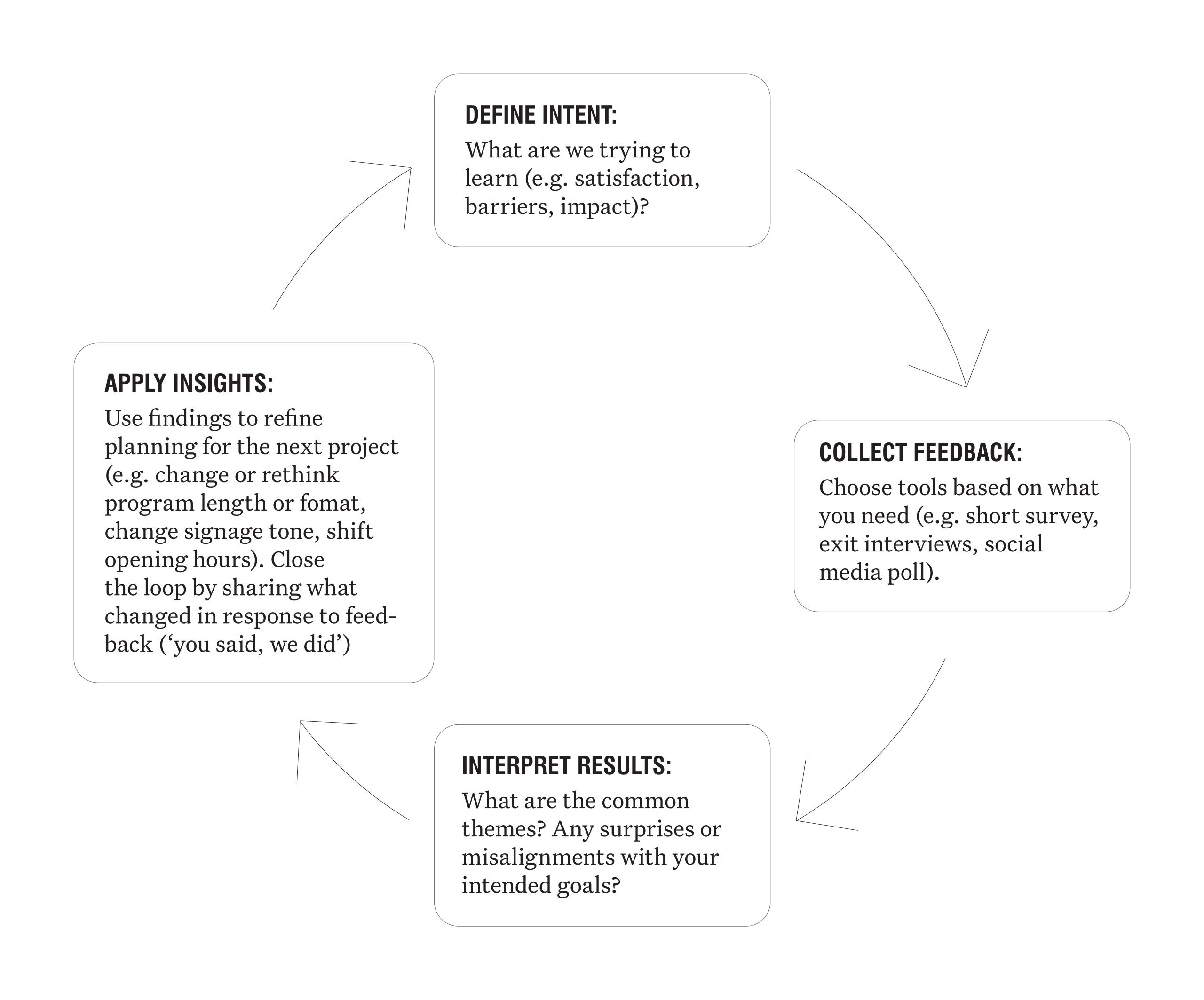
Listening to audiences and learning about their interests and needs is an important step towards trust and relevance. For people who may have already engaged with your museum, seeking feedback on their experience is essential to reviewing and improving your projects and services. If there are important segments of your community who do not engage with your museum, it’s crucial to understand why – what barriers or challenges might exist?
Ways of learning
Journey mapping
Journey mapping involves stepping out the different stages of a visitor’s interaction with a museum, such as the entrance, security and cloaking, information and ticket desks, interacting with museum staff, moving through galleries and displays, and encountering interpretative material such as signage or labels.
The process is useful to identify areas of challenge for visitors and opportunities for improvement. The Audience Experience Map template, created by the IAE Network, guides museums to consider the perspective of three different audiences: first-time visitor, repeat visitor and museum staff.
Surveys and research
Surveys, research and data are critical for bench-marking and to assess the value, purpose and performance of your museum or particular projects. It is important to first identify exactly what you wish to learn about or from your audience, and why this information will be valuable. This might include:
-
Demographic data such as age, gender, cultural or language background, city, country or state of residence – useful in identifying communities you are not reaching, as well as who you are;
-
Reason for visiting or motivation/driver to participate;
-
Expectation versus actual experience;
-
If their experience aligns with your purpose, goals and objectives;
-
If they are a first time visitor or have engaged before – this can help to understand proportions of new to repeat visitors.
Consider what questions will provide the information you seek. Shorter surveys will have a higher completion rate, so keep it direct and focused only on what you need to learn. For instance, you might want to know if a program format, ticket price or topic is working for your intended audience, if you are reaching target audiences, if your objectives for the program align with the experience of participants or other indicators of success (attendance, revenue, audiences engaged).
There are different ways to survey; here are a few:
Onsite feedback: Collecting feedback from visitors or participants face-to-face in your exhibition or program space, asking why they attended, what they enjoyed or felt worked well, and suggestions for improvements.
Post-visit surveys: Sometimes also called exit- surveys, are usually conducted face-to-face as visitors make their way out of the museum. Surveys can also be emailed to visitors who purchased exhibition or program tickets (ensure you are complying with any privacy guidelines).
Net Promoter Score (NPS): This measures the likelihood of attendees recommending the experience to others. You can learn more about NPS in a web search including ways to use it in surveys.
Thank you
New Principles for Audience Engagement in Museums: Forming Connections through Collaboration & Communication, published by the International Audience Engagement (IAE) Network, was developed with contributions from the members w ho attended the March 2024 IAE Network meeting at the National Gallery of Victoria in Melbourne, Australia. We extend our sincere thanks to all attendees for their valuable input. A special thank you to Esther Conyard, Director, Marketing Communications, Visitor Experience and Business Development, Singapore Art Museum and Rachael Hammond, Director Marketing, Partnerships and Experiences, Botanic Gardens of Sydney, for their thoughtful review of drafts of this publication.
We express our gratitude to, from the National Gallery of Victoria, Tony Ellwood AM, Director and Andrew Clark, Deputy Director for their leadership, vision and commitment regarding the International Audience Engagement Network, and the field of audience engagement and to all museum directors worldwide engaged with supporting staff to participate in IAE activities.
Thank you also Zoe Kirkby, Programs and Audience Engagement Manager and Monica Do, Programs and Audience Engagement Coordinator, National Gallery of Victoria, for their support in delivering the 2024 IAE Network meeting.
Finally, we acknowledge all current and previous IAE Network steering group members and meeting participants for their invaluable contributions to this ongoing work in museum audience engagement and advocating the value and social contribution of museums worldwide.
International Audience Engagement Network Steering Group 2024–2025
Museum Reading and Resources
International Audience Engagement Network publications
International Audience Engagement (IAE) Network, 2021: Audience Engagement in a Changing World
International Audience Engagement Network, 2018–19: Guidelines for Museums
Both publications available at ngv.melbourne
International Audience Engagement Network Online Hub
International Audience Engagement Network, ‘International Audience Engagement Network – Official Website’, National Gallery of Victoria, 2024. Available at ngv.melbourne
Publications and Museum Resources
Dementia Singapore & National Gallery Singapore, ‘Art with You: Final Report’, National Gallery Singapore, October 2022. Available at nationalgallery.sg
Denekamp, Cathelijne, Accessibility without limits, Rijksmuseum, 2022. Available at www.rijksmuseum.nl
Disability Action Committee, ‘NGV Disability Action Plan 2021–24’, National Gallery of Victoria, January 2021. Available at Available at ngv.melbourne
Kalbach, Jim, The Jobs to be Done playbook: Align Your Markets, Organization, and Strategy Around Customer Needs, Rosenfeld Media, 2020.
Kintz, Pauline, Text in the Rijksmuseum, Rijksmuseum, 2024. Available at www.rijksmuseum.nl
Kotter, John P., Leading Change, Harvard Business Review Press, 1996.
Khashan, Natanya & Rozan, Adam, Senior Audience Development Lead, ‘The Unofficial NMAH Staff Bio Writing Guidelines’, American Alliance of Museums and National Museum of American History, March 2024.
Lord, Gail, The Manual of Museum Management: for Museums in Dynamic Change, Third Edition, Rowman & Littlefield Publishers, 2024.
Maggie McColl, Pete Brown, Michelle Delaney, Karl Borromaus Murr and Henrik Zipsane (eds), Routledge Handbook of Museum and Heritage Education, Routledge, 2026.
National Museum of American History, ‘Trauma based knowledge work’, National Museum of American History. Available at americanhistory.si.edu
Nitze, Marina & Sinai, Nick, Hack your bureaucracy: Get Things Done No Matter What Your Role on Any Team, Hachette, 2022.
Tan, Suenne, ‘Museums as Spaces for Well- Being’ in Cultural Connections, Vol. 6, July 2021. Available at www.mccy.gov.sg
TRONVIG, ‘Museum Marketing, Communications & Audience Engagement Glossary’, TRONVIG, May 2023 Available at glossary.tronviggroup.com
Wycherley, James, Transforming insight: The 42 Secrets of Successful Corporate Insight Teams, Insight Management Academy, 2020.
Youth Engagement Team, ‘The Youths Take Over: Our Kolektif Journey in Youth Engagement’, National Gallery Singapore, September 2023 Available at nationalgallery.sg
International Audience Engagement (IAE) Network Meeting
March 2024, National Gallery of Victoria, Melbourne, Australia
Attendees and Publication Working Group
Art Gallery of New South Wales, Sydney, Australia
Rachael Hammond, Head of Marketing and Communications
Mori Art Museum, Tokyo, Japan
Masumi Okada, Leader of Learning
Eise Shiraki, Learning Curator
National Gallery of Art, Washington D.C., USA
Eric Bruce, Chief Experience Officer, Visitor Experience
National Gallery Singapore, Singapore
Suenne M. Tan, Senior Director (Museum Planning and Audience Engagement)
National Gallery of Victoria, Melbourne, Australia
Donna McColm, Assistant Director, Curatorial and Audience Engagement
Michele Stockley, Head of Learning
Leigh Cartwright, Head of Customer Service
Elisha Buttler, Head of Audience Engagement
Megan Patty, Head of Publications, Photographic Services and Library
Zoe Kirkby, Programs and Audience Engagement Manager
Siân Scott-Clash, Publishing Manager
Lucy Hambleton, Project Manager, Learning
Andrea Stahel, Community and Access Programs Manager
Kate Ryan, Curator of Children’s Programs
Stephanie Pohlman, Senior Project Coordinator, Community and Access Programs
Elisa Scarton, Senior Editorial Coordinator, Audience Engagement
Sofie Johansson, Audience Engagement Operations Coordinator
Leah Santilli, Educator
Philbrook Museum of Art, Tulsa, USA
Rachel Keith, Deputy Director for Audience Engagement & Curatorial Affairs
Rijksmuseum, Amsterdam, the Netherlands
Annemies Broekgaarden, Head of Public Engagement and Education
Singapore Art Museum, Singapore
Esther Conyard, Director, Marketing Communications, Visitor Experience and Business Development
Smithsonian’s National Museum of American History, Washington, USA
Adam Rozan
Copyright and usage
The International Audience Engagement (IAE) Network Melbourne 2024 working meeting at the National Gallery of Victoria was co-designed and facilitated by the IAE Network Steering Group with the National Gallery of Victoria as host venue.
All material in this publication including text, resources, guides, tips, diagrams and templates have been developed by the IAE Network and are intellectual property of the IAE Network. Permission to reproduce or republish material must be granted by the IAE Network.
Contact us
For information on the IAE Network please email your regional Steering Group contact or via our online form.