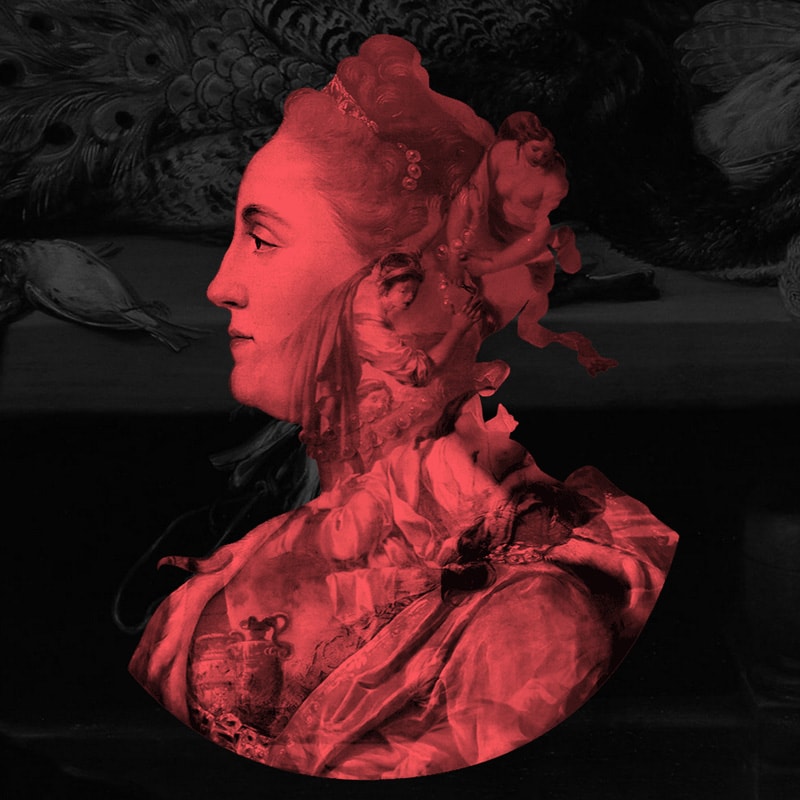


Immerse yourself this winter in the cosmopolitan court of Catherine the Great, the eighteenth century’s most visionary female art collector. From 31 July 2015 the National Gallery of Victoria, in conjunction with the Hermitage Museum, St Petersburg and Art Exhibitions Australia (AEA), presents Masterpieces of the Hermitage: The Legacy of Catherine the Great, bringing the legendary collection of the woman who embodied the Age of Enlightenment to Australia for the first time.
Told through a sweeping survey of masterpieces of art and design, this is the story of Sophie Friederike Auguste von Anhalt-Zerbst-Dornburg (1729–1796), a German-born woman who embraced her adopted country of Russia, transforming its imperial capital Saint Petersburg into an international centre of Enlightenment.
A woman of the world
Catherine the Great (Catherine II) oversaw a period of cultural renaissance for Russia during the thirty-four years of her reign (1762–1796). The world of ideas in which she was deeply involved from an early age found tangible expression everywhere in the material world she later created around herself. The great complexes of imperial buildings that Catherine constructed reflected her informed interest in Classical and Chinese culture. Her collecting of paintings stemmed from a belief in the civilising power of art, and in its potential role in international diplomacy. Catherine’s diverse collections of decorative arts not only aimed to dazzle and please, with their richness and technical perfection, but also had the more practical purpose to raise standards of artistic production in Russia. It is an occasion for celebration that more than 500 exemplary works of art from her personal collection, including paintings, sculptures, drawings, porcelain, silver and precious gems, are being seen in Australia for the first time.
The immense breadth of Catherine’s interests and enthusiasms is showcased by this exhibition, as each room reveals another field of learning and yet another artistic tradition. Although she took no credit for being connoisseur, Catherine was no mere dabbler. She worked hard, read widely and corresponded about all manner of artistic subjects with the finest minds of her age. In portraits, Catherine self-consciously styled herself as Minerva, goddess of wisdom and protector of the arts. She employed an army of artists, architects and artisans, many of them lured from abroad, in projects she was genuinely interested in. Catherine was curious about the practical application of ideas, designing her own buildings and encouraging family members to take up the art of gem engraving.
Catherine and the Classical world
The peace that came after the pan-European Seven Years War turned Rome into a busy epicentre of archaeological excavations in the late 1760s. Untold marvels of ancient Roman architecture and sculpture were being unearthed to the frenzied delight of scholars and collectors alike. The fever for Antiquity struck Catherine – 3000 kilometres away – very hard. Unable to travel there in person because she was too busy, the Empress enlisted artists of all nationalities, from gem engravers to watercolourists, to capture these Classical wonders for herself and, ultimately, for her fellow Russians. Paradoxical as it may seem to modern thinking, to partake in the cult of Antiquity during the eighteenth century was to signal oneself as at the ‘cutting edge’ of culture. Artists were clever and quick at finding ways to combine the best of the past with the best of the present, producing enchanting novelties in the neoclassical taste which they turned to commercial advantage.
‘Cameo fever’
Catherine assembled a collection of thousands of tiny classical gems and casts by English gem carvers as a personal library of visual ideas. From the Sèvres Manufactory in France she ordered a vast and precious turquoise dessert service ‘after Antique models’, encrusted with ‘reproductions of cameos … in the best and newest style’ for her court ‘favourite’ and fellow gem-lover, Count Grigory Potemkin.
To fulfil her wishes, British gem makers and French porcelain workers employed the latest technical knowledge and Catherine rewarded them handsomely for their commitment to excellence. From her passion for cameos grew a wider love of collecting objects that led eventually to the foundation of the Hermitage.
A passionate collector
Aware of the political prestige that a great art collection could bring to a nation, Catherine collected masterpieces of modern and historical art. Sometimes she purchased directly from artists; for example, the Roman views bought from Charles-Louis Clérisseau. More often, however, she bought collections on the recommendation of her many learned and willing advisers across Europe who (in addition to her own energetic Russian agents) included the French philosophers Voltaire and Denis Diderot, the German writer Baron Friedrich Melchior von Grimm, and her own personal consultant and artistic agent, the French sculptor Etienne-Maurice Falconet. In this way in 1779 Catherine acquired a Leonardo da Vinci, along with masterpieces by Anthony van Dyck, as part of the collection of Sir Robert Walpole, England’s first prime minister.
Catherine: A buyer of collections
Acquiring large groups of works was often expensive and not foolproof, but was a pragmatic approach which allowed Catherine to gather examples of every ‘important’ phase and national school of painting rapidly. Energetic in all things, she wished to waste no time in creating and projecting an image of herself and her country as engaged in the Enlightenment project.
The fruits of this great collecting endeavour, which Catherine so evidently enjoyed, are seen in the enfilade of rooms in this exhibition dedicated to Italian, Flemish, Dutch, French and British paintings and modern and Old Master drawings. In keeping with their method of acquisition, the pictures – beyond their visible beauty – have provenances that hint of the stories of earlier inspired collectors: august European names, such as Count Heinrich von Brühl, Count Cobenzl, Louis-Antoine Crozat, Baron de Thiers, Robert Walpole and others, are now interleaved into the tradition of the Hermitage and Catherine the Great.
Catherine not only looked to the West, but also turned to her counterpart the Qianlong Emperor in the East for lessons in harmonious government. She recognised a height of refinement in China’s decorative arts that fuelled her imagination and acquisitive instincts. Just as her French table settings were an inspiration to nascent Russian porcelain industries, here again Catherine’s extensive collection of silver filigree and enamel functioned to inspire the Russian imperial metal workshops and armouries. Originally Catherine’s Chinese collection adorned the Oranienbaum, Tsarskoe Selo and the Winter Place in specially designed, sympathetic interiors where one could breathe ‘the Ambrosia of Asia’. Deprived of opportunities to travel due to her busy schedule, Catherine travelled imaginatively through her art.
Friendships and the art of intimacy
Noted and loved for her sense of informality in private, Catherine nurtured rewarding friendships to a degree that is surely unusual among monarchs of any time. Although serfdom was not abolished in her age, Catherine abolished social hierarchy in her personal apartments. Some outstanding examples of family and child portraiture by Flemish, Dutch and French artists pay tribute to the warm, familial relations enjoyed by the growing bourgeoisie of Europe. In private, Catherine did her best to emulate the easy intimacy and affection radiating from these pictures, although she herself was raised with no such examples and did not rear her own children. She also understood that exposing her fellow countrymen to the world’s finest cultural offerings was an important means of elevating taste and knowledge, thus including Russia in the great and global Enlightenment movement of the eighteenth century.