One must buy for the future, even against public opinion, although it is satisfying when you do buy a picture that’s popular … It’s important to get really top class things.
– Mary Woodall, Melbourne Herald, 1965
On 1 May 1965 Dr Mary Woodall CBE (1901–1988) became the first woman to be appointed London-based adviser to the Felton Bequest for the National Gallery of Victoria and subsequently proved to be one of the most effective advisers in the history of that office (fig. 1). One feature of her tenure from 1965 to 1974 was the manner in which she managed to revive the Felton Bequest’s ability to purchase old master (thirteenth century to seventeenth century) works of art. Although the buying power of the Bequest had been severely depleted by inflation since 1955, and had consequently been unable to keep pace with the price increases of the international art market,1 See ‘Mr McDonnell as adviser to the Felton Bequest and its purchasing policy during the post-war period’ (Felton Committee Report, 3 June 1964, National Gallery of Victoria archive); the one exception during this period of restricted buying power was the purchase in 1959 of George Romney’s A large family piece, c.1768. Dr Woodall’s astute acquisition policies helped her to acquire major works by artists including Claude Lorrain (1600–1682), Guido Reni (1575–1642) and Annibale Carracci (1560–1609). The new mezzanine galleries of sixteenth- and seventeenth-century European art at NGV International (fig. 2) are dominated by seven of Mary Woodall’s major purchases from both the Felton Bequest and the Everard Studley Miller Bequest and dramatically showcase the quality and quantity of her acquisitions. While this essay examines Dr Woodall’s acquisitions of Italian paintings, it is also important to note that her tenure saw the purchase of some equally significant works in the area of prints and drawings, Asian arts and the decorative arts.
This was the second time Dr Woodall had successfully built up the pre-eighteenth-century collection for a gallery. She developed her acquisition philosophy during her distinguished career at the Birmingham City Museum and Art Gallery. Her guiding principle is best exemplified by John Ruskin’s statement concerning J. M. W. Turner: ‘The greatest picture is that which conveys to the mind of the spectator the greatest number of the greatest ideas’.2 A. Inglis & J. Long, European Masterpieces: Six Centuries of Painting from the National Gallery of Victoria, Australia, Melbourne, 2000, p. 132. The problem facing small regional galleries with limited funds like the Birmingham was that important and minor works alike had become unaffordable. To combat this Dr Woodall turned her attention to first-rate examples from the second-tier old master market that was being overlooked by her major competitors, the wealthier public institutions and even wealthier private collectors. The success of her policy lay in the fact that she avoided purchasing at public auction. She fully utilised her intimate connections with art dealers to acquire works before they became publicly listed in catalogues. She realised that trying to compete with large public institutions and private collectors would be completely futile for the Birmingham or any small gallery. In this way Dr Woodall was able to build up the collection from the pre-eighteenth-century Italian school, even though they were already highly priced.3 Felton Committee Report, 3 June 1964, NGV archive. In addition, her combined art scholarship and experience as a senior civil administrator bolstered the old master collections for both the Birmingham and the National Gallery of Victoria.
Mary Woodall was born on 6 March 1901 in Kent, England, into the industrial aristocracy. Her mother was Bertha Nettlefold whose family business, Nettlefolds & Chamberlain, had for many years dominated the economic sphere of Birmingham City and beyond. Mary Woodall read modern history at Somerville College, Oxford, and later graduated from the Slade School of Art, where she studied under Henry Tonks. She went on to the Courtauld Institute of Art and was awarded her PhD in 1937 (a rarity at the time for a woman) for her thesis on the landscapes of Thomas Gainsborough.4 Mary Woodall, The Place of Gainsborough in the Development of English Landscape with Special Reference to his Drawings, Courtauld Institute, 1937; published in 1939 as Gainsborough’s Landscape Drawings. In 1964 The Letters of Thomas Gainsborough, edited by Mary Woodall, was published. Ralph Edwards stated, ‘Dr Woodall has placed all students of Gainsborough in her debt (her Gainsborough’s Landscape Drawings which appeared so long ago as 1939 is still the only book on the subject) and now she has greatly increased the obligation’ (Connoisseur, February, vol. 155, 1964, p. 100). For a short time she was a volunteer attaché at the British Museum but with the onset of World War II she joined the Women’s Volunteer Services as a regional director. During the war she was employed at the Ministry of Health and, later, the Ministry of Supply.
In 1945 Dr Woodall was encouraged to take the position of Keeper of Art at the Birmingham City Museum and Art Gallery. After one year in this position the director, Trenchard Cox (Sir), promoted her to deputy director. In 1956 Cox departed to become director of the Victoria and Albert Museum and Dr Woodall succeeded him as director of the Birmingham. Her appointment raised a few eyebrows at the time as she had become the first woman director of any major municipal gallery or museum in Great Britain (fig. 3).5 ‘Dr Mary Woodall. Art administrator and scholar’, Obituary, Times, London, 6 April 1988, p. 16. The Birmingham had been distinguished mainly by its Pre-Raphaelite painting collection, but under Dr Woodall’s directorship its reputation was elevated to one of national significance through her successful acquisition of pre-eighteenth-century paintings that bolstered the Italian-school collection. It required all of her administrative and negotiating skills to secure the necessary funds to acquire works by Guido Reni, Annibale Carracci, Giovanni Benedetto (1609–1664), Carlo Dolci (1616–1687) and Jacques Rousseau (1630–1693), as well as a large painting, Erminia and the shepherds, 1626, which had been painted for the Duke of Mantua by Giovanni Francesco Barbieri (1591–1666), nicknamed ‘Guercino’ (cross-eyed). But the acquisition that best demonstrates Dr Woodall’s skills is her coup in 1958 in purchasing the painting by Sandro Botticelli (c.1444–1510) Descent of the Holy Ghost, 1495–1505.6 Times, London, 11 August 1959, p. 11. The Botticelli had been bought earlier in June 1958 on behalf of an American gallery in London at a Sotheby’s auction. Dr Woodall successfully applied to the Reviewing Committee on the Report of Works of Art, requesting them to not grant an export license. At the same time she secured funding from the National Art Collections Fund to purchase the work for the very reasonable sum of 6000 pounds sterling.7 ibid., (repr.).
In 1962 Dr Woodall was elected as the first woman president of the Museums Association of Great Britain. In this role she lobbied heavily for an increase in the educational training and academic standard of museum employees. She asserted that higher wages should be paid as quality people were being lured instead to universities and private collections. She was a perfectionist herself and, as director of the Birmingham, she had a hands-on approach to every aspect of the gallery and museum. She organised the hanging of works and even mixed the paint used on the walls.
In 1964 Dr Woodall retired as director of the Birmingham and the following year she agreed to become the London-based adviser to the Felton Bequest. The acquisition policy that she subsequently implemented altered slightly from the very successful one she had developed at the Birmingham City Museum and Art Gallery. She seems to have been heavily influenced by the fact that, unlike the Birmingham, the National Gallery of Victoria was known as a gallery and not as a gallery and museum. With gallery collecting principles as her premise, Dr Woodall’s passion and experience in the area of Italian painting predisposed her to such acquisitions, but she also saw the great value in collecting in other areas. As John Poynter has noted: ‘She made no specific suggestions, but remarked that the Gallery needed more sculpture, that it should seek modern prints … and should look to works from South-East Asia’.8 J. Poynter, Mr Felton’s Bequests, Melbourne 2003, p.523.
The conditions Dr Woodall encountered were the opposite to those of her predecessor, A. J. L. (John) McDonnell (1904–1964). His advisership from 1947 until his sudden death in London in 1964 was under the most favourable circumstances.9 Felton Committee Report, 3 June 1964, NGV archive. From 1949 to 1954 the Felton had been able to purchase an average of three or four major paintings each year. Yet, from 1955 onwards, the number and quality of such works decreased sharply.10 ibid. The local media had for years published obituaries of the Felton, describing it, at best, as a spent force and, at worst, obsolete.11 See Poynter, p.522. Despite these considerable obstacles, Dr Woodall almost managed to recapture the postwar boom by acquiring, on average, two Italian old master paintings for every year of her tenure.
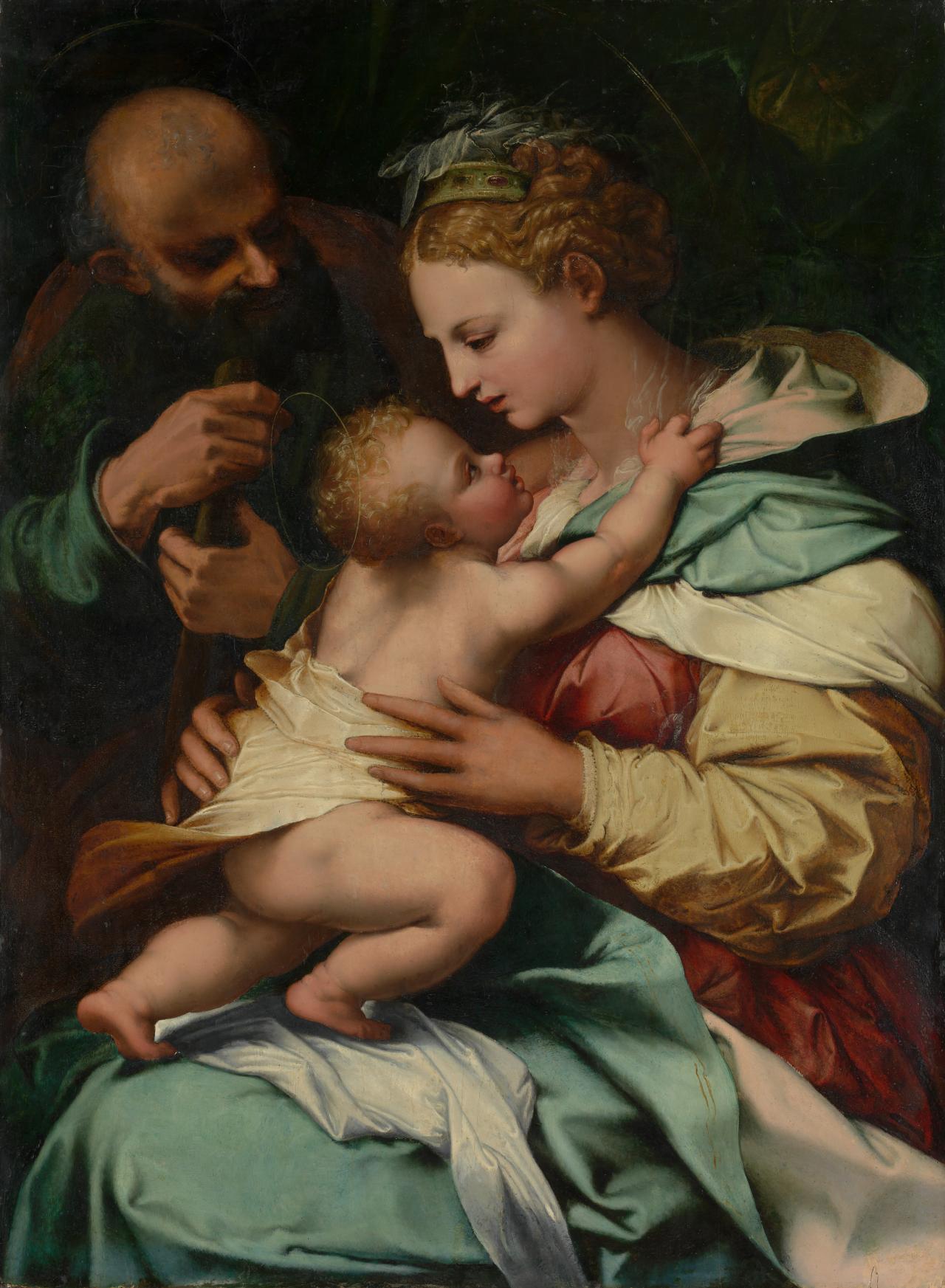
In 1966 and 1967 Dr Woodall purchased two paintings that perfectly reflected her exploitation of the system of buying first-rate examples from the second-tier market. The panel painting The Holy Family, c.1545, by the Italian Mannerist Perino del Vaga (1501–1547), was acquired in 1966 from the Hazlitt Gallery, London, for 12,000 pounds sterling, and a small panel painting, The Adoration of the Magi, c.1420, by the Italian artist Giovanni Toscani ((1370–80)–1430) (fig. 4), was purchased from Herbert N. Bier, London in 1967.12 Acquired as Italian School, Florentine, 15th century (see U. Hoff, European Paintings before 1800 in the National Gallery of Victoria, Melbourne, 1995, p. 292). Perino del Vaga had assisted Raphael and was considered one of his most brilliant disciples, representing a fundamental link between the two stylistic periods of Raphael and Michelangelo. The purchase of Toscani’s The Adoration of the Magi became the earliest Renaissance work to enter the collection; the price of AUD$31,000, a considerable percentage of the total Felton income for that year,13 Felton Committee Minutes, 10 February 1966, p.33, NGV archive. highlights how costly such works had become.
In 1967 Dr Woodall also secured a small early work by the ‘father of European landscape’ Claude Lorrain. This first-class example came from the Earl of Brownlow’s collection and was purchased through Dr Woodall’s trusted connections at Agnew’s, the art dealers in London. The painting, an oil on canvas titled River landscape with Tiburtine Temple at Tivoli, c.1635 (fig. 5),14 This painting represented the National Gallery of Victoria in Claude Lorrain (1600–1682): A Tercentenary Exhibition at the National Gallery of Art, Washington DC, and Galeries nationales du Grand Palais, Paris, between 1982 and 1983 (see Hoff, p.56, cat. no. 7). was purchased for 15,000 pounds sterling. The work was previously unknown, which explains why it was sold for such a relatively low price. Yet, at the time, the Felton funds were at one of their lowest levels.15 Felton Committee Minutes, 8 April 1967, p. 40, NGV archive. In the competitive international art market it required every bit of inside information and access to major collections and dealers for Dr Woodall to make quality acquisitions. The purchase of a genuine Lorrain filled the gap in the collection which had been created by a Lorrain work that proved to be a contemporary copy.
Dr Woodall had also been asked to undertake advisery work on behalf of the Everard Studley Miller Bequest,16 See P. Paffen, ‘Everard Studley Miller and his bequest to the National Gallery of Victoria’, Art Bulletin of Victoria, no. 35, 1994, p. 35. which had an unusually fortunate period during 1967–68. Through the bequest the NGV received four portraits of outstanding merit. Unlike the Felton Bequest, the Miller Bequest stipulated its funds be used to purchase ‘portraits of individuals of merit in History painted, engraved or sculptured before AD 1800’. Dr Woodall used the funds to acquire the Gallery’s first example of an ‘elevated’ portrait with the purchase in 1967 of the British artist Johan Zoffany’s (1733–1810), painting, Elizabeth Farren as Hermione in the The Winter’s Tale, c.1780.17 See Hoff, ‘Recent additions to the National Gallery and Art Museum’, Art Bulletin of Victoria. no. 9, 1967–68, p. 38. Elizabeth Farren’s stance is very similar to that of the sitter in Joshua Reynolds’s Mrs Abington as the The Comic Muse. 1764–65 (Waddesdon Manor, Buckinghamshire, England), indicating Zoffany’s alignment with Reynolds’s ‘grand style’ of portraiture. The marble bust Emperor Septimus Severus, acquired 1967–68, was the first Roman portrait bust to enter the Gallery’s collection and was also purchased through the Miller Bequest. Three further sculptural acquisitions were made between 1967 and 1968. The bust George Gougenot, 1748, by Jean-Baptiste Pigalle (1714–1785), was a superb example of baroque illusionism, and the terracotta bust of Rubens, c.1743, by Michael Rysbrack (1693–1770), was an ideal acquisition for the Miller Bequest since it was made as part of a series of ‘men of merit in history’. Jean-Antoine Houdon (1741–1828) was the most celebrated French sculptor of the eighteenth century and is considered to be one of the greatest portraitists of the period. His plaster bust Jean-Jacques Rousseau, c.1778, which was taken from a death mask, conveys the nervous sensibility at the core of the great French philosopher’s mind.
The acquisition in 1968 of the painting by Bernardo Cavallino (1616–c.1656) The Virgin Annunciate, c.1645 (fig. 6), was purchased for 12,000 pounds sterling, which was approximately one-third of the Felton funds available at that time; however, the choice to expend these funds was well made.18 Felton Committee Minutes, 24 February 1968, p. 65, NGV archive. About eight of his paintings are extant and only one of them is dated.19 See Getty Museum, , viewed 6 October 2002. In a report of a joint meeting of representatives from the Gallery and Felton Committee members on 19 August 1971, the opening remarks by Felton chairman Sir Clive Fitts illustrate how highly they regarded Dr Woodall’s professional and personal attributes:
I may say that I had known Dr Woodall for a long time before she became a Felton adviser. Her standing and reputation in England and the U.S.A. are very high … She is exceedingly well liked and there is no doubt that opportunities come her way that would not be available to everyone.20 Report of the joint meeting between representatives of the National Gallery of Victoria and Felton Committee members, 19 August 1971, NGV archive.
In relation to the usefulness of a London adviser, Sir Clive added:
One of the functions of the adviser is to make the rounds of the Galleries to keep in touch with works which may never get into a firm’s catalogue and thus never come to the notice of the local curators.21 ibid.
In 1971 and 1974 Dr Woodall acquired two works by the famed Annibale Carracci, The Holy Family, c.1589 and Pan, c.1592 (fig. 7), from the Hazlitt Gallery in London.22 Hoff, European Paintings, p. 50.
Three years later Sir Denis Mahon stated that Pan was certainly by Annibale and was ‘of the finest quality and considerable art historical importance’.23 Sir Denis Mahon, quoted in Hoff, European Paintings, p. 52. Dr D. Stephen Pepper considers the picture to be ‘one of the masterpieces of Annibale Caracci’.24 D. Stephen Pepper, quoted in Hoff, ibid. In 1974 she also acquired Head of an old woman, 1640–42, by Guido Reni. Reni was born in Bologna and at the age of twenty he joined the Carracci Academy to further his painting studies. He was a quintessential academic but remained one of the most elegant painters of all time.
In 1969 Dr Woodall’s portfolio of responsibilities expanded considerably with her appointment as a trustee of the National Gallery in London and as a representative for the gallery on the Council of the National Trust. In 1972 she was also elected to the National Gallery Scientific Liaison Committee. None of these activities had a detrimental effect on her responsibilities to the Felton Bequest.
In her last letter to Sir Clive Fitts, Dr Woodall stated: ‘I have tried to strengthen further the strong points in the collection, to buy quality rather than names and not to try to “gap-fill”’.25 Mary Woodall, letter to Sir Clive Fitts, Felton Bequest correspondence, Fitts archive, University of Melbourne, 29 October 1974. She added that she had tried to forge links in the NGV collection between paintings and drawings of the same subject and period, and to decorative-arts objects similar to those appearing in paintings. This principle distinguished Dr Woodall’s major painting purchases during her tenure as adviser. Works were not recommended for purchase simply because they were reasonably priced, but also because they provided a scholarly link between existing works in the collection. Dr Woodall had successfully managed, through quiet professionalism and consistency, to steer the Felton Committee to concentrate their depleted funds on special paintings and objects.
Dr Woodall’s term as Felton Adviser officially ended on the 30 March 1975,26 Felton Committee correspondence, 21 April 1975, NGV archive. when she was seventy-four. In the following year she also retired as a trustee of the National Gallery, London. Dr Woodall immediately returned to her own painting and, later in 1978, the Ashmolean Museum in Oxford held a one-woman exhibition of fifty-four of her works in the Eldon Gallery.27 Dr Kenneth Garlick, the former authority on Japanese art at the Ashmolean Museum, has described Dr Woodall’s paintings as having been ‘drawn with surety and being on a small scale of quiet and often poetic feeling’. He considered that she was a Wordsworthian at heart (see K. Garlick, ‘Dr Mary Woodall’, Obituary, Independent, London, 14 April 1988).
On 31 March 1988, aged eighty-seven, Mary Woodall died in a nursing home near the village of Clifton Hampden, Oxfordshire, where she had lived for some years in retirement.
Peter Tzamouranis, completed BA (Honours), University of Melbourne in 2002.
This essay was originally published in Art Journal, no. 44, 2004, edited by Isobel Crombie.
Acknowledgements
I am deeply indebted to Malcolm Cormack, Paul Mellon Curator, Virginia Museum of Fine Arts, Virginia, USA, for his generous response to my enquiries about Dr Woodall.
My thanks and appreciation to Dr Kenneth Garlick for his informative correspondence that answered crucial biographical and professional information which had eluded my research. I also thank Toby Watley, Curator of Fine Arts, Birmingham Museums and Art Gallery, for his invaluable assistance in supplying information about Dr Woodall’s acquisitions and contributions during her professional career at the Birmingham.
The following archivists have generously provided information and advice in furthering my research: Katherine Boothman and Julie Mallinson, Cheltenham Ladies College, Birmingham; Judith Etherton and Joanne S. Kilgannon, the Courtauld Institute of Art, University of London; Katie Dawson, Museums Association of Great Britain; Isobel Hunter, National Gallery, London; Julia Nurse and Gary Thorn, British Museum; Wendy Kirkby, University College, London; Pauline Adams, Somerville College, Oxford; and Christopher Hunwick, Main University Archive, Oxford.
I would also like to thank and acknowledge Professor John Poynter whose research and work on the Felton Bequest has enabled me to place Mary Woodall within the context of the Bequest’s history.
Notes
This article is based on the author’s Bachelor of Arts (Honours) thesis: A Presentation of Dr Mary Woodall (1901–1988): First woman to be appointed London-based adviser to the Felton Bequest at the National Gallery of Victoria. Department of Fine Arts, Classical Studies and Archaeology, University of Melbourne, 2002
1 See ‘Mr McDonnell as adviser to the Felton Bequest and its purchasing policy during the post-war period’ (Felton Committee Report, 3 June 1964, National Gallery of Victoria archive); the one exception during this period of restricted buying power was the purchase in 1959 of George Romney’s A large family piece, c.1768.
2 A. Inglis & J. Long, European Masterpieces: Six Centuries of Painting from the National Gallery of Victoria, Australia, Melbourne, 2000, p. 132.
3 Felton Committee Report, 3 June 1964, NGV archive.
4 Mary Woodall, The Place of Gainsborough in the Development of English Landscape with Special Reference to his Drawings, Courtauld Institute, 1937; published in 1939 as Gainsborough’s Landscape Drawings. In 1964 The Letters of Thomas Gainsborough, edited by Mary Woodall, was published. Ralph Edwards stated, ‘Dr Woodall has placed all students of Gainsborough in her debt (her Gainsborough’s Landscape Drawings which appeared so long ago as 1939 is still the only book on the subject) and now she has greatly increased the obligation’ (Connoisseur, February, vol. 155, 1964, p. 100).
5 ‘Dr Mary Woodall. Art administrator and scholar’, Obituary, Times, London, 6 April 1988, p. 16.
6 Times, London, 11 August 1959, p. 11.
7 ibid., (repr.).
8 J. Poynter, Mr Felton’s Bequests, Melbourne 2003, p.523.
9 Felton Committee Report, 3 June 1964, NGV archive.
10 ibid.
11 See Poynter, p.522.
12 Acquired as Italian School, Florentine, 15th century (see U. Hoff, European Paintings before 1800 in the National Gallery of Victoria, Melbourne, 1995, p. 292).
13 Felton Committee Minutes, 10 February 1966, p.33, NGV archive.
14 This painting represented the National Gallery of Victoria in Claude Lorrain (1600–1682): A Tercentenary Exhibition at the National Gallery of Art, Washington DC, and Galeries nationales du Grand Palais, Paris, between 1982 and 1983 (see Hoff, p.56, cat. no. 7).
15 Felton Committee Minutes, 8 April 1967, p. 40, NGV archive.
16 See P. Paffen, ‘Everard Studley Miller and his bequest to the National Gallery of Victoria’, Art Bulletin of Victoria, no. 35, 1994, p. 35.
17 See Hoff, ‘Recent additions to the National Gallery and Art Museum’, Art Bulletin of Victoria. no. 9, 1967–68, p. 38. Elizabeth Farren’s stance is very similar to that of the sitter in Joshua Reynolds’s Mrs Abington as the The Comic Muse. 1764–65 (Waddesdon Manor, Buckinghamshire, England), indicating Zoffany’s alignment with Reynolds’s ‘grand style’ of portraiture. The marble bust Emperor Septimus Severus, acquired 1967–68, was the first Roman portrait bust to enter the Gallery’s collection and was also purchased through the Miller Bequest. Three further sculptural acquisitions were made between 1967 and 1968. The bust George Gougenot, 1748, by Jean-Baptiste Pigalle (1714–1785), was a superb example of baroque illusionism, and the terracotta bust of Rubens, c.1743, by Michael Rysbrack (1693–1770), was an ideal acquisition for the Miller Bequest since it was made as part of a series of ‘men of merit in history’. Jean-Antoine Houdon (1741–1828) was the most celebrated French sculptor of the eighteenth century and is considered to be one of the greatest portraitists of the period. His plaster bust Jean-Jacques Rousseau, c.1778, which was taken from a death mask, conveys the nervous sensibility at the core of the great French philosopher’s mind.
18 Felton Committee Minutes, 24 February 1968, p. 65, NGV archive.
19 See Getty Museum, , viewed 6 October 2002.
20 Report of the joint meeting between representatives of the National Gallery of Victoria and Felton Committee members, 19 August 1971, NGV archive.
21 ibid.
22 Hoff, European Paintings, p. 50.
23 Sir Denis Mahon, quoted in Hoff, European Paintings, p. 52.
24 D. Stephen Pepper, quoted in Hoff, ibid.
25 Mary Woodall, letter to Sir Clive Fitts, Felton Bequest correspondence, Fitts archive, University of Melbourne, 29 October 1974.
26 Felton Committee correspondence, 21 April 1975, NGV archive.
27 Dr Kenneth Garlick, the former authority on Japanese art at the Ashmolean Museum, has described Dr Woodall’s paintings as having been ‘drawn with surety and being on a small scale of quiet and often poetic feeling’. He considered that she was a Wordsworthian at heart (see K. Garlick, ‘Dr Mary Woodall’, Obituary, Independent, London, 14 April 1988).
Dai nostri archivi: La NGV può vantare una consolidata tradizione di studi dedicati all’arte italiana conservata nelle proprie collezioni. Questo saggio è tratto dal numero 44 (2014) di Art Journal, la storica rivista accademica della NGV, pubblicata per la prima volta nel 1945.
Occorre investire con uno sguardo rivolto al futuro, anche quando ciò significa andare contro l’opinione dominante. Certo, è gratificante acquisire opere già apprezzate dal grande pubblico, ma la priorità resta assicurarsi lavori di altissimo livello.
– Mary Woodall, Melbourne Herald, 1965
Il 1° maggio 1965 la dott.ssa Mary Woodall CBE (1901–1988) fu nominata prima donna consulente con sede a Londra per il Felton Bequest della National Gallery of Victoria, distinguendosi in seguito come una delle figure più efficaci nella storia di questo incarico (fig. 1). Una delle caratteristiche distintive del suo mandato, tra il 1965 e il 1974, fu la capacità di rilanciare il ruolo del lascito della famiglia Felton nell’acquisizione di opere degli antichi maestri, che operarono tra il XIII il XVII secolo. Sebbene il potere d’acquisto del lascito fosse stato fortemente eroso dall’inflazione a partire dal 1955, impedendogli di tenere il passo con l’aumento dei prezzi sul mercato internazionale dell’arte,1 See ‘Mr McDonnell as adviser to the Felton Bequest and its purchasing policy during the post-war period’ (Felton Committee Report, 3 June 1964, National Gallery of Victoria archive); the one exception during this period of restricted buying power was the purchase in 1959 of George Romney’s A large family piece, c.1768. le accorte politiche di acquisizione della dott.ssa Woodall le consentirono di assicurarsi opere di grande rilievo di artisti quali Claude Lorrain (1600–1682), Guido Reni (1575–1642) e Annibale Carracci (1560–1609). Le nuove gallerie del mezzanino dedicate all’arte europea del XVI e XVII secolo presso la NGV International (fig. 2) sono dominate da sette tra le principali opere acquisite da Mary Woodall attraverso il Felton Bequest e l’Everard Studley Miller Bequest, evidenziando in modo significativo la qualità e la consistenza delle sue acquisizioni. Sebbene questo saggio si concentri sulle acquisizioni di dipinti italiani effettuate dalla dott.ssa Woodall, è opportuno sottolineare che durante il suo mandato furono acquistate anche opere di pari rilievo nei settori delle stampe e dei disegni, delle arti asiatiche e delle arti decorative.
Si trattava della seconda occasione in cui la dott.ssa Woodall riusciva a costituire una collezione di opere anteriori al XVIII secolo per una galleria. La sua filosofia in materia di acquisizioni si sviluppò nel corso della sua illustre carriera presso il Birmingham Museum and Art Gallery Il suo principio guida trova la sua espressione più compiuta nelle parole di John Ruskin riguardanti J. M. W. Turner: «Il quadro più straordinario è quello che trasmette alla mente dello spettatore il maggior numero delle idee più straordinarie».2 A. Inglis & J. Long, European Masterpieces: Six Centuries of Painting from the National Gallery of Victoria, Australia, Melbourne, 2000, p. 132. Il problema che le piccole gallerie regionali con risorse limitate, come quella di Birmingham, si trovavano ad affrontare era che sia le opere di primo livello sia quelle secondarie erano ormai diventate inaccessibili sul mercato. Per ovviare a questa situazione, la dott.ssa Woodall rivolse la propria attenzione a opere di altissimo livello provenienti dal mercato secondario degli antichi maestri, un ambito spesso trascurato sia da altre istituzioni, anche più facoltose, sia da collezionisti privati ancora più ricchi. Il successo della sua politica risiedeva anche nella scelta di evitare gli acquisti durante aste aperte al pubblico. La dott.ssa Woodall seppe sfruttare appieno i suoi stretti rapporti con i mercanti d’arte, assicurandosi delle opere prima che venissero rese pubbliche nei cataloghi. Si rese conto che tentare di competere con le grandi istituzioni pubbliche e con i collezionisti privati sarebbe stato del tutto vano per la galleria di Birmingham, così come per qualsiasi altra piccola istituzione. In questo modo la dott.ssa Woodall riuscì ad ampliare la collezione dedicata alla scuola italiana anteriore al XVIII secolo, nonostante i prezzi di queste opere fossero già molto elevati. 3 Felton Committee Report, 3 June 1964, NGV archive. Inoltre, la sua competenza in materia d’arte, unita all’esperienza maturata come alta funzionaria pubblica, contribuì ad arricchire le collezioni di capolavori antichi sia della Birmingham Museum and Art Gallery sia della National Gallery of Victoria.
Mary Woodall nacque il 6 marzo 1901 nel Kent, in Inghilterra, in una famiglia appartenente all’aristocrazia industriale. Sua madre era Bertha Nettlefold, la cui azienda di famiglia, la Nettlefolds & Chamberlain, aveva dominato per molti anni la scena economica di Birmingham e delle zone limitrofe. Mary Woodall studiò storia contemporanea al Somerville College di University of Oxford e successivamente si formò alla Slade School of Fine Art, dove ebbe come insegnante Henry Tonks. Proseguì gli studi al Courtauld Institute of Art e nel 1937 conseguì il dottorato di ricerca (all’epoca un traguardo raro per una donna) con una tesi sui paesaggi di Thomas Gainsborough. 4 Mary Woodall, The Place of Gainsborough in the Development of English Landscape with Special Reference to his Drawings, Courtauld Institute, 1937; published in 1939 as Gainsborough’s Landscape Drawings. In 1964 The Letters of Thomas Gainsborough, edited by Mary Woodall, was published. Ralph Edwards stated, ‘Dr Woodall has placed all students of Gainsborough in her debt (her Gainsborough’s Landscape Drawings which appeared so long ago as 1939 is still the only book on the subject) and now she has greatly increased the obligation’ (Connoisseur, February, vol. 155, 1964, p. 100). Per un breve periodo lavorò come assistente volontaria al British Museum, ma con lo scoppio della Seconda guerra mondiale entrò nel Servizio volontario femminile (Women’s Volunteer Services) in qualità di direttrice regionale. Durante la guerra lavorò presso il Ministero della Salute e successivamente presso il Ministero dell’Approvvigionamento.
Nel 1945 la dott.ssa Woodall fu invitata ad assumere l’incarico di conservatrice della sezione artistica presso la Birmingham Museum and Art Gallery. Dopo un anno in tale ruolo, il direttore Sir Trenchard Cox la promosse a vicedirettrice. Nel 1956 Cox lasciò l’incarico per assumere la direzione del Victoria and Albert Museum e la dott.ssa Woodall gli succedette come direttrice del museo di Birmingham. La sua nomina suscitò alcune perplessità all’epoca, poiché divenne la prima donna a ricoprire la carica di direttrice di una delle principali gallerie o musei municipali della Gran Bretagna (fig. 3). 5 ‘Dr Mary Woodall. Art administrator and scholar’, Obituary, Times, London, 6 April 1988, p. 16. Il museo di Birmingham si era distinto soprattutto per la sua collezione di pittura preraffaellita, ma sotto la direzione della dott.ssa Woodall la sua reputazione acquisì rilievo nazionale grazie al successo delle acquisizioni di dipinti anteriori al XVIII secolo, che rafforzarono in modo significativo la collezione di scuola italiana. Fu necessario impiegare tutte le sue capacità amministrative e negoziali per ottenere i fondi necessari all’acquisto di opere di Guido Reni, Annibale Carracci, Giovanni Benedetto Castiglione (1609–1664), Carlo Dolci (1616–1687) e Jacques Rousseau (1630–1693), oltre a un grande dipinto, Erminia e i pastori (1626), realizzato per il duca di Mantova da Giovanni Francesco Barbieri, detto Guercino. Ma l’acquisizione che meglio dimostra le capacità della dott.ssa Woodall è il colpo da maestro messo a segno nel 1958 con l’acquisto del dipinto di Sandro Botticelli (1444 ca.–1510), La discesa dello Spirito Santo (1495–1505). 6 Times, London, 11 August 1959, p. 11. Il Botticelli era stato in precedenza acquistato, nel giugno 1958, per conto di una galleria americana con sede a Londra, in occasione di un’asta di Sotheby’s. La dott.ssa Woodall presentò con esito positivo una richiesta alla Commissione di revisione per la relazione sulle opere d’arte, chiedendo che non venisse concessa la licenza di esportazione. Contestualmente ottenne un finanziamento dal National Art Collections Fund per acquistare l’opera al prezzo, molto vantaggioso, di 6.000 sterline. 7 ibid., (repr.).
Nel 1962 la dott.ssa Woodall fu eletta prima donna presidente dell’Associazione dei Musei della Gran Bretagna. In questo ruolo si impegnò a fondo per migliorare la formazione professionale e il livello accademico del personale museale. La dott.ssa Woodall sosteneva la necessità di aumentare gli stipendi, poiché i professionisti più qualificati venivano attratti piuttosto dalle università e dalle collezioni private. Era una perfezionista e, in qualità di direttrice del museo di Birmingham, seguiva direttamente ogni aspetto della galleria e delle attività museali. Curava personalmente l’allestimento delle opere e arrivava persino a preparare in prima persona la pittura utilizzata per le pareti.
Nel 1964 la dott.ssa Woodall si dimise dalla carica di direttrice del museo di Birmingham e l’anno successivo accettò l’incarico di consulente con sede a Londra per il Felton Bequest. La politica di acquisizione che mise successivamente in atto si discostava leggermente da quella che aveva elaborato con grande successo presso il Birmingham City Museum and Art Gallery. Sembra che tale orientamento sia stato fortemente influenzato dal fatto che, a differenza dell’istituzione di cui era stata direttrice a Birmingham, la National Gallery of Victoria fosse conosciuta principalmente come galleria d’arte piuttosto che come istituzione con funzioni sia di galleria sia di museo. Partendo dai principi che regolano il collezionismo museale, la passione e l’esperienza della dott.ssa Woodall nel campo della pittura italiana la portarono a realizzare tali acquisizioni, pur riconoscendo al contempo il grande valore del collezionismo anche in altri ambiti. Come ha osservato John Poynter: «(Woodall) Non ha avanzato proposte concrete, ma ha suggerito che la Galleria avrebbe bisogno di più sculture e che dovrebbe inoltre mettersi alla ricerca di stampe moderne… oltre ad orientarsi verso opere provenienti dal Sud-Est asiatico» 8 J. Poynter, Mr Felton’s Bequests, Melbourne 2003, p.523.
Le condizioni che la dott.ssa Woodall si trovò ad affrontare erano l’esatto opposto di quelle del suo predecessore, A. J. L. (John) McDonnell (1904–1964). Il suo incarico di consulente, dal 1947 fino alla sua improvvisa scomparsa a Londra nel 1964, si svolse in circostanze altamente favorevoli. 9 Felton Committee Report, 3 June 1964, NGV archive. Tra il 1949 e il 1954 infatti, il Felton Bequest era riuscito ad acquistare in media tre o quattro dipinti di grande rilievo all’anno. Tuttavia, a partire dal 1955, il numero e la qualità di tali opere subirono un drastico calo. 10 ibid. Da anni i media locali pubblicavano necrologi del Felton Bequest, descrivendolo, nel migliore dei casi, come una forza esaurita e, nel peggiore, come ormai obsoleta. 11 See Poynter, p.522. Nonostante questi notevoli ostacoli, la dott.ssa Woodall riuscì quasi a ricreare il boom del dopoguerra, acquisendo in media due dipinti di antichi maestri italiani per ogni anno del suo mandato.
Nel 1966 e nel 1967 la dott.ssa Woodall acquisì due dipinti che riflettevano pienamente la sua strategia di acquistare opere di prim’ordine sul mercato secondario. Il dipinto su tavola La Sacra Famiglia (ca. 1545), opera del manierista italiano Perino del Vaga (1501–1547), fu acquistato nel 1966 dalla Hazlitt Gallery di Londra per 12.000 sterline, insieme a un piccolo dipinto su tavola, L’Adorazione dei Magi (ca. 1420), dell’artista italiano Giovanni Toscani (1370/80–1430), acquistato da Herbert N. Bier, Londra, nel 1967 (fig. 4). 12 Acquired as Italian School, Florentine, 15th century (see U. Hoff, European Paintings before 1800 in the National Gallery of Victoria, Melbourne, 1995, p. 292). Perino del Vaga era stato assistente di Raffaello ed era considerato uno dei suoi discepoli più brillanti, rappresentando un importante anello di congiunzione tra i linguaggi stilistici di Raffaello e Michelangelo. L’acquisto dell’opera di Toscani, L’Adorazione dei Magi, segnò l’ingresso in collezione della prima opera rinascimentale. Il prezzo di 31.000 dollari australiani, pari a una quota considerevole del reddito complessivo del Felton per quell’anno, 13 Felton Committee Minutes, 10 February 1966, p.33, NGV archive. evidenzia quanto fossero ormai diventate onerose opere di questo tipo sul mercato.
Nel 1967 la dott.ssa Woodall riuscì inoltre ad aggiudicarsi una piccola opera giovanile di Claude Lorrain, il cosiddetto «padre del paesaggio europeo». Questo esemplare di prim’ordine proveniva dalla collezione del conte di Brownlow e venne acquistato grazie ai contatti di fiducia della dott.ssa Woodall presso la Agnew’s Gallery, la galleria d’arte londinese. Il dipinto, un olio su tela intitolato Paesaggio fluviale con il Tempio Tiburtino a Tivoli (ca. 1635) (fig. 5), 14 This painting represented the National Gallery of Victoria in Claude Lorrain (1600–1682): A Tercentenary Exhibition at the National Gallery of Art, Washington DC, and Galeries nationales du Grand Palais, Paris, between 1982 and 1983 (see Hoff, p.56, cat. no. 7). fu acquistato per 15.000 sterline. L’opera era fino ad allora sconosciuta, il che spiega perché sia stata venduta a un prezzo relativamente contenuto. Eppure, all’epoca, i fondi del Felton Bequest erano ai minimi storici. 15 Felton Committee Minutes, 8 April 1967, p. 40, NGV archive. Nel competitivo mercato internazionale dell’arte, la dott.ssa Woodall aveva bisogno di ogni possibile informazione riservata e dell’accesso alle principali collezioni e ai principali mercanti d’arte per poter realizzare acquisizioni di qualità. L’acquisto di un’opera autentica di Lorrain riuscì a colmare una lacuna nella collezione, causata da un dipinto attribuito a Lorrain che si era poi rivelato una copia contemporanea.
Alla dott.ssa Woodall era stato inoltre chiesto di svolgere attività di consulenza per conto dell’Everard Studley Miller Bequest, 16 See P. Paffen, ‘Everard Studley Miller and his bequest to the National Gallery of Victoria’, Art Bulletin of Victoria, no. 35, 1994, p. 35. che nel periodo 1967-1968 attraversò una fase di particolare favore. Grazie a questo lascito, la National Gallery of Victoria ha acquisito quattro ritratti di eccezionale valore. A differenza del Felton Bequest, il lascito della famiglia Miller stabiliva che i fondi dovessero essere destinati all’acquisto di «ritratti di personaggi illustri della storia, realizzati con tecniche pittoriche, incisioni o sculture anteriori al 1800». La dott.ssa Woodall utilizzò i fondi per acquisire il primo esempio di ritratto «elevato» della Galleria, con l’acquisto nel 1967 del dipinto dell’artista britannico Johan Zoffany (1733–1810), intitolato Elizabeth Farren nel ruolo di Hermione in The Winter’s Tale (ca. 1780). 17 See Hoff, ‘Recent additions to the National Gallery and Art Museum’, Art Bulletin of Victoria. no. 9, 1967–68, p. 38. Elizabeth Farren’s stance is very similar to that of the sitter in Joshua Reynolds’s Mrs Abington as the The Comic Muse. 1764–65 (Waddesdon Manor, Buckinghamshire, England), indicating Zoffany’s alignment with Reynolds’s ‘grand style’ of portraiture. The marble bust Emperor Septimus Severus, acquired 1967–68, was the first Roman portrait bust to enter the Gallery’s collection and was also purchased through the Miller Bequest. Three further sculptural acquisitions were made between 1967 and 1968. The bust George Gougenot, 1748, by Jean-Baptiste Pigalle (1714–1785), was a superb example of baroque illusionism, and the terracotta bust of Rubens, c.1743, by Michael Rysbrack (1693–1770), was an ideal acquisition for the Miller Bequest since it was made as part of a series of ‘men of merit in history’. Jean-Antoine Houdon (1741–1828) was the most celebrated French sculptor of the eighteenth century and is considered to be one of the greatest portraitists of the period. His plaster bust Jean-Jacques Rousseau, c.1778, which was taken from a death mask, conveys the nervous sensibility at the core of the great French philosopher’s mind.
L’acquisizione nel 1968 del dipinto di Bernardo Cavallino (1616–c. 1656), La Vergine Annunciata (ca. 1645) (fig. 6), fu effettuata per 12.000 sterline, una somma che rappresentava circa un terzo dei fondi del Felton Bequest disponibili all’epoca; tuttavia, la decisione di impiegare tali risorse si rivelò pienamente giustificata. 18 Felton Committee Minutes, 24 February 1968, p. 65, NGV archive. Si conoscono circa otto suoi dipinti e solo uno di essi è datato. a id=”19″ href=”#19;”>19 See Getty Museum, , viewed 6 October 2002. In un resoconto di una riunione congiunta tra i rappresentanti della Galleria e i membri del Comitato Felton del 19 agosto 1971, le osservazioni iniziali del presidente del Comitato Felton, Sir Clive Fitts, evidenziano quanto fossero apprezzate le qualità professionali e personali della dott.ssa Woodall:
«Conoscevo la dott.ssa Woodall già da molto tempo prima che diventasse consulente del Felton Bequest. La sua reputazione e la stima di cui gode in Inghilterra e negli Stati Uniti sono molto elevate… È estremamente apprezzata e non vi è dubbio che le si presentino opportunità che non sarebbero alla portata di chiunque». 20 Report of the joint meeting between representatives of the National Gallery of Victoria and Felton Committee members, 19 August 1971, NGV archive.
Riguardo all’utilità del ruolo di un consulente con sede a Londra, Sir Clive aggiunse:
«Uno dei compiti del consulente è quello di visitare regolarmente le gallerie per rimanere aggiornato sulle opere che potrebbero non essere mai incluse nei cataloghi e che, di conseguenza, rischierebbero di non essere notate dai curatori locali».21 ibid.
Nel 1971 e nel 1974 la dott.ssa Woodall acquistò due opere del celebre Annibale Carracci, La Sacra Famiglia (ca. 1589) e Pan (ca. 1592) (fig. 7), dalla Hazlitt Gallery di Londra. 22 Hoff, European Paintings, p. 50.
Tre anni dopo, Sir Denis Mahon affermò che Pan era senza dubbio un’opera di Annibale Carracci e che risultava «di altissima qualità e di notevole importanza storico-artistica». 23 Sir Denis Mahon, quoted in Hoff, European Paintings, p. 52. Il dottor D. Stephen Pepper lo considera «uno dei capolavori di Annibale Carracci». 24 D. Stephen Pepper, quoted in Hoff, ibid. Nel 1974 la dott.ssa Woodall acquistò anche Testa di donna anziana (1640–42) di Guido Reni. Guido Reni nacque a Bologna e all’età di vent’anni si iscrisse all’Accademia dei Carracci per proseguire la sua formazione pittorica. Era un accademico per eccellenza, ma è rimasto uno dei pittori più eleganti di tutti i tempi.
Nel 1969 le responsabilità della dott.ssa Woodall si ampliarono notevolmente con la sua nomina a membro del consiglio di amministrazione della National Gallery e a rappresentante della galleria nel consiglio del National Trust. Nel 1972 fu inoltre eletta membro del Comitato di collegamento scientifico della National Gallery. Nessuna di queste attività ebbe ripercussioni negative sui suoi doveri nei confronti del Felton Bequest.
Nell’ultima lettera indirizzata a Sir Clive Fitts, la dott.ssa Woodall affermò: «Ho cercato di valorizzare ulteriormente i punti di forza della collezione, puntando sulla qualità piuttosto che sui nomi e senza cercare di “colmare le lacune”». 25 Mary Woodall, letter to Sir Clive Fitts, Felton Bequest correspondence, Fitts archive, University of Melbourne, 29 October 1974. Aggiunse inoltre di aver cercato di creare collegamenti all’interno della collezione della National Gallery of Victoria tra dipinti e disegni dello stesso soggetto e dello stesso periodo, nonché con oggetti di arti decorative affini a quelli raffigurati nelle opere pittoriche. Questo principio ha caratterizzato le principali acquisizioni pittoriche effettuate dalla dott.ssa Woodall durante il suo incarico di consulente. Le opere non venivano raccomandate per l’acquisto soltanto perché disponibili a un prezzo ragionevole, ma anche perché offrivano un collegamento storico e scientifico con le opere già presenti in collezione. La dott.ssa Woodall riuscì, grazie alla sua discreta professionalità e alla sua costanza, a orientare il Comitato Felton a concentrare i propri fondi ormai limitati sull’acquisto di dipinti e oggetti d’arte selezionati.
Il mandato della dott.ssa Woodall come consulente del Felton Bequest terminò ufficialmente il 30 marzo 1975, 26 Felton Committee correspondence, 21 April 1975, NGV archive. all’età di 74 anni. L’anno successivo si dimise anche dalla carica di membro del consiglio di amministrazione della National Gallery. La dott.ssa Woodall riprese subito a dedicarsi alla pittura e, più tardi nel 1978, l’Ashmolean Museum organizzò una mostra personale di cinquantaquattro sue opere presso la Eldon Gallery. 27 Dr Kenneth Garlick, the former authority on Japanese art at the Ashmolean Museum, has described Dr Woodall’s paintings as having been ‘drawn with surety and being on a small scale of quiet and often poetic feeling’. He considered that she was a Wordsworthian at heart (see K. Garlick, ‘Dr Mary Woodall’, Obituary, Independent, London, 14 April 1988).
Il 31 marzo 1988, all’età di 87 anni, Mary Woodall morì in una casa di riposo nei pressi del villaggio di Clifton Hampden, nell’Oxfordshire, dove aveva trascorso alcuni anni della sua pensione.
Peter Tzamouranis ha conseguito la laurea triennale (con lode) presso l’University of Melbourne nel 2002.
Questo saggio è stato originariamente pubblicato su Art Journal, n. 44 (2004), a cura di Isobel Crombie.
Ringraziamenti
Sono profondamente grato a Malcolm Cormack, curatore della Paul Mellon Collection presso il Virginia Museum of Fine Arts (USA), per la sua generosa disponibilità nel rispondere alle mie richieste di informazioni sulla dott.ssa Woodall.
Desidero esprimere i miei ringraziamenti e la mia gratitudine al dott. Kenneth Garlick per la sua corrispondenza esauriente, che mi ha fornito informazioni biografiche e professionali fondamentali non reperibili attraverso la mia ricerca. Ringrazio inoltre Toby Watley, curatore di Belle Arti presso i Birmingham Museums and Art Gallery, per il suo prezioso aiuto nel fornirmi informazioni sulle acquisizioni e sui contributi della dott.ssa Woodall nel corso della sua carriera a Birmingham.
I seguenti archivisti mi hanno generosamente fornito informazioni e consigli utili per portare avanti la mia ricerca: Katherine Boothman e Julie Mallinson, Cheltenham Ladies College, Birmingham; Judith Etherton e Joanne S. Kilgannon, Courtauld Institute of Art, Università di Londra; Katie Dawson, Associazione dei Musei della Gran Bretagna; Isobel Hunter, National Gallery, Londra; Julia Nurse e Gary Thorn, British Museum; Wendy Kirkby, University College, Londra; Pauline Adams, Somerville College, Oxford; e Christopher Hunwick, Archivio Centrale dell’Università, Oxford.
Vorrei inoltre ringraziare e rendere omaggio al professor John Poynter, le cui ricerche e il cui lavoro sul Felton Bequest mi hanno permesso di collocare Mary Woodall nel contesto storico del lascito.
Notes
Questo articolo si basa sulla tesi di laurea triennale (con lode) dell’autore: A Presentation of Dr Mary Woodall (1901–1988): First woman to be appointed London-based adviser to the Felton Bequest at the National Gallery of Victoria (Una presentazione della dott.ssa Mary Woodall (1901–1988): Prima donna a essere nominata consulente con sede a Londra per il Felton Bequest della National Gallery of Victoria). Dipartimento di Belle Arti, Studi Classici e Archeologia, Università di Melbourne, 2002
1 Cfr. «McDonnell in qualità di consulente del Felton Bequest e la sua politica di acquisti nel dopoguerra» (Relazione della Commissione Felton, 3 giugno 1964, archivio della National Gallery of Victoria); l’unica eccezione in questo periodo caratterizzato da un potere d’acquisto limitato fu l’acquisto, nel 1959, dell’opera di George Romney intitolata A large family piece (ca. 1768).
2 A. Inglis& J. Long, European Masterpieces: Six Centuries of Painting from the National Gallery of Victoria, Australia, Melbourne, 2000, p. 132
3 Relazione della Commissione Felton, 3 giugno 1964, archivio NGV.
4 Mary Woodall, The Place of Gainsborough in the Development of English Landscape with Special Reference to his Drawings, Courtauld Institute, 1937; pubblicato nel 1939 come Gainsborough’s Landscape Drawings. Nel 1964 fu pubblicato il volume The Letters of Thomas Gainsborough, a cura di Mary Woodall. Ralph Edwards ha affermato: «La dott.ssa Woodall ha fatto sì che tutti gli studiosi di Gainsborough le siano debitori (il suo Gainsborough’s Landscape Drawings, pubblicato nel 1939, è tuttora l’unico libro sull’argomento) e ora ha notevolmente accresciuto questo debito» (Connoisseur, febbraio, vol. 155, 1964, p. 100).
5 ‘Dr Mary Woodall. Amministratrice nel settore dell’arte e studiosa, Necrologio, Times, Londra, 6 aprile 1988, p. 16.
6 Times, Londra, 11 agosto 1959, p. 11.
7 ibid., (rist.).
8 J. Poynter, Mr Felton’s Bequests, Melbourne 2003, p.523.
9 Relazione della Commissione Felton, 3 giugno 1964, archivio NGV.
10 ibid.
11 Cfr Poynter, p.522.
12 Attribuito alla scuola italiana, fiorentina, XV secolo (cfr. U. Hoff, European Paintings before 1800 in the National Gallery of Victoria, Melbourne, 1995, p. 292).
13 Verbale della Commissione Felton, 10 febbraio 1966, p. 33, archivio NGV.
14 Questo dipinto, opera di Claude Lorrain (1600–1682), era esposto alla National Gallery of Victoria: Una mostra per il tricentenario tenutasi alla National Gallery of Art di Washington DC e alle Galeries nationales du Grand Palais di Parigi tra il 1982 e il 1983 (cfr. Hoff, p. 56, n. cat. 7).
15 Verbale della Commissione Felton, 8 aprile 1967, p. 40, archivio NGV.
16 Cfr. P. Paffen, «Everard Studley Miller and his bequest to the National Gallery of Victoria», Art Bulletin of Victoria, n. 35, 1994, p. 35.
17 Cfr. Hoff, «Recent additions to the National Gallery and Art Museum», Art Bulletin of Victoria, n. 9, 1967–68, p. 38. La posa di Elizabeth Farren è molto simile a quella della modella nel dipinto di Joshua Reynolds intitolato La signora Abington come Musa comica. 1764–65 (Waddesdon Manor), a testimonianza dell’adesione di Johan Zoffany allo «stile grandioso» della ritrattistica di Joshua Reynolds. Il busto in marmo dell’imperatore Settimio Severo, acquisito nel 1967–68, fu il primo busto ritrattistico romano a entrare nella collezione della Galleria ed è stato anch’esso acquistato grazie ai fondi del Miller Bequest. Tra il 1967 e il 1968 furono effettuate altre tre acquisizioni di opere scultoree. Il busto di George Gougenot (1748), opera di Jean-Baptiste Pigalle (1714–1785), era un superbo esempio di illusionismo barocco, mentre il busto in terracotta di Rubens (ca. 1743), opera di Michael Rysbrack (1693–1770), rappresentava un’acquisizione ideale per il Miller Bequest poiché realizzato nell’ambito di una serie dedicata agli «uomini illustri della storia». Jean-Antoine Houdon (1741–1828) fu il più celebre scultore francese del XVIII secolo ed è considerato uno dei più grandi ritrattisti dell’epoca. Il suo busto in gesso di Jean-Jacques Rousseau, risalente al 1778 circa e realizzato sulla base di una maschera mortuaria, trasmette quella sensibilità inquieta che caratterizzava l’animo del grande filosofo francese.
18 Verbale della commissione Felton, 24 febbraio 1968, p. 65, archivio NGV.
19 Cfr Getty Museum, , consultato il 6 ottobre 2002.
20 Resoconto della riunione congiunta tra i rappresentanti della National Gallery of Victoria e i membri del Comitato Felton, 19 agosto 1971, archivio della NGV.
21 ibid.
22 Hoff, European Paintings, p. 50.
23 Sir Denis Mahon, citato in Hoff, European Paintings, p. 52.
24 D. Stephen Pepper, citato in Hoff, ibid.
25 Mary Woodall, lettera a Sir Clive Fitts, corrispondenza relativa al lascito Felton, archivio Fitts, Università di Melbourne, 29 ottobre 1974.
26 Corrispondenza della Commissione Felton, 21 aprile 1975, archivio NGV.
27 Kenneth Garlick, che operò in qualità di esperto di arte giapponese presso l’Ashmolean Museum, ha descritto i dipinti della dott.ssa Woodall come «eseguiti con sicurezza e caratterizzati da un’atmosfera tranquilla e spesso poetica, pur essendo di piccole dimensioni». Riteneva che, nel profondo, fosse una seguace di William Wordsworth (cfr. K. Garlick, «Dr Mary Woodall», necrologio, Independent, Londra, 14 aprile 1988).
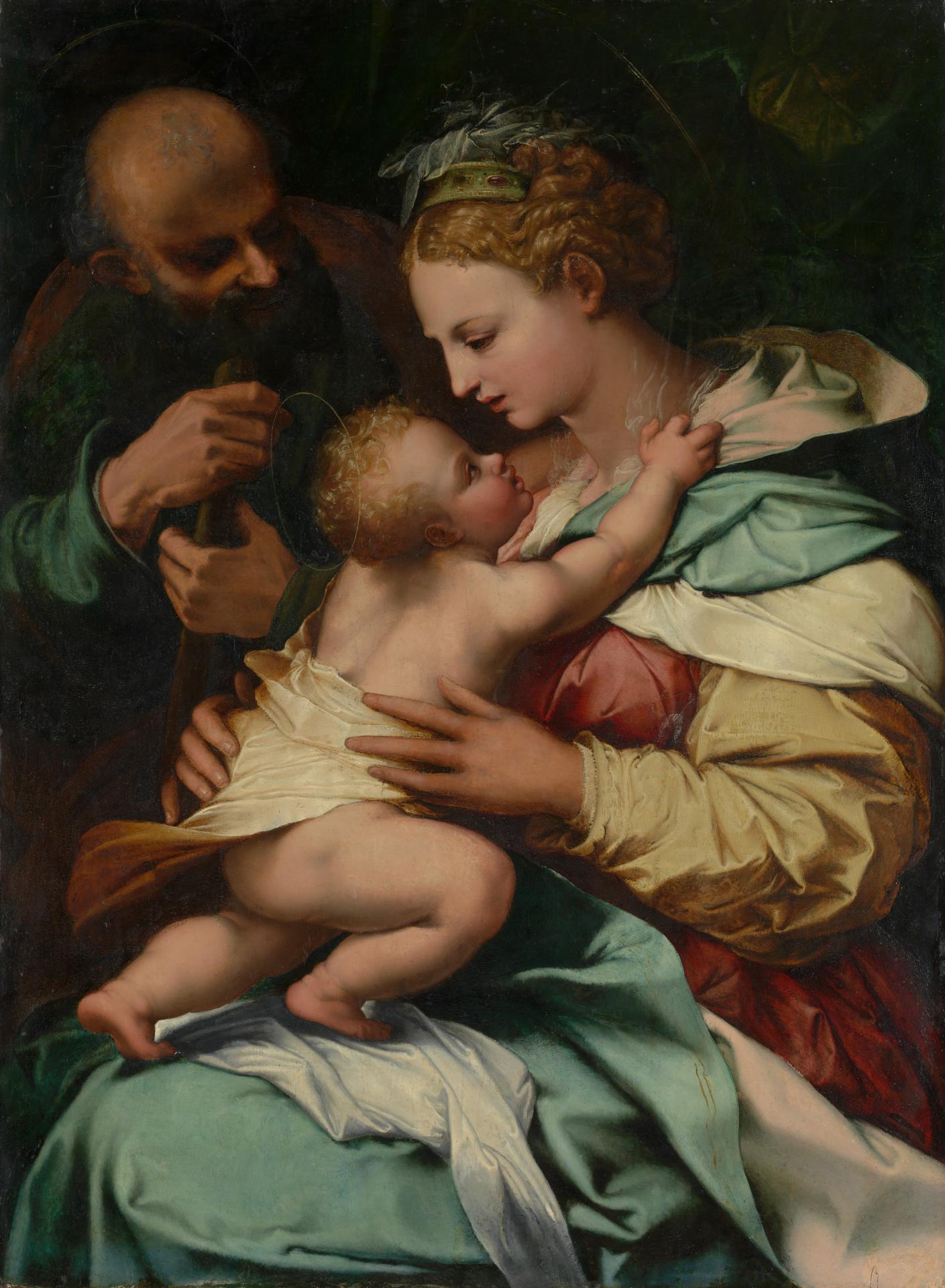
PERINO DEL VAGA
The Holy Family (c. 1545-1546)
oil on wood panel
101.0 x 74.4 cm
National Gallery of Victoria, Melbourne
Felton Bequest, 1966
1666-5