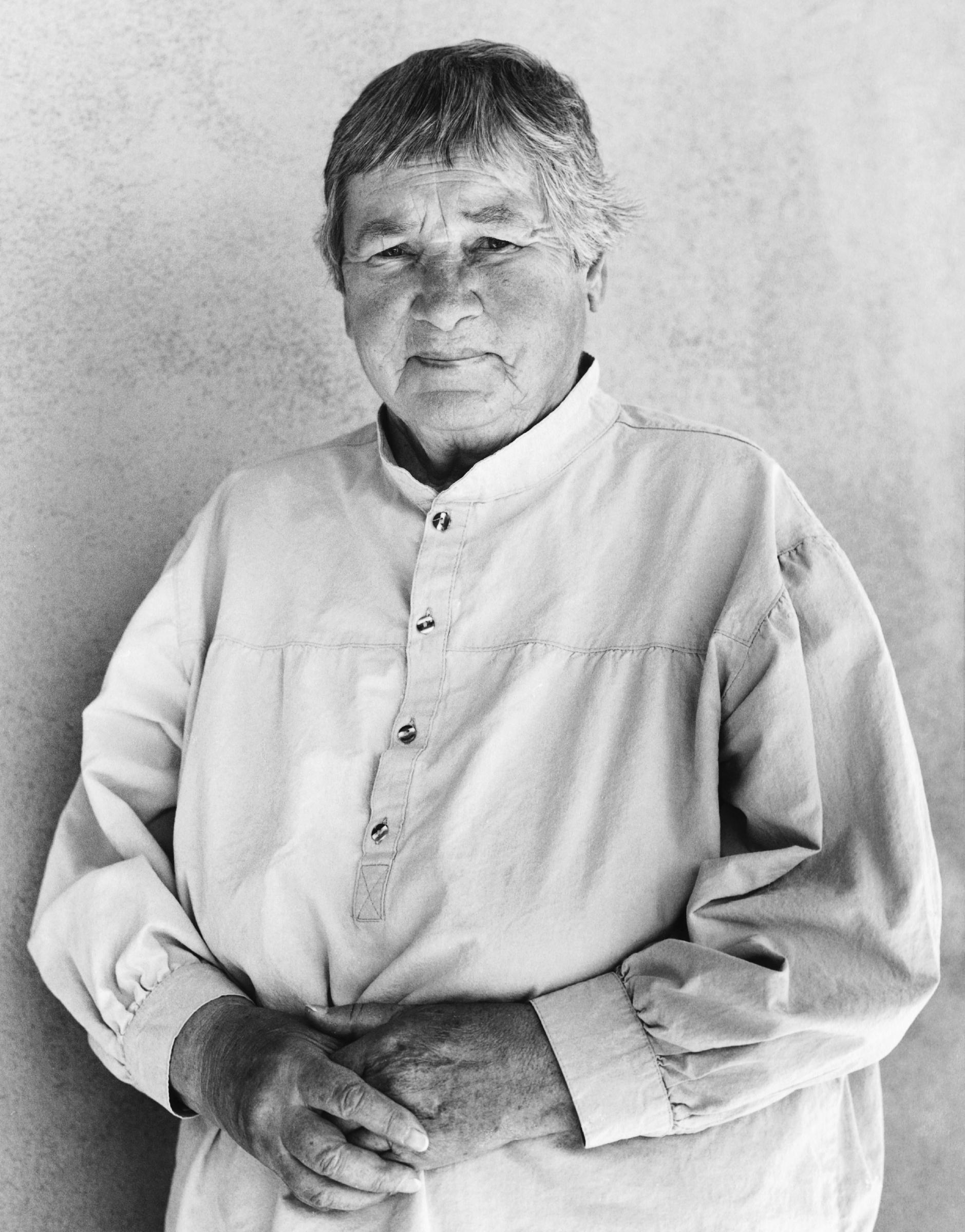
‘I paint about emotions, not lines’
Agnes Martin
Born in rural Canada in 1912, Agnes Martin migrated to the United States at the age of twenty. Initially trained as a teacher, she developed an interest in art after moving to New York in the early 1940s. In 1947 she undertook summer school studies at the University of New Mexico in Taos, New Mexico – marking the beginning of a lifelong connection to the region’s unique landscape and adobe architecture in the American Southwest. Back in New York in the early 1950s, she attended lectures at Columbia University given by the Japanese philosopher and religious scholar Daisetz Teitaro Suzuki. A specialist in both Zen and Shin Buddhism, Suzuki’s teaching inculcated in Martin a determination to adopt an approach to living inspired by Eastern thought and its attitudes toward nature. The late 1940s and 1950s saw a reaction in American art against the primarily figurative painting the had predominated in that country during the Depression and war years. Later to be known as Abstract Expressionism, this movement privileged non-representation and gestural brushstrokes spread over expansive canvases, conveying the emotional heft of the painter rather than any specific subject matter. In New York, the artists working in this bold new mode were championed by gallerist Betty Parsons.
Encouraged by Parsons, in 1957 Martin rented a studio in Lower Manhattan, in a run-down part of the Financial District near the East River docks called Coenties Slip. The area offered cheap loft accommodation and studio space for artists in former sail-making factories. There she worked alongside and befriended an exciting group of artists engaging with Abstract Expressionism and the emerging style of American Pop Art, including Ellsworth Kelly, Ad Reinhardt, Jasper Johns and Robert Rauschenberg, and others who lived nearby, such as Barnett Newman.
Martin shared a studio with Kelly, whose boyfriend at the time was the Pop artist Robert Indiana. The atmosphere of queer acceptance in Coenties Slip, a decade before gay liberation transformed recognition of alternative sexualities in the United States, encouraged Martin to explore her own sexuality. During this period, she was romantically involved with several women, including Betty Parsons, who gave Martin her first solo exhibition in 1958. This aspect of Martin’s life was as progressive as her commitment to minimal abstraction in her Coenties Slip years.
Praising Mark Rothko for having ‘reached zero so that nothing could stand in the way of truth’, Martin developed her own minimal approach to art-making at this time, a core tenet of which was a strict adherence to non-representation. Her canvases championed the primacy of the grid, square and oblong, whose minimal forms were at times enhanced with the application of gold leaf, boat spikes or brass nails. Influenced by her study of the ancient Taoist writings of Laozi and Zhuang Zhou, Martin sought to eliminate personal ego from her art, inviting audiences to encounter spirituality and the sublime through contemplation of the quiet perfection of her self-effacing, pared back art. Muted colours often provided a transcendent backdrop to her rhythmically spare right-angled aesthetic. There is a sense in these works that Martin found perfection in the abandonment of her physical surrounds and circumstances, channelling her emotions into abstracted compositions that for her epitomised her personal ideals of calm and serenity. She hoped that viewers would be able to share this vision through contemplative, immersive engagement with her art. As she stated in 2002:
‘There’s no indication or hint about the material world in my painting … I am simply painting concrete representation of abstract emotions such as innocent love, ordinary happiness. I do want an emotional response. And I paint about emotions, not lines’.
In 1967, following the death of her abstract painter friend Ad Reinhardt, the demolition of parts of Coenties Slip and the end of her relationship with the Greek American artist Chryssa Vardea-Mavromichali, Martin left New York and returned to New Mexico. She first settled in the tiny village of Cuba, where she built an adobe pink brick home influenced by the region’s unique architectural vernacular. This itself reflected the distinctive colouration of New Mexico’s high-desert plains and mountains. She later relocated to the slightly larger but still small town of Taos, where she worked in happy and Spartan isolation until her death in 2004 at the age of 92.
Untitled #16 belongs to a series of delicately coloured and finely textured canvases that Martin created in the last decade of her career, when she was in her eighties. It is related to a series of seven paintings from 1993–94 that Martin installed in 1997 in an octagonal gallery of her own design at the Harwood Museum of Art in Taos, where they remain on permanent display.
In Untitled #16 alternating bands of gentle dusky pink and pale blue evoke the light, colour and texture of New Mexico’s panoramic desert vistas and seemingly endless skies. In the pink areas of the painting especially, Martin’s brushstrokes are applied in thick swatches, recalling the application of the outer daubed pinkish mud plaster of adobe homes in Martin’s beloved New Mexico. As one stands before the work, its oscillating coloured bands seem to expand and contract, as though breathing, inviting viewers to stop, slow down and quietly breathe in turn, entering into Martin’s uplifting vision of personal meaning and perfect happiness, achieved though abstraction’s liberation of the self from physical constraint.
One of the leading artists of the twentieth century whose influence continues today, Agnes Martin’s held more than 85 solo shows during her lifetime. Her works grace the walls of every major art museum in the United States; and they have also been a major influence upon artists practising Minimalism here in Australia since the 1960s.
Dr Ted Gott is NGV Senior Curator, International Art
This essay was originally published in the NGV Magazine Issue 58 | May–June 2026.