Donna BAILEY<br/>
<em>Lush</em> (2002) <!-- (recto) --><br />

type C photograph<br />
50.3 x 65.0 cm irreg. (image) 61.7 x 76.2 cm irreg. (sheet)<br />
National Gallery of Victoria, Melbourne<br />
Purchased with funds arranged by Loti Smorgon for Contemporary Australian Photography, 2006<br />
2006.295<br />
© Donna Bailey
<!--81174-->

Produced alongside the exhibition MOTHER: Stories from the NGV Collection at The Ian Potter Centre: NGV Australia, this illustrated publication presents ten curatorial essays exploring themes of motherhood through and inspired by artworks in the NGV’s Collection.

The depiction of mother and child is one of the oldest and most enduring themes in art history. From ancient cave paintings and Egyptian tombs to Renaissance frescos and contemporary depictions, artists have long engaged with the complex experiences of motherhood. Traversing geographies, cultures and mediums, MOTHER explores works by contemporary and historical Australian and First Nations artists, alongside international art. It explores both universal and culturally specific experiences of motherhood – from private transformation and societal expectation to intergenerational trauma and loss, mythology and religious iconography, storytelling and language and the deep connection between motherhood, nature and Country.

MOTHER: Stories from the NGV Collection features artists Davida Allen, Hannah Brontë, Tui Emma Gillies and Sulieti Fieme’a Burrows, Sophie Calle, Karla Dickens, Tracey Emin, Christine Godden, Francisco Goya y Lucientes, Katherine Hattam, Camille Henrot, David Hockney, Kate Just, Iluwanti Ken, Yvonne Koolmatrie, Tala Madani, Hayley Millar Baker, Tracey Moffat, Ann Newmarch, Ruth O’Leary, Patricia Piccinini, Faye Toogood, Rembrandt Harmensz. van Rijn and Djerrkŋu Yunupiŋu, among many others. Explore exhibition works by theme, date or artist with the illustrated index of works.

Donna BAILEY
Lush (2002)
type C photograph
50.3 x 65.0 cm irreg. (image) 61.7 x 76.2 cm irreg. (sheet)
National Gallery of Victoria, Melbourne
Purchased with funds arranged by Loti Smorgon for Contemporary Australian Photography, 2006
2006.295
© Donna Bailey

Birth of a Mother

Katharina Prugger

‘But only a mother can walk with the weight of a second beating heart.’
Ocean Vuong, ‘Headfirst’, 2014

Embarking on the journey into parenthood must be one of the most hopeful things a human could choose to do. Hope for oneself, for the child and for the future. It glimmers amid all the uncertainty that shadows every step of this enormous life transition.

In her 2012 series The Skin of Hope, Kate Just revisits the optimism she felt when she and her wife, Paula, became parents to their adopted child, Harper. ‘The work An armour of hope strangely began the day I met Harper and shook his hand as a two-year-old joining our family for the first time,’ Just reflects. ‘In that moment, I felt and saw an image of Harper in soft armour in my mind’s eye. I think I recognised the difficulty Harper had already been through, but also noted a keen receptivity to new connections and bonds.’1 In the resulting work, Just pairs the exquisite chain-mail hand-knitted to fit her then four-year-old, with a pair of fleshy-pink, arm-length gloves for herself – an embroidered scar alongside the words Mother and Hope, marking her own resilience. The work is further shaped by personal loss: ‘as my adopted brother Billy had died some years before as a young person, I was also holding a sense of familial loss and defensiveness with a desire for hope.’2

Kate JUST
An armour of hope 2012
from The skin of hope series 2012
metal and silk (yarn)
(104.0 x 45.0 x 4.0 cm) (installed)
National Gallery of Victoria, Melbourne
Purchased, Victorian Foundation for Living Australian Artists, 2025
2025.672
© Kate Just

Every human life begins with a physical, and often emotional, connection to a mother, leaving a lasting, sometimes even cellular, legacy. As Adrienne Rich writes, ‘motherhood is the great mesh in which all human relations are entangled, in which lurk our most elemental assumptions about love and power’.3 There are, of course, many ways to be touched by mothering beyond raising a biological child: adoption, fostering, caring for siblings, elders and chosen family; the heartbreak of miscarriage, stillbirth and loss; the pain of longing to be a mother while still hoping and trying; mothering oneself.

On the eve of my daughter’s fourth birthday – 23 weeks into my fourth pregnancy, two of them lost – the algorithm served me a striking coincidence in the form of two topical pieces of news. In February 2026, the Peanut app, often described as ‘Tinder for mum friends’, teamed up with baby feeding and childcare brand Tommee Tippee to campaign for the inclusion of the word ‘matrescence’ in the dictionary. Their full-page New York Times ad declared:

IDGAF is in the dictionary, matrescence isn’t.
It’s time to GAF about mothers.

Coined fifty years ago by American medical anthropologist Dana Raphael, matrescence describes the process of becoming a mother. Later expanded by Aurelie Athan, it encompasses ‘a developmental passage where a woman transitions, through pre-conception, pregnancy and birth, surrogacy, or adoption to the postnatal period and beyond’.4 The term gives language to a transformation so profound that it can be hard to put into words.

The same day, a headline on BBC’s global women news feed also caught my attention:

Second pregnancy uniquely changes the female brain

A new study conducted by the Pregnancy Brain Lab at the Amsterdam University Medical Center, led by Dr Elseline Hoekzema, found that both first and subsequent pregnancies have strong but distinct impacts on the brain. While the structure of the brain is altered the first time around, later pregnancies bring further changes – particularly in neural networks associated with attention and responding to sensory stimuli – to support the care of multiple children.

Although obstetrics has been practised for centuries, medicine has historically treated the male body as the universal standard, producing enduring blind spots in women’s and maternal health care and research, particularly in conditions such as endometriosis, perinatal anxiety and depression. While knowledge about maternal health has been impacted by patriarchal structures and religious taboos around sexuality more generally, the figure of the Virgin Mary occupies a uniquely influential symbolic role. In Western art history, she is the most enduring and frequently depicted mother figure, shaping ideals of motherhood across the globe. Her image, associated with purity, obedience and maternal devotion, has often produced a reductive understanding of women’s bodies and lives. As Dutch cultural theorist Rosemarie Buikema argues in her essay ‘Beyond the Madonna’:

The traditional images of the Madonna and the Pietà predominantly produced by male artists represent the institution rather than the experience of motherhood. In other words, these myriad images depicting univocally loving and devoted mothers merely serve as a non-negotiable pillar supporting the patriarchal order.5

Giovanni TOSCANI
Madonna and Child (early 15th century)
oil, tempera and gold leaf on wood panel
121.7 x 67.3 cm
National Gallery of Victoria, Melbourne
Bequest of Howard Spensley, 1939
557-4

HJ Wedge
Immaculate conception - What hypocrisy! (Nun) 1992
synthetic polymer paint on plywood
203.5 x 100.5
National Gallery of Victoria, Melbourne
Purchased with funds donated by Supporters and Patrons of Indigenous Art, 2006
2006.223
© The Estate of HJ Wedge

Under colonialism, Christian ideals of purity and motherhood shaped by the veneration of the Virgin Mary, became tools for controlling women’s bodies. Missions, such as Erambie, where Wiradjuri artist HJ (Harry) Wedge was born, imposed European norms while suppressing First Nations beliefs and practices surrounding conception, birth and care. In works such as Immaculate conception – What hypocrisy! (Nun), 1992, Wedge draws on his experiences of mission life, particularly the impact of enforced Christianity.

Being forced into western models of maternity care has had long-reaching impacts on First Nations women and babies. Despite Australia being considered one of the safest places in the world to give birth, First Nations women and babies continue to experience significantly poorer health outcomes than non-First Nations mothers and babies.6

In recent years, ‘Birthing on Country’ models of care have emerged to address these inequities. One such program, run at Waminda (South Coast Women’s Health and Wellbeing Aboriginal Corporation) in Nowra, NSW, is led by Elders and Aunties. Dharawal and Gumbaynggirr woman Melanie Briggs, Waminda's senior endorsed midwife and the first Aboriginal endorsed midwife in NSW, describes ‘Birthing on Country’ as a process of healing intergenerational trauma through cultural birthing:

Indigenous women have been birthing since time immemorial, when the lands were pure, and the dreaming stories were a reality. Birthing is the first ceremonial journey we go through to leave the spirit world to come into the physical world. Our connection to our ancestors and our culture provides our people with a sense of belonging and grounds our ways of knowing, being and doing.7

Rituals and ceremonies around pregnancy and birth can vary greatly between Country, Nation and language groups. Elizabeth Djutarra’s Nganiyal (Conical mat), 1998, references her mother’s Dreaming, the Djang’kawu Sisters. At the beginning of time, two spirit women travelled across the land, giving birth to the first people. They carried conical mats containing sacred objects, which they passed on for everyday use. The mat itself takes the form of a broad, basket-like structure, well suited for use as a protective enclosure for children, or as a secluded space for women during menstruation. Traditionally, it could also be flattened into a triangular configuration and worn hanging in front of a woman’s body throughout pregnancy. Its shape, mirroring female reproductive anatomy, reflects the deeper significance of the mat as a metaphoric ‘container of life’, reflected by the Yolŋu Matha term nganmarra, meaning ‘womb’.

Elizabeth Djutarra
Nganiyal (conical mat) 1998
pandanus fibre, vegetable dyes
142.0 x 142.0 cm (variable)
National Gallery of Victoria, Melbourne
Purchased, 1999
1999.15
© Elizabeth Djutarra/Licensed by Copyright Agency, Australia

Like the nganiyal carried by the Djang’kawu Sisters, motherhood can be understood as a kind of container, holding memory, knowledge and possibility across generations. Whether expressed through biological birth, adoption, cultural ceremony or everyday acts of nurturing, mothering shapes how life continues. In this sense, matrescence remains one of the most hopeful transformations a human being can undertake.


  1. Kate Just, email to author, 28 Nov. 2025.

  2. Just, email to author.

  3. Adrienne Rich, ‘Motherhood: The contemporary emergency and the quantum leap’, in On Lies, Secrets and Silence: Selected Prose 1966–1978, Virago, London, 1984, p. 261.

  4. Aurelie Athan, ‘Working definition’, Matrescence, 2016, accessed 15 Mar. 2026.

  5. Rosemarie Buikema, ‘Beyond the Madonna’, in Laurie Cluitmans & Heske ten Cate (eds.), Mothering Myths: An ABC of Art, Birth and Care, Valiz, Amsterdam, 2025, p. 169.

  6. Melanie Briggs & Rebecca Coddington, ‘Reclaiming intergenerational wellbeing for First Nations families through Birthing on Country’, World Association For Infant Mental Health, 15 Oct. 2025, accessed 15 Mar. 2026.

  7. Briggs & Coddington.

Christine GODDEN
Untitled 1974; 1986 {printed}
gelatin silver photograph
20.6 x 30.6 cm (image) 25.2 x 35.2 cm (sheet)
National Gallery of Victoria, Melbourne
Purchased from Admission Funds, 1991
PH120-1991
© Christine Godden

A Brief History of Infant Feeding Through the NGV Collection

Katharina Prugger

Between ‘Breast is Best’ and ‘Fed is Best’, feeding a baby can be a minefield. A quick Google produces countless opinion pieces arguing passionately for both sides. The reality is, of course, much more nuanced. People may choose breastfeeding or formula feeding, or a combination of based on personal preferences or circumstance, while many others are not offered a choice at all. Breastfeeding can be not only physiologically impossible for many parents, but also impacted by societal structures such as return-to-work policies, workplace pressures, or a lack of environments that facilitate breastfeeding and expressing. Baby formula can place financial strain on families and requires a reliable source of clean water, which, in a global context, is still lacking for billions of people.

The ways infants are fed have changed significantly across history, shaped by cultural beliefs, medical knowledge and social conditions. This evolution can be traced through art, with representations of breastfeeding appearing as early as the prehistoric period and ancient Egypt, such as in the influential motif of Isis suckling Horus. As one of the most powerful mother goddesses, Isis was revered as a protector and nurturer. Depictions of her breastfeeding the infant Horus convey the transfer of divine power from mother to child, and had a lasting afterlife, especially through their influence on Christian imagery of the Virgin and Child.

EGYPT
Isis suckling Horus Late Period – Ptolemaic Period 644 BCE-30 BCE
bronze
21.0 x 5.6 x 8.5 cm
National Gallery of Victoria, Melbourne
Gift of Mr P. Chaldjian, 1996
1996.459

Albrecht DÜRER
The Madonna nursing 1519
engraving
11.6 x 7.4 cm (image) 11.7 x 7.5 cm (sheet)
National Gallery of Victoria, Melbourne
Felton Bequest, 1956
3453-4

Virgo Lactans, Mary nursing the Child Jesus, became one of the most widespread devotional images in medieval and Renaissance Europe, even accompanying women during childbirth, until a shift occurred towards greater modesty in Catholic visual culture. Responding to Protestant criticism, the Council of Trent (1545–63) called for greater decorum, and even sacred maternal nudity became increasingly scrutinised in religious art.1

Prior to the eighteenth century in Europe, aristocratic and wealthy women tended to delegate nursing to wet nurses, viewing breastfeeding as incompatible with their social standing. Philosopher and writer Jean-Jacques Rousseau challenged this. In his educational treatise Émile (1762), he passionately argued that mothers should nurse their own children, framing it as a natural moral duty essential to healthy child development and family bonds.2 His ideas contributed to a cultural reappraisal of breastfeeding, gradually elevating it from something associated with necessity or lower-class life into a consciously chosen expression of good motherhood, as reflected in Paul-César Helleu’s tender portrayal of his wife Alice Guérin feeding their child.

Paul-César HELLEU
Motherhood (c. 1887-1900)
(Maternité)
drypoint
40.9 x 30.7 cm (image) 41.5 x 31.5 cm (plate) 61.3 x 47.0 cm (sheet)
National Gallery of Victoria, Melbourne
Felton Bequest, 1927
3574-3

Bottles have been used to feed babies for millennia, evolving as people sought safer and more effective ways to nourish infants when breastfeeding was not possible, and when wet nurses were either unavailable or unaffordable. In antiquity, gutti – small-spouted vessels typically made from clay or ceramic – were used to feed young children a variety of liquids, including animal milk, diluted wine and porridge-like mixtures. In ancient Greece, gutti also functioned as an early form of the modern breast pump, used to draw and store maternal milk separately from the act of nursing itself.

These vessels persisted and transformed across centuries of changing materials and medical understanding. The use of infant feeding bottles increased throughout the nineteenth century, including boat-shaped ceramic vessels used to feed products such as unboiled cow's milk, sugar water and pap – a flour and milk mixture. However, hand-feeding at this time remained associated with poorer health outcomes for infants, as these substitutes offered little nutrition and the connections between contaminated vessels, spoiled milk and infant mortality were not yet fully understood. Cleanliness and safe storage remained largely unsolved problems, making artificial feeding a last resort rather than a reliable alternative.3

GREECE, Attica or ITALY
Guttus (Greek black-glaze ware) 4th century BCE
earthenware
8.0 x 11.7 x 11.5 cm
National Gallery of Victoria, Melbourne
Purchased, 1933
3425F-D3

ENGLAND, Staffordshire (manufacturer)
Feeding bottle (c. 1850)
earthenware
5.1 x 7.8 x 8.3 cm
National Gallery of Victoria, Melbourne
Felton Bequest, 1939
4538-D3

The development of rubber teats and glass bottles in the second half of the nineteenth century improved hygiene incrementally. Justus von Liebig created the first commercial infant formula in 1865, a mixture of cow's milk, wheat flour and malt. 4 Condensed and powdered milks followed, expanding access further. By the mid twentieth century, formula feeding had become dominant across much of the Western world, actively promoted by medical professionals and manufacturers alike. Formular companies also aggressively marketed their products in developing countries, leading to a displacement of breastfeeding – a controversy that prompted the World Health Organisation's International Code of Marketing of Breastmilk Substitutes in 1981.

Fred WILLIAMS
Feeding baby (1955-1956)
etching, aquatint and foul-bite
11.2 x 10.1 cm (plate) 14.3 x 12.8 cm (sheet)
ed. 13/20
National Gallery of Victoria, Melbourne
Presented through The Art Foundation of Victoria by Mrs Lyn Williams, Founder Benefactor, 1996
1996.638
© Estate of Fred Williams

Ann NEWMARCH
Colour me bold 1977
colour photo-stencil screenprint, crayon and coloured fibre-tipped pens
73.6 x 46.4 cm (image) 91.2 x 65.0 cm (sheet)
artist's proof
National Gallery of Victoria, Melbourne
Michell Endowment, 1978
DC12-1978
© Anne Newmarch

Coinciding with broader societal changes in the 1970s across Western middle-class communities, breastfeeding began to emerge as a topic in art and critical discourse as part of debates around reproductive labour, care and women’s autonomy. In Colour me bold, 1977, Australian feminist artist Ann Newmarch reimagines the traditional Queen of Hearts playing card, transforming Leonardo da Vinci’s Mona Lisa – a quintessential symbol of male artistic genius – into a breastfeeding mother armed with an assortment of hand tools. Considering breastfeeding is often compared to a full-time job, taking up around 1,800 hours during the first year of a baby’s life, Newmarch’s working mother Mona Lisa might signal that the labour of feeding and sustaining life is as skilled and demanding as any trade, yet one that has never been counted, compensated or celebrated.

From divine iconography to feminist intervention, artists have returned again and again to the nursing body, not merely as subject, but as a site of meaning. What these works collectively reveal is that infant feeding has always been entangled with questions of power, value and whose labour the world chooses to see.


  1. Fundación María Cristina Masaveu Peterson, ‘The Virgin Nursing The Child’, accessed 23 Mar. 2026.

  2. Stewart Buettner, ‘Images of Modern Motherhood in the Art of Morisot, Cassatt, Modersohn-Becker, Kollwitz’, Woman’s Art Journal, vol. 7, no. 2, 1986, pp. 14–21.

  3. Science Museum Group, ‘Infant's feeding bottle, England, 1801–1891’, accessed 23 Mar. 2026.

  4. E. E. Stevens, T. E. Patrick & R. Pickler, ‘A history of infant feeding’, Journal of Perinatal Education, vol. 18, no. 2, spring 2009, pp. 32-9.

Camille HENROT
Life span (2019)
from the Systems of attachment series 2019
watercolour
(118.2 x 88.4 cm) (image and sheet)
National Gallery of Victoria, Melbourne
Purchased NGV Foundation, 2021
2021.646
© Camille Henrot

A Burst Bubble: Motherhood, Art, Attachment and the Politics of Care

Ellen Keillar

June 17, 2024
I added angry mother to my identity.
Another trope to wear. Draped across my shoulders like my heavy winter coat.
Hidden beneath it was the nurturing mother, the intuitive mother, the one being told to reclaim herself before she disappeared beneath her winter layers into a wasteland of love and care. Another mother facing relegation into the shadows of invisibility.
Or perhaps I could brace myself for the storm.
Wrap myself in a scarf – the tired mother.
Pull on my gloves – the overwhelmed mother.
Pick up my bag – the guilty mother.
Now I was ready for work.

January 21, 2026
I watched my nearly two-year-old son’s eyes widen with awe as he followed, with unwavering fixation, a bubble rising into the sky. And then it burst.

November 3, 2024
Nine months after my son was born, I returned to work – earlier than some, later than others, angrier than most.
Like the bubble that vanished into oblivion, my baby bubble ended abruptly.
Small droplets hung like dead weight in the sky.
I fell, fractured and fragmented.

Camille Henrot’s work exposes motherhood as a political, psychological and bodily rupture that contemporary society renders anecdotal and invisible. Motherhood, despite being one of the most universal human experiences, is persistently framed as private and politically marginalised. In her series System of Attachment, Henrot represents feelings of powerlessness and the tension between distance and closeness. The drawings and paintings give form to questions of care and dependency.

In her artwork Lifespan, 2019, which forms part of the series, Henrot presents an evolutionary rendering of motherhood, a blurring between mother and child, from which child becomes adult. The weightlessness of watercolour sits in contrast to the weight of the world causing the growing figure to buckle and bend, gazing downcast toward a baby, perhaps her baby – or maybe it’s her as a baby? A clenched fist anchors the artwork. I interpret this as belonging to a defiant mother, fighting for baby and self. Henrot is an important voice in art and culture, through her refusal to sentimentalise motherhood.

It is with sentimentality that we speak of the baby bubble, a period in which parents and newborns are afforded space, care and time to bond. A bubble that floats for days, perhaps weeks. Yet this language diminishes what is in fact a profound psychological and relational state. The baby bubble is not a soft indulgence or a fleeting romance, but a shared ecology: a time in which mother and child exist as one nervous system, where regulation and identity are formed in tandem. To collapse this period prematurely fractures a developmental process. And yet, contemporary culture treats the baby bubble as a short period of time to be swiftly dissolved in the service of productivity. In doing so, we reduce foundational human attachment to the luxury of the rich and ‘idle’, rather than recognising it as a public necessity. Put simply, we know how to embed care structurally, we just rarely sustain it for long enough. And we must only look to Henrot’s artwork to be reminded that from baby grows adult, from care grows prosperity. Systems of Attachment explores the need for security from which adventure and freedom can be fostered. Lifespan reminds us that in caring for a mother we nurture a baby, a toddler, a child. Like many of the ironies of our capitalist systems, investing in mothers would indeed yield stronger more emotionally resilient and financially adept future generations. Instead, we give mothers weeks, months at best, a year to usher their children into the world. And then the bubble bursts, financially burdened by the lack of support, women are given a ‘choice’ to return to work.

I don’t wonder what we would choose if we knew we could take the necessary time required to raise children – not to mention recover – and maintain our career prospects and salaries. What if we didn’t have to choose, what if we could have it all, just not all at once? What if we held the raising of children with the same reverence as being a lawyer, doctor or artist? There is no one size, one path for all mothers. But there is no true choice when we live in a society that diminishes care as frivolous and does not adequately compensate the work of mothers. There is no choice when faced with no money, no superannuation and stagnated career prospects.

To raise children in proximity to their parents is not the idle path. It is the path backed by science as best for brain development. It is what attachment theory teaches us. Keeping child and parent close does not yield weak children, it nurtures adventure and strength. In the words of Henrot, ‘the system of exploration is made possible only if the system of attachment is present. As humans we need to securely attach in early life, in order to later detach and grow into autonomous individuals.’

What has become my trope as angry mother, is not my rage, but rage for all children who deserve to have their parents close. It is an anger at the collective cultural and structural invisibility of child rearing.

The persistent framing of maternal experience as ‘anecdotal’ reveals a deeper tyranny within patriarchal knowledge systems. What is embodied, emotional, relational and subjective is often dismissed as unreliable. Yet motherhood is not marginal because it is insignificant; it is marginalised precisely because it is structurally central. This is to say that to see motherhood in its full complexity would require a structural overhaul of the current operating system. It would need us to draw out mothering from the confines of the private sphere where it poses no threat to capitalist productivity or institutional authority.

The work is to draw from Henrot and make visible the invisible. To show motherhood as tethered to all people, politics, religions, cultures and economies. And to listen to motherhood as both personal and collective.

To end with an anecdote, my journey has been an experience of unparalleled joy against the hard wall of structural dissolution. In the first days of my baby bubble, it was hard to imagine if life could get any better. I now know it could: we could remain financially, structurally, politically and socially supported.

To nurture the baby bubble is not to retreat from the world, but to insist on reshaping it.

Ruth O'LEARY
Flinders Street, 2017 (2017)
digital type C photograph
110.4 x 77.8 cm (image) 112.0 x 82.3 cm (sheet)
National Gallery of Victoria, Melbourne
Purchased, Victorian Foundation for Living Australian Artists, 2025
2025.685
© Ruth O'Leary

Supermum

Sophie Oxenbridge

I arrived the same day your son was born. You might call this a coincidence. I do not.

I always arrive at moments of reorganisation, when responsibility multiplies and the body is asked to absorb the difference.

Doctors describe me as a neurological malfunction: a misfiring of circuits, a vascular disturbance, an ‘error’ in perception. Their language tries to locate me – along trigeminovascular pathways, within cortical networks, across the visual cortex. But those who live with me know that I am not confined to anatomy. I alter time. I rearrange space. I remake the conditions of seeing and hearing.

Like motherhood, I am a rupture in how the world is lived and held.

You weren’t expecting me, but you have been conditioned for my arrival. Primed to listen more carefully. To assess every signal, sound or cry that might require a response. Rest has become provisional. Downtime, conditional. One self moves through the day; another runs ahead, tracking what is still to come. Attention splits and re-splits, until it is impossible to locate a single centre.

I am not an interruption to this labour. I am one of its consequences.

The pain I generate is regularly dismissed: framed as stress, hormones, weakness – anything that keeps me individual and reducible. But my pain has its own intelligence. It disrupts the fantasy of seamless functioning on which systems of productivity and visibility depend. I am not merely a symptom within these systems. I am an epistemological event that reveals the tension between embodied limits and social expectation.

Migraines with aura are not an illusion. They are exposure.

Prodrome

Before I take hold, I raise the alarm.

In Iluwanti Ken’s Walawuru ngunytj`u kukaku ananyi (Mother eagles going hunting), the canvas is alive with mother eagles in motion. The walawuru appear plural even when singular, doubled even when still. Their wings stretch outward in anticipation, watching in several directions at once.

This is the prodrome: vigilance before impact.

Iluwanti Ken
Walawuru ngunytju kukaku ananyi (Mother eagles going hunting) 2023
ink and synthetic polymer paint on canvas
(a-c) 210.5 x 509.0 cm (overall)
National Gallery of Victoria, Melbourne
Purchased NGV Foundation with the assistance of Beatrice Moignard, 2023
2023.600.a-c
© The Artist, Tjala Arts and Jan Murphy Gallery

Aura

As I advance, I reorganise perception.

In Ruth O’Leary’s Flinders Street, the artist takes a self-portrait in a public photobooth with their infant present. Public, automatic and exposed, the photobooth compresses the encounter into a narrow frame where there is no time to withdraw or adjust. The conditions of new motherhood – constant presence, limited time, attention pulled in multiple directions – are folded into the image’s structure.

This is the aura: the sensory field beginning to shimmer within a tightening frame.

Ruth O'LEARY
Flinders Street, 2017 (2017)
digital type C photograph
110.4 x 77.8 cm (image) 112.0 x 82.3 cm (sheet)
National Gallery of Victoria, Melbourne
Purchased, Victorian Foundation for Living Australian Artists, 2025
2025.685
© Ruth O'Leary

Headache

At my peak, I collapse distinctions.

In Ananta Ram Rana’s Durga, 2017, the Hindu goddess appears as a warrior mother with multiple arms. Her hands are full, bearing a trident, a blade, a gesture of command. Here, protection and violence coexist within the same figure. The body is pulled in multiple directions, holding incompatible demands without hierarchy or pause.

This is the headache: everything arriving at once.

Ananta Ram RANA
Durga 2017
earthenware
97.9 x 47.0 x 33.8 cm
National Gallery of Victoria, Melbourne
Purchased NGV Foundation, 2019
2019.618
© Ananta ram Rana, courtesy of Minhazz Majumdar

Postdrome

As the intensity recedes, I loosen my grip.

In Katrin Koenning’s repair, 2020, a child rests in the arms of a carer. Bodies lean into one another, held within a moment of quiet attention. Here, care appears as durational rather than climactic, resistant to narratives of mastery or resolution.

This is the postdrome: a slow recalibration

Katrin KOENNING
repair 2020; 2022 {printed}
archival pigment print
(40.0 x 30.0 cm)
National Gallery of Victoria, Melbourne
Purchased, Victorian Foundation for Living Australian Artist, 2022
2022.1553.28
Katrin Koenning

Afterimage

After the event, I leave an imprint.

In Queenie McKenzie’s Blackfellas in bush country, 1987, bodies and Country are inseparable. Presence is dispersed across land and memory. The figures do not interrupt the land; they rise quietly from within it, lingering within the same visual field.

This is the afterimage: perception shaped by what has passed through the body.

Queenie McKenzie
Blackfellas in bush country 1987
earth pigments and natural binder on canvasboard
45.5 x 55.8 cm
National Gallery of Victoria, Melbourne
Purchased through The Art Foundation of Victoria, 1991
O.130-1991
© Queenie McKenzie/Copyright Agency, Australia

You are taught to treat me as an isolated event. But I am not isolated. I form under specific and repeated conditions.

I emerge when the labour of sustaining life is romanticised as love rather than recognised as infrastructure, when the prolonged division of the self is disguised as devotion, and when institutional absences are absorbed into individual bodies and reframed as resilience.

Like motherhood, once I have passed through the body, it is forever altered.

What has been asked of the body cannot be unlearned. All that can change is how it is held. There is no return to a singular self, no restoration of what was before. Instead, the task becomes how to inhabit multiplicity differently.

The images that appear above understand this condition.

They do not promise clarity. They admit distortion, excess and interruption as forms of knowledge. Like me, they linger after the moment has passed, insisting that attention has limits, and that how we see and how we hear are shaped by what we are asked to carry.

I arrived the day your son was born, because that was the day your nervous system began to stretch across more than one life.

I remain, because the world continues to demand that stretching without recognising its cost.

I am not an enemy to be eliminated.

I am the accumulated trace that forms when care exceeds what one body can contain, and when that excess, still, is mistaken for virtue.

Ethel WALKER
Lilith (c. 1920s)
oil on canvas
173.5 x 107.3 cm
National Gallery of Victoria, Melbourne
Felton Bequest, 1948
1842-4

Bad Mother, or a Mothers’ Monstrous Love

Maria Quirk

Is there anything more monstrous – more monumental and fearful – than a mother’s love? A towering, lurching life force that is at once colossal and so small, so intimate it devours every crevice of the human heart.

A monstrous mother has haunted humanity for thousands of years. A mysterious figure recorded in the margins of folklore and Jewish religious texts since around 2000 BCE, Lilith is the fabled first woman, whose refusal to lay with Adam resulted in her banishment from Eden and transformation into a shapeshifting monster. In various tellings of her story, she gives birth to hundreds of demonic children; threatens pregnant and fertile women; and lures men away from their families. In one telling, there are two Liliths, both screaming demons whose very names derive from the verb ‘to scream’.1 Aramaic incantation bowls show that women wore amulets and recited magical words to protect their unborn child from Lilith and her demon children, who attached themselves to humans and sucked their blood.2

Monsters represent what society fears. The fact that Lilith, a non-canonical figure not even recorded in the Bible, has endured across cultures and centuries reflects her embodiment of perhaps mankind’s greatest fear: an unruly, unholy and uncontrollable mother. Lilith as feminine iconoclast is what appealed to Ethel Walker. A bohemian and artist working at a time when both of those identities were near unattainable for women, Walker had a fascination with Lilith and painted her several times.3 In these works – including Lilith, c. 1920s (NGV Collection) – Lilith is a sensuous, self-absorbed nude, towering over a reclining, almost invisible, Adam. In a letter to her friend and lover Vita Sackville-West, Virigina Woolf reveals that she had been invited to sit for Walker, who described Woolf as the splitting image of Lilith.4 For Walker, Lilith seemed to symbolise a woman-centred eroticism and autonomy. It is this interpretation that led later theorists of Jewish theology to reclaim Lilith as a proto-feminist icon.5

Many modern retellings of Lilith’s story – including Walker’s – highlight her refusal to obey Adam and rejection of Eden as the ultimate challenge to patriarchy. Lilith’s enduring connection to motherhood, including her own parentage of, in some tellings, hundreds of children, complicates this narrative. Perhaps it is still uncomfortable, even in feminist reframing, to lionize a monstrous mother. A mother whose love is unsafe and threatening.

Maybe the enduring cultural fascination with Lilith stems from an even deeper and more insidious truth. If demonic Lilith, and not subservient Eve, was intended as the true mother of humanity, does that suggest that motherhood is, intrinsically and biblically, monstrous? Physically, it follows that pregnancy and birth are body horror. But it is emotionally that this legacy of monstrousness truly persists and terrifies. In Toni Morrison’s 1987 novel Beloved, loosely drawn from the Lilith myth, the character of Sethe kills her own child to protect her from a fate of slavery and sexual violence. Here, Lilith’s love is so huge, so monstrous it becomes devouring. Mother, Lilith reminds us, is both creator and destroyer of all life. Mother is the greatest monster of them all.


  1. Raphael Patai, The Hebrew Goddess Detroit: Wayne State University Press, 1990, pp.226-27

  2. See Marcus, Alexander W., and Jason Sion Mokhtarian, eds. Aramaic Incantation Bowls in Their Late Antique Jewish Contexts. Atlanta: SBL Press, 2025.

  3. See Jon King, ‘Ethel Walker, Advocacy and Recognition in the Early Twentieth Century’, in Tate Papers no.36, 2025

  4. Virginia Woolf, The Letters of Virginia Woolf. Volume 5: 1932–1935, ed. Nigel Nicolson and Joanne Trautmann. London: Harcourt Brace Jovanovich, 1979, pp.174–5.

  5. For the foundational feminist reinterpretation of Lilith see Judith Plaskow, “The Coming of Lilith.” In Womanspirit Rising: A Feminist Reader in Religion, eds Carol P. Christ and Judith Plaskow. San Francisco: Harper & Row, 1979.

John LONGSTAFF
The young mother 1891
oil on canvas
97.3 x 138.2 cm
National Gallery of Victoria, Melbourne
Purchased with funds donated by the NGV Women's Association, Alan and Mavourneen Cowen, Paula Fox, Ken and Jill Harrison and donors to the John Longstaff Appeal, 2013
2013.766

Magic Maker

Anna Honan

To cite an overused quote by an overexamined man, Pablo Picasso said, ‘Every child is an artist. The problem is how to remain an artist once he grows up.’ Unsurprisingly, the absent father Picasso seems to have missed, or forgotten, the artists and architects of childlike wonder: mothers. They embrace a world where fantasy exists in everyday life and logic is dismissed in favour of a little magic. Setting a place for an imagined friend at dinner, investigating the dark corners under the bed for a monster, envisioning the fort and costumes from a pile of blankets, mothers create spaces to explore life, emotions, dreams and embrace creativity.

Ruth Maddison’s No title (Christmas tree and presents), 1977–78, presents a familiar scene in Australian households: a decorated Christmas tree in a family living room with presents sitting at its base. The scene is still and calm, the family has not yet entered the frame, and the presents are still wrapped, although we know the events that are about to transpire. Children waking giddy with excitement to find presents and hunt for clues of Santa’s visit – a carrot slightly gnawed as if from a reindeer and a glass of milk half drunk (or in my house a beer and a cookie). Despite its magic, the scene has not appeared overnight through the intrusion of an overweight bearded European forcing entry through a chimney. It has been orchestrated, planned and laboured over by an unacknowledged maker, almost always a mother rendering herself invisible in the process – intrinsic to the creation of magic is the invisibility of its maker.

Ruth MADDISON
No title (Christmas tree and presents) 1977-1978; 1979 {printed}
from the Christmas Holidays with Bob's Family, Mermaid Beach, Queensland series
gelatin silver photograph, coloured pencils and fibre-tipped pen
16.3 x 10.8 cm
ed. 1/5
National Gallery of Victoria, Melbourne
Purchased 1980
PH207.2-1980
© Ruth Maddison

Moments of magic are not only reserved for these big events. If you are lucky, they are interwoven into a child’s everyday life. As a child, my younger sister had an ongoing correspondence with a fairy named Joy. At night she would leave a note on her bedside table and wake to find it answered on a piece of sparkling pink paper. It wasn’t magic or Joy the fairy behind these notes, but my mother; writing late at night and disguising her handwriting in looping cursive script. I had the wisdom of being two years older and the self-assurance to believe that if fairies did exist, one would have written to me. From my worldly position as a seven-year-old, I could see the delight, love and magic in the exchange. As with many stories of young girlhood, female friendship was at the centre. Her best friend also had a fairy pen pal and each day they would proudly share their respective letters and write new ones together. Their mothers had shaped a world where magical winged creatures watched over them and in doing so, created the stage for a friendship formed over conspiratorial and shared magic.

Both in art and in life, we see countless images of mothers and children playing. Utagawa Kuniyoshi’s Mother and child, 1830–48, Iso Rae’s Breton family, c. 1892, and Siri Hayes’s Prickly pears and mumbling old stones, 2011, depict similar scenes across vastly different cultural contexts. Children’s games and make-believe can easily be written off as inconsequential, child’s play if you will. But it is through these games that we learn to process emotion, practice empathy and imagine our future selves. Each game is set up with its own level of realism and specific logic, the child a fussy art director micromanaging its elements. Dashing between the surreal and the mundane with equal enthusiasm, from caterpillars using special powers to fight evil, to a coffee shop attended by a standoffish barista that has always run out of your milk of choice.

Utagawa KUNIYOSHI
Mother and child (1830-1848)
ink, colour pigment on silk
71.1 x 45.9 cm (image)
National Gallery of Victoria, Melbourne
Purchased with funds donated by Baillieu Myer AC and Sarah Myer, 2017
2017.1034

Mythologised in nostalgia, we forget the force of uncontrollable emotion felt in childhood; the kind that leads to a toddler’s screaming tantrum. The first experiences of schoolyard conflict to the realisation of our own mortality. Faced with these moments as a child, my anxieties and emotions were explored through an elaborate interactive theatre performance at the end of my bed. Dramaturg and playwright, my mother cast my stuffed toys as complex characters, complete with emotional plotlines and dramatic backstories. Many were designed for pure entertainment, including a posh white cat who believed she was better than the other toys, and a particularly talkative giraffe. While others embodied an emotion; a depressed polar bear would groan lethargically, and an anxious dog was forever concerned he would be sent back to the store. Along with building a young empathetic muscle, she was teaching a healthy lesson in the value of creativity as a tool for distraction and processing. Something many adults seem to forget as our childlike worries are replaced with ‘real’ concerns.

Eventually the magic of childhood becomes a distant memory to be examined by our friends, therapists and Instagram algorithms. We learn more about the world, and logical thinking separates the imagined from reality. We also see the work – and the woman – behind the magic moments of our childhood. Discourse on motherhood has helped make visible the external pressures, commitments and strain of this period. Perhaps that’s the real sacrifice: to know how scary and uncertain the world can be, watch the news, go to work and still come home to dream, play and believe.

I asked my sister recently how she discovered her fairy's identity. As she got older, she stopped leaving notes, but she and my mother never acknowledged this change; as if between them this magic could still exist. Child logic may suspend belief, but I think we understand our mothers are behind most of the fairy dust, in the same way we believe a kiss can cure a grazed knee. The magic of childhood isn’t chance or supernatural – it’s made by our mothers: the magic makers.

Max DUPAIN
Mother and child 1952; (c. 1986) {printed}
gelatin silver photograph
40.6 x 39.8 cm (image)
National Gallery of Victoria, Melbourne
Purchased through The Art Foundation of Victoria with the assistance of Mr A. C. Goode, Fellow, 1987
PH20-1987

Ann NEWMARCH
Jake, Bruno and Jessie, 10, 5 and 5 days 1982
from the Children series 1977-87
colour photoscreenprint
49.0 x 72.3 cm (image) 53.3 x 75.2 cm (sheet)
ed. 11/35
National Gallery of Victoria, Melbourne
Purchased, 2001
2001.527.6
© Ann Newmarch

Invisible Mother

Eva Christoff

From sacred images of the Madonna to sentimental depictions of domestic life, mother figures have long occupied a prominent place within the history of art. However, this visibility is often deceptive. Such representations have frequently served religious, moral or ideological ends, obscuring the complexity and diversity of maternal experience.

Visual representations of mothers play a powerful role in shaping the social institution of motherhood. Western art – alongside advertising and popular culture – has historically constructed the ‘ideal’ mother as white, upper middle class, heterosexual, cisgender, endlessly nurturing, self-sacrificing and fulfilled. This selective and idealised imagery widens the gap between cultural expectations and the lived realities of mothering, marginalising those whose lives and identities fall outside societal norms.

While art can reinforce entrenched social hierarchies and gender roles, it also offers a means through which such norms can be challenged. Long dismissed as a private, apolitical and feminised realm, the domestic sphere emerged in the 1970s as a particularly charged site of artistic inquiry. Feminist artists challenged dominant cultural expectations concerning motherhood by politicising the home, transforming a space traditionally associated with women’s confinement into a site of radical resistance.

Born in Adelaide in 1945, Australian artist Ann Newmarch was raised in a conservative household where women were expected to abandon professional ambitions in favour of motherhood. This patriarchal world view was mirrored in the art world Newmarch encountered as a young artist. When Newmarch challenged a prominent critic for failing to review her exhibition, she was told, ‘You are a woman under thirty and can’t prove that you won’t fall in love and have babies … therefore you can’t be seen as an investment.’1 Such remarks expose how structural sexism routinely denied women professional legitimacy and cultural authority. Among the cultural elite, there was a pervasive assumption that ‘artist’ and ‘mother’ were inherently incompatible identities, and that creative production belonged exclusively to the public, ‘male’ domain.

Newmarch rejected this sexist rhetoric. A vocal advocate of the belief that all representation is political and that silence tacitly upholds existing power structures, she turned to her own family life as subject matter after becoming a mother in the early 1970s. In doing so, Newmarch defiantly positioned motherhood as a legitimate and meaningful site of artistic inquiry. In the screenprint Jake, Bruno and Jessie, 10, 5 and 5 days, 1982, she depicts her two older children tenderly watching over her youngest, then just five days old. This work forms part of the Children series (1977–87), in which Newmarch documented her children annually over a decade. The series held particular significance for Newmarch, as it articulated the interwoven roles she inhabited as mother, photographer and artist.

A parallel challenge to masculinist assumptions about artistic identity and value emerged through the feminist recovery and reappraisal of craft. In the West, women were historically excluded from, or received limited training in, the narrow range of media recognised as ‘fine’ art, such as sculpture and oil painting. Founded in Sydney in 1976, the Women’s Domestic Needlework Group (WDNG) sought to expose the sexism embedded within dominant definitions of art by foregrounding the anonymous women whose needlework had long been dismissed or trivialised. For the WDNG, the celebration of needlework was a feminist act, regardless of its entanglement with patriarchal conditions, as it conferred value upon forms of women’s work that had been made invisible within dominant narratives of culture.

In 1979 the WDNG presented The D’oyley Show, a touring exhibition comprising hundreds of examples of embroidery, lace making and crochet, many of which were salvaged from op shops. These works were displayed alongside ten screenprinted posters. One such poster, The forgotten workers, declared:

Women for the most part have spent their lives cooking, cleaning, washing, ironing and patiently mending and making clothes for the family. The work of such women was truly ‘never done’. But now and then the artist imprisoned in the housewife was evident in the creative and decorative things she made for the house.

By foregrounding the artistry embedded in domestic labour, this poster – and The D’oyley Show more broadly – positioned women in homemaker roles as creative agents whose lives were not defined by motherhood alone.

Second-wave feminists challenged patriarchal exclusion by asserting the political and creative significance of motherhood and domestic labour. However, in celebrating a ‘global sisterhood’, they often implicitly posited a sameness among diverse groups. Ann Newmarch and, to a lesser extent, the Women’s Domestic Needlework Group elsewhere acknowledge the devastating impacts of colonisation on Aboriginal people in their practices. Nevertheless, within an Australian context, white artists frequently positioned a settler-colonial maternal perspective as an impartial, universal viewpoint.

Although social conditions in Australia have shifted significantly since the 1970s, the domestic sphere remains a potent site for challenging cultural prescriptions surrounding motherhood. Contemporary Ballardong artist Dianne Jones extends the legacy of artists and collectives such as Newmarch and the WDNG. However, rather than simply advocating for the creative possibilities of the domestic, her work critically interrogates how histories of colonial dispossession and erasure structure the conditions of domestic visibility.

In her 2003 work Redfern interior, Jones appropriates a well-known 1949 photograph of the same title by Australian photojournalist David Moore. In the original image, a young white mother breastfeeds her infant in a cramped apartment, while an older woman – likely her mother – stares blankly ahead, a toddler at her feet. Produced following a chance encounter in which the older woman urged Moore to document the family’s dire living conditions, the photograph has long been regarded as a powerful record of urban hardship.

In Jones’s reworking, the white breastfeeding mother is replaced by an image of the artist herself. By inserting herself into the photograph, Jones foregrounds a central tension in the politics of visibility: in bringing one story to light, what – and who – remains unseen?

For much of the nineteenth and twentieth century, photographs of First Nations people were exploitative and taken without full consent; some of these images were studied by ethnographers before later disappearing from the public record, along with other evidence of colonial injustice. At the same time, First Nations people were commonly ‘seen’ as ‘living in the Outback’, rendering invisible the continued existence of significant Indigenous communities in Australia’s major cities. Jones reclaims this painful history with sharp wit and a powerful sense of agency. Reinserting Aboriginal people into the photographic archive on their own terms, she challenges viewers to interrogate the biases that shape their understanding of motherhood and ‘the domestic’.

Taken together, these artists and feminist collectives demonstrate that making space for the fluid spectrum of maternal experience requires ongoing negotiation. Rather than proposing a new totalising alternative to restrictive cultural prescriptions – which risks reproducing its own forms of exclusion – this involves embracing complexity and foregrounding multiple perspectives. It is precisely within this unsteady terrain that more inclusive, nuanced and politically generative representations of motherhood can emerge.


  1. Quoted in Helen Vivian (ed.), When You Think About Art: The Ewing and George Paton Galleries 1971–2008, Macmillan, Melbourne, 2008, p.183.

David HOCKNEY
My mother sleeping (1982)
type C photograph
(46.8 x 45.2 cm irreg.) (image and sheet)
edition of 20
National Gallery of Victoria, Melbourne
Gift of John Hockney, 2025
2025.615
© David Hockney

Recording Loss and Servicing Grief: The Photographic Work of Sophie Calle and David Hockney

Meg Slater

For what I have lost is not a Figure (the Mother), but a being; and not a being, but a quality (a soul): not the indispensable, but the irreplaceable.
– Roland Barthes, Camera Lucida, 19801
Up until yesterday, I always knew exactly where my mother was. If I wanted to have a chat with her, I could phone her and she would drop whatever she was doing to talk to me.
– David Hockney, 12 May 19992
No use investing in the tenderness of my children, between Antoine’s placid indifference and Sophie’s selfish arrogance! My only consolation is she is so morbid that she will come and visit me in my grave more often than on rue Boulard.
– An excerpt from the diary of Monique Sindler, Sophie Calle’s mother3

Photography has a special power during times of great loss. This power has been variously conceptualised by photographers and philosophers alike. When grappling with the passing of his mother, Roland Barthes wrote Camera Lucida, in which he describes the photograph as a memorial, capable of trapping time. When analysing a photograph from his childhood, he goes deeper. Barthes describes a power, one specific to the medium, the presence of which depends entirely on the viewer’s connection to the photograph’s subject:

I cannot reproduce the Winter Garden Photograph. It exists only for me. For you, it would be nothing but an indifferent picture, one of the thousand manifestations of the ‘ordinary’; it cannot in any way constitute the visible object of a science; it cannot establish an objectivity, in the positive sense of the term; at most it would interest your studium: period, clothes, photogeny; but in it, for you, no wound.4

For Barthes, this ‘wound’ is the result of what he calls the punctum: a particularly poignant detail embedded in a photograph, capable of ‘pricking’, ‘piercing’ and even permanently marking the viewer. Unlike the studium – the punctum’s opposite, described by Barthes as the broad cultural and political interpretation of a photograph – the punctum is subjective. Its existence is entirely dependent upon the knowledge, experiences and perspective of who is looking at the photograph. What ‘wounds’ one person may be completely ignored by another.

Barthes is not alone in his exploration of this curious sensory aspect of photography. From Susan Sontag to John Berger, theorists have explored the unique connection between photography, loss, memory and the passage of time.5 And so have the medium’s practitioners. Photographer and educator Jörg Colberg describes photography as ‘sticky’, capable of conjuring up specific feelings, experiences and memories.6

I acknowledge this special power of photography – whatever you want to call it – because it is what led me to select works by Sophie Calle and David Hockney as the focus of this essay. Typically, I do not write about art in first person, but I experienced a strange coincidence when I was commissioned to write this essay, one that deserves acknowledgement. My wife’s mother – who I had grown very close with over the past decade – was nearing the end of her life. Hers was not a kind death. It was the culmination of years of pain and struggle brought about by a degenerative neurological disability and the failures of a health system not built to support her. Beyond the peace found in rare moments of comfort and connection while she was still with us, after she passed, we found the most solace in the time spent looking through her photo albums.

In her youth, my wife’s mother was meticulous in building and maintaining photo albums. All major events were documented, with detailed annotations on the reverse of the images. What hit me hardest, though, were not the milestones, but the careful attention paid to the most mundane of activities – her cat Samson riffling through the groceries, the construction of the pool in the backyard of her first home. These moments often filled most of an album and gave me the truest sense of her at a stage of her life that I was not present to witness. Despite not knowing her during these moments, their record was my punctum.

This experience informed my decision to write about David Hockney’s My mother sleeping, 1982. This assemblage of images exemplifies an expanded photography pioneered by Hockney in the 1980s. Unsatisfied with the single-point perspective and static nature of the medium, Hockney began take multiple photographs of the same subject at close range and from different angles. He pieced these images together to create a single artwork. Hockney termed these compositions ‘joiners’, which he described as being ‘much closer to the way we actually look at things, closer to the truth of experience’.7

There is no clear start or end to My mother sleeping. The eye wanders freely over the overlapping images of Laura Hockney dozing peacefully on an armchair while visiting her son’s Los Angeles home. Looking at this work reminded me of my recent experience flipping through my wife’s mother’s albums, closely inspecting image after image of the same subject. She, like Hockney, seemed to share a desire to capture a subject in its totality. I also found it impossible to look at this (and other ‘joiners’ depicting Hockney’s mother) without thinking about her death. Though this work was made in 1982 (seventeen years before Laura’s passing), I got a sense (likely influenced by my own recent experience of loss) that she was already on her deathbed, and that Hockney was attempting to record as much of her as possible.

But to reduce this work and its subject to loss would be to overlook Hockney’s relationship with his mother, and her constant presence in his art. Time spent with Laura was frequent, and almost always marked by the production of a new drawing, painting or photocollage (including My mother with a parrot, 1973–74, also in the MOTHER exhibition). One of the most celebrated depictions of Laura is in a large double portrait Hockney painted of his parents in 1977 (My parents, Tate, London). To me, this painting aptly captures the strong bond between mother and son. While Hockney’s father, Kenneth, closely studies a book, Laura sits tall and looks directly at her son, giving him her full attention.

A similarly close, albeit less visually direct record of an artist’s bond with their mother can be found in the work of Sophie Calle. Much of Calle’s interdisciplinary, conceptual practice can be described as an investigation of absence and loss. Who does this address book belong to, and what do those who constitute its contents think of the owner (The man’s address book, 1983)? My partner just broke up with me via email – how might you interpret his parting words (Take care of yourself, 2007)?

Beyond random strangers, Calle often enlisted her mother, Monique Sindler, as a participant in her art making. For The detective, 1980, she asked her mother to hire a private detective to track Calle’s every movement, so that Calle could compare his notes to her memories of the significant places they walked through together. For The birthday ceremony (dated 1998 but spanning 1980–93 in its production), Calle invited her mother to contribute gifts to be displayed in glass vitrines alongside a larger bounty received from friends and relatives. Interpreted by Calle as an act of defiance, her mother repeatedly opted to gift her large, utilitarian items (including a washing machine) that could not fit into a vitrine (and could only be represented in the artwork through the inclusion of their warranty documents).

Sindler’s passing in 2006 marked a shift in Calle’s representation of her mother in her art. She was no longer a participant; she was now the subject. Calle began to produce large bodies of work such as Rachel/Monique, 2010, the product of hours spent poring over her mother’s old photographs and diary entries. Works produced by Calle after Sindler’s death are not eulogies or dedications to her mother, nor are they straightforward representations of their relationship. Among these is The giraffe, 2012, which takes as its subject a taxidermy giraffe named after Sindler. Above a large photograph of ‘Monique’ the giraffe hangs a framed fragment of text written by Calle: ‘When my mother died I bought a taxidermied giraffe. I named it after my mother and hung it up in my studio. Monique looks down at me with sadness and irony.’

Sophie CALLE
The giraffe (2012)
from the Les Autobiographies (Autobiographies) series 2012
type C photograph, gelatin silver photograph, enamel paint on wood, aluminum and painted wood
(a-b) 266.2 x 110.5 x 27.0 cm (overall)
ed. 3/5
National Gallery of Victoria, Melbourne
Purchased NGV Foundation, 2013
2013.578.a-b
© Sophie Calle. ADAGP/Copyright Agency, 2023

What appeals to me most about The giraffe is its honesty about the complexity of Calle and Sindler’s relationship. Calle does not focus only on the good and honourable parts of her mother. She shares everything. She does not present grief as a tidy, linear process. She embraces its peculiarities and persistence. As someone who, for close to a decade, witnessed a loving, difficult, joyous, dependent and unconditional bond between my wife and her mother, I find solace in Calle’s honesty.

As I write, my wife’s mother – my second mother – watches over me from our bookshelf.


  1. Roland Barthes, Camera Lucida: Reflections on Photography, Farrar, Straus and Giroux, New York, 1982 [1980], p. 75.

  2. Marco Livingstone, ‘Obituary: Laura Hockney’, The Independent, 17 May 1999.

  3. Mary Kaye Schilling, ‘The fertile mind of Sophie Calle’, The New York Times Style Magazine, 10 April 2017.

  4. Barthes, Camera Lucida, p. 73.

  5. See their respective collected writings on photography: Sontag’s On Photography (1977) and Berger’s Understanding a Photograph (2013).

  6. Jörg Colberg, quoted in Zak Dimitrov, ‘Sophie Calle: Detachment, death, and dialogue’, LENSCRATCH, 16 Jan. 2020.

  7. Meredith A. Brown, ‘A bigger photography’, in Chris Stephens & Andrew Wilson (eds), David Hockney, Tate Publishing, London, 2017, p. 125.

Yvonne Koolmatrie
Weaver's baby in coolamon 2008
sedge (Carex sp.), kangaroo skin
(a-c) 15.3 x 68.0 x 29.5 cm (overall)
National Gallery of Victoria, Melbourne
Purchased with funds donated by Helen Kennan, 2008
2008.569.a-c
© Yvonne Koolmatrie courtesy Aboriginal & Pacific Art Gallery

Lucky

Sophie Gerhard

I am writing this essay in the early weeks after the birth of my second child. A son we named Lucky.

I felt lucky when I found out he was coming. Lucky that finally, after all the trying and the hope and the loss, that he was on his way. The journey wasn’t steady for either of my babies to arrive, but now they’re here, I am drenched in more love than I once knew possible. I am, by any measure, so very, very lucky.

To write this essay from within the ‘baby bubble’ is difficult. An essay focused on maternal love, and loss. It seems to me that while the two emotions feel deeply in combat with one another, they may, in fact, occur in symbiosis: each allowing the other to exist. To feel love so fiercely is to acknowledge the possibility of loss. While the love I have for my children feels, at this time of my life, at its most intense, the terror of losing them is all too easy to reach for. From the day my daughter existed, I have never not been terrified.

Maternal loss takes many forms and, at some point, will affect most mothers, if not someone we know. In Australia, one in four known pregnancies results in miscarriage and, on an average day across this continent, six babies are stillborn and two die within their first 28 days. These numbers continue to disproportionately affect First Nations women and women of colour. In this essay I want to acknowledge maternal loss in all of its experiences, and the grief that accompanies not only losing a child, but infertility, miscarriage, failed IVF, adoption, abortion, and for those whose right to choose whether to become a mother has been threatened through international regressions in reproductive rights.

Artists have grappled with the depths of maternal love and loss since time immemorial and continue to give breath to feelings of terror, grief and love when words fall drastically short.

As I write this essay from the Western suburbs of Melbourne, on Wurundjeri Woi Wurrung Country, I let my mind drift to the parents who, like me, have also once felt lucky. Perhaps the moment they found out their young one was coming, or the mothers, with deep knowing, who first felt a tiny flutter. Perhaps the feeling came with the news their transfer had been successful, or that, somewhere close or somewhere far, a child – their child – was waiting for them. Love often begins this way: with hope, anticipation and a fragile sense of fortune. For many, this fortune continues on, shaping not only their lives but their children’s, grandchildren’s and so forth. Yet this feeling of fortune, of luck, is unevenly distributed.

The land from which I write was stolen – taken from people who have lived here for tens of thousands of years. Who gave birth, adopted, nurtured, taught and mourned their children in an unbroken cycle of care and continuity. This cycle, sustained for more than 60,000 years, was violently interrupted by colonisation. The theft of land, followed by genocide and systemic violence, produced a collective grief inseparable from place itself. Sometime later, the act of theft was repeated through the removal of Aboriginal and Torres Strait Islander children from their families. As with land, this theft was sanctioned by the state – legal, ordered, bureaucratised. Between 1910 and 1970, it is estimated that one in three Indigenous children were taken, though the exact number will never be known. The scale was such that the Bringing them Home report (1997) would later conclude that few families remained untouched. The resulting trauma, intergenerational and unresolved, continues to shape the lives and wellbeing of Indigenous Australians today. The ‘lucky country’, hey?

The term Stolen Generations names a collective trauma, and in doing so homogenises and conceals the individual experiences of those affected. Today, many contemporary artists are exposing the stories long left untold. John Packham’s Petin – to abduct, steal, 1999, is a wrenching and horrific depiction of the moment a mother watches her child being abducted. To Packham, the image is intimate, drawn from his own story, at the moment his maternal lineage was ruptured. ‘This painting was inspired by my mother’s grief,’ says Packham. ‘She still suffers, along with so many others, because she was taken, stolen at birth, back in the mid 1900s and institutionalised at Colebrook Home.’ Babies, children and teenagers were taken from their families, mostly by force or by forced signing of legal documents. ‘A lot of parents sent their children off to hide in the bushes, which I’ve depicted,’ notes Packham, ‘I’ve also shown the great grief of the mother.’1
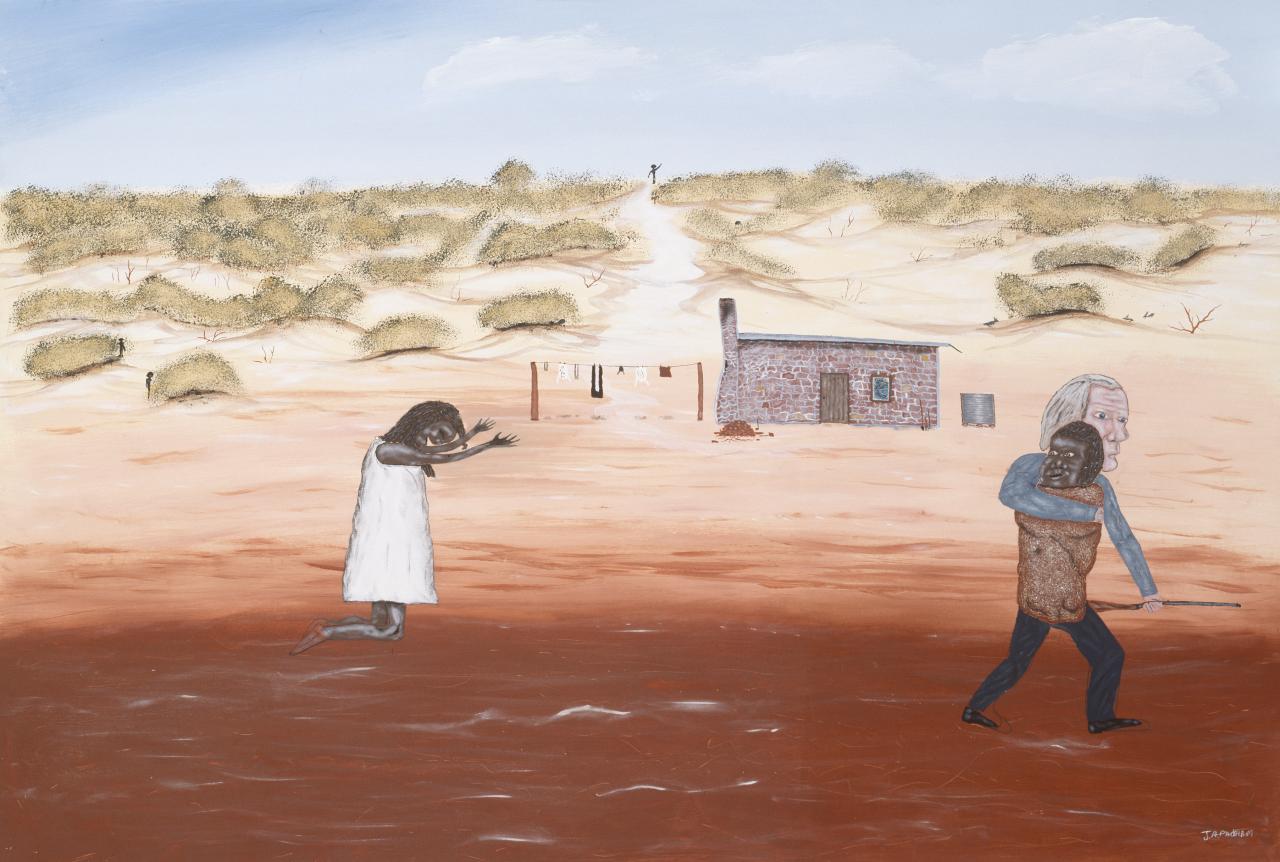
John Packham
Petin - to abduct, steal 1999
synthetic polymer paint on canvas
117.7 x 175.5 cm
National Gallery of Victoria, Melbourne
Purchased, 1999
1999.332
© John Packham

With the same generosity, Heather Koowootha also permits a view into her family’s history with her work Mother and daughter's reunion, 2014. Both of Koowootha’s parents were stolen in childhood. Her mother was confined to a dormitory at Yarrabah, just outside of Cairns, while her father was removed from his family in Aurukun and sent to work as a stockman at Normanton Mission. The two later met at Yarrabah and raised ten children together, of whom Koowootha and four siblings survive. While deeply connected to her family’s truth, in reality, Mother and daughter's reunion depicts an imagined event dreamt by her mother: the moment she would reunite with her own mother back on Country. A dream that never eventuated.
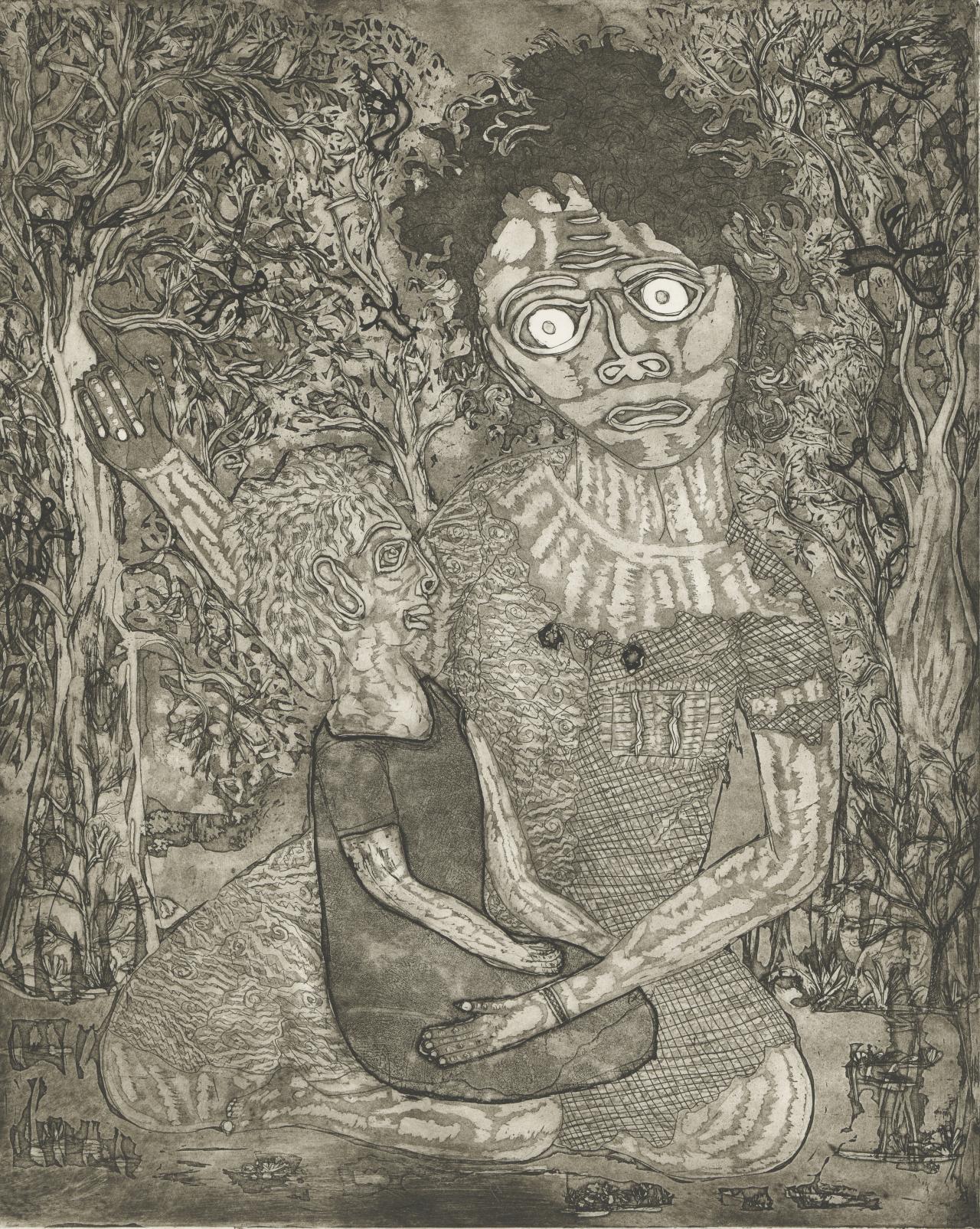
Heather Koowootha
Mother and daughter's reunion 2014
etching
49.2 x 39.6 cm (plate) 70.7 x 52.0 cm (sheet)
ed. 2/35
National Gallery of Victoria, Melbourne
Purchased, Victorian Foundation for Living Australian Artists, 2015
2015.7
© Heather Koowootha, courtesy of Canopy Art Centre, Cairns

These women were not unlucky. Their loss was not the result of misfortune or chance, but of deliberate, ordered policy. Although the government-sanctioned removal of Indigenous children officially ended in the 1970s, First Nations families continue to experience the loss of children at vastly uneven rates. In 2018, the Indigenous child mortality rate was 141 per 100,000 – more than double that of non-Indigenous children.2 As of June 2025, First Nations young people aged 10 to 17 comprised 60 per cent of Australia’s youth detention population, despite representing only 6.6 per cent of that age group. Aboriginal children are 21 times more likely to be incarcerated than their non-Indigenous peers and, in Victoria, children as young as fourteen may now be tried in adult courts and face life sentences – a shift that will ultimately affect First Nations youth far more than their white counterparts.

Raising my own children in Australia at this moment in history, my days are punctuated by reports of devastation from elsewhere. I feed my baby as images of starving children move across my screen, their suffering folded by the algorithm between selfies and memes. Each morning, I leave my daughter at daycare, confident she will be cared for, while stories circulate of children detained by immigration agents, removed from classrooms and families. From the safety of my home, the grief of other mothers reaches me through the news, their loss reported as the unfortunate by-product of another justified war. Conflict has always had a disproportionate impact on women and children. I took for granted the constant, nurturing, dignified care I received from Melbourne’s Royal Women’s Hospital, all the while tens of thousands of women across the world are currently expected to imminently give birth under inhumane and dangerous conditions, with fuel, medicine, water and medical supplies diminishing.

The images that circulate during times of conflict are reminiscent of powerfully affecting works by Käthe Kollwitz. Distress (Not), 1897, and Run over, 1910, are part of Kollwitz’s turn away from historical imagery toward more socially critical works. In both drawings, the mother’s body is hunched deeply over her dead child, her bereavement desperately evocative of the misery of losing a child. For Kollwitz, these figures do not signify individual tragedy alone but stand as metaphors for the erasure of the poor and the vulnerable during periods of governmental upheaval and social neglect. As images, they resonate far beyond their time, offering a visual language through which maternal suffering produced by war, displacement and systemic failure can be understood.
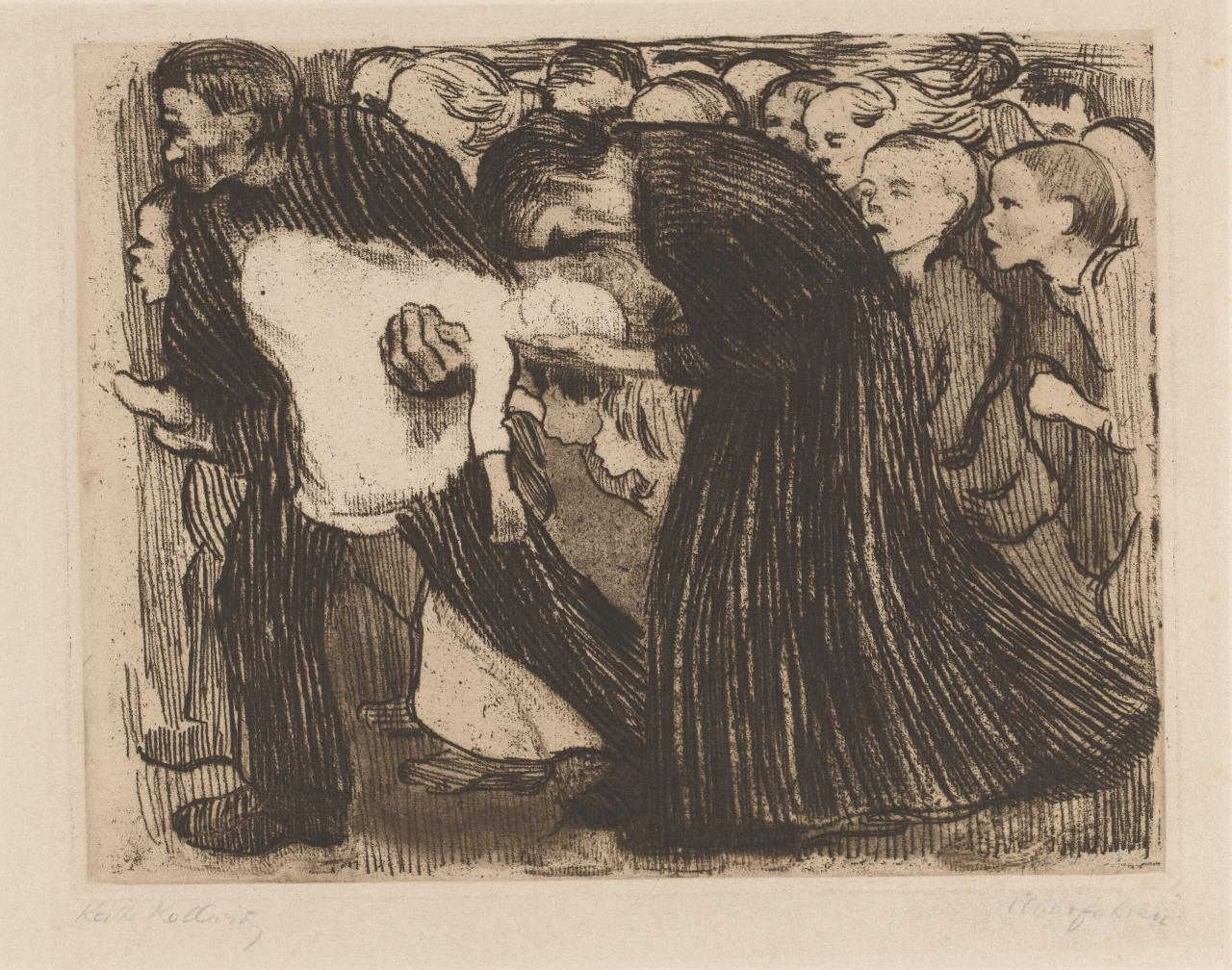
Käthe KOLLWITZ
Run over 1910
(Űberfahren)
soft-ground etching
25.4 x 32.2 cm (image and plate) 37.3 x 42.8 cm (sheet)
National Gallery of Victoria, Melbourne
Felton Bequest, 1944
1364-4

While Kollwitz was not drawing on first-hand experience of maternal grief at the time these works were made, the nightmare of losing a child weighed heavily within her practice. As a child, her baby brother Benjamin died of meningitis – a tragedy which the artist carried with her throughout her life. Later, married to a physician and living in a working-class Berlin neighbourhood, Kollwitz was often exposed to infant mortality. As themes, death of both the child and the mother appear frequently in her work, often as a personified force of inevitable darkness and dread. Kollwitz would sometimes employ her son, Peter, as model, most notably in Woman with dead child (Frau mit Totem Kind), 1903 (Museum of Modern Art, New York). Eleven years after the work was completed, at the beginning of the First World War, Peter died in Flanders aged just nineteen. Her older son Hans later wrote, ‘I asked mother where she got the image of the mother with her dead child from – years before that period. She thought she foresaw Peter’s death even then. She said she had been crying while working on these images.’3

Judith Wright expresses the terror of losing a child in her work A journey, 2011–12, with both theatricality and profound melancholia. The installation is inspired by the sudden death of her daughter, just days after her birth and comprises of surreal, ghostly figures assembled in procession: wooden puppets and Victorian dolls, antique mannequins with prosthetic limbs. Together, a band of childlike characters march ‘on their journey from one realm to the next’.4 For Wright, the figures sit somewhere between the extremities of maternal love and loss, their creation an endeavour to reconstruct the imagined life of her daughter. The work is eerie and playful, likened by curator Andrew Jensen to the tale of Peter Pan – a boy whose shadow was stitched back on and destined to never grow old. To Jensen, like A journey’s young protagonist, Peter Pan was youthful and brave, but denied the dimensions that come with age. He writes, ‘I have learnt we require both the shadows and the light in the same way. To understand happiness, we must know sadness; to value possession, we must reconcile loss. Peter himself represented all children who were lost to us and lived in the shadows of our thoughts and feelings.’5 A journey captures the magic of motherhood and is an extraordinary example of the power of art making in its ability to hold space for human experience.
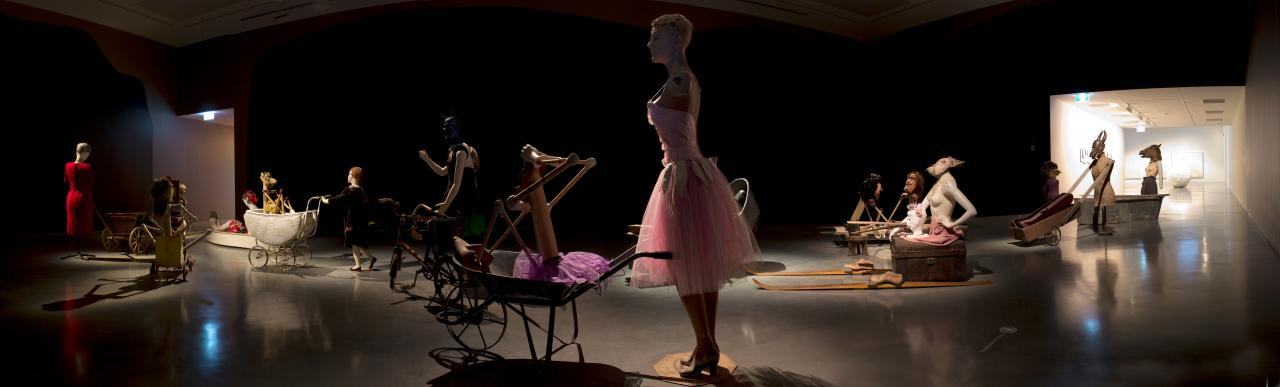
Judith WRIGHT
A journey (2011-2012)
various found objects, wood, metal, bamboo, cork, fibreglass, glass, sequins, tin, rubber, synthetic polymer paint, palm fronds, synthetic fur, synthetic hair
(a-nnn) 168.6 x 790.0 x 4111.5 cm (variable) (installation)
National Gallery of Victoria, Melbourne
Gift of an anonymous donor through the Australian Government's Cultural Gifts Program, 2015
2015.108.a-ooo
© Judith Wright

The knowledge of our own eventual departure from our children’s lives carries with it another kind of maternal grief. For me, this inevitability surfaced in the early months of motherhood: the hope that life unfolds in the correct order, and the dread that my own death could occur before my children no longer need me. For her final body of work before dying from cancer, Polixeni Papapetrou photographed her daughter, Olympia, as she had done many times throughout her career. In this series, shot in black and white and stripped of the imaginative fairytale that previously underpinned her child portraits, the photographs present the complexity of the mother-child relationship which was central to Papapetrou’s life and work. Prophetically titled MY HEART – Still Full of Her, 2018, the series is a summation of maternal love. In its intensity, the works replace embellishment for a presentation of the raw and familiar connection between the artist and her daughter. The works’ individual titles, such as My ghost, I once was and Curtain magnify the series’ strength, evoking both presence and impending absence, and holding tension between the closeness of maternal attachment and the knowledge of its unavoidable end:
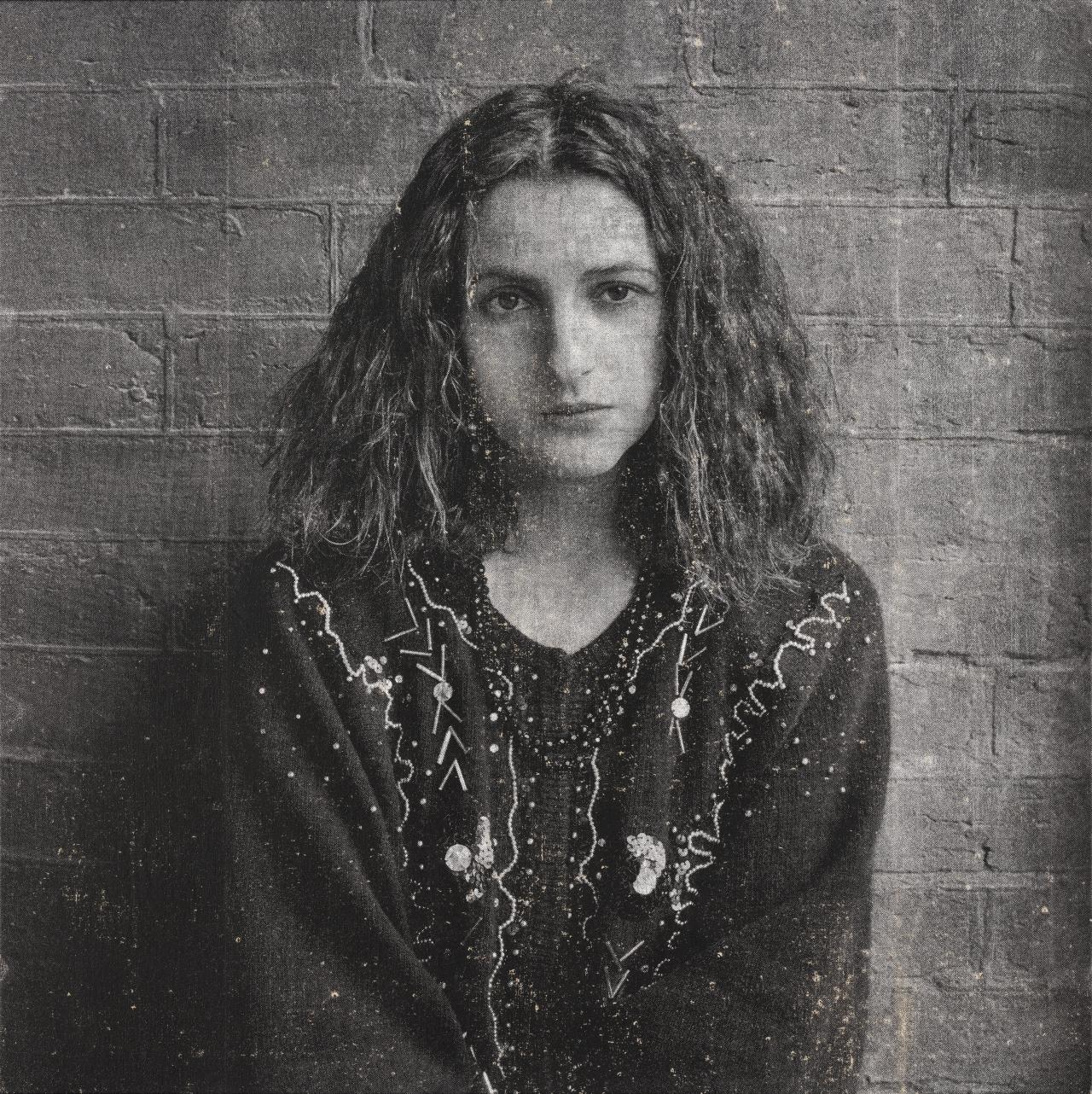
Polixeni PAPAPETROU
I once was (2018)
from the My heart, still full of her series 2018
photo-screenprint, metallic foil, water-based pigment on canvas
99.8 x 99.7 cm
National Gallery of Victoria, Melbourne
Gift of Olympia, Solomon and Robert Nelson in memory of Polixeni Papapetrou, 2026

© Polixeni Papapetrou/Licensed by Copyright Agency, Australia

My children are now adults and I appear to be at the end of my life with terminal cancer. I cannot think of a more valid way to have lived the past twenty-five years as an artist and in particular tapping into that liminal and mysterious space of childhood, to have had the privilege of engaging in conversations with children, because this is where my inspiration came from. It did not come solely from my imagination, but rather from paying attention to theirs.6

At the heart of these reflections on love and loss sits a simpler, shared impulse, surmised in a singular work by Yvonne Koolmatrie. Weaver’s baby in coolamon, 2008, depicts a small woven infant, nestled securely within a pelt-lined baby basket. Dedicated to, in Koolmatrie’s words, ‘all the mothers who just want to keep their babies safe and close,’ the work centres maternal care in its most fundamental form. Set alongside stories of grief that, in many cases, are specific to the cultures and times within which they surface, Koolmatrie’s woven infant transcends difference. It reminds us that across race, history and circumstance, motherhood is bound by the same fragile desire: to hold our children close and to keep them safe, for as long as we are able.
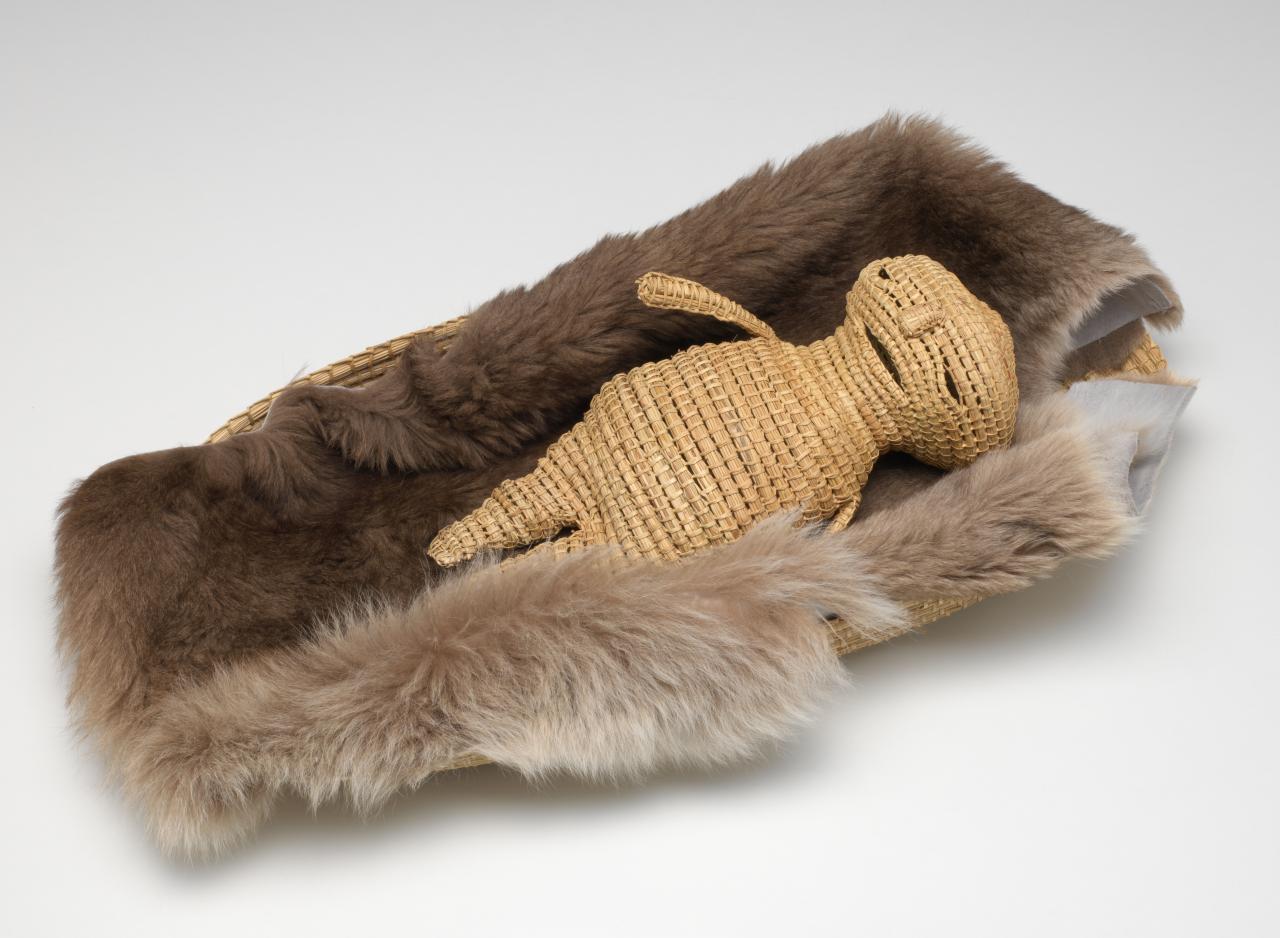
Yvonne Koolmatrie
Weaver's baby in coolamon 2008
sedge (Carex sp.), kangaroo skin
(a-c) 15.3 x 68.0 x 29.5 cm (overall)
National Gallery of Victoria, Melbourne
Purchased with funds donated by Helen Kennan, 2008
2008.569.a-c
© Yvonne Koolmatrie courtesy Aboriginal & Pacific Art Gallery


  1. John Packham, artist statement, 1999.

  2. Australian Government, ‘1.20 Infant and child mortality’, Aboriginal and Torres Strait Islander Health Performance Framework, Australian Government, accessed 3 Feb. 2026. Australian Government, ‘Child Mortality’, Closing the Gap Report 2020, accessed 3 Feb. 2026.

  3. Hans Kollwitz, ‘Käthe Kollwitz 1867–1945. Briefe der Freundschaft und Begegnungen’ (‘Letters of friendship and encounters’), quoted in Woman with Dead Child, Käthe Kollwitz Museum, Cologne, accessed 27 Jan. 2026.

  4. Judith Wright

  5. Andrew Jensen, ‘Shadow play’, catalogue essay, Fox Jensen McCory, Sydney, accessed 3 Feb. 2026.

  6. Polixeni Papapetrou, cited in exhibition didactic for Olympia: Photographs by Polixeni Papapetrou, 2019–20, National Gallery of Victoria, accessed 29 Jan. 2026.

Matthew Harris
Big love 2021
possum skin, synthetic fur, wax-coated polyester thread, (other materials)
(125.0 x 90.0 x 50.0 cm)
National Gallery of Victoria, Melbourne
Purchased, Victorian Foundation for Living Australian Artists, 2022
2022.819
© Matthew Harris

Wolf Mother

Amita Kirpalani

[to be read aloud]

Wolf cried to Moon. Moon, full of patient, round waiting, turned. Wolf, in full-throated appeal, called to Moon's night-shine. Wolf lifted herself off her haunched waiting. Wolf was hungry. She was straight-backed, her ears and tongue flicked, red gums thirsty; she could understand the air currents. Like yesterday, and all the other days before it, pungent Forest was a soupy cool of deathly stink: of leaf, of desiccated bones and gunky puddles. She set off, barrelling, moving as a blur. Underneath her, barely touching, was the blanket of wood rot, moulding moss, animal dung and black sod. She could nose and tongue the weeks, months and years of reek.

She flew across partial tracks where paws met older, ancient indents, and loose muddy divots swallowed all trace of lonesome pathfinders. She flitted through hilly slopes and over fallen branches and sloping, runny-wet rocks that sparkled. Then gates and gates and gates and cobblestones, closer. Finally, she reached that familiar human stink, both magnet and warning all at once.

Unlike Dog, Wolf understood she was trespassing. She was low-backed, head dropped, slinking. These provisional boundaries – of gate and road and dwelling – were not deep and wide like Forest. Wolf brushed against rain-slicked walls that held the humans in. She fixed her mind for a moment on the red warm of padded softness, of feeding and being fed. She recalled sun-flecked notions of nuzzling, of wet noses as she tended, warmed and encircled. Abruptly, she shook off – side to side, top to bottom – tremoring off the memory comfort. She was far from that place.

Wolf was sick with hunger and sick of hearing ‘Wolf!’. A repetitive soundtrack of her own name, summoned, spat and shouted. A lone, loping figure of threat and fear.

At the windowsill was a portrait of Mother and Child. Moon looked on. Child, a small bundle, full of unrelenting shriek that shot through the cool night air. Wolf, like Child, was hungry. Mother coddled, condemned and cried. Mother sang and sulked and spurned the sweet goodness of Child. Mother, wiping exasperation from her brow, began to sing a song of promises to Child – a long, sweet line of low tones, hush and shoosh. Mother sang of diamond rings and a looking glass. Mother sang tunes that came to her like dreams and half-formed visions. Mother sang for herself and for Child. But Child wasn't lulled, would not be lulled.

Tracey EMIN
Mother 2014
bronze
7.1 x 17.5 x 8.6 cm
ed. 1/6
National Gallery of Victoria, Melbourne
The Nigel Peck AM and Patricia Peck Fund, 2024
2024.130
© Tracey Emin. All rights reserved, DACS 2022

It was darker still, inky black and once the song was finished, Mother, from side of mouth, not to Child (maybe to Wolf?), hissed a threat. A threat that made Wolf's mouth water and her heart beat a little faster. ‘I'll throw you to Wolf!’ Mother said.

Moon continued on her westward turn. Mother rocked and cradled and paced and occasionally sang of billy goats, horses, bulls and dogs, but never of Wolf.

Lena Yarinkura
Jamu (Camp dog) 2001
earth pigments on Paperbark (Melaleuca sp.) and pandanus (Pandanus sp.), feathers, glass
26.5 x 60.0 x 23.0 cm
National Gallery of Victoria, Melbourne
Presented through the NGV Foundation in memory of Axel Poignant by an anonymous donor, 2001
2001.572
© Lena Yarinkura/Licensed by Copyright Agency, Australia

‘I'll throw you to Wolf!’ Mother said

Wolf was salivating – the bundle would transform from burden to bloody bone. Sweet, sweet Child. Then inside quieting, then resting and fat-bellied fullness.

Wolf sank deeper into her haunches and tuned in to Mother's song and then back to Moon. Moon was a faint outline, turning still further downwards.

Child's shriek turned to mutter, turned to tiny rhythmic breaths. Abruptly, Mother gently shut the window and turned away, proffering a last silently mimed shoo at Wolf. Mother's song and threats lead around rounds and circles.

Wolf rose. Wolf had attended this ministry before. Mother would never throw Child to Wolf. Child was too much like Mother. Wolf felt ashamed of her wasted wait. Wolf scampered out – out through gates and gates and gates and over wet-slicked rocks – chasing a lost notion of heart-beating warmth in Forest.

Slowly, Moon grinned, light-smiling down dale.

Elvis RICHARDSON
Settlement and the Gatekeepers (2022-2023)
powder-coated steel
234.0 x 1080.5 x 150.0 cm (variable) (installation) (closed) 234.0 x 1080.5 x 165.2 cm (variable) (installation) (open)
National Gallery of Victoria, Melbourne
Commissioned by the National Gallery of Victoria, Melbourne. Purchased, Vicrorian Foundation for Living Australian Artists, 2023
2023.727
© Elvis Richardson

Birth of a Mother

(ENGLAND)
Pregnancy ensemble
(1790s)

Anniebell Marrngamarrnga
Yawkyawk
2007

Ashanti people, Ghana, West Africa
Akua'ba figure
(early 20th century)

Bernardo CAVALLINO
The Virgin Annunciate
(c. 1645-1650)

CHINESE
Guanyin
Qing dynasty, Kangxi period 1662-1722

Christine GODDEN
Untitled
1974

Christine GODDEN
Untitled
1974

Christine GODDEN
Untitled
1974

Christine GODDEN
Untitled
1974

Christine GODDEN
Untitled
1974

Christine GODDEN
Untitled
1974

Christine GODDEN
Untitled
1974

Christine GODDEN
Untitled
1974

Christine GODDEN
Untitled
1974

Christine GODDEN
Untitled
1974

Christine GODDEN
Untitled
1974

Christine GODDEN
Untitled
1974

Christine GODDEN
Untitled
1974

Christine GODDEN
Untitled
1974

Christine GODDEN
Untitled
1974

Christine GODDEN
Untitled
1974

Christine GODDEN
Untitled
1974

Christine GODDEN
Untitled
1974

Christine GODDEN
Untitled
1974

Christine GODDEN
Untitled
1974

Christine GODDEN
Untitled
1974

Christine GODDEN
Untitled
1974

Christine GODDEN
Untitled
1974

Christine GODDEN
Untitled
1974

CORREGGIO
Madonna and Child with infant Saint John the Baptist
(c. 1514-1515)

David Mowaljarlai
I am Banggal
1994

Djerrkŋu Yunupiŋu
New generation
2021

Donna BAILEY
Lush
(2002)

Elizabeth Djutarra
Nganiyal (conical mat)
1998

Elizabeth Djutarra
Nganiyal (conical mat)
1998

Elizabeth Djutarra
Nganiyal (conical mat)
1998

Faye TOOGOOD
Roly-Poly chair / Water
(2016)

FLANDERS
The Virgin and Child
(mid 15th century-late 15th century)

Fred WILLIAMS
Willdendorf Madonna
1955

Giovanni TOSCANI
Madonna and Child
(early 15th century)

HJ Wedge
Immaculate conception - What hypocrisy! (Nun)
1992

Jean-Auguste-Dominique INGRES
Virgin of the Adoption
1858

Kate JUST
An armour of hope
2012

Kate JUST
The arms of mother
2012

Kyra Mancktelow
One continuous string
2021

ENGLAND, Staffordshire (manufacturer)
The Virgin and Child
(c. 1800)

William BELL SCOTT (etcher) William BLAKE (after)
The Nativity
1875

Katsushika Ōi
Illustrated handbook on daily life for women
(1847)

Milk

Baby Bubble

Supermum

Bad Mother

Magic Maker

Invisible Mother

My Mother

To Love and to Lose

Maternal Legacies

John Prince Siddon
Took our children away
2024

Lucy Williams-Connelly
Dilly bags
2024

Tui Emma Gillies Sulieti Fieme'a Burrows
Pacifika Ocean
2024

Iluwanti Ken
Walawuru ngunytju kukaku ananyi (Mother eagles going hunting)
2023

Hayley Millar Baker
Entr'acte
2023

Guruwuy Murrinyina
Dhatam
2023

Mitch Mahoney
Baba (Mother), possum skin cloak
2023

Katherine HATTAM
The pinch
2022

Djerrkŋu Yunupiŋu
New generation
2021

Kyra Mancktelow
One continuous string
2021

Matthew Harris
Big love
2021

Katrin KOENNING
repair
2020; 2022 {printed}

Hannah Brontë
EYE HEAR U MAGIK
2020

Soni JOGI
Empowered mother
(2020)

Teju JOGI
Traffic in the city
(2020)

Camille HENROT
Life span
(2019)

Camille HENROT
Carnivore
(2019)

Polixeni PAPAPETROU
I am a camera
(2018)

Polixeni PAPAPETROU
I once was
(2018)

Polixeni PAPAPETROU
Muse
2018

Polixeni PAPAPETROU
The gaze
2018

Polixeni PAPAPETROU
Thousand yard stare
(2018)

Polixeni PAPAPETROU
To(ge)ther
(2018)

Shirley Macnamara
Galah nest
2017

Ananta Ram RANA
Durga
2017

Ruth O'LEARY
Flinders Street, 2017
(2017)

Polixeni PAPAPETROU
My ghost
2017

Daroga RAM
Screen
2017

Malaluba Gumana
Dhatam (Waterlilies)
2017

Faye TOOGOOD
Roly-Poly chair / Water
(2016)

Tala MADANI
Primer
2015

Margaret Rarru Garrawarra
Bathi (Baby basket)
2015

Rob McHAFFIE
You're not going out tonight
2014

Heather Koowootha
Mother and daughter's reunion
2014

Karla Dickens
The weight of grief
2014

Kate JUST
An armour of hope
2012

Kate JUST
The arms of mother
2012

Sophie CALLE
The giraffe
(2012)

Siri HAYES
Prickly pears and mumbling old stones
(2011)

Judith WRIGHT
A journey
(2011-2012)

Bugai Whylouter Pinyirrpa Nancy Patterson
Parnngurr
2009

Yvonne Koolmatrie
Weaver's baby in coolamon
2008

Anniebell Marrngamarrnga
Yawkyawk
2007

Patricia PICCININI
Nest
(2006)

Lorraine Connelly-Northey
Narrbong (String bag)
2005

Lorraine Connelly-Northey
Narrbong (String bag)
2005

Lorraine Connelly-Northey
Narrbong (String bag)
2005

Lorraine Connelly-Northey
Narrbong (String bag)
2005

Lorraine Connelly-Northey
Narrbong (String bag)
2005

Lorraine Connelly-Northey
Narrbong (String bag)
2005

Lorraine Connelly-Northey
Narrbong (String bag)
2005

Dianne Jones
Redfern interior
2003; 2024 {printed}

Donna BAILEY
Lush
(2002)

Lena Yarinkura
Jamu (Camp dog)
2001

SHENG Qi
Memories (Mother)
2000; 2004 {printed}

Destiny Deacon
Adoption
2000; 2016 {printed}

Julie Dowling
All the way
2000

Mark Virgil Puautjimi Maria Josette Orsto
Murtankala
1999

John Packham
Petin - to abduct, steal
1999

Elizabeth Djutarra
Nganiyal (conical mat)
1998

Elizabeth Djutarra
Nganiyal (conical mat)
1998

Elizabeth Djutarra
Nganiyal (conical mat)
1998

Lena Djamarayku
Echidna
1998

David Mowaljarlai
I am Banggal
1994

Tracey MOFFATT
Mother's Day, 1975
1994

Tracey MOFFATT
Birth certificate, 1962
1994

Anne GRAHAM
The fountain of the universal housewife
1993

HJ Wedge
Immaculate conception - What hypocrisy! (Nun)
1992

Louise BOURGEOIS
Ste Sébastienne
(1992)

Ruth MADDISON
Pat Counihan, 74
1991

GUERRILLA GIRLS, New York (art collective)
What I want for Mother's Day
(1991)

Viva GIBB
Sybil Gibb
(1991)

John SPOONER
Pieta
1990; 1990 {published in Quadrant, December}

Davida ALLEN
Baby
1989

Queenie McKenzie
Blackfellas in bush country
1987

Destiny Deacon
Home Video
1987

Viva GIBB
Rupert and Sybil
(c. 1983)

David HOCKNEY
My mother sleeping
(1982)

Bashir BARAKI
Untitled
(1978-1987)

Ann NEWMARCH
Colour me bold
1977

Vivienne BINNS
Laura (Lowe) Wilkinson and Harriet (Chatwin) Lowe
1975-1976

Christine GODDEN
Untitled
1974

Christine GODDEN
Untitled
1974

Christine GODDEN
Untitled
1974

Christine GODDEN
Untitled
1974

Christine GODDEN
Untitled
1974

Christine GODDEN
Untitled
1974

Christine GODDEN
Untitled
1974

Christine GODDEN
Untitled
1974

Christine GODDEN
Untitled
1974

Christine GODDEN
Untitled
1974

Christine GODDEN
Untitled
1974

Christine GODDEN
Untitled
1974

Christine GODDEN
Untitled
1974

Christine GODDEN
Untitled
1974

Christine GODDEN
Untitled
1974

Christine GODDEN
Untitled
1974

Christine GODDEN
Untitled
1974

Christine GODDEN
Untitled
1974

Christine GODDEN
Untitled
1974

Christine GODDEN
Untitled
1974

Christine GODDEN
Untitled
1974

Christine GODDEN
Untitled
1974

Christine GODDEN
Untitled
1974

Christine GODDEN
Untitled
1974

Christine GODDEN
Untitled
1974; 1986 {printed}

Jan SAUDEK
The love
1973

David HOCKNEY
My mother with a parrot
(1973-1974)

Christine GODDEN
Untitled
(c. 1972)

Olive COTTON
My daughter and grand-daughter
1971

INDONESIAN
Mother and child
(c. 1970)

Grace LOCK
Mother and Child
(1960s-1970s)

Fred WILLIAMS
Willdendorf Madonna
1955

Fred WILLIAMS
Feeding baby
(1955-1956)

Harry CALLAHAN
Eleanor and Barbara, Chicago
(1954); (1970s) {printed}

Max DUPAIN
Mother and child
1952; (c. 1986) {printed}

Noel COUNIHAN
The artist's mother
(1948)

John PERCEVAL
Romulus suckling the wolf with Remus
1946

Eric WILSON
The painter's mother
(1944)

Henry RAYNER
My mother
1944

Paul JACOULET
The treasure, Korea
(1940)

A. D. COLQUHOUN
Portrait of my mother
(1934)

Jamini ROY
Mother and son
(1930s)

Sybil CRAIG
Mother figure with children
(mid 1930s)

Ethel WALKER
Lilith
(c. 1920s)

Thea PROCTOR
Mother and son
1915

Max MELDRUM
Portrait of the artist's mother
(1913)

Käthe KOLLWITZ
Run over
1910

E. Phillips FOX
(Mother and child)
1908

Michael POWOLNY (designer) WIENER KERAMIK, Vienna (manufacturer)
Madonna and Child
(c. 1908)

Maurice DENIS
Visit to the purple room
(1899)

Frank SHORT
Mrs J. T. Short
(1898)

William BENTLEY
No title (Baby), cabinet print
(1895-1900)

Bertram MACKENNAL
Circe
1893

Iso RAE
Breton family
(c. 1892)

John LONGSTAFF
The young mother
1891

William T. B. LATIMER
No title (Baby on chair), cabinet print
(1890s); (1901) {dated}

John Henry LORIMER
A lullaby
1889

Paul-César HELLEU
Motherhood
(c. 1887-1900)

Paul-César HELLEU
Mother and child
(1887-1906)

ALFRED SYMMONS, Newcastle
No title (Child holding a tambourine), carte-de-visite
(1884-1897)

Eleanor BELL
Grandmother’s bible
(c. 1880)

John BISHOP-OSBORNE
No title (Baby), carte-de-visite
(1879-1881)

J. & J. KOHN, Vienna (manufacturer)
Cradle
(c. 1878)

August Friedrich Albrecht SCHENCK
Anguish
(c. 1878)

JAMES R. DOBSON & CO., Adelaide
No title (Baby), carte-de-visite
(1877-1883)

William BELL SCOTT (etcher) William BLAKE (after)
The Nativity
1875

Frederick WALKER
The right of way
(1875)

Julia Margaret CAMERON
Mrs Herbert Duckworth, her son George, Florence Fisher and H. A. L. Fisher
(c. 1871)

JAPANESE
Mother with child, okimono
Meiji period 1868-1912

Alfred WINTER
No title (Baby), carte-de-visite
(1860-1881)

P. L. REID & CO., Hobart
No title (Baby), carte-de-visite
(1860s)

Jean-Auguste-Dominique INGRES
Virgin of the Adoption
1858

Joseph SWAIN (wood engraver) George John PINWELL (after)
Making it up
(c. 1858-1875)

William STRUTT
Maria Elizabeth O'Mullane and her children
(c. 1854)

ENGLAND, Staffordshire (manufacturer)
Feeding bottle
(c. 1850)

Honoré DAUMIER
My wife has been a long time at this banquet….It's been the best part of forty-eight hours
(1849)

Katsushika Ōi
Illustrated handbook on daily life for women
(1847)

Paul GAVARNI
It’s very odd – my wife was supposed to dine at Madame Coquardeau’s but only the children were there
(1841)

Queen Victoria
Victoria, Princess Royal, with her nurse
1841

Utagawa KUNIYOSHI
Mother and child
(1830-1848)

Kitagawa HIDEMARO
A reflection of summer's cool breeze
(c. 1810)

ENGLAND, Staffordshire (manufacturer)
The Virgin and Child
(c. 1800)

Francisco GOYA y Lucientes
Here comes the bogey-man
(1797-1798)

Francisco GOYA y Lucientes
Where is mother going?
(1797-1798)

(ENGLAND)
Pregnancy ensemble
(1790s)

Johannes Christiaan JANSON (etcher) Christina CHALON (after)
The mother teaching her child to walk
(c. 1778-1823)

CHINESE
Guanyin
Qing dynasty, Kangxi period 1662-1722

Mary BEALE
Portrait of the artist's son, Bartholomew Beale
(c. 1660)

Bernardo CAVALLINO
The Virgin Annunciate
(c. 1645-1650)

REMBRANDT Harmensz. van Rijn
The artist's mother, with hand on chest: small bust
1631

Cornelis de VOS
Mother and child
1624

Picchi DI MARCANTONIO (attributed to) (decorator)
Myrrha giving birth to Adonis, plate
1550

Luca CAMBIASO (school of)
Seated woman with playing children
(1542-1585)

MITHRAM
Folio from a Bhagavata Purana: Yashoda nursing the child Krishna
(c. 1525-1550)

Albrecht DÜRER
The Madonna nursing
1519

Dosso DOSSI Battista DOSSI (attributed to)
Lucrezia Borgia, Duchess of Ferrara
(1519-1530)

CORREGGIO
Madonna and Child with infant Saint John the Baptist
(c. 1514-1515)

Albrecht DÜRER
The Madonna on a grassy bank
1503

Cosimo di Lorenzo ROSSELLI Cosimo di Lorenzo ROSSELLI (studio of)
Madonna and Child with three angels
(c. 1478-1480)

Hans MEMLING
The Man of Sorrows in the arms of the Virgin
(1475) {or (1479)}

EGYPT
Isis suckling Horus
Late Period – Ptolemaic Period 644 BCE-30 BCE

Ashanti people, Ghana, West Africa
Akua'ba figure
(early 20th century)

FLANDERS
The Virgin and Child
(mid 15th century-late 15th century)

Giovanni TOSCANI
Madonna and Child
(early 15th century)

ITALY
She-wolf
(16th century)

GREECE, Attica or ITALY
Guttus (Greek black-glaze ware)
4th century BCE

George BROWNING
Marsupial mother

Inuit, Clyde River, Nunavut, Canada
Mother and child
(20th century)

INDIAN
Durga glass painting
(late 19th century)

(ENGLAND)
Pregnancy ensemble
(1790s)

ALFRED SYMMONS, Newcastle
No title (Child holding a tambourine), carte-de-visite
(1884-1897)

Davida ALLEN
Baby
1989

Ashanti people, Ghana, West Africa
Akua'ba figure
(early 20th century)

Donna BAILEY
Lush
(2002)

Hayley Millar Baker
Entr'acte
2023

Bashir BARAKI
Untitled
(1978-1987)

Mary BEALE
Portrait of the artist's son, Bartholomew Beale
(c. 1660)

Eleanor BELL
Grandmother’s bible
(c. 1880)

William BENTLEY
No title (Baby), cabinet print
(1895-1900)

Vivienne BINNS
Laura (Lowe) Wilkinson and Harriet (Chatwin) Lowe
1975-1976

John BISHOP-OSBORNE
No title (Baby), carte-de-visite
(1879-1881)

Louise BOURGEOIS
Ste Sébastienne
(1992)

Hannah Brontë
EYE HEAR U MAGIK
2020

George BROWNING
Marsupial mother

Harry CALLAHAN
Eleanor and Barbara, Chicago
(1954); (1970s) {printed}

Sophie CALLE
The giraffe
(2012)

Luca CAMBIASO (school of)
Seated woman with playing children
(1542-1585)

Julia Margaret CAMERON
Mrs Herbert Duckworth, her son George, Florence Fisher and H. A. L. Fisher
(c. 1871)

Bernardo CAVALLINO
The Virgin Annunciate
(c. 1645-1650)

CHINESE
Guanyin
Qing dynasty, Kangxi period 1662-1722

A. D. COLQUHOUN
Portrait of my mother
(1934)

Lorraine Connelly-Northey
Narrbong (String bag)
2005

Lorraine Connelly-Northey
Narrbong (String bag)
2005

Lorraine Connelly-Northey
Narrbong (String bag)
2005

Lorraine Connelly-Northey
Narrbong (String bag)
2005

Lorraine Connelly-Northey
Narrbong (String bag)
2005

Lorraine Connelly-Northey
Narrbong (String bag)
2005

Lorraine Connelly-Northey
Narrbong (String bag)
2005

CORREGGIO
Madonna and Child with infant Saint John the Baptist
(c. 1514-1515)

Olive COTTON
My daughter and grand-daughter
1971

Noel COUNIHAN
The artist's mother
(1948)

Sybil CRAIG
Mother figure with children
(mid 1930s)

Honoré DAUMIER
My wife has been a long time at this banquet….It's been the best part of forty-eight hours
(1849)

Destiny Deacon
Home Video
1987

Destiny Deacon
Adoption
2000; 2016 {printed}

Maurice DENIS
Visit to the purple room
(1899)

Karla Dickens
The weight of grief
2014

Lena Djamarayku
Echidna
1998

Elizabeth Djutarra
Nganiyal (conical mat)
1998

Elizabeth Djutarra
Nganiyal (conical mat)
1998

Elizabeth Djutarra
Nganiyal (conical mat)
1998

Dosso DOSSI Battista DOSSI (attributed to)
Lucrezia Borgia, Duchess of Ferrara
(1519-1530)

Julie Dowling
All the way
2000

Max DUPAIN
Mother and child
1952; (c. 1986) {printed}

Albrecht DÜRER
The Madonna nursing
1519

Albrecht DÜRER
The Madonna on a grassy bank
1503

EGYPT
Isis suckling Horus
Late Period – Ptolemaic Period 644 BCE-30 BCE

ENGLAND, Staffordshire (manufacturer)
The Virgin and Child
(c. 1800)

ENGLAND, Staffordshire (manufacturer)
Feeding bottle
(c. 1850)

FLANDERS
The Virgin and Child
(mid 15th century-late 15th century)

E. Phillips FOX
(Mother and child)
1908

Margaret Rarru Garrawarra
Bathi (Baby basket)
2015

Paul GAVARNI
It’s very odd – my wife was supposed to dine at Madame Coquardeau’s but only the children were there
(1841)

Viva GIBB
Sybil Gibb
(1991)

Viva GIBB
Rupert and Sybil
(c. 1983)

Tui Emma Gillies Sulieti Fieme'a Burrows
Pacifika Ocean
2024

Christine GODDEN
Untitled
1974

Christine GODDEN
Untitled
1974

Christine GODDEN
Untitled
1974

Christine GODDEN
Untitled
1974

Christine GODDEN
Untitled
1974

Christine GODDEN
Untitled
1974

Christine GODDEN
Untitled
1974

Christine GODDEN
Untitled
1974

Christine GODDEN
Untitled
1974

Christine GODDEN
Untitled
1974

Christine GODDEN
Untitled
1974

Christine GODDEN
Untitled
1974

Christine GODDEN
Untitled
1974

Christine GODDEN
Untitled
1974

Christine GODDEN
Untitled
1974

Christine GODDEN
Untitled
1974

Christine GODDEN
Untitled
1974

Christine GODDEN
Untitled
1974

Christine GODDEN
Untitled
1974

Christine GODDEN
Untitled
1974

Christine GODDEN
Untitled
1974

Christine GODDEN
Untitled
1974

Christine GODDEN
Untitled
1974

Christine GODDEN
Untitled
1974

Christine GODDEN
Untitled
(c. 1972)

Christine GODDEN
Untitled
1974; 1986 {printed}

Anne GRAHAM
The fountain of the universal housewife
1993

GREECE, Attica or ITALY
Guttus (Greek black-glaze ware)
4th century BCE

GUERRILLA GIRLS, New York (art collective)
What I want for Mother's Day
(1991)

Malaluba Gumana
Dhatam (Waterlilies)
2017

Matthew Harris
Big love
2021

Katherine HATTAM
The pinch
2022

Siri HAYES
Prickly pears and mumbling old stones
(2011)

Paul-César HELLEU
Motherhood
(c. 1887-1900)

Paul-César HELLEU
Mother and child
(1887-1906)

Camille HENROT
Life span
(2019)

Camille HENROT
Carnivore
(2019)

Kitagawa HIDEMARO
A reflection of summer's cool breeze
(c. 1810)

David HOCKNEY
My mother sleeping
(1982)

David HOCKNEY
My mother with a parrot
(1973-1974)

INDIAN
Durga glass painting
(late 19th century)

INDONESIAN
Mother and child
(c. 1970)

Jean-Auguste-Dominique INGRES
Virgin of the Adoption
1858

Inuit, Clyde River, Nunavut, Canada
Mother and child
(20th century)

ITALY
She-wolf
(16th century)

J. & J. KOHN, Vienna (manufacturer)
Cradle
(c. 1878)

Paul JACOULET
The treasure, Korea
(1940)

JAMES R. DOBSON & CO., Adelaide
No title (Baby), carte-de-visite
(1877-1883)

Johannes Christiaan JANSON (etcher) Christina CHALON (after)
The mother teaching her child to walk
(c. 1778-1823)

JAPANESE
Mother with child, okimono
Meiji period 1868-1912

Soni JOGI
Empowered mother
(2020)

Teju JOGI
Traffic in the city
(2020)

Dianne Jones
Redfern interior
2003; 2024 {printed}

Kate JUST
An armour of hope
2012

Kate JUST
The arms of mother
2012

Iluwanti Ken
Walawuru ngunytju kukaku ananyi (Mother eagles going hunting)
2023

Katrin KOENNING
repair
2020; 2022 {printed}

Käthe KOLLWITZ
Run over
1910

Yvonne Koolmatrie
Weaver's baby in coolamon
2008

Heather Koowootha
Mother and daughter's reunion
2014

Utagawa KUNIYOSHI
Mother and child
(1830-1848)

William T. B. LATIMER
No title (Baby on chair), cabinet print
(1890s); (1901) {dated}

Grace LOCK
Mother and Child
(1960s-1970s)

John LONGSTAFF
The young mother
1891

John Henry LORIMER
A lullaby
1889

Francisco GOYA y Lucientes
Here comes the bogey-man
(1797-1798)

Francisco GOYA y Lucientes
Where is mother going?
(1797-1798)

Bertram MACKENNAL
Circe
1893

Shirley Macnamara
Galah nest
2017

Tala MADANI
Primer
2015

Ruth MADDISON
Pat Counihan, 74
1991

Mitch Mahoney
Baba (Mother), possum skin cloak
2023

Kyra Mancktelow
One continuous string
2021

Picchi DI MARCANTONIO (attributed to) (decorator)
Myrrha giving birth to Adonis, plate
1550

Anniebell Marrngamarrnga
Yawkyawk
2007

Rob McHAFFIE
You're not going out tonight
2014

Queenie McKenzie
Blackfellas in bush country
1987

Max MELDRUM
Portrait of the artist's mother
(1913)

Hans MEMLING
The Man of Sorrows in the arms of the Virgin
(1475) {or (1479)}

MITHRAM
Folio from a Bhagavata Purana: Yashoda nursing the child Krishna
(c. 1525-1550)

Tracey MOFFATT
Mother's Day, 1975
1994

Tracey MOFFATT
Birth certificate, 1962
1994

David Mowaljarlai
I am Banggal
1994

Guruwuy Murrinyina
Dhatam
2023

Ann NEWMARCH
Colour me bold
1977

Ruth O'LEARY
Flinders Street, 2017
(2017)

P. L. REID & CO., Hobart
No title (Baby), carte-de-visite
(1860s)

John Packham
Petin - to abduct, steal
1999

Polixeni PAPAPETROU
I am a camera
(2018)

Polixeni PAPAPETROU
I once was
(2018)

Polixeni PAPAPETROU
Muse
2018

Polixeni PAPAPETROU
My ghost
2017

Polixeni PAPAPETROU
The gaze
2018

Polixeni PAPAPETROU
Thousand yard stare
(2018)

Polixeni PAPAPETROU
To(ge)ther
(2018)

John PERCEVAL
Romulus suckling the wolf with Remus
1946

Patricia PICCININI
Nest
(2006)

Michael POWOLNY (designer) WIENER KERAMIK, Vienna (manufacturer)
Madonna and Child
(c. 1908)

Thea PROCTOR
Mother and son
1915

Mark Virgil Puautjimi Maria Josette Orsto
Murtankala
1999

SHENG Qi
Memories (Mother)
2000; 2004 {printed}

Iso RAE
Breton family
(c. 1892)

Daroga RAM
Screen
2017

Ananta Ram RANA
Durga
2017

Henry RAYNER
My mother
1944

REMBRANDT Harmensz. van Rijn
The artist's mother, with hand on chest: small bust
1631

Cosimo di Lorenzo ROSSELLI Cosimo di Lorenzo ROSSELLI (studio of)
Madonna and Child with three angels
(c. 1478-1480)

Jamini ROY
Mother and son
(1930s)

Jan SAUDEK
The love
1973

August Friedrich Albrecht SCHENCK
Anguish
(c. 1878)

William BELL SCOTT (etcher) William BLAKE (after)
The Nativity
1875

Frank SHORT
Mrs J. T. Short
(1898)

John Prince Siddon
Took our children away
2024

John SPOONER
Pieta
1990; 1990 {published in Quadrant, December}

William STRUTT
Maria Elizabeth O'Mullane and her children
(c. 1854)

Joseph SWAIN (wood engraver) George John PINWELL (after)
Making it up
(c. 1858-1875)

Faye TOOGOOD
Roly-Poly chair / Water
(2016)

Giovanni TOSCANI
Madonna and Child
(early 15th century)

Queen Victoria
Victoria, Princess Royal, with her nurse
1841

Cornelis de VOS
Mother and child
1624

Frederick WALKER
The right of way
(1875)

Ethel WALKER
Lilith
(c. 1920s)

HJ Wedge
Immaculate conception - What hypocrisy! (Nun)
1992

Bugai Whylouter Pinyirrpa Nancy Patterson
Parnngurr
2009

Fred WILLIAMS
Willdendorf Madonna
1955

Fred WILLIAMS
Feeding baby
(1955-1956)

Lucy Williams-Connelly
Dilly bags
2024

Eric WILSON
The painter's mother
(1944)

Alfred WINTER
No title (Baby), carte-de-visite
(1860-1881)

Judith WRIGHT
A journey
(2011-2012)

Lena Yarinkura
Jamu (Camp dog)
2001

Djerrkŋu Yunupiŋu
New generation
2021

Katsushika Ōi
Illustrated handbook on daily life for women
(1847)

Credits

First published in 2026 by the Council of Trustees of the National Gallery of Victoria
180 St Kilda Road
Melbourne, Victoria 3004, Australia
ngv.melbourne

This publication is copyright and all rights are reserved. Apart from any use as permitted under the Copyright Act 1968, no part may be reproduced or communicated to the public by any process without prior written permission. Enquiries should be directed to the publisher.

© National Gallery of Victoria, Melbourne, 2026

All reasonable efforts have been made to obtain permission to use copyright material reproduced in this publication. In cases where this has not been possible, owners are invited to notify the Publications Department at the National Gallery of Victoria.


NGV Publications
Head of Publications, Photographic Services and Library: Megan Patty
Publishing Manager: Siân Scott-Clash
Curators: Katharina Prugger, Sophie Gerhard and Eva Christoff
Designer: Oscar Jackson
Developer: Madi Reader
Editors: Eleanor Jordan-Gahan, Kelsey Oldham and Michael Ryan