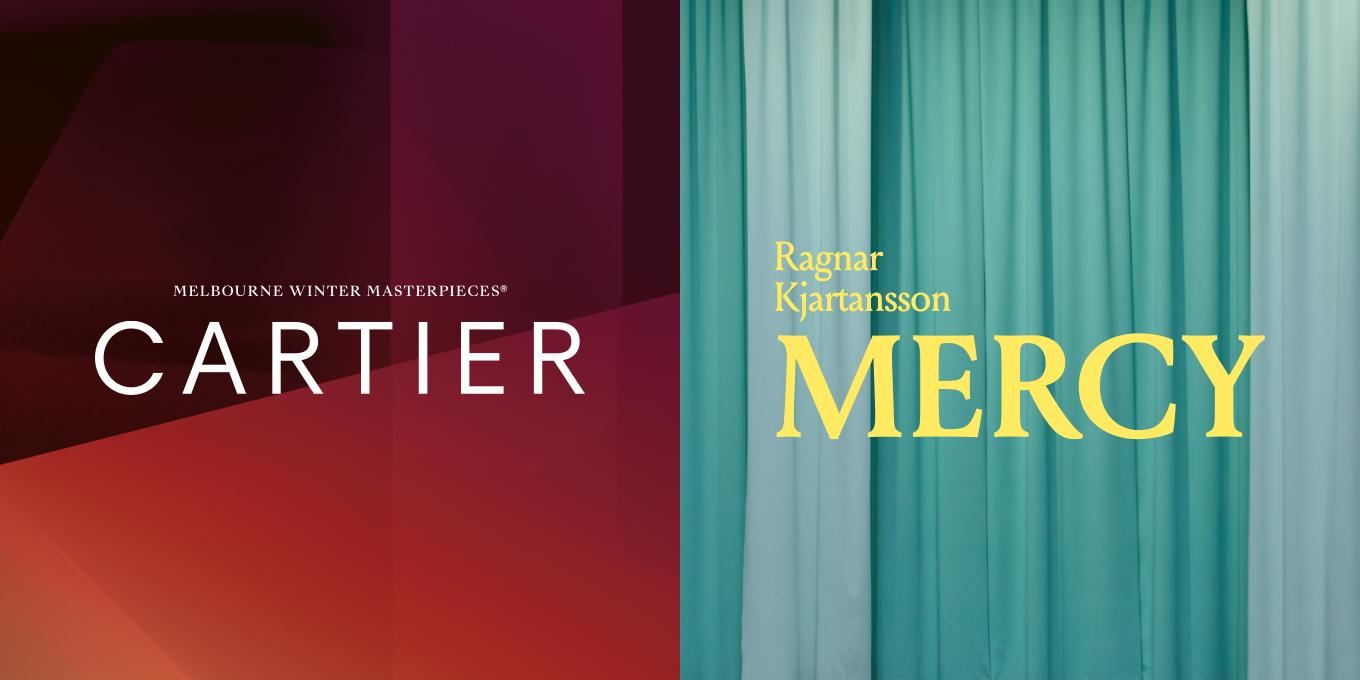
Special Joint ticket offer
See Ragnar Kjartansson: Mercy for only $10 when purchasing a CARTIER exhibition ticket.
Valid until 4 October 2026
NGV International
26 Jun – 4 Oct 26
Friday Nights 6–10pm (with NGV Friday Nights ticket)
Icelandic artist Ragnar Kjartansson was born into a family of artists, authors, theatre professionals and performers. He frequently includes music and performance in his video works, in an effort to explore the full spectrum of human emotion.
This exhibition showcases eight distinct video and film projects. The works incorporate an array of stylistic influences, from choreographed music videos and live musical performances to American video art of the 1970s, and stage traditions such as opera and ballet. Through the key elements of duration and repetition, Kjartansson’s video works uncover rehearsed truths, unanticipated candour, and the pleasures of participation, collaboration and choreography.
Across the exhibition, Kjartansson adopts various personae – bathing band leader, coiffed crooner, Rococo dinner guest, medieval troubadour – to both celebrate and satirise the romanticised figure of the artist. Through his video works, Kjartansson reveals a range of human truths at the mercy of artifice.
2015–2021
single-channel videos with sound
3 hours 10 min
Composed of nine individual works, Kjartansson’s Scenes from Western Culture series comprises non-narrative vignettes representing various social groups and spaces of leisure. These ‘cinematic paintings’, as Kjartansson describes them, were inspired by the artist’s self-diagnosed ‘Western culture claustrophobia’, or a flattening of cultural difference. The scenes include a couple dining at a New York restaurant, children playing in a garden in Germany, and a speedboat on a Swiss lake. These videos that operate like picturesque tableaus can be linked to the artist’s fascination with French Rococo painter Jean-Antoine Watteau (1684–1721), who is celebrated for his dreamlike fête galante paintings that feature impressively attired eighteenth-century aristocrats engaged in merrymaking within lush parklands.The tableau-like scenes also serve as portraits of several of Kjartansson’s friends, as well as artists whom he admires.
Courtesy of the artist, i8 Gallery, Reykjavík and Luhring Augustine, New York
2025
single-channel video with sound
19 min 14 sec
Sunday without Love is a single-take film drawn from a three-hour performance staged in the Italian countryside. The music was adapted by Kjartansson and his frequent collaborator Davíð Þór Jónsson from the comedic 1996 song ‘Ohne Liebe Leben Lernen’ (‘Learning to Live without Love’) by German artist Rocko Schamoni. Kjartansson earnestly sings the lyrics ‘You must learn to live, live without love / love is not good for you’. He continues: ‘Stop all this longing / looking at stars / stay on the ground / hear what I say / you must learn to live / live without love / love is not good for you’.
Original performance commissioned by TRANSART25, presented in Renon, Italy in September 2025. Courtesy of the artist, i8 Gallery, Reykjavík and Luhring Augustine, New York
2012
nine-channel video with sound
64 min
Described by Kjartansson as a work that emerged from a weeklong house party, the nine-screen video installation The Visitors was made during the summer of 2012. The artist gathered a group of eight musician friends at 200-year-old Rokeby Mansion, a ramshackle historic estate in upstate New York whose faded glory serves as the artwork’s stage. The video begins with Kjartansson strumming an acoustic guitar while sitting in a bathtub. Together, the eight musicians play a ‘feminine nihilistic gospel song’, as Kjartansson describes it, with each member of the group in a different room, connected by headphones.
A paean to collaborative music making and art derived from intimate relationships, the work shares its title with Swedish pop band ABBA’s 1981 album The Visitors. ABBA famously comprised two married couples, and The Visitors was the group’s final record before creative tensions and both couples’ divorces ended their collaboration. Similarly, the chorus of Kjartansson’s song of melancholic contemplation is the product of a collaboration between the artist and his estranged partner. Composed while their marriage was breaking apart, the lyrics ‘Once again I fall into my feminine ways’ were taken from performances by Kjartansson’s ex-wife, artist Ásdís Sif Gunnarsdóttir.
Commissioned by the Migros Museum für Gegenwartskunst, Zurich. Courtesy of TBA21 Thyssen-Bornemisza Art Contemporary, Madrid
2018
single-channel videos
24 hours each
Figures in Landscape consists of seven silent, twenty-four-hour-long video works, each filmed on a hand-painted theatre set. Each video depicts actors within a landscape inspired by cliched representations of nature: a forest, a desert, a beach, a jungle, a meadow, and barren and snow-covered mountains. Originally commissioned for the Faculty of Health and Medical Sciences at the University of Copenhagen, the work, according to Kjartansson, is a ‘nod to heroic murals of science and prosperity, with a modern, mundane twist’. The characters represent workers in the field of science and medicine, their white robes symbolising idealised humanity, while the mundanity can be found in the work’s lack of narrative. Questions about the work of the theatre and the theatre of work are at play. The actors talk among themselves but their dialogue is inaudible to the viewer, and their repeated movements soon become predictable.
Commissioned by the Danish Building and Property Agency for the Faculty of Health, University of Copenhagen. Courtesy of the artist, i8 Gallery, Reykjavík and Luhring Augustine, New York
2004
single-channel video with sound
64 min
The earliest work in the exhibition, this video features the artist in front of a red curtain, squinting into bright theatre lights and strumming an acoustic guitar. Complete with Johnny Cash–like quiff, Kjartansson croons ‘Why do I keep on hurting you?’ over and over. With this repeated expression of regret, subtle differences in cadence emerge, the words becoming tinged with both actual remorse and facetiousness. Through a song that neither builds nor concludes, Kjartansson evokes the boredom inherent in repeated performances, as well as the notion that practice makes perfect. By making and remaking an initially charismatic moment, the artist ultimately lulls his audience into a trancelike state.
Courtesy of the artist, i8 Gallery, Reykjavík and Luhring Augustine, New York
2013
single-channel video with sound
23 min 11 sec
The video work Steak (Variation on Meat Joy) was originally staged as a live performance. Within a Rococo-style dining room, ten actors, including the artist, joylessly take their time to eat individual steaks. The work concludes when the final diner has finished their final bite. The ‘meat joy’ of the title references American multimedia artist Carolee Schneemann’s iconic 1964 performance of the same name, in which the artist enacts, in her words, ‘an erotic rite ... that could at any moment be sensual, comic, joyous, repellent’. Kjartansson harnesses these contrasts in what he describes as his ode to Schneemann, in which the opulent scene, costumes and occasion stand in stark contrast to the soundtrack.
Original performance commissioned as part of BMW Tate Live: Performance Room, Tate Modern, 2013. Courtesy of the artist, i8 Gallery, Reykjavík and Luhring Augustine, New York
2000–2025
single-channel videos with sound
20 min 26 sec
Me and My Mother is an ongoing collaboration between Kjartansson and his mother, much-loved Icelandic actress Guðrún Ásmundsdóttir. The series began in 2000, when Kjartansson was twenty-four years old and still at art school, and has been restaged every five years since. In Me and My Mother, Kjartansson reflects on his childhood spent in the theatre, observing the discomfort and repetitive strain of rehearsals, the breaks in character, and the unspoken communion between actors. The work somewhat violently brings together the artifice, authenticity, absurdity and genuine emotion inherent in parent–child relationships, both public and private.
Courtesy of the artist, i8 Gallery, Reykjavík and Luhring Augustine, New York
2022
six-channel film, 30 channels of sound
29 min 18 sec
This kaleidoscopic video installation was developed by Kjartansson, choreographer Margrét Bjarnadóttir and composer Bryce Dessner, along with eight guitar-playing dancers from the Icelandic Dance Company. No Tomorrow brings together Kjartansson’s interest in Rococo painting, classical ballet and symbols of Western culture. Each dancer is dressed in jeans and a white T-shirt – the archetypal uniform of Western culture, with roots in 1950s American subcultures. The turquoise draped curtains of the work’s sceneography recall the elaborate geometric-patterned choreography of 1930s Hollywood musicals directed by Busby Berkeley. The video work also incorporates a song based on excerpts from the eighteenth-century French libertine novella No Tomorrow by Vivant Denon, and fragments from the work of the ancient Greek poet Sappho.
This video work was originally staged as a performance commissioned for the Iceland Dance Company in 2017, and features the original cast of performers, all of whom were integral to the development of the work. The dancers in the work are: Aðalheiður Halldórsdóttir, Anais Barthe, Elín Signý Weywadt Ragnarsdóttir, Halla Þórðardóttir, Heba Eir Kjeld, Hjördís Lilja Örnólfsdóttir, Inga Maren Rúnarsdóttir and Lovísa Ósk Gunnarsdóttir.
Courtesy of the artist, i8 Gallery, Reykjavík and Luhring Augustine, New York


Background image: Ragnar Kjartansson The Visitors 2012 (still). nine-channel video with sound, 64 min. Commissioned by the Migros Museum für Gegenwartskunst, Zurich. © Ragnar Kjartansson; Courtesy of the artist, Luhring Augustine, New York and i8 Gallery, Reykjavik. Photo: Elísabet Davids